
Introduction
Further education and sixth form colleges (jointly referred to as FE hereafter) in the UK offer post‑secondary education pathways to a broad range of learners. Apprenticeships and flexible higher education (HE) courses enable access to education for an array of situations, attracting adults as well as school leavers. Decades of reform and policy change have left the sector under pressure and underfunded (Crawley, 2024; Foster, 2020; Institute for Fiscal Studies, 2025). For the FE library, this can play out through budget cuts (Totty, 2019) or restructuring and merging with other services (Marsden, 2024). Libraries are often required to demonstrate the value they provide (Cox, 2023), an added demand to an often‑overstretched service.
Concerns about the mental health and well‑being of students in FE have been growing for some time (Broglia et al., 2018), a trend exacerbated by the Covid‑19 pandemic. It is estimated that 23% of 17‑ to 19‑year‑olds have a probable mental disorder (National Health Service England, 2023). Moreover, the pandemic highlighted the vulnerabilities of students in FE settings, compounded by the move to online learning (Crawley et al., 2021). Four years on, the mental well‑being of students remained a key focus for college leaders, with poor mental health being cited as the main reason for low student attendance (Association of Colleges, 2024a).
Libraries within tertiary education institutions have responded to institutional priorities supporting mental health and well‑being by moving beyond traditional core services (Schlak et al., 2022). Whilst there is a growing knowledge base within the Library and Information Science (LIS) literature on this subject in HE libraries, there is remarkably little published literature examining well‑being support in FE libraries. FE libraries can draw from this knowledge base; however, FE students can have considerably different needs to those in HE (Wixcey et al., 2024). Earlier negative education experiences may lead students to have a poor view of themselves, and they may face numerous social barriers to learning that make FE a complex environment to operate in (Duckworth & Smith, 2018; Smothers et al., 2022). Therefore, the HE approach to well‑being may be less applicable in an FE setting.
The findings of this study seek to address the gap in knowledge and provide insight into current FE library practice. Moreover, this study identifies approaches to well‑being support in FE that go beyond the ‘activity’ by considering the day‑to‑day role of the library in supporting students holistically and investigates how libraries are communicating the value they bring to college administrators. As an exploratory piece of work, this study may act as a springboard for FE library staff to conduct their own research in this field.
The study aimed to answer the following questions:
What well‑being activities beyond traditional services are taking place in FE libraries?
What are the drivers for the development of well‑being activities, and does organizational position have an influence?
What are the challenges perceived by library staff concerning the implementation of well‑being initiatives?
To what extent is the impact of the well‑being initiative being evaluated?
Literature review
Defining well‑being
Defining and measuring well‑being is not without its challenges and is a much‑debated topic (Bautista et al., 2023; Keyes, 2002; Martela, 2024; Ryan & Deci, 2001). Mental health and well‑being are often coupled together and interlinked, as illustrated by the World Health Organisation (WHO) definition for mental health, which states:
‘Mental health is a state of mental well‑being that enables people to cope with the stresses of life, realise their abilities, learn well and work well, and contribute to their community. It has intrinsic and instrumental value and is integral to our well‑being.’ (n.d. Para 1).
The WHO (2021) more recently defined well‑being as a ‘positive state experienced by individuals and societies … determined by social, economic and environmental conditions’ (p.10). This much broader concept places responsibility for the well‑being of societies at a governmental policy level and recognizes that societal and cultural factors have a strong part to play in individual well‑being (La Placa et al., 2013; Taylor, 2011). Institutions, including education settings, therefore, are instrumental in supporting well‑being, a notion that has grown in prevalence over recent years. As a result, mental health and well‑being in schools and colleges have seen significant changes in approaches.
Well‑being and further education
Well‑being as a concept is now well‑recognized in educational policy and practice, and has become a priority for schools, colleges and universities. Mental health and well‑being are often interlinked when presented in the education context and identified as playing an important role in student success.
Whilst colleges want the best for all students, wider institutional priorities, such as retention, are also impacted by the mental health and well‑being of students (Association of Colleges, 2024a), further cementing the need to prioritize support. The marketization of the FE sector has led to increasing pressure to improve the retention and attainment of students. The withdrawal of students directly affects funding and reputation (Foster, 2020) and can happen for several reasons. Personal reasons and mental well‑being are strong influential factors (Wixcey et al., 2023). Since colleges are judged on student outcomes and retention levels, it is clear why mental health and well‑being support has gained more emphasis over recent years. This, along with emerging evidence linking positive well‑being to academic success (Klapp et al., 2024) and the government’s call for a ‘whole college approach’ to mental health and well‑being (Department for Education, 2021), solidifies student well‑being as a key component of success in FE. The subsequent Mental Health and Well‑being Charter (Association of Colleges, 2024b) has provided a framework for colleges to implement college‑wide approaches.
Approaches to well‑being support in FE are not well documented; however, a preventive approach through a variety of interventions appears evident in post‑secondary education (Worsley et al., 2022). Often, rooted in positive psychology, these approaches usually take an individualistic stance (Cahill & Gowing, 2024; Dickinson & Connolly, 2022). Insights from a 2025 report on UK colleges (Association of Colleges, 2025a) support this viewpoint. The report, based on a wide‑ranging survey, indicated that colleges continue to prioritize mental health and well‑being, often in an unfunded capacity. This is typically achieved through a proactive and preventative approach within the programme of study, including resilience building, enrichment programmes and physical health initiatives.
The Association of Colleges mental health report (2025a) calls for urgent investment and a continuation of partnership working with outside agencies. Concerns around training for staff to support mental health and well‑being have highlighted a lack of consistency nationally (Ford & Waller, 2024), along with questions about whether institutions supporting young people are focusing too much on the individual rather than the structures and environments they find themselves in (Cahill & Gowing, 2024). Education‑based libraries play an integral role in contributing to the wider learning environment and therefore need to engage with these questions and critically reflect on how the spaces and services impact student well‑being.
Libraries and well‑being
The LIS literature within the public, academic and school library fields provides useful insights into the trends observed as support for well‑being beyond traditional services increases. In a world where libraries’ activities are seen as declining in relevance (International Federation of Library Associations and Institutions [IFLA], 2023), many libraries are seeking to stay current by offering services beyond their core remit. Whilst public libraries have been promoting health and well‑being for some time (Elia, 2019) and continue to run a wide variety of schemes (Lenstra & Roberts, 2023; Sirisena et al., 2024; Zanal Abidin et al., 2023), well‑being support in academic libraries is part of a more recent trend. Perceived as a ‘social turn’ (Schlak et al., 2022) whilst aligning to wider institutional strategic priorities (Cox & Brewster, 2022), academic libraries are increasingly diversifying, with well‑being support being one example. There are some arguments, however, that point to this ‘diversification’ as detrimental to the library service and call for careful consideration and environmental scanning of the well‑being support already in place (Walton, 2018).
Academic libraries and well‑being
Superconvergence (Weaver, 2013), the social turn (Schlak et al., 2022) and identity blurring (Cox, 2023) have all influenced a developing trend in recent years for academic libraries to move beyond core services and contribute more intentionally to student well‑being. Cox and Brewster (2020), identifying a lack of evidence base in the LIS literature, conducted a study within UK HE libraries to conceptualize the approaches to well‑being that libraries were taking, resulting in a tentative holistic model of library support to mental health and well‑being (Academic Libraries North, n.d.). They proposed five aspects of the library role within well‑being support.
The five approaches are: signposting, hosting events and activities, detection of a well‑being need through students interacting with staff, well‑being as a library service, for example a bibliotherapy collection and library services impact, such as reducing wait times at the enquiry desk. It suggests that signposting students to further support requires the least amount of library commitment, whilst library service impact requires more commitment from the library service. These five aspects are supported by being a good partner, staff well‑being and inherent library value.
Bladek’s (2021) comprehensive review highlights a plethora of activities taking place in HE libraries. Examples include mindfulness workshops, yoga and pet therapy sessions. Whilst both these studies highlight the challenges of staff competencies and evaluation and impact, Cox and Brewster (2021) take this critique further and question to what extent some of the more novel initiatives might be more of a publicity stunt with little to no evidence of improving outcomes for students. In a later scoping review of global academic libraries, Suresh et al. (2025) built on the work of Bladek (2021) and identified 11 categories of initiatives and activities: mindfulness activities, animal‑assisted activities, book clubs, facilitating dialogues about identity and belonging, health awareness, physical activity promotion, fun recreational activities, study support, art exhibitions, free food and tea and technology and digital support, all of which appear to fit within the five aspects outlined in the Cox and Brewster holistic model (2020).
One popular initiative emerging from the literature is to provide bibliotherapy collections, and this is being increasingly implemented by academic libraries (Hill & Cox, 2024). Bibliotherapy is based on the idea that reading can provide guidance and solace (Brewster & McNicol, 2018). Bibliotherapy programmes have been present in public libraries for some years. Consisting of a physical collection of books often presented as a ‘reading for well‑being’ collection, it usually offers a combination of fiction and non‑fiction curated for therapeutic use through the reader experience. In a small‑scale study of academic library well‑being book collections, Hill and Cox (2024) identified that there is often evidence of partnership working with well‑being services.
Whilst the libraries are delivering activities with good intentions, a recurring theme running through much of the literature around well‑being points to little consensus as to the effectiveness of such endeavours (Bladek, 2021; Cox & Brewster, 2021; Suresh et al., 2025). Cox and Brewster (2021) go on to propose that library staff must carefully consider and plan well‑being activities, taking into account the professional knowledge base before launching any initiatives and taking a deliberate strategic approach. In a further study of the activities during Covid‑19, Cox and Brewster (2022) suggest there is an ‘aligning of services’ (p.119). However, these services are not necessarily integrated, and whilst there is some evidence of measuring impact, it is often informal and ad hoc. Suresh et al.’s scoping review (2025) further highlights the issue and argues that ‘connections between academic libraries and well‑being remain tenuous and unclear’ (p.3).
It seems that whilst libraries are contributing to student well‑being, they are not often able to capture this in a way that is demonstrable to key stakeholders. Perhaps made more difficult by the perceptions of senior leaders around what a library is and its core mission and purpose in an ever‑changing world of information overload. A thread that runs through the literature, this issue needs addressing to develop a robust knowledge base from which practitioners can confidently draw.
Positioning the study
It might be conceivable from the substantive literature to be found on HE libraries that FE libraries are facing the same trends and challenges as HE libraries. However, FE serves a somewhat different demographic of students with a complex array of social barriers such as low self‑esteem and confidence, often as a result of poor experiences at school or care responsibilities (Duckworth & Smith, 2018; Smothers et al., 2022). FE is relatively under‑resourced and subject to regular reforms (Crawley, 2024). Since there is no published literature pertaining specifically to the FE setting for libraries and student well‑being support, it is impossible to be certain that the approaches being used in HE are appropriate. This gap in the literature is an area in need of exploration.
Methodology
A cross‑sectional survey approach was chosen to ascertain views from a sample of the FE library worker population, enabling a point‑in‑time snapshot across a broad range of settings to be observed (Clark et al., 2021). Since FE libraries and the FE landscape are generally not well documented in the literature, the broad, exploratory lens is well‑suited and may provide a springboard for future research.
The study aimed to collect data from members of staff working in libraries across the 260 further education colleges in the UK (Association of Colleges, 2025b). The total number of staff within this population is unknown; representative sampling was a challenge, and as a result, convenience sampling was chosen. Quantitative and some qualitative data were obtained using an online form. The link to the questionnaire was shared across professional networks, including the JISC FE Community of Practice, the Council for Learning Resources in Colleges network distribution list and LinkedIn.
A set of structured closed questions was designed and piloted to elicit anonymous data from FE library workers in the UK about current well‑being services in their workplace. Several questions were adapted from Cox and Brewster (2022), allowing for some comparison between the sectors of HE and FE. The questionnaire comprised 26 questions (see Supplementary File), with seven open‑text questions. The study was approved by the University of Sheffield ethics committee, and no data was collected prior to ethical approval being granted. The data collected covered the main themes of the questions, exploring the range of activities being offered, what the drivers and barriers might be and how library staff are measuring and demonstrating impact. The open questions and attitudinal questions aimed to elicit a deeper level of response for content analysis. Themes were chosen that reflected issues raised in the literature exploring HE settings, allowing comparison between the findings.
The questionnaire data were cleaned and coded for use in IBM SPSS Statistics (version 29.0.2) in order to be quantitatively analysed in a structured manner. A codebook outlining the code options was used for each variable. The open‑ended attitude questions were inductively analysed using the qualitative description technique of content analysis (Matthews & Ross, 2010; Vaismoradi et al., 2013).
Limitations
Convenience sampling cannot claim to be fully representative, leaving an inability to generalize or apply significance tests. Since the research is inherently exploratory, this approach to sampling was adequate.
There was a potential for the data collection method to result in a low response rate. To mitigate this risk, reminder messages were sent out one week after the first invitations to encourage further responses. There was also a potential for non‑response bias as it is likely that those who do not have an interest in well‑being in libraries would not respond. In recognition of the fact that these survey responses may not be completely representative of the whole FE library community, conclusions have been made with caution.
Findings and discussion
Characteristics of the data
There were 42 valid responses collected, 31 from general FE colleges and 11 from sixth form colleges or specialist colleges. Three‑quarters of the responses were from library managers. The colleges represented in the data were made up of a wide range of sizes and incomes, identified via JISC banding information ([JISC], n.d.) as shown in Table 1.
Table 1
Distribution of college income (N=42)
| Student numbers | Total | |||
|---|---|---|---|---|
| 5,000 or less | 5,001 or more | |||
| Total Relevant Income | £35,211,000 or above | 3 | 18 | 21 |
| £35,210,000 or below | 18 | 3 | 21 | |
| Total | 21 | 21 | 42 | |
Regarding organizational positioning, 19 libraries came under student support and 12 in Quality for Education; the remaining colleges came under IT or other areas. 29 respondents stated they are not a merged service, thus the responses reflect the diversity of provision across the FE sector as a whole.
Drivers
Respondents were asked to define the problem their well‑being activities aim to address (see Table 2). This was a multiple‑response question; the large number of responses reflects a multi‑pronged approach.
Table 2
Q9. How would you define the problem the library is trying to address? (N=42)
| Responses | Percent of Cases | |
|---|---|---|
| N | ||
| Academic Pressures | 34 | 83% |
| Exam Stress | 32 | 78% |
| Lack of Study Space | 30 | 73% |
| Mental Ill Health | 28 | 68% |
| Social Isolation | 21 | 51% |
| Digital Well‑being | 17 | 41% |
| Financial Pressures | 11 | 27% |
The three most common types of problems the library is trying to address are academic pressures, exam stress and lack of study space. This suggests that the primary focus is rooted in the recognition that studying is stressful, a point also identified in HE libraries by Cox and Brewster (2020) and remains within the traditional core services role of the library.
The Association of Colleges Mental Health Survey Report (2023) identified home issues as the main reason why students are reporting mental health issues. Providing calm, independent learning spaces within the library environment, therefore meets a real need for some students. However, the broad range of drivers that were reflected in responses could be interpreted as being untargeted, suggesting a lack of clarity around exactly what it is the library is trying to address. This could lead to a challenge when it comes to demonstrating impact.
Well‑being support in FE libraries saw a significant increase from 2021 to 2024. Partly driven by a response to the Covid‑19 pandemic, 71% (N=30) of the respondents reported that initiatives were started after this time. Initiatives were mostly driven by library staff themselves (only seven were directed by senior leaders).
Some of the open question responses suggested that wider college alignment was a driver:
‘We publish well‑being/enrichment activities to staff and students using the intranet and report in our monthly reports. We believe these activities enhance our core remit of providing study spaces and resources by encouraging non‑users to attend. We also believe we contribute to the PDBA (Personal Development and Behaviour and Attitudes) section of Ofsted, which is something senior leadership may be interested in.’
‘Managers outside of our department don’t see it as a priority or as part of our remit; a College‑wide project to support disadvantaged learners has just launched, so we may get library well‑being featured in the strategy, but it is too early to tell.’
These comments reflect a recognition of the need for libraries to take a strategic approach to positioning (Cox, 2026), as with all aspects of the service, aligning to college priorities and goals whilst balancing this against the resources available.
Challenges and barriers
Respondents were asked an open question about the challenges that were encountered in their well‑being activities (Q.20). From 35 responses, 20 referred to the lack of engagement or interest from students or college staff. Ten commented on the lack of resources and eight mentioned the difficulty in promoting the activity. Four responses referred to a lack of respect for the space, indicating that there are some behavioural challenges – an issue not mentioned in HE studies – perhaps reflecting the different demographics each setting serves.
A further question asked, ‘What are the top three barriers to libraries providing well‑being support?’ (Q.23). Levels of staffing, pressures on staff time and lack of space and funding for activities ranked highest. The question was followed by an option to comment further on the barriers, to which 15 responses were made. Some comments expand on the impact of resource reduction:
‘I work in one of 10 site libraries and am the only member of the library staff.’
‘Lack of funds for activities; library space and stock have been drastically reduced; managers outside of our department don’t see it as a priority or as part of our remit.’
‘We had a much larger space for well‑being and for the library in general, but the library space was cut in half, and our well‑being area is now a table near the front counter.’
It seems to be possible that the challenges faced by libraries when it comes to providing services shape the type of activity being offered, as reflected in several comments:
‘Our staffing is very much a ‘skeleton crew’ and just about runs the desk enquiries and general service and meets our safeguarding commitments. This is why we prefer “passive” activities such as creating a collection, as we don’t actively have to run a session.’
‘We have either donated resources from within the team or asked for donations like board games from the college community.’
‘Many well‑being activities are run at lunchtimes, when we have no spare staff to help facilitate these.’
Despite the challenges and barriers, there is evidence of a level of resourcefulness as seen in the following open responses:
‘We all wish there was more money – but ultimately, raising awareness and signposting are a good start, and offering activities and a listening ear supports those that may need a moment of calm.’
‘Funding is a major issue, particularly staffing and space being taken away from the LRC. We are very innovative with resources and use free things where we can. Also, like schools we sadly have to rely on the goodwill and support of LRC staff.’
These challenges and barriers are likely to directly impact the extent to which the library can design and deliver well‑being support that is sustainable. Internal factors such as organizational position and merged services, which can affect the culture, may also influence the approach and implementation of well‑being support.
The pressure for colleges to do more with less is a perpetual challenge; substantial real‑term cuts have been experienced since 2010 (IFS, 2025). The IFS further point out that ‘Of all the education spending, further education faced the deepest cuts in the last decade’ (2025, p. 13). The UK FE sector saw 57 college mergers between 2015 and 2019 (Baldwin et al., 2022), which will inevitably have impacted the libraries within them; the budgets, staffing and culture, as illustrated by one respondent:
‘We are a large, merged college, so there is an element that some library staff feel it is an essential aspect to their role and the library as a service, whereas others see it as less important. Changing this culture is hard, although the college itself is very well‑being‑focused.’
Whether teams within FE should be taking on more with fewer resources is a bigger question. As students arrive with more complex needs in an underfunded sector (Association of Colleges, 2025a), FE staff are being expected to support students in ways that would have been supported through the social and mental health care system in the past (Sunderland, 2021). This, of course, impacts staff well‑being, with mental ill health in staff on the rise (Association of Colleges, 2023).
A further argument suggests that too much emphasis is put on the individual to improve their own well‑being. This is problematic as it can lead to feelings of shame and low self‑esteem when improvements are not realized (Cahill & Gowing, 2024). Meanwhile, the bigger systemic issues that lead to poor mental health and well‑being are not being adequately addressed at a societal level (Morris & Thedham, 2025). This view is supported by the wider definition of well‑being from the WHO (2021), which incorporates social, economic and environmental conditions. As do the Global Sustainable Development Goals from the United Nations (n.d.), many of which are linked to societal well‑being. Recent understandings of youth well‑being draw from ecological models, where ‘young people are recognised as existing within a complex ecology of societal, familial, institutional, political, historical, technological, and biological influences’ (Cahill & Gowing, 2024, p. 18). In a college environment, the library is an important component of the ‘ecology’ and therefore must consider how its services impact the well‑being of students.
Approaches to well‑being support
Activities
When it comes to approaches and implementation, the variety of activities within FE libraries is diverse (see Table 3). Responses suggest the main approach is via collections of books, through the recommendation of leisure reads or a more tailored collection of self‑help books. Offering mindfulness sessions (N=32) is also a popular activity and exam stress relief activities occurs in over half of responses (N=24).
Table 3
Q8a. What kinds of activities are currently offered by the library to support well‑being? (N=42)
| Responses | Percent of Cases | |
|---|---|---|
| N | ||
| Recommending the leisure reading/reading for pleasure collection | 39 | 93% |
| Recommending self‑help books, e.g Bibliotherapy | 36 | 86% |
| Mindfulness activities | 32 | 76% |
| Exam stress relief activity | 24 | 57% |
| Digital well‑being advice on VLE | 18 | 43% |
| Offering a specially designated space for well‑being | 16 | 38% |
| Improved spatial design | 14 | 33% |
| Bookclub | 13 | 31% |
| Pet therapy | 6 | 14% |
These findings mirror those of the HE sector (Cox & Brewster, 2020; Suresh et al. 2025), suggesting that there is a congruity of thinking between FE and HE settings, perhaps through the sharing of knowledge through networks and published literature.
Open comments suggest that social issues can be a driver:
‘Period Dignity and a clothing wardrobe is available within the library to ease anxiety around the lack of these resources amongst students.’
‘…had free snacks as giveaways during exam periods, provided interface between students and their tutors, signpost to proper well‑being services...’
Levels of disadvantage are higher in FE than school settings (Association of Colleges, 2024a), it is no surprise therefore that libraries look to support social needs.
Question 8a. allowed for more than one response to ascertain the range of activities being offered. The median number of activities being offered is five. Therefore, a multi‑faceted approach to well‑being support is being taken by most FE libraries, reflecting the findings of Cox and Brewster (2021) who also found evidence of a range of approaches in HE.
A high proportion (71%, N= 30) started the chosen activity after the Covid‑19 pandemic. However, around a fifth (21%, N= 8), were running pre‑pandemic. In terms of frequency, 60% of the activities are being offered every week, some less frequently and others are available all the time, either as a digital resource or self‑led activities such as mindful colouring.
Holistic approaches to well‑being support
The mixture of open and closed questions allowed for analysis of both the attitudes and behaviours of library staff in FE regarding well‑being support. Question 24 asked ‘In what ways do libraries contribute to well‑being?’ Respondents were asked to what extent they agreed or disagreed with a range of statements (see Supplementary File). Each statement referred to one of the eight role aspects from Cox and Brewster’s Holistic Well‑being Model (2020). The five roles are: signposting, hosting, detection, well‑being as a library service and library services impact. These aspects are supported by: inherent library value, library as a good partner and library staff well‑being.
This same question was asked in the Cox and Brewster (2022) study in HE libraries, and results can therefore be compared directly, as shown in Figure 1. Results show a high level of agreement with most aspects and a lower level of agreement with hosting and detection as an approach to well‑being support. In the main, these results mirror the findings in HE, with a difference noted in the strength of agreement that supporting library staff well‑being is an approach adopted to support student well‑being.
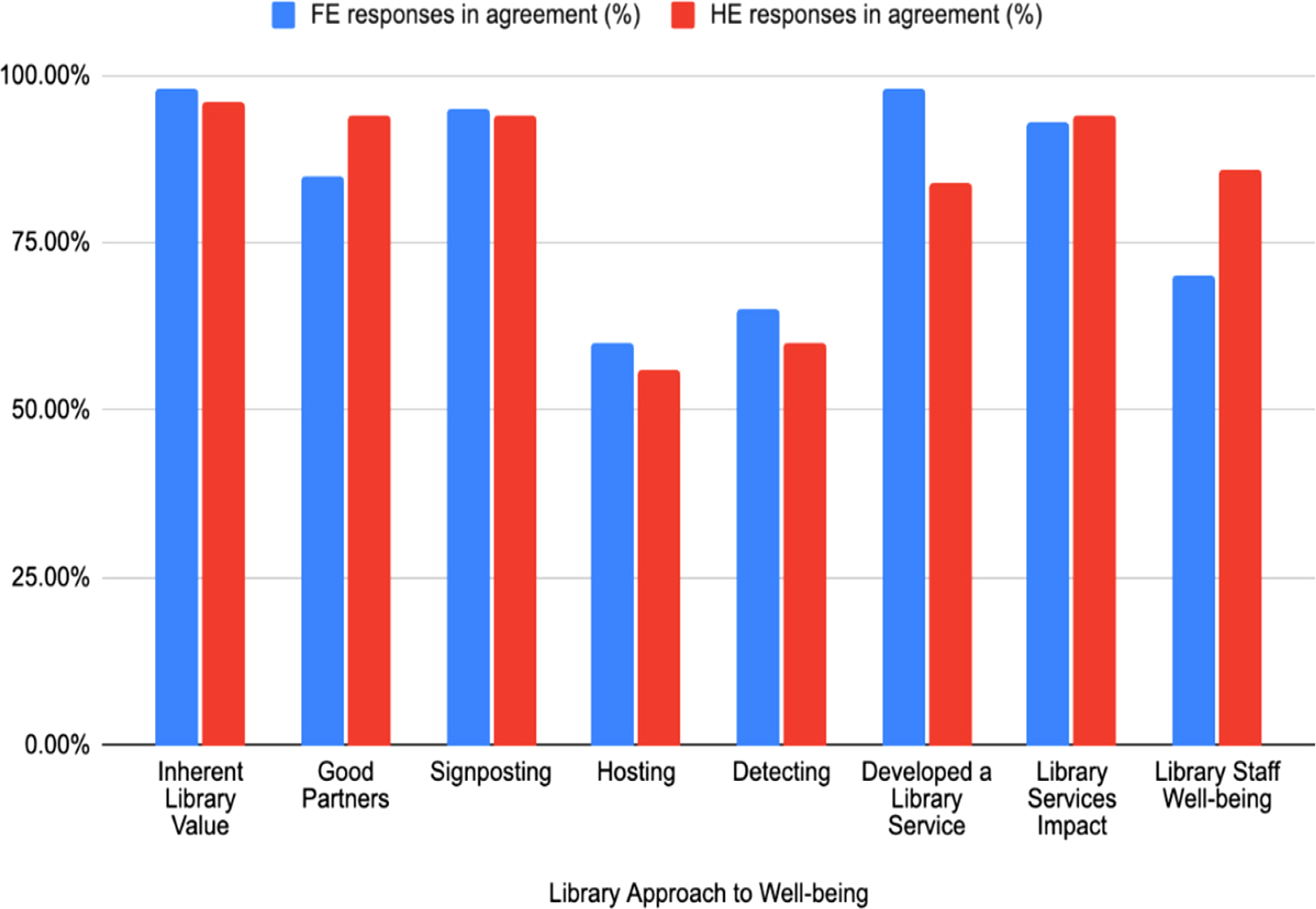
Figure 1
Percentage levels of agreement with the eight aspects of Cox and Brewster’s holistic model (2020) FE v HE
Further coding of the open response questions searched for evidence of alignment to the eight approaches from Cox and Brewster’s Holistic Model and the results are shown in Figure 2.
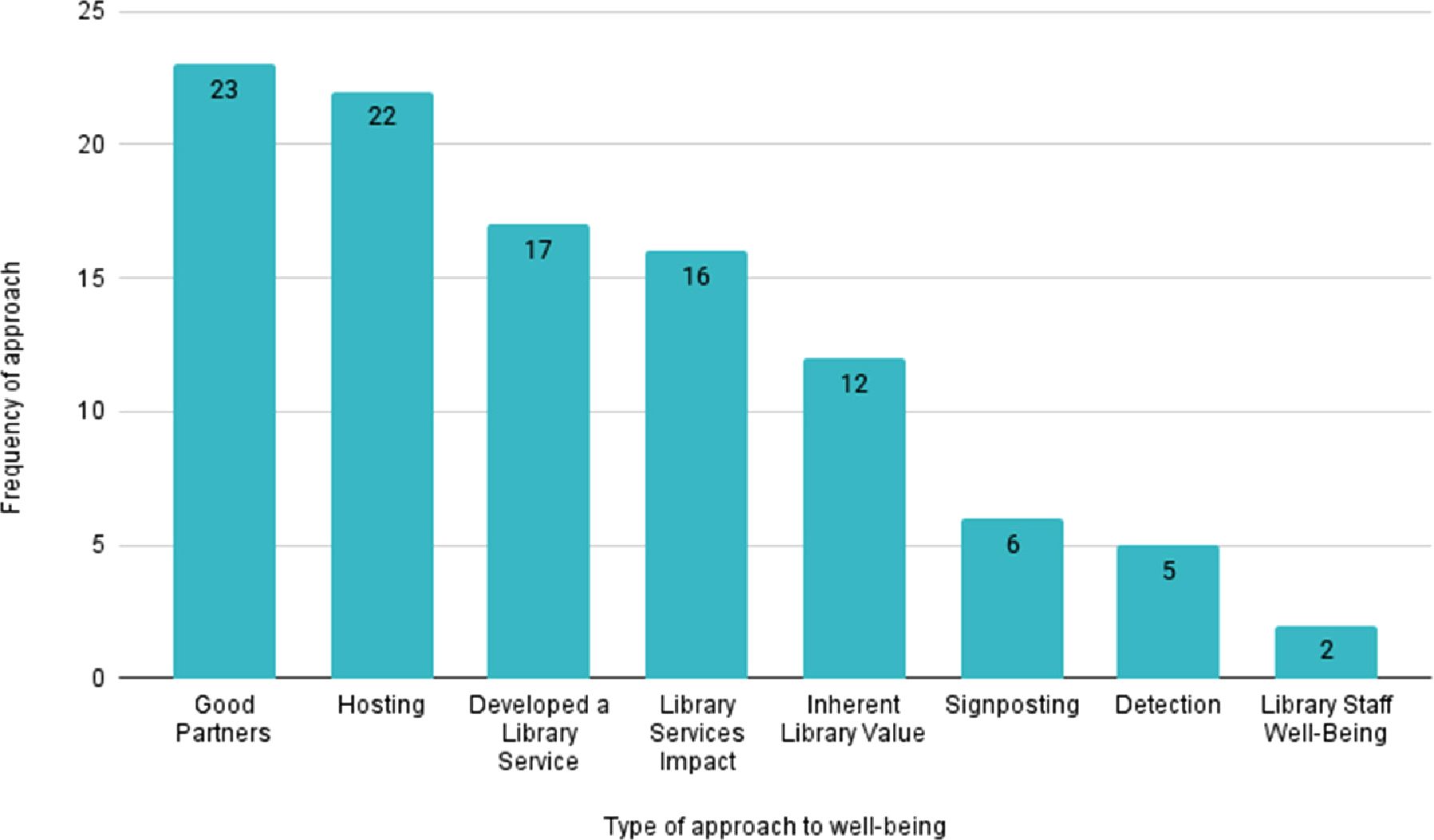
Figure 2
Coded open responses to aspects of Cox and Brewster’s Holistic Model (2020)
Evidence of the eight aspects of the holistic model within the open responses suggests that, like HE libraries, FE libraries are taking a multi‑faceted, holistic approach to well‑being support. Although evidence of supporting staff well‑being as an approach was minimal. This could be an area for further exploration, as staff well‑being support is an issue being discussed widely in education literature (Stephenson et al., 2025).
Additionally, evidence of hosting initiatives appears within the responses, through mindfulness activities, clubs or study support. Library service impact is evident through the improvement of spaces by offering stress‑free spaces, as demonstrated in the following response:
‘The “cosy corners” are the simplest of ideas with the most success. Students love the comfy chairs and colourful rugs. Many take laptops into the areas to work privately. Our greatest joy is seeing students curled up reading a book.’
Some respondents identified the role of being approachable, leading to detection and signposting to further support:
‘Our friendly (most of us) staff are easy to talk to and our therefore adult students can turn to without the formality and ties of the teaching staff.’
‘We are a natural place to air thoughts and act as a soundboard as well as a signposting service to ensure students are given clear information on further support if needed.’
In summary, respondents agreed with the eight aspects of well‑being support proposed by Cox and Brewster’s (2020) research in HE libraries, in particular with inherent library value, signposting and developing a well‑being service. Meanwhile, an examination of the coded open text responses revealed that the most common approaches being instigated are through being a good partner, hosting and developing a well‑being service. Improving library staff well‑being does not appear to be a support consideration when approaching student well‑being.
Collaboration
Evidence of partnership working is strong, with 56 internal partnerships represented in the responses (see Table 4). Libraries are partnering with safeguarding, student services or teaching staff most commonly. There are 38% working with more than one partner, whilst over a third (37%) are not partnering. Challenges can arise, however, as seen in some open responses:
‘There is a lot of silo working in my workplace, we are very large and it seems there has not been much collaboration in the past.’
‘Lack of engagement with the well‑being team/student services since launch.’
Table 4
Q18. Who did you partner with? (N=42)
| Responses | Percent of Cases | |
|---|---|---|
| N | ||
| Partnered with well‑being team | 15 | 38% |
| We did not partner | 15 | 38% |
| Partnered with Student Support | 9 | 23% |
| Partnered with Safeguarding | 9 | 23% |
| Partnered with Student Services | 8 | 20% |
| Partnered with Teaching Staff | 8 | 20% |
| Partnered with Senior Leaders | 4 | 10% |
| Partnered with Enrichment Team | 3 | 8% |
Whilst further research is needed to establish the strength of these partnerships, it is encouraging to see the library workforce values this shared approach. A collaborative approach with other stakeholders within the college is a strength, a strength purported by Cox (2023) that needs to be embedded into library strategy. In a discussion of the prospects of academic libraries, Cox goes on to emphasize the need for libraries to ‘communicate the benefits that arise from the partnerships ... to assert their own identity’ (2023, p. 379) and thus elevate the position of the library as an integral team player within the organization.
Respondents were asked further whether any activities were co‑created with students. Six of them responded positively and 16 said it is planned for the future, again providing a similar picture to the findings of Cox and Brewster (2022) in HE. Of the 23 respondents who added further comments to this question, 35% (N= 8) expressed a desire to co‑create activities with students in the future. Their comments point to the challenges involved:
‘I would like to get some student ambassadors and ask their ideas on well‑being activities. We were going to attend a student champions event but it got cancelled!’
‘To my knowledge, this has not been considered for the future as engagement of students is very difficult and events have little to no uptake, when they have tried in the past.’
There is, however, much evidence of involving students, albeit in a participatory way rather than co‑producing. Examples given included displaying artwork and using student ambassadors or collecting student feedback. Co‑creation seems to be an approach yet to be explored by many in FE and is perhaps limited by the lack of resources highlighted by many responses.
When co‑creation is successfully implemented, the impact appears evident:
‘Our reading group was delivered in class by a work experience student on a prepping for employment course for young people with additional learning needs and neurodiversities. The student became a National Literacy Trust Literacy Champion and will be doing more work experience with the library.’
Evaluation and Impact
By asking ‘Q19. What do you consider to be the success factors regarding this activity?’ as an open question, it was possible to get an insight into how libraries measure success and what they consider influences that success. The 36 responses provided a rich picture of staff views.
Many responses referred to the accessibility of the activity (87%, N=31), whether this was having it available all the time or creating a welcoming and inclusive environment that encouraged students to engage. Other responses suggested that success was due to effective promotion. A single response indicated that success was due to being part of a wider college strategy, ‘That we are part of the whole package offered to students to help with their well‑being’. This comment also strongly suggests the partnership approach is working.
Table 5 shows how the success is being measured; respondents were able to give multiple answers and the number of responses illustrate that multiple methods are used.
Table 5
Q15. How is the success of this activity being evaluated? (N=42)
| Responses | Percent of Cases | |
|---|---|---|
| N | ||
| Number of people accessing recommended resources | 19 | 46% |
| Stories of positive experiences with our activities | 16 | 39% |
| Number of people attending sessions | 13 | 32% |
| Thank‑you messages received from students/staff | 12 | 29% |
| We do not evaluate our well‑being activities | 10 | 24% |
| Satisfaction survey | 9 | 22% |
| Number of messages distributed/broadcast | 1 | 2% |
Note that ten did not evaluate well‑being activities, suggesting that demonstrating the impact of the activity may not be a priority for some libraries. Conversely, how libraries measure impact can be influenced by whether they are held accountable for the success of the well‑being activity through reporting to senior leaders. When asked ‘Q16a. Do you include data on well‑being support to senior leaders via the reporting cycle?’ 15 respondents include data on well‑being support in reports to senior management, with a further nine intending to include it in the future, suggesting that there is a desire to demonstrate the value and impact of these activities. It is clear from open question responses on measuring success that library staff see these initiatives as positively impacting students:
‘Encourages more students into the LRC, gives socially isolated or neurodivergent students a safe space and an activity to focus on.’
‘Students chat to each other and are more engaged while colouring in; staff bring ESOL students to the library to experience themed activities and learn about culture and integration; lower‑level learners come to do activities whereas because they realize it is more than just books.’
‘We have seen an increase in usage of fiction books. Students say they love being able to sit and read for one of their study periods each week and it helps them de‑stress.’
Whether these outcomes are being communicated effectively to senior leaders, however, is unclear. With less than half of the respondents including activity data in their reports, it is possible that these impact stories are not reaching beyond the walls of the library and suggests that more work could be done to highlight to senior leaders the contribution being made in this area. A challenge also faced by libraries within HE (Bladek, 2021; Cox & Brewster, 2021).
In today’s data‑driven environment, where funding requests need to be evidence‑based, libraries are required to demonstrate their value. Libraries need to go beyond the traditional key performance indicators of footfall and circulation figures to paint a broader picture of the holistic contribution being made to the aims of the college as a whole. The challenge is developing a quantifiable measure that can be easily communicated. Qualitative feedback is the most impactful but not always easy to collect. Looking for ways to share the stories of how the library is positively affecting student well‑being would be a powerful tool, but not always feasible in a busy library environment.
The wider question of what a library is and its mission and purpose within an ever‑changing information landscape requires a firm commitment to communicate, educate and advocate for libraries. Encouragingly, there is a desire by several of the respondents to include well‑being support data in reports in the future, indicating an understanding that libraries need to better communicate the breadth and depth of the service they provide.
Recommendations
It is clear from the responses that, despite limitations on resources, FE libraries are creative and innovative when it comes to providing well‑being support and often work in collaboration with other college teams. However, there is a danger that libraries are spreading themselves too thinly and activities do not quite have the impact or the engagement that library staff desire. Taking a more strategic approach and considering ways to better communicate impact would give libraries the ability to establish sustainable well‑being support alongside the core services being offered. Focusing on the inherent library value and how the current service impacts student well‑being may be a more realistic approach for some libraries without the resources to introduce new services.
It appears from the literature that a driving force for supporting well‑being in colleges is to reduce withdrawal and improve academic outcomes, both of which have funding and reputational implications (Wixcey et al., 2024). Libraries would be astute to align and focus their well‑being activities to these goals. By fostering a sense of belonging and providing services that enhance academic resilience, libraries are well‑positioned to support student well‑being. Joining committees and working groups could further elevate the library’s position within the college as a supporter of equality, diversity and inclusion (EDI) principles and lead to further partnership opportunities. Developing collaborations can contribute to wider college priorities and, at the same time, prevent overstretching the library service.
Whatever approach FE libraries take when it comes to well‑being, assessing the need and analysing the best way forward is an important first step. Whilst there are some differences between well‑being support in FE libraries compared to HE libraries, they face, in the main, similar issues. Consequently, FE libraries can confidently draw from the HE library literature, which provides key insights into approaches, especially around bibliotherapy (Hill & Cox, 2024). FE library case studies would provide a useful addition to the knowledge base, giving a wider representation of currently unheard voices and offer valuable new perspectives on the subject.
Conclusion
This research project set out to investigate further education libraries and the part they play in supporting student well‑being. FE libraries are expected to meet the information needs of a staggering range of ages and abilities, often on limited budgets and staffing. Recent years have seen an increasing focus on supporting student well‑being as poor mental health and wider social needs are creating an ever‑challenging learning environment (Duckworth & Smith, 2018). It is possible that the unique challenges faced by the FE sector, such as a lack of adequate funding, difficulties around staff retention and workload pressures, as well as the diverse challenges faced by the students themselves, may inform and impact the approaches and attitudes to well‑being support within their libraries.
By gathering the views of library staff, it was possible to better understand the motivations, challenges and approaches being taken. The findings of this study enabled a limited comparison of the approaches between FE and HE. In the main, these findings were similar between FE and HE, as were the challenges in measuring impact.
Whilst partnership working was strong, the biggest barriers to supporting well‑being in the FE library context stood out as a lack of resources. For those with limited resources available, improving current services through a broader, more collaborative EDI lens rather than overextending resources and strengthening partnership working could be a sustainable approach.
It is becoming increasingly difficult for libraries to demonstrate their value within the marketized and underfunded sector of FE. Services such as libraries, where significant investment is required and return on that investment is not always easy to measure and communicate, are increasingly vulnerable to budget cuts and face a reduction in resourcing. From the responses of the sample of 42 FE library staff, it is evident that many of the respondents feel the library services contribute to the student well‑being positively through a variety of approaches. With innovative and resourceful efforts, libraries support the whole student in ways that go beyond the basic provision of information.
In conclusion, returning to the ecological model of well‑being outlined in the discussion (Cahill & Gowing, 2024), libraries are part of the complex ecology of a student’s environment and, as such, have a role to play in nurturing a space that is conducive to human flourishing. This study has highlighted the range of ways FE libraries holistically support students.
By ensuring the principles of public benefit, common good and social justice (Chartered Institute of Library and Information Professionals, 2018) are firmly at the heart of the library ethos, every student can be supported. When libraries take a user‑centred approach to service development, whether this is overtly connected to well‑being or not, they can create conditions that both contribute to the mission of the college and provide a learning environment where all students, regardless of circumstance, can flourish and grow.
Supplementary File
The supplementary file for this article can be found as follows:
Student well‑being and FE Libraries – Questionnaire Questions
Data accessibility statement
The datasets generated during the current study are not available for sharing. In alignment with the ethical guidelines approved by the University of Sheffield ethics committee, the data were required to be destroyed a year after collection to protect participant privacy.
Acknowledgements
This article is based on research conducted as part of the author’s master’s degree dissertation in library and information services management at the University of Sheffield. The author would like to thank Dr Andrew Cox for his invaluable guidance and support throughout the project.
Abbreviations and Acronyms
A list of the abbreviations and acronyms used in this and other Insights articles can be accessed here – click on the following URL and then select the ‘full list of industry A&As’ link: http://www.uksg.org/publications#aa.
Competing interests
The author has declared no competing interests.