
Introduction
Open access (OA) was conceived as a path to democratize the circulation of knowledge and expand the audiences for scholarly communication along with the emergence of the internet and digitalization. However, during this transformation, the transition to open access grew rapidly as a commercial business model, and the ‘gold route’, as defined by the pioneers of the movement, ceased to be free and immediate open access. It evolved, eventually, into a new paywall to rapidly increase the profit rates of the publishing industry (Chan et al., 2020; Guédon, 2024; Pinfield, 2025). This marketization has severe consequences in terms of money, time, trust and loss of control by the academic community (Beigel et al., 2025a). Academic autonomy is at stake due to the aggressive intrusions of commercial publishers, which underlines the need to align the future of open access publishing towards a re‑communalization of journals (Beigel, 2025a).
In parallel, the hybrid model featured a path for a relevant portion of ‘high impact’ journals included in the Web of Science (WoS) and Scopus databases that evolved as a specific publishing segment in terms of symbolic recognition and commercial revenues. This business model reinforced two phenomena in scholarly publishing that are being observed with increasing interest in bibliometric studies. The first is the issue of transparency surrounding article processing charge (APC) pricing in journals managed by the big commercial publishers. The second is the slowdown in the transition to open access, which is fostered by the closed nature of the hybrid route, given the fact that researchers who cannot pay APCs are choosing this option.
It was then that the ‘diamond’ label emerged, as a reaction to the growing commodification of open access and its associated asymmetries. However, the concrete paths to achieving this inclusive and universal form of access are not yet visible. Steinhart et al. (2024) note that what is now called diamond OA refers to something that has existed for a long time, as completely free journals, available online, have existed since the mid 1990s. It is also pertinent to note that the concept of diamond is under scrutiny, given that this mineral embodies the very nature of colonial extraction (Chan et al., 2020) – this is indeed a good reason to discuss its definition or even abandon its use.
In recent years, the cOAlition S consortium has recognized the inequities and distortions that emerged in scientific communication with the expansion of open access (Mounier & Rooryck, 2024). Diverse initiatives have begun to support global actions in favour of diamond access. Events such as the Global Summits on Diamond Open Access in Mexico (2023), Cape Town (2024) and Bengaluru (2026), and studies such as the Open Access Diamond Journals Study (OPERAS, Science Europe), have provided an initial overview of the global landscape of diamond journals. It has been estimated that there are around 29,000 journals worldwide that do not charge for reading or publishing (Bosman et al., 2021), but empirical information on these journals is limited to half of them, mainly extracted from one source: Directory of Open Access Journals (DOAJ).
Despite the numerous reports and research projects that attempt to describe existing diamond journals, there remains a significant gap concerning the global landscape of these journals, including what kind of audiences they reach, their business models, the indexation services they have, the type of editorial management they use and the institutional publishers that support them. The studies available at the journal level point out these limitations, and there have been several efforts to overcome this gap by observing national publishing landscapes, university journals or regional circuits (ALMASI, 2026; Beigel, 2025b; Kulczycki et al., 2026; Nazarovets et al., 2025; Taubert et al., 2024).
Latin America is often presented as a model of diamond OA publishing, although its organizational features and publishing infrastructures remain insufficiently examined. In an attempt to answer the question in the title of this article, we will argue that there is an extended form of publishing distinctive to Latin America, known as the ‘journal university portals’ (JUP). However, rather than a normative model, we will present it as a successful experience, led by universities, that has been instrumental in preserving academic editorship against the advancement of commercial publishing.
Differently from the marketization that occurred for journals led by learned societies, university journals operate with major autonomy and within a potential framework for sustainability. Recent surveys have been conducted with different data sources, such as ISSNs (international standard serial numbers) or national aggregators. Nazarovets et al. (2025) recently listed more than 19,000 active titles directly edited by universities or learned societies in association with universities. This shows that universities have both the experience and the capacity to develop efficient platforms for scholarly communication. They possess experts who can cultivate community‑led venues and uphold the ethical integrity of these journals (Nazarovets, 2025).
In this article, we describe a cartography of indexed diamond journals updated to June 2025, based on an aggregated dataset with multiple data sources, including a total 17,855 journals analysed by country. Secondly, we delve into the results of a regional survey of journal university portals performed during August–October 2025, examining a total of 741 portals responsible for the publication of 10,823 active journals. We address the JUP as a management system, frequently organized by centralized editorial teams working at libraries or digital institutional repositories and rarely connected with a university press, which is traditionally dedicated to book publishing. Finally, we argue that to support these institutional organizations represents a realistic path to advancing diamond scholarly publishing. However, there is no one‑size‑fits‑all solution, and each region ought to assess the advantages and disadvantages of the available options to find a suitable path forward.
The hybrid route and the marketization of community‑led publishing
The idea of community‑led publishing is a polyphonic one that has gained momentum in recent years along with the growth of megajournals, marketization and predatory journals. One of the definitions currently in use is the idea of the ‘OA community’, which generally includes scientific agencies, funders, universities, service providers, publishing platforms and OA publishers, among others. cOAlition S fostered this broad definition of OA, while in other regions, the open access ecosystem is made up of academic institutions, indexing systems and publishing platforms operating in the public sphere, without the dominance of commercial publishers, as in the case of Latin America.
In its most recent report, cOAlition S (de Castro et al., 2024) concludes that Plan S has ‘galvanized the open access community’ by raising the profile of OA, drawing publishers to negotiations, harmonizing funder policies and inspiring initiatives like the retention of institutional rights and momentum for diamond OA. What Plan S ‘got right’, according to the report, was identifying the right levers to pull, primarily by operating as a consortium and engaging with publishers, while maintaining a flexible approach through various strategies for achieving open access. However, what Plan S ‘got wrong’ was the tenuous link to national‑level contexts and its failure to secure support from additional funders, especially from Asia and Latin America/the Caribbean, which impacts the credibility of its equitable publishing discourse (de Castro et al., 2024). In sum, this open access community built by Plan S seems to have facilitated the detachment of scholarly publishing from its national and institutional academic bases. The study also stresses that hybrid open access has notably increased among cOAlition S funders (de Castro et al., 2024). This route has been documented as instrumental for the disproportional increase in APC prices (Butler et al., 2024) and restricting progress in open access because of the non‑OA choice made by researchers unable to afford these charges (Beigel et al., 2025b). As seen in Figure 1 and Table 1, there was a rapid increase in the number of hybrid titles between 2019 and 2021.
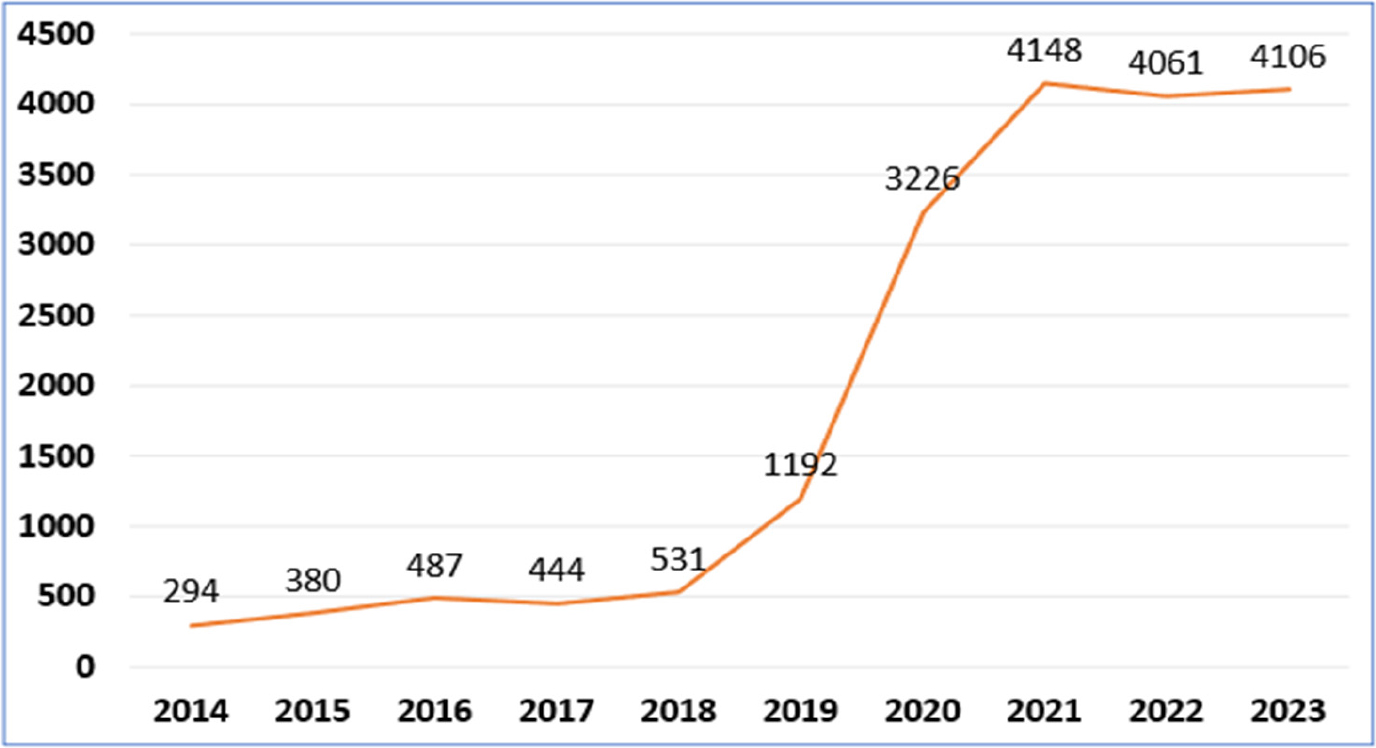
Figure 1
Evolution of hybrid journals, 2014–2023
Table 1
Evolution of hybrid journals, 2014–2023
| Year | Hybrid journals |
|---|---|
| 2014 | 294 |
| 2015 | 380 |
| 2016 | 487 |
| 2017 | 444 |
| 2018 | 531 |
| 2019 | 1,192 |
| 2020 | 3,226 |
| 2021 | 4,148 |
| 2022 | 4,061 |
| 2023 | 4,106 |
[i] Source: GitLab.UB
Jahn (2025) built a multi‑source database to examine the impact of transformative agreements on hybrid open access publishing. Analysing over 13,000 hybrid journals between 2019 and 2023, this research found substantial growth in open access, although most articles remain paywalled. The analysis highlights the dominance of the three largest publishers, Elsevier, Springer Nature and Wiley, which collectively accounted for 47% of hybrid journals and 62% of the articles published during this five‑year period. The results were consistent across all three data sources, showing strong correlations in country‑level metrics despite differences in journal coverage and metadata availability. By 2023, transformative agreements had enabled the open access option in hybrid journals, with particularly high adoption in European countries. Meanwhile, the number of open access articles published by researchers in the Global South showed relatively low (Frank et al., 2023; Huais et al., 2026).
Does this mean that the Global South is not part of the open access community? Quite the contrary – it is supported by strong and well‑established foundations in regions like Latin America. This publishing ecosystem is fed by public platforms and indexing systems like Redalyc, Latindex, Biblat and Scielo, boosted by using the open‑code journal system Open Journal Systems (OJS). As a result, there are thousands of diamond journals characterized by multilingualism and disciplinary diversity (Beigel et al., 2024a, 2024b). What is less highlighted is that these active journals (some of which date back to 1900) are sustained by universities that have both the experience and the capacity to develop community‑led publishing.
Overall, this Latin American publishing infrastructure can be considered a regional circuit with different degrees of visibility and impact. Regardless of the scale and audience they reach, these journals are typically managed by research groups or faculty members aiming to communicate with a specialized community. An alternative value system is observed throughout the criteria for entrance into these curated journal collections, focused on academic quality and autonomous editorship (Beigel, 2025c). The strong institutional anchoring of most of these venues within universities seems to be an important safeguard against predatory publishing and marketization, as the Latindex committee dedicated to detecting questionable journals seems to prove (Universidad Nacional Autónoma de México, 1997).
Global mapping of diamond journals indexed in curated collections
Building a cartography of indexed diamond journals could be useful in informing researchers and fostering a change in publishing choices. Several landscape studies have been carried out in recent years, producing empirical results and recommendations, including the Open Access Diamond Journal Study. According to this report, the number of diamond journals can be estimated at 29,000, but only half of them are registered in DOAJ. The authors observed a declining share of diamond journal articles after 2018, which coincides with the increase in articles published in APC‑based journals. They argue that the diamond OA sector in terms of discipline is dominated by the social sciences and humanities (60% in SSH, 22% in science, 17% in medicine) and that regional distribution also varies significantly: 45% in Europe, 25% in Latin America, 16% in Asia and 5% in the United States/Canada (Bosman et al., 2021).
This picture is highly dynamic, as the authors of the report rightly affirm, because mapping diamond journals globally is not an easy task. Beyond the changes produced by journals closing while many new ones open, the most contested issue is the data sources available. As we will see further, Latin America’s share is under‑reported because the main source is DOAJ, which covers only some of the journals published in this regional circuit. Our mapping includes only titles indexed in services that can guarantee an evaluation of the academic quality of the publication, rather than those featured in a non‑curated list of journals, because our final goal is to foster a shift in academic culture. Diamond journals that can certify quality can be rewarded by institutions and funding agencies seeking to advance more responsible approaches to research assessment. However, it is relevant to note that this leaves aside hundreds of academic journals that may comply with quality standards but are not indexed in curated collections, such as many found in OpenEdition (France) or Érudit (Canada). More examples can be found in Latin America (Salatino, 2017) or in Germany, where almost half of the diamond titles are not included in any kind of indexation system (Taubert et al., 2024).
Hence, to compile our aggregated dataset of indexed diamond journals, we started with DOAJ, harvesting a total of 13,950 no‑fee journals. This list was compared with seven other curated collections using the R programming language and by cross‑checking ISSNs and titles (see Table 2 and Figure 2). The list from African Journals Online (AJOL) provided a total of 810 new titles. This was followed by the integration of JUFO (Publication Forum)’s diamond journal list, which contributed 161 journals. Latindex’s list was the most numerous, adding 1,631 new titles, while SciELO’s list provided 697 diamond journals. Redalyc’s list added 270 journals, and Biblat’s list provided 18 new titles. Finally, we found 318 additional diamond journals in Scopus and Web of Science.
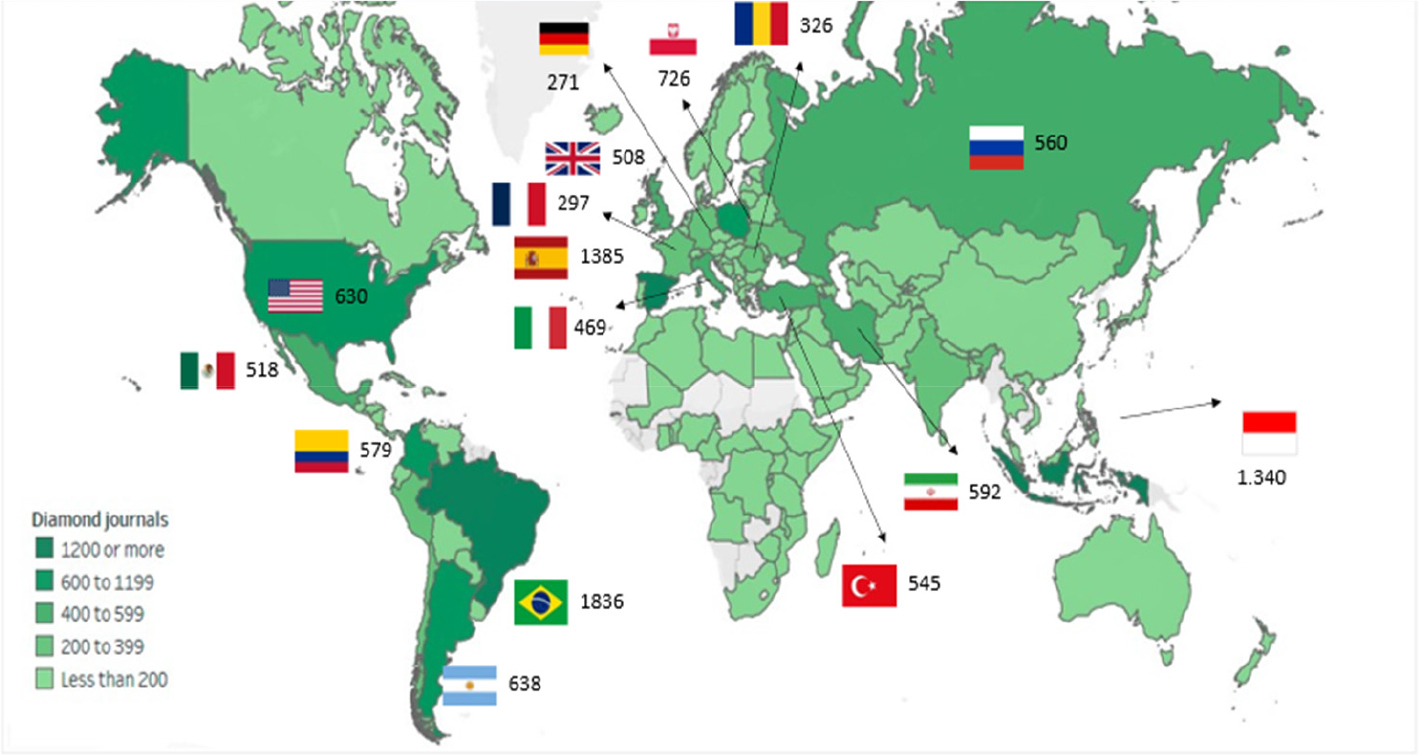
Figure 2
Cartography of no‑fee indexed journals, n=17,855
Sources and dates of extraction: DOAJ June 18, 2025; AJOL June 18, 2025; JUFO June 17, 2025; LATINDEX May 27, 2025; SCIELO May 28, 2025; REDALYC May 28, 2025; BIBLAT May 27, 2025; WoS & SCOPUS (through SSIE‑UNAM) July 8, 2025
Table 2
No‑fee indexed journals by source (collection), n=17,855
| Curated journal collection | Journals |
|---|---|
| DOAJ | 13,950 |
| AJOL | 810 |
| JUFO | 161 |
| LATINDEX | 1,631 |
| SCIELO | 697 |
| REDALYC | 270 |
| BIBLAT | 18 |
| WoS‑Scopus | 318 |
| TOTAL | 17,855 |
[i] Sources and dates of extraction: DOAJ June 18, 2025; AJOL June 18, 2025; JUFO June 17, 2025; LATINDEX May 27, 2025; SCIELO May 28, 2025; REDALYC May 28, 2025; BIBLAT May 27, 2025; WoS & SCOPUS (through SSIE‑UNAM) July 8, 2025
Table 3 shows the distribution of journals by country, with Latin America being the region with the largest share, accounting for 29.2% of the total. Compared with the 25% attributed to this region in the Open Access Diamond Journal Study (2021), this suggests that diamond journals published in Latin America remain under‑represented in DOAJ, the list most frequently used for this kind of mapping. In the case of Europe, Spain (1,385) and Poland (726) provide the highest number of indexed diamond journals, with a significant proportion of titles published in Spain integrated into the Latindex catalogue. The Ibero‑American proportion would likely increase further if we added the numerous non‑indexed diamond journals.
Table 3
Indexed diamond journals by country, n=17,855
| Country | N | Country | N | Country | N |
|---|---|---|---|---|---|
| Brazil | 1,836 | Austria | 53 | Tunisia | 7 |
| Spain | 1,385 | Ethiopia | 52 | Mongolia | 7 |
| Indonesia | 1,340 | Kenya | 50 | Iceland | 7 |
| Poland | 726 | Belgium | 48 | Libya | 7 |
| Argentina | 638 | Slovakia | 46 | Oman | 6 |
| United States | 630 | Bosnia & Herzegovina | 45 | Montenegro | 6 |
| Iran | 592 | Algeria | 44 | Angola | 5 |
| Colombia | 579 | Singapore | 44 | Brunei | 5 |
| Russia | 560 | Ghana | 40 | Congo ‑ Kinshasa | 5 |
| Turkey | 545 | Tanzania | 38 | Senegal | 4 |
| Mexico | 518 | Paraguay | 38 | Israel | 4 |
| United Kingdom | 508 | Panama | 37 | Yemen | 4 |
| Italy | 469 | Bolivia | 36 | Eswatini | 3 |
| Ecuador | 347 | Morocco | 35 | Burkina Faso | 3 |
| Chile | 331 | Iraq | 33 | Kyrgyzstan | 3 |
| Romania | 326 | Moldova | 33 | Palestinian Territories | 3 |
| France | 297 | Japan | 33 | Mauritius | 3 |
| South Africa | 297 | Thailand | 30 | Malawi | 3 |
| Peru | 280 | Philippines | 28 | Côte d’Ivoire | 3 |
| Germany | 279 | Nepal | 28 | Botswana | 3 |
| India | 265 | Greece | 27 | Gambia | 2 |
| Nigeria | 262 | Guatemala | 25 | Malta | 2 |
| Ukraine | 259 | Sri Lanka | 25 | Congo ‑ Brazzaville | 2 |
| Portugal | 199 | Nicaragua | 24 | Afghanistan | 2 |
| Finland | 191 | Estonia | 23 | Sudan | 2 |
| Serbia | 190 | Saudi Arabia | 21 | Jordan | 2 |
| Canada | 180 | Taiwan | 20 | Luxembourg | 2 |
| Cuba | 175 | Belarus | 20 | Zambia | 2 |
| Croatia | 155 | Ireland | 20 | South Sudan | 2 |
| Czechia | 139 | Uganda | 20 | Bhutan | 1 |
| Venezuela | 123 | New Zealand | 20 | Guadeloupe | 1 |
| Netherlands | 117 | El Salvador | 16 | Syria | 1 |
| Norway | 114 | Hong Kong SAR China | 16 | Bahrain | 1 |
| China | 111 | Puerto Rico | 16 | Uzbekistan | 1 |
| Costa Rica | 110 | Bangladesh | 16 | Togo | 1 |
| South Korea | 103 | Dominican Republic | 16 | Kuwait | 1 |
| Switzerland | 98 | Qatar | 15 | Trinidad & Tobago | 1 |
| Pakistan | 93 | North Macedonia | 14 | Burundi | 1 |
| Hungary | 92 | Vietnam | 14 | Eritrea | 1 |
| Egypt | 88 | Zimbabwe | 13 | Azerbaijan | 1 |
| Australia | 84 | Honduras | 11 | Lesotho | 1 |
| Slovenia | 81 | Cameroon | 11 | Benin | 1 |
| Malaysia | 80 | Armenia | 11 | Turkmenistan | 1 |
| Lithuania | 79 | Kazakhstan | 10 | Tajikistan | 1 |
| Internacionales | 67 | Latvia | 10 | Sierra Leone | 1 |
| Uruguay | 64 | Georgia | 9 | Barbados | 1 |
| Bulgaria | 59 | Rwanda | 9 | Mali | 1 |
| Denmark | 53 | Albania | 8 | Lebanon | 1 |
| Sweden | 53 | United Arab Emirates | 8 | Unidentifiable country | 301 |
| GRAND TOTAL | 17,855 | ||||
[i] Sources and dates of extraction: DOAJ June 18, 2025; AJOL June 18, 2025; JUFO June 17, 2025; LATINDEX May 27, 2025; SCIELO May 28, 2025; REDALYC May 28, 2025; BIBLAT May 27, 2025; WoS & SCOPUS (through SSIE‑UNAM) July 8, 2025
One of the main problems in determining the diamond feature of a journal lies in the lack of transparency around APC costs, as discussed above, particularly in commercial databases. Given the type of curated lists used as a source for our research, this issue had minimal impact, as was shown by cross‑referencing our aggregated list with the APC dataset produced by Butler et al. (2024). After this process, 276 titles were identified and removed from our dataset. Table 4 shows the distribution of this group of journals by collection, with 71 (25.7%) being published in the United Kingdom.
Table 4
Journals excluded, by platform n=276
| Platform | Q | % |
|---|---|---|
| DOAJ | 196 | 71.00% |
| AJOL | 2 | 0.70% |
| JUFO | 3 | 1.10% |
| LATINDEX | 22 | 8.00% |
| SCIELO | 32 | 11.60% |
| WOS‑SCOPUS | 21 | 7.60% |
| TOTAL | 276 | 100.00% |
Another limitation in the data for this mapping concerns titles without information on the country, which in this case had a low incidence: 301 titles (see Table 1). This could suggest that most of the diamond journals have an institutional base, in which case their geographical location is easily identifiable. Most of the titles with an unidentifiable country are listed in WoS and Scopus.
In total, 5,209 of the 17,855 diamond titles indexed in curated collections and included in this cartography were published in Latin America. Unlike in Europe, where most journals have been established by learned societies, in Latin America, most of these titles are published by universities (Beigel et al., 2024b). This may be a common feature of the diamond journals published in the Global South (Debat et al., 2025) – consider, for example, the case of Indonesia (Widiantoa et al., 2025). However, some countries in Europe, such as Poland, have government support for scholarly journals edited in universities, which strengthens this type of publication venue (Kulczycki et al., 2026).
Trzesniak (2009) stresses the advantages of university journals in terms of the credibility of the editors and scientific committees but also argues that an adequate technical team is essential to manage the increasing volume of editorial work. Some universities provide this institutional support, including access to digital infrastructure, administrative resources and staffing for editorial processes. Another relevant process that is frequently centralized or performed collaboratively is indexation. This could explain why most university journals are indexed in two or more collections that perform academic evaluation for inclusion.
However, not all university journals benefit from institutional support, nor do they receive direct funding from university budgets. Nazarovets (2025) highlights that an institutional environment is one of the key factors for ensuring stability – and, we could add, for sustaining diamond OA – but the level and consistency of this support vary widely. This raises one of the main questions of this research: how does institutional publishing function within Latin American universities?
Journal university portals in Latin America
One of the most widespread publishing models for diamond journals in this region is the ‘university portal’ – a centralized space for the integration of editorial teams and/or a means to disseminate all the titles edited by the institution. A ‘journal university portal’ is defined here as a website that compiles titles and aggregates them into a single search interface. These portals not only exist on an institutional scale but also on a national and regional scale. Miguilim is a prominent national portal (Instituto Brasileiro de Informação em Ciência e Tecnologia (Ibict), n.d.), with metadata of 4,956 active Brazilian journals and 282 portals. Another national example is the Portal de Revistas Académicas Chilenas (SISIB, n.d.), which contains information about 91 institutions and their 384 journals. A regional portal par excellence is Latindex (Universidad Nacional Autónoma de México, 1997), with a directory of 28,612 titles and a catalogue collection with 4,056 journals that were subject to a rigorous evaluation for inclusion.
In this section, we will only address the JUP managed at the institutional level of a given university located in Latin America. JUP function as an information service for readers and authors but also as a kind of organization that tends to cooperatively fulfil editorial tasks and make more efficient use of the human resources available. We found 741 university portals that represent 10,823 active journals. A great diversity was found in terms of the scope of the portals, which can be described as websites providing basic visibility or organizations aimed at offering hosting and editorial management services to the journals published by the university. In the latter case, they often provide infrastructures such as persistent identifiers or digital preservation. When organized as a publishing unit, they can be managed by a centralized editorial team working at the rectorate or directly by a department, at the library or the repository. These publishing offices are normally separated from the university presses and are often dedicated only to editing books.
The JUP are not always integrated with the library and/or the institutional repositories. Argentina is an interesting case for observing diverse models of JUP, considering that this country has a national law establishing mandatory open access through institutional repositories. However, many universities manage their journals through the JUP separately from the general output of the university, which is normally published in the repository. This often leads to duplication or the invisibility of the journals in local open infrastructures (Di Domenico & Zó, 2025). A counter‑example – one that demonstrates good practices and interaction between the centralized journal portal and the repository – is SEDICI (Universidad Nacional de La Plata (UNLP), n.d.) at Universidad Nacional de La Plata.
Table 5 shows that these JUP are distributed across the whole region, with the largest shares in Brazil, Colombia, Argentina, Peru and Mexico. However, Mexico stands out not only for its share in the number of JUP but also for hosting major regional infrastructures such as Latindex, along with established regional indexing systems such as Biblat and Redalyc. It is worth mentioning that both Mexico and Uruguay share the feature of a highly centralized structure of JUP with numerous journals, given the great size of their historic universities (UNAM and UdelaR, respectively).
Table 5
Number of active university portals per country, n=741
| Country | Number of portals | % Portals |
|---|---|---|
| BRAZIL | 264 | 35.6% |
| COLOMBIA | 98 | 13.2% |
| ARGENTINA | 93 | 12.6% |
| PERU | 59 | 8.0% |
| MEXICO | 52 | 7.0% |
| CHILE | 40 | 5.4% |
| ECUADOR | 35 | 4.7% |
| VENEZUELA | 17 | 2.3% |
| BOLIVIA | 14 | 1.9% |
| CUBA | 12 | 1.6% |
| PARAGUAY | 11 | 1.5% |
| URUGUAY | 10 | 1.3% |
| COSTA RICA | 10 | 1.3% |
| PANAMA | 9 | 1.2% |
| EL SALVADOR | 5 | 0.7% |
| GUATEMALA | 5 | 0.7% |
| NICARAGUA | 4 | 0.5% |
| HONDURAS | 2 | 0.3% |
| PUERTO RICO | 1 | 0.1% |
| GRAND TOTAL | 741 | 100.0% |
When analysing the number of titles that these portals include per country (Table 6), we see that Brazil accounts for 52.8% (5,710) of the total 10,823 journals in the survey. In second place is Argentina with 1,146 titles, followed by Colombia with 993 and Mexico with 837. The size of the public universities in these countries explains a large part of the variation in their respective shares of the total number of portals. Concerning the difference between types of universities, more than half of the total portals (393) are managed by public institutions, while 348 are run by private universities. Interestingly, 39.1% of these portals in private universities are in Brazil; 19.8% are in Colombia (63); and 9.8% are in Peru (34). In the rest of the countries, the dominant framework for the JUP is the public university, and these institutions are responsible for 62.9% of the titles, as can be seen in Table 7.
Table 6
Number of active titles published per university portal, by country n=10,823
| Country | N Journals | % Journals |
|---|---|---|
| BRAZIL | 5,710 | 52.8 |
| ARGENTINA | 1,146 | 10.6 |
| COLOMBIA | 993 | 9.2 |
| MEXICO | 837 | 7.7 |
| CHILE | 447 | 4.1 |
| PERU | 439 | 4.1 |
| VENEZUELA | 322 | 3.0 |
| ECUADOR | 233 | 2.2 |
| BOLIVIA | 135 | 1.2 |
| COSTA RICA | 114 | 1.1 |
| GUATEMALA | 83 | 0.8 |
| PANAMA | 80 | 0.7 |
| PARAGUAY | 79 | 0.7 |
| CUBA | 55 | 0.5 |
| URUGUAY | 49 | 0.5 |
| EL SALVADOR | 32 | 0.3 |
| NICARAGUA | 27 | 0.2 |
| PUERTO RICO | 27 | 0.2 |
| HONDURAS | 15 | 0.1 |
| GRAND TOTAL | 10,823 | 100.0 |
Table 7
Number of journals by type of university, n=10,823
| Type of university | N Journals | % Journals |
|---|---|---|
| PUBLIC UNIVERSITY | 6,613 | 62.9 |
| PRIVATE UNIVERSITY | 4,210 | 37.1 |
| GRAND TOTAL | 10,823 | 100.0 |
Our survey and the available literature on the Latin American publishing circuit show that most of these journals are edited using OJS. The JUP are also implemented very frequently using the same platform: 516 of the total 741. While using the remaining platforms, we more frequently encountered technical failures or websites that could not be accessed. Among the portals that use OJS, 49.6% (256) correspond to private universities, while the remaining 50.4% (260) correspond to public universities. Out of the portals that use services other than OJS, 33.6% (44) correspond to private universities, while the remaining 66.4% (87) correspond to public universities. Finally, of the websites that failed to load, 51.1% (48) correspond to private universities, while the remaining 48.9% (46) correspond to public universities. Table 8 shows the relation between portals and the number of titles edited at the Latin American mega‑universities that stand out for using portals as a mean to give visibility to the journals and/or centralizing the editorial tasks.
Table 8
Top 10 universities by portal and number of journals included n=46
| University | Number of portals | Number of journals |
|---|---|---|
| UNIVERSIDAD DE BUENOS AIRES | 5 | 236 |
| UNIVERSIDADE DE SÃO PAULO (USP) | 4 | 230 |
| UNIVERSIDAD NACIONAL AUTÓNOMA DE MÉXICO | 5 | 203 |
| UNIVERSIDAD NACIONAL DE LA PLATA | 7 | 110 |
| UNIVERSIDAD DE CHILE | 3 | 109 |
| UNIVERSIDAD DE SAN CARLOS DE GUATEMALA | 3 | 68 |
| UNIVERSIDADE ESTADUAL PAULISTA ‘JÚLIO DE MESQUITA FILHO’ (UNESP) | 7 | 56 |
| UNIVERSIDADE FEDERAL DE MINAS GERAIS (UFMG) | 3 | 46 |
| UNIVERSIDAD NACIONAL DE MAR DEL PLATA | 4 | 42 |
| UNIVERSIDAD DE LA REPÚBLICA | 5 | 34 |
| GRAND TOTAL | 46 | 1,134 |
Only 131 portals provided enough information to verify the internal organization and examine the relationship between visibility and management. In Table 9, we can see that 48.1% of these JUP are managed by centralized university administrations (63); 31.3% are managed by faculties (41); 16.0% are managed by publishing houses administrated by the rectorate (21); and the remaining 4.6% correspond to other types of editorial management (6).
Conclusions
Numerous initiatives and academic organizations have drawn attention to the marketization of publishing and the need to strengthen the future of scholarly communication towards the expansion of diamond OA. In the current debates in the field, Latin America appears as a model to follow in this direction. However, the features of the publishing landscape in this region are not yet fully understood, nor are its different management models, which have not been deeply examined. Our survey suggests that this regional experience of scholarly journals integrated into JUP could represent an efficient way towards sustainability and a strong path for retaining, or regaining, academic autonomy. In Brazil, Dias (2025) explored 139 institutional portals, observing that only 35% of these have explicit inclusion policies and suggesting incentives to foster the institutionalization of these portals as publishing units.
The recent valorization of the community‑led nature of scholarly publishing conflicts with increasing marketization and raises questions about the definition and scale of these ‘communities’. Given that a university journal is published by an institution, it is a pertinent question whether these venues are led by disciplinary communities or should be considered as led by the scholarly community in a broad sense. The European ideal type of academic journal was forged through the model of the learned society’s most renowned titles. Meanwhile, in Latin America, non‑commercial academic editorship has been fuelled by scholarly groups or research institutes supported by universities. This experience leads to a broader definition of academic journals that are not merely ‘free for readers and authors’, as the diamond label intends to highlight. Re‑communalization is the central issue, and it goes beyond the no‑fee feature.
Gatti et al. (2025) argue that most journals across both the sciences and the humanities are now owned and controlled by a very small number of large, commercially orientated publishers because many learned societies outsource the production, management and revenue strategies of their journals. To recover academic autonomy, they argue, diamond publishing must be understood beyond institutional publishing. In contrast, we suggest that the Latin American experience is a good example of how the institutional anchoring of universities could be a safeguard against the current dynamics of marketization.
Many facts support our argument. First, university journals in Latin America are predominantly published as diamond open access, and there is little incidence of the hybrid publishing model or the combination of several paywalls. Second, the scale of contemporary scholarly publishing does not allow much space for a nostalgic return to the small, artisan print journals of the 1990s. The growing volume of submissions and the complexity of rigorous peer‑review processes require professional editorial teams capable of handling technical and administrative tasks, allowing academic editors to focus on scholarly evaluation. Third, university journals are developed in the same environment where institutional and national research assessment systems evolve. As a result, these journals make efforts to be included in national and international indexes, to increase their value for researchers and encourage submissions. The global cartography of diamond journals presented in this article shows that 47.5% of the total 17,855 indexed diamond journals are included in two or more collections that apply academic evaluation criteria for inclusion.
A further point of debate concerns the scale of the academic community incarnated in a journal. While the ideal type fosters the definition of community‑led journals as necessarily international in scope, an institutional journal may legitimately represent global interdisciplinary fields and could also be valuable as a communication space for national research communities or even locally relevant fields. This reaffirms the need to avoid normative one‑size‑fits‑all models or funding incentives aimed, for example, exclusively at learned societies, but outsourcing all publishing tasks to service providers. Bibliometric overviews of the effects of actions by large funders like Plan S indicate the sustained growth of hybrid and gold OA (Céspedes et al., 2026). In short, policy actions that are built only for this particular sector of journals risk damaging the virtuous circle at work in other sectors of the publishing field.
Data accessibility statement
The dataset corresponding to the cartography of indexed diamond journals can be consulted in: https://ri.conicet.gov.ar/handle/11336/256625.
The datasets corresponding to the survey on university journal portals can be accessed in: https://ri.conicet.gov.ar/handle/11336/284062.
Acknowledgements
Funding Statements: AGENCIA I+D+i (Argentina) PICT 2021‑0146; Universidad Nacional de Cuyo (Argentina) grants N° 06/80020240400025UN and 800202502000002UN.
Abbreviations and Acronyms
A list of the abbreviations and acronyms used in this and other Insights articles can be accessed here – click on the following URL and then select the ‘full list of industry A&As’ link: http://www.uksg.org/publications#aa.
Competing interests
The authors have declared no competing interests.