
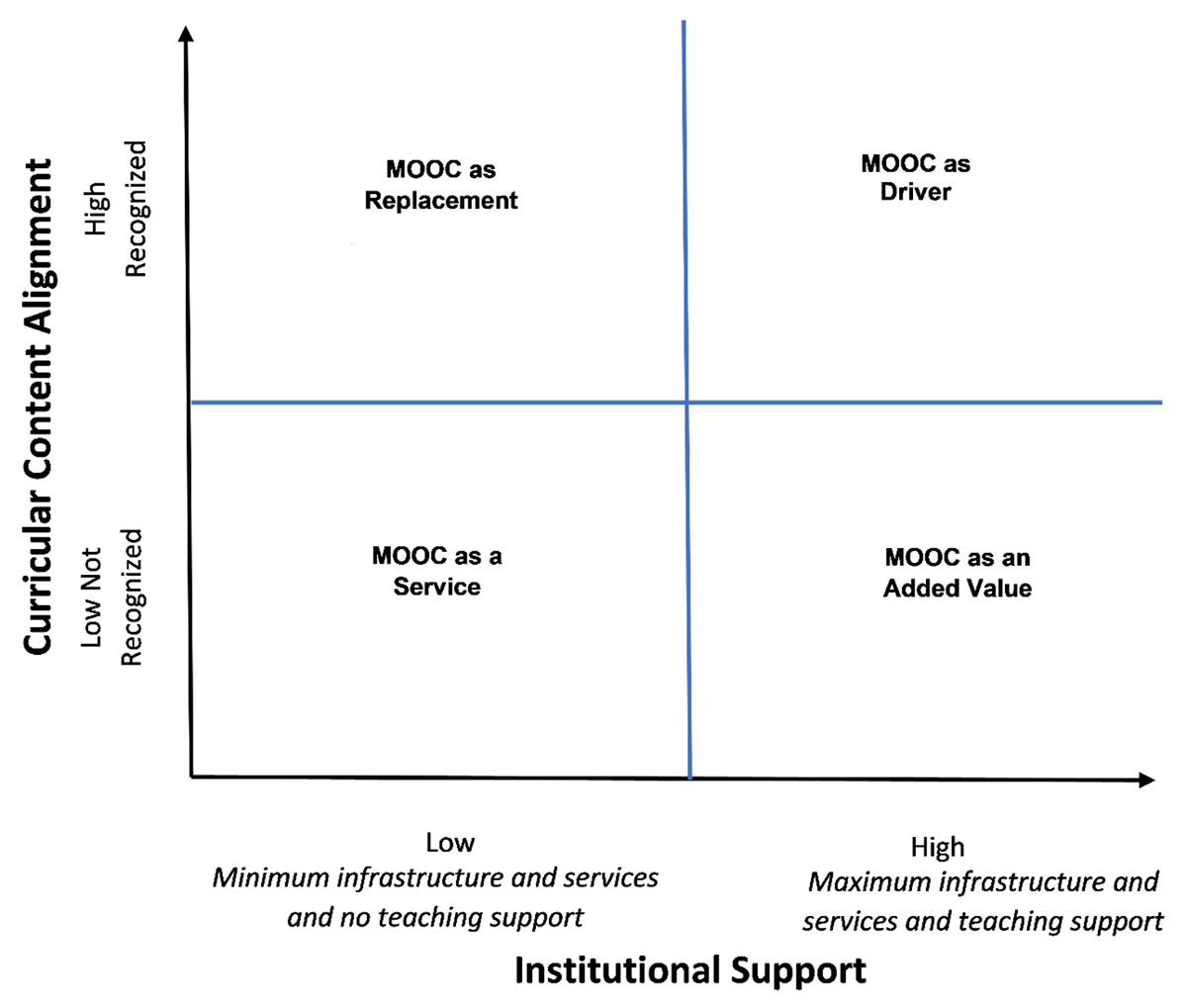
Figure 1
H-MOOC Framework of Pérez-Sanagustín et al.13
Table 1
H-MOOC Framework
| X: Low Y: Low | MOOC as a service model | Students study MOOCs voluntarily, with no similarity of its content to the current curriculum and no support from the institution. |
| X: High Y: Low | MOOC as an added value | Students study MOOCs of their choice, with no similarity to the existing curriculum, but the institution provides support for students to complete their MOOC course. |
| X: Low Y: High | MOOC as replacement | MOOC replaces existing courses due to the high similarity between its content and the existing curriculum. |
| X: High Y: High | MOOC as driver | Institution course is designed according to the MOOC. |
Table 2
Four Quadrant Approach for SWAYAM
| Quadrant 1 | E-tutorial | Video and audio content, simulations, video demonstrations, animation, virtual laboratory, etc. |
| Quadrant 2 | E-content | E-books, PDFs, text, illustrations, interactive simulations, practical assignments |
| Quadrant 3 | Web resources | Open education resources (OERs), related links, case studies, journals, research papers, anecdotes, historical overview, etc. |
| Quadrant 4 | Self-assessment | Problems and solutions, multiple-choice questions (MCQs), quizzes, frequently asked questions (FAQs), doubt clearance, peer assessment |
[i] Source: Guidelines for development and implementation of MOOCs, Department of Higher Education, MHRD (F. No. 8-1/2015-TEL).
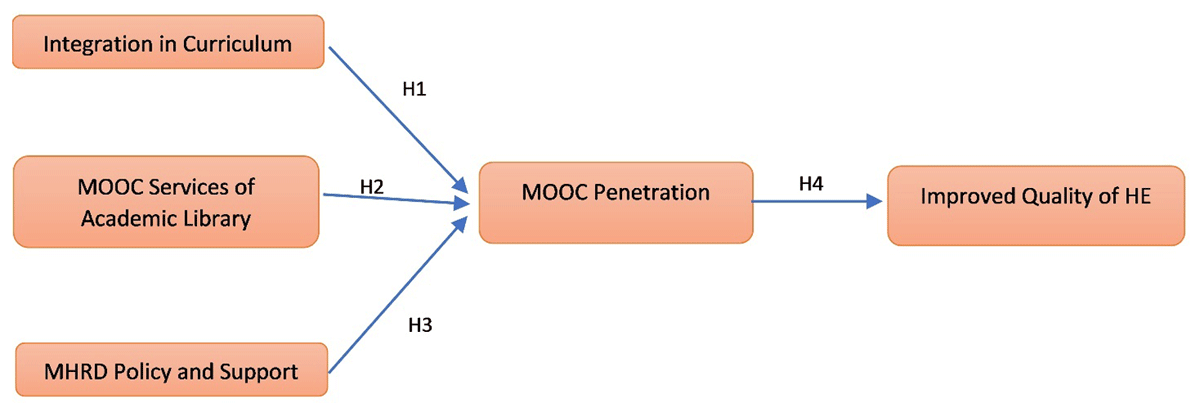
Figure 2
Research model
Table 3
Scale properties
| Construct | FLR | AVE | CR |
|---|---|---|---|
| Integration in Curriculum | 0.93 | 0.69 | 0.83 |
| Academic Library Services for MOOCs | 1.17 | 0.66 | 0.74 |
| MHRD Policy and Support | 0.95 | 0.64 | 0.71 |
| MOOC Penetration | 0.97 | 0.55 | 0.87 |
| Improved Quality of HE | 0.91 | 0.63 | 0.81 |
Table 4
Fit indices for the research model
| goodness of fit index | 0.953 | comparative fit index | 0.948 |
|---|---|---|---|
| adjusted goodness of fit index | 0.896 | incremental fit index | 0.955 |
| Tucker Lewis index | 0.925 | root mean square error of approximation | 0.073 |
| normed fit index | 0.908 | chi-square value | 171.546 |
| degrees of freedom | 152 | significance value | 0.110 |
| chi-square/degrees of freedom | 1.128 |
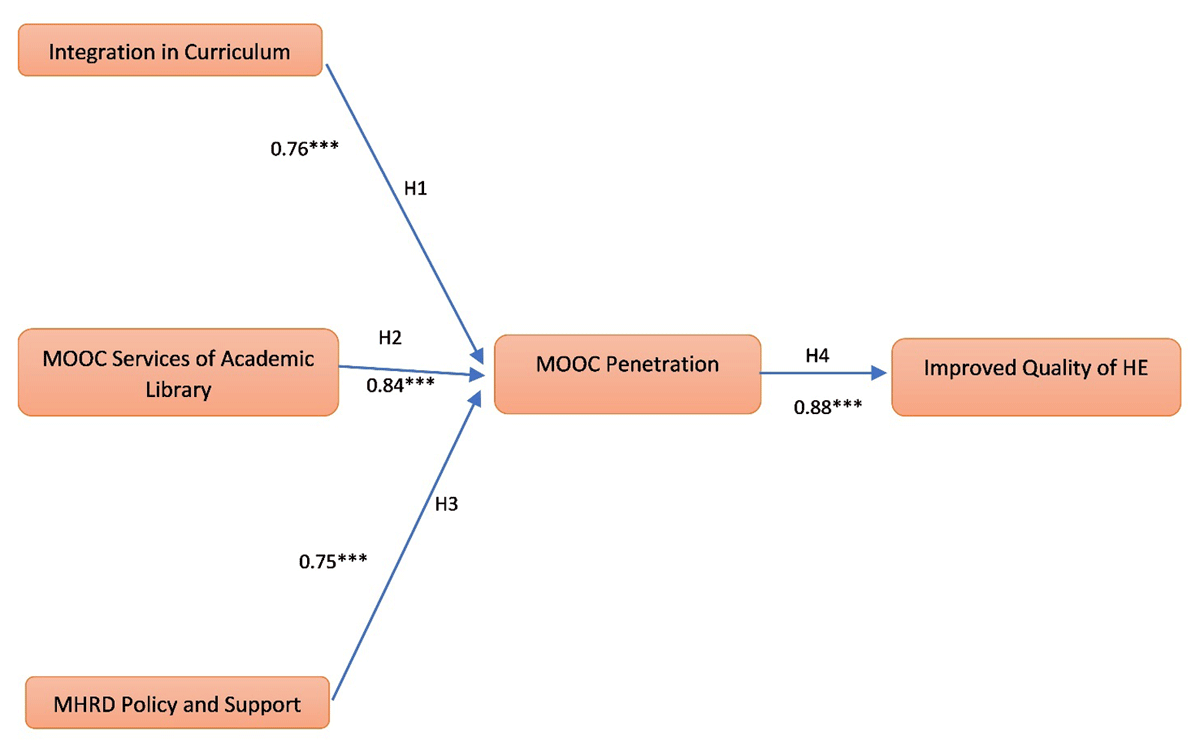
Figure 3
Improved quality of HE structural equation model
Table 5
Classification of the MOOC services of the academic library
| MOOCs as an extension of Existing Library Services | Citations | Scope of New Library MOOC Services | Citations |
|---|---|---|---|
| Teaching reference services for MOOCs | 35 | Support services for development of new MOOCs | 36 |
| Copyright services for MOOC resources | 37 | Digital platform for peer discussion on MOOCs | 38 |
| Provide physical space for MOOC learning | 39 | Development and management of a university-wide digital MOOC platform for access, instruction, evaluation, feedback and support, based on artificial intelligence | 40 |
| Reliable broadband access | 41 | MOOC technical support | 42 |
| Library network for sharing of digital resources | 43 | Centralized MOOC administration | 44 |
| Training students and instructors on latest technology to use MOOCs | 45 | MOOC pedagogy training for instructors | 46 |
| Index, ranking, organizing and cataloguing MOOCs | 47 | Student counselling for MOOCs | 48 |
| Technical infrastructure for MOOCs | 49 | MOOCs with embedded links for resources | 50 |
| Promoting MOOCs | 51 | MOOC knowledge services for students | 52 |
| Training students in English language to understand MOOCs | 53 | Development of FAQs for student self-service | 54 |
| Preserving and archiving MOOCs | 55 | Mobile access of MOOCs, resources and services | 56 |
| Learning resources for MOOCs | 57 | Information retrieval training for MOOCs | 58 |
| Continual improvement of digital learning resources for MOOCs | 59 | Technical team for MOOC support | 60 |
| Digitization of traditional resources | 61 | Co-ordinate in MOOC instruction, design, development and management | 62 |
| Developing open educational resources for MOOCs | 63 | Evaluation of prospective MOOCs for inclusion | 64 |
| Cybrarian services | 65 | ||
| Programmes for information literacy of MOOC students | 66 | ||
| Inter-departmental co-ordination for MOOC-based education | 67 |
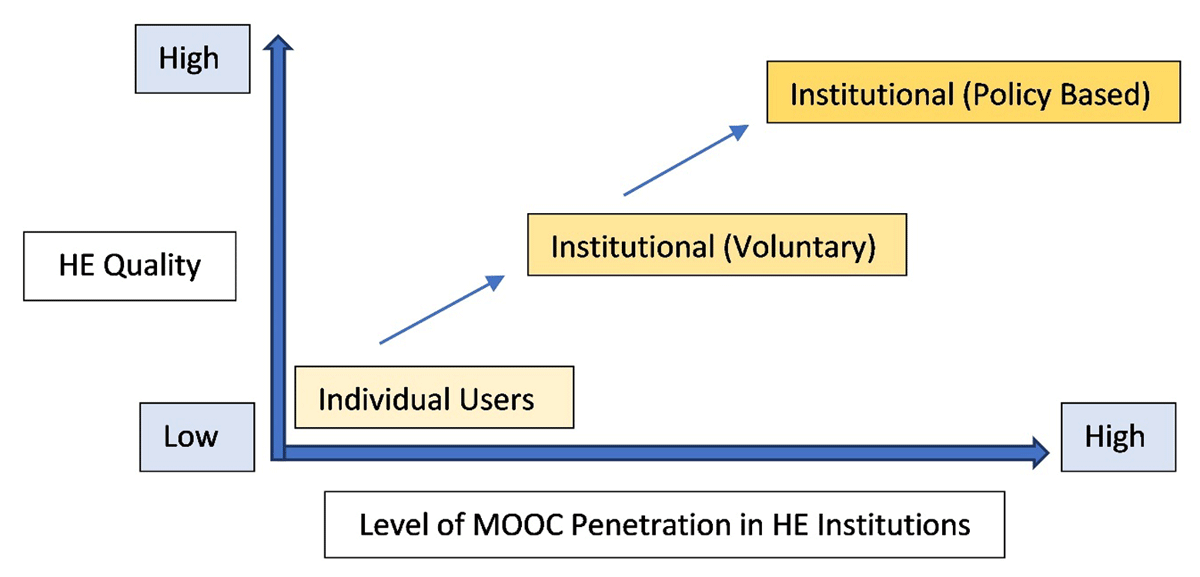
Figure 4
Relationship between the level of MOOC penetration and the quality of higher education
Table 6
Relationship between the level of MOOC penetration and the quality of higher education
| Case 1 | MOOC adoption by individual users | Low MOOC penetration | High dropout rate. Not affordable for everybody. Language constraints, lack of resource availability, guidance and motivation |
| Case 2 | Institutional adoption (voluntary) | Medium MOOC penetration | Based on sparingly dispersed cases. The adoption rate and effect if localized and not translated to the masses |
| Case 3 | Institutional adoption (policy based) | High MOOC penetration | Pan India institutional adoption under central policy. MHRD will provide guidelines, policy framework, resources and training under NME-ICT programme |
Table 7
Decision Model for MOOC integration into the curriculum
| X: High Y: High | Quadrant 1 | Flipped classroom | This model uses the best of both worlds. The traditional lecture and homework are reversed. The students learn from MOOCs as homework and then discuss the learning with their peers and the instructor in the classroom for problem solving and activities. The instructor may offer only relevant sections of MOOCs as homework, as per their curriculum design. This model engages students in higher-order learning through proper discussions and active engagement. In this case, the content from more than one MOOC can be used. |
| X: Low Y: High | Quadrant 2 | MOOC credit transfer | According to the latest UGC guidelines on MOOC credit recognition, online courses offered on SWAYAM platform can constitute up to 40 per cent of the total credits in each semester. Major MOOC providers like Coursera and EdX have started to associate credits based on online proctored exams with their monetized MOOCs. If the MOOCs are approved by an institution due to their fit to the curriculum, credit transfer becomes possible. This model provides maximum autonomy to the students, as they are free to choose their course and can self-regulate their learning process. Instructor autonomy is the least in this case, as there is no role for the instructor in such a MOOC integration model. |
| X: Low Y: Low | Quadrant 3 | Bridge course/exam | When the learning outcomes of the traditional course and the MOOC are similar, the courses are considered equivalent. The institute can save on the delivery cost of the course by adopting MOOCs in such a case. But the credit transfer cannot be done due to problems of potential plagiarism and cheating in the online assessment. In such a case, the institute may add a few tutorials, laboratory sessions and assessments to compensate for the quality issues with the MOOCs. In this model, the level of autonomy is low for both the students and the instructor. The students need to adhere to the institutional requirements to get the course credits, and the instructor will not get to design and manage the curriculum as the majority of learning takes place on the MOOCs. |
| X: High Y: Low | Quadrant 4 | MOOC as content | MOOC components are used in regular teaching as learning objects, e.g. videos, reading resources, quizzes, activities, etc. Content from more than one MOOC can be used. In this case, the instructor has maximum autonomy on the curriculum. |
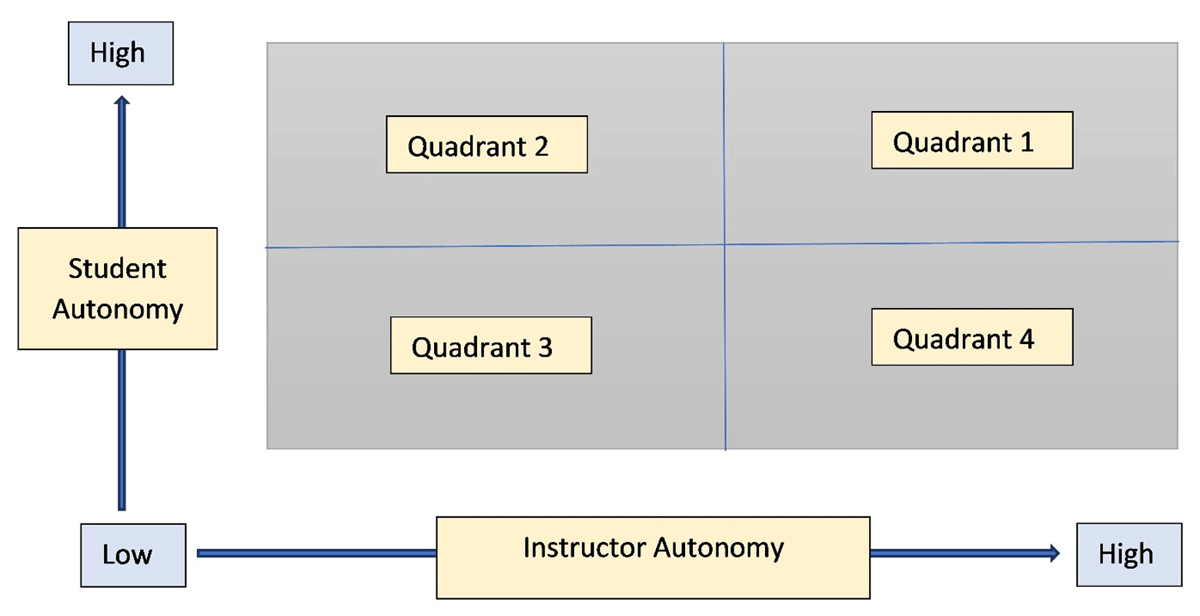
Figure 5
Decision model for MOOC integration into the curriculum