
Introduction
Pregnant women are susceptible to health problems that can disrupt their health and the health of the fetus they are carrying. If pregnant women do not consume nutritious food, they are likely to experience malnutrition. Around 462 million pregnant women worldwide are malnourished.1 Malnutrition in pregnant women is a global problem, especially in developing countries including Africa. The prevalence of malnutrition in pregnant women in Africa reaches 23.5%. Among the 23.5% of pregnant women who are malnourished, 68% of them are those who live in rural areas.2 Factors contributing to this high prevalence include illiteracy, living in rural areas, early marriage (before the age of 18), lack of antenatal care, substance use during pregnancy, inadequate prenatal dietary advice, low participation in women’s health initiatives, intestinal parasitic infections, skipping meals, household food insecurity, and low dietary diversity.3-5
Pregnant women need more nutrients than non-pregnant women. Pregnant women need additional energy of 300-450 kcal/day for pregnant women in the second and third trimesters. During pregnancy, pregnant women need additional macronutrient content, including 20-25 grams of protein/day and additional carbohydrates of 30-40 grams/day.6,7 In addition to macronutrient content, pregnant women need micronutrient nutritional content, including 1000 mg to 1300 mg of calcium per day, folic acid would be better if it were 600 µg/day, 27 mg of iron per day, 700 to 770 µg of vitamin A per day, 75 to 85 mg of vitamin C/day, 600 IU of vitamin D per day, and 220 µg of iodine/day.7,8 A person is declared to have a normal body mass index if their BMI is 18.5-24.9. Pregnant women with normal pre-pregnant BMI are recommended to gain 11-15 kg during pregnancy.7 The consequences of maternal malnutrition are severe, leading to an increased risk of maternal death, miscarriage, premature birth, low birth weight, congenital disabilities, and overall neonatal and child mortality.9,10 To address this problem, a comprehensive strategy is needed, including increasing access to nutritious food, improving health services, providing education on maternal nutrition, and implementing targeted interventions to improve maternal nutrition in sub-Saharan Africa and globally. Although several interventions have been conducted, scoping review of how maternal nutrition education impacts pregnant women’s nutritional status and newborn outcomes in Africa remains limited. Therefore, the review aims to explore the impact of nutrition education interventions on the nutritional status of pregnant women and the nutritional status of newborn babies.
Method
This study was developed according to the protocol proposed by Arksey and O’Malley (2005) to explore the key concepts underlying a research area quickly. The general question of the literature review is, “What is the impact of maternal nutrition education on the nutritional status and food consumption behavior of pregnant women in Africa?”
The inclusion criteria in this study used the PCC (Population, Concept, Context) technique recommended by the Joanna Briggs Institute for literature reviews.11 The population in this study are pregnant women in Africa. The concept in this study is the impact of maternal nutrition education intervention and food consumption behavior of pregnant women in Africa. The context in this study included peer reviewed empirical studies (such as randomized controlled trials quasi experimental studies, cohort studies, or cross sectional research) published in English between 2014-2024. Reviews, editorials, conference abstracts, and uncontrolled case reports were excluded.
The search was conducted in November 2024. The first step was an initial search in three databases (PubMed, Scopus, and Science Direct). The search in this study refers to the process of identifying only articles published in peer reviewed journals to ensure scientific rigor.
From the three databases, a total of 1,556 articles were obtained. All articles were downloaded and entered into the Mendeley application. After removing duplicates across databases, 1,498 unique article remained. Following title and abstract screening, Eleven studies were selected for full text review. Of these, three studies were excluded because they:
did not measure nutritional outcomes (e.g., MUAC or birth weight),
targeted populations other than pregnant women, or
implemented non educational interventions (e.g., supplementation only).
Finally, 8 articles meeting the eligibility criteria. Keywords, databases, and steps in filtering articles can be seen in the columns and images below:
Table 1
Details Keywords and Article Database
| Database | Keyword | Number |
|---|---|---|
| PubMed | “nutrition education”; AND “pregnant women”; OR pregnancy; AND “malnourished” OR “Chronic Energy Deficiency” | 971 |
| Scopus | “pregnant women”; OR “pregnancy”; AND “nutrition intervention”; OR “nutrition education”; AND “malnutrition”; OR “chronic energy deficiency” | 266 |
| Science Direct | “nutrition intervention”; AND “pregnant women”; AND “malnourished” | 319 |
| Total | 1,556 |
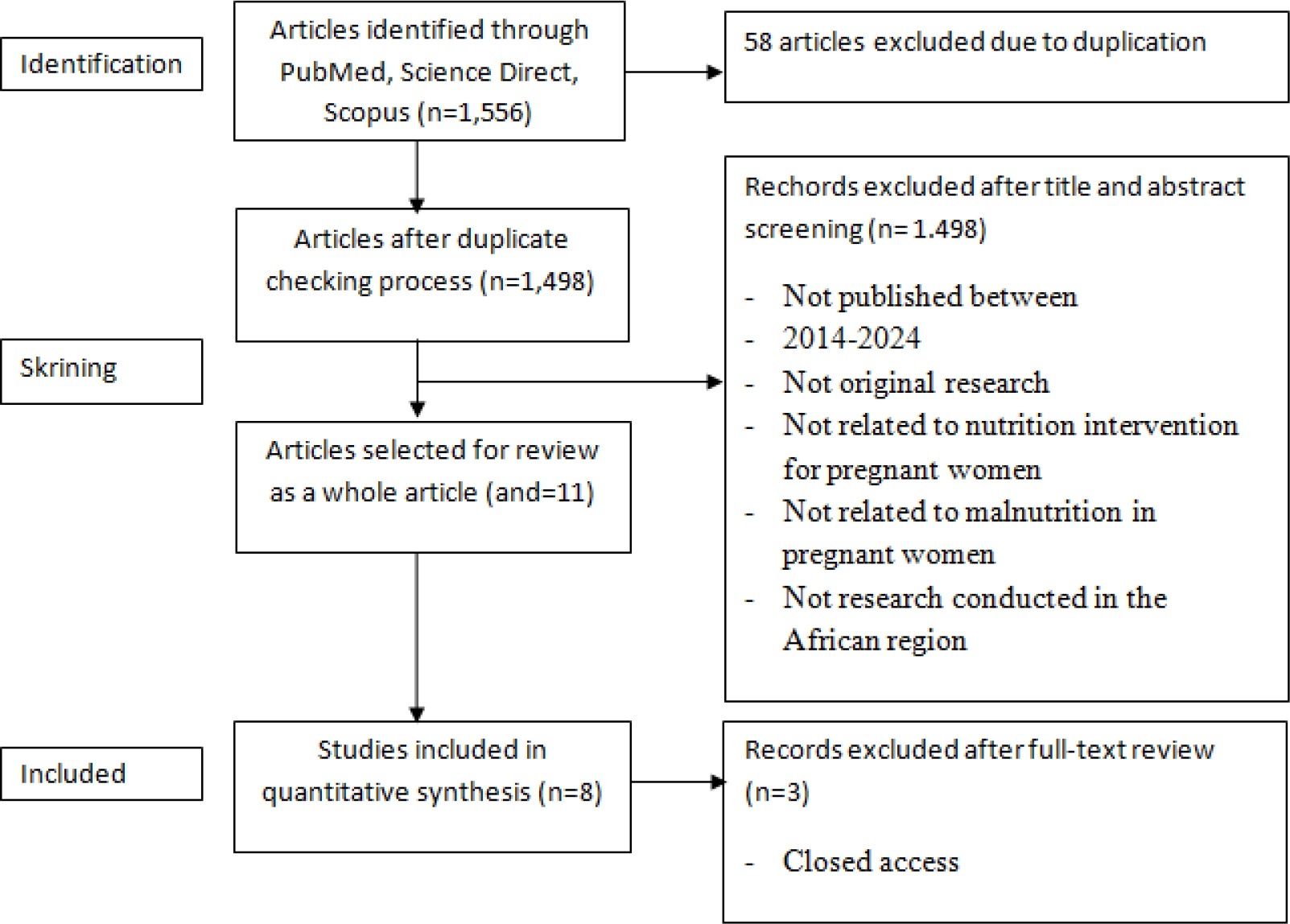
Figure 1
Prisma ScR
Results
A total of eight studies met the inclusion criteria. All studies evaluated the effects of nutrition education interventions on pregnant women’s food consumption behaviour, nutritional status (measured by Mid- Upper Arm Circumference), and infant birth weight. These studies were conducted in Ethiopia, Kenya, Nigeria, and Uganda, including one that involved South Sudane refugees in Uganda’s West Nile region. Most of research examined the effects of nutrition education interventions on dietary behavior , maternal nutritional status, and infant birth outcomes.
Food consumption and dietary diversity
Five interventional studies demonstrated significant improvements in dietary diversity following nutrition education (p<0.05). The interventions commonly involved group based counseling, home gardening, or the inclusion of male partners, which enhanced women’s knowledge and encouraged consumption of a wider variety of foods. Although none of the studies reported exact mean changes in dietary diversity score, all showed higher proportions of pregnant women achieving the mnimum dietary diversity (≥5 food groups) after intervention. Two cross sectional studies conducted in Kenya and Ethiopia also reported significant positive associations between maternal nutrition knowledge and dieary diverity (p<0.05).12,13
Maternal nutritional status
Four studies assessed mid upper arm circumference (MUAC) as an indicator of maternal nutritional status. Three of these reported significant improvements after nutrition education, while one found no significant improvements after nutrition education (p = 0.18).14 The magnitude of improvement among the significant studies ranged from 0.36 cm to 0.59 cm, suggesting modest but consistent enhancement in maternal nutritional status.15,16
Birth outcomes
Three studies evaluated infant birth weight as an outcomes measure. One trial found that mothers who received nutrition education were 2.43 times less likely to deliver low birth weights infants (95% Cl: 1.6-3.7), while another study reported overall higher mean birth weights in the intervention group.(17) In addition, one Ugandan suty identified improvements in both infants length and weight of length (LAZ mean differences = 2.05, p <0.001), reflecting broader benefits of maternal nutrition education on child growth indicators.18
Table 2
Review Article
| Author (year) | Country | Study Design | Main result | References | Theme |
|---|---|---|---|---|---|
| Komakech JJ, Emerson SR, Cole KL, Walters CN, Rakotomanana H, Kabahenda MK, et al. 2024 | Uganda (South Sudanese refugees) | A cluster randomized control trial | Group nutrition education will increase the consumption of nutritious foods (protein, vitamin A, and iron), reduce stunting, and increase infant weight/height (LAZ mean diff = + 2.05 (p < 0.001)) | 18 | Food consumption behavior Birth outcomes |
| Kumal, MN., Tamiru, D., Belachew, T. 2023 | Ethiopia | Randomized control trial | Gardening education utilizing home gardens can increase the dietary diversity of pregnant women and increase infant birth weight. However, there is no significant increase in MUAC as a result of this intervention (p = 0.18) | 14 | Food consumption behavior Maternal nutritional status Birth outcomes |
| Obonyo, KO., Kaindi, DWM., Ngala, S., W, Kogi-Makau. 2024 | Kenya | Cross-sectional | Digital technology is effective in enhancing nutrition education and improving the consumption of diverse foods and the nutritional status of pregnant women (p< 0.01) | 12 | Food consumption behavior Maternal nutritional status |
| Tesfaye, A., Adissu, Y., Tamiru, D., Belachew,T. 2024 | Ethiopia | Cross-sectional | Nutrition education can improve knowledge and consumption of diverse foods in pregnant adolescents (p < 0.05) | 13 | Food consumption behavior |
| Tsegaye, D., Tamiru, D., Belachew, T. 2022 | Ethiopia | Quasi-eksperimental | Education involving husbands can increase the consumption of more diverse foods, and husband involvement can significantly increase MUAC (p < 0.05) | 19 | Food consumption behavior Maternal nutritional status |
| Wakwoya, EB., Belachew, T., Girma, T. 2023 | Ethiopia | Randomized controlled trial. | MUAC of pregnant women increases (average difference of 0.36 cm (p < 0.05)) | 15 | Maternal nutritional status |
| Baressa, G., Whiting, SJ., Belachew, T. 2024 | Ethiopia | Quasi-eksperimental | MUAC of pregnant women increases (average difference of 0.59 cm (p < 0.01)) | 16 | Maternal nutritional status |
| Sisay, G., Tesfaye, A. 2023 | Ethiopia | Quasi-eksperimental | Nutrition education and counseling reduce the risk of Low Birth Weight (OR = 2.43 (Cl: 1.6-3.7)) | 17 | Birth outcomes |
Discussion
The Relationship between Nutrition Education Interventions for Pregnant Women and Nutritious Food Consumption Behavior
Dietary diversity can be calculated using the Dietary Diversity Score indicator. DDS assesses the variation in a person’s diet based on the number of food groups consumed over time—the more diverse the food consumed, the better the nutritional quality.20 Of the nine articles studied, five tested dietary diversity’s effects before and after the intervention. Of the five articles, all showed significant developments in dietary diversity after the intervention. Research conducted in West Uganda showed that mothers participating in this program were likelier to consume a balanced nutritious diet, including sources of iron and vitamin A, essential for fetal growth. Dietary diversity increased in the intervention group. If previously many mothers tended to rely on staple foods such as cereals and tubers, after participating in nutritional education, their diet became more diverse with the addition of green vegetables, nuts, eggs, and other sources of animal protein. On the other hand, the cooking training provided in this program encouraged mothers to be more creative in utilizing local food ingredients available around them. This increases the variety of food in the family and helps ensure that babies get more nutritious complementary foods.18 In a study examining nutritional knowledge using a mobile phone application in Kenya, it was found that 86 respondents (20.3%) consumed starchy staple foods. This was the type of food with the highest proportion. A total of 54 pregnant women (12.8%) consumed fruits rich in vitamin A. A total of 48 pregnant women (11.3%) consumed offal and fruits. A total of 46 pregnant women (10.9%) consumed nuts or seeds. A total of 44 pregnant women (10.3%) consumed vegetables. Protein (poultry, eggs, meat, fish, and milk) was the food with the lowest proportion consumed by pregnant women, at 10%.12
Articles that examine the impact of nutrition education interventions involving couples and special groups of pregnant women show significant differences compared to other groups. Research was conducted in the Southwest region that tested food diversity through MDD-W (Minimum Food Diversity for Women of Reproductive Age) in the last 24 hours. The results showed that food diversity in pregnant women accompanied by husbands was higher compared to other groups.14 Similar research was also conducted in the Illu Aba Bor Zone, Ethiopia. After controlling for possible confounding variables, the couple group (pregnant women accompanied by husbands during the intervention) was 3.9 times more likely to consume a variety of foods. In addition, in the special group of women, the results were 2.8 times more likely to consume a variety of foods.19 Husband support encourages women to remember, practice, and increase food portions to reduce mortality due to low birth weight.14 In addition, group support is people who have similar experiences can relate better and, as a result, can offer more authentic empathy and validation because they have the same life experiences to offer advice and suggestions to each other.19,21,22 In comparison, several studies in the African region are in accordance with studies in the Indonesian region. Fatmawati et al.’s (2023) study stated that after receiving nutritional counseling, there was a significant increase in the consumption of bread and cereals (79.4% to 95.9% (p < 0.001)), vegetables (50.5% to 64.9% (p = 0.004)), and milk & dairy products (38.1% to 81.4% (p < 0.001)), and the frequency of women following dietary guidelines increased from 3.1% to 37.1%.23
The Relationship of Nutrition Education Intervention for Pregnant Women to the Maternal Nutritional Status
The nutritional status of pregnant women is the result of the food consumption behavior of pregnant women. Food consumption behavior in pregnant women is caused by predisposing, enabling, and reinforcing factors, including economic level, education level, maternal knowledge, maternal attitude, culture, health facilities, availability of food ingredients, and support from people closest to pregnant women.24 This statement aligns with research examining the impact of maternal nutritional knowledge and maternal abilities by utilizing mobile phone applications in Kenya. The results of the study showed a significant relationship between nutritional status and the scores of pregnant women’s mobile phone applications, indicating that pregnant women who have higher knowledge scores regarding pregnancy-related information obtained through mobile phone applications tend to have better nutritional status.12 In addition to nutritional counseling activities that can improve consumption practices, Siregar and Sukartini’s (2022) research stated that Nutrition Education Using Booklet Media significantly increased knowledge (p=0.000) and body weight (p=0.000).25 UAC of pregnant women is often used as a practical indicator to detect the risk of malnutrition.26 The suitable UAC threshold in pregnant women varies depending on geographical conditions.27 In addition to UAC, the Body Mass Index (BMI) of pregnant women is also used to detect malnutrition risk. If the BMI before pregnancy or Trimester I (gestational age ≤12 weeks) is below 18.5 kg/m2, then the pregnant women is indicated as malnourished.28 Malnutrition can cause stunting, low birth weight, premature birth, maternal mortality, and even disrupt the child’s physical and psychological development process.29,30 Pregnant women who experience malnutrition have a 1.6% higher risk of stunting than pregnant women who do not experience malnutrition.31
Five articles discuss the Impact of interventions with upper arm circumference (UMC) measurements. The UAC test is measured using the Mid-Upper Arm Circumference (MUAC). Four of these articles stated that there was an increase in the size of the UAC. However, one of the five articles noted no statistically significant difference in the increase in UAC after the intervention. A study of nutritional education interventions through the involvement of men in the Southwest Ethiopia region found that after controlling for sociodemographic factors such as age, education level, type of mother’s job, economic level, and number of family members, women in the couple group showed a significant increase in nutritional status at the end of the intervention. Likewise, the pregnant women-only group also showed increased nutritional status after the intervention.19 In addition, a study examining the effect of nutritional education on the nutritional status of pregnant women was also conducted in Robe and Goa Districts. The results showed that there was a significant difference between the control group and the intervention group. The average MUAC in the intervention group increased from 22.56 cm to 23.50 cm (p < 0.0001), and the average difference in MUAC between the intervention and control groups was 0.59 cm after being given nutrition education.16 Similar research was also conducted in the East Shoa Zone. The study’s results stated significant changes in nutritional status and the proportion of malnutrition between the intervention and control groups after the intervention. The t-test results showed that the UAC size increased by 1.8% after the intervention. The proportion of pregnant women in the intervention group decreased by 11% (36% before intervention to 25% after intervention). The average difference in MUAC increased by 0.36 cm (23.08 cm before intervention and 23.44 cm after intervention).15
However, the four studies above are not in line with the survey conducted in the Jimma region, Southwest Ethiopia. The results showed that the difference in MUAC between the intervention group and the control group showed a value (p = 18), which was statistically insignificant. In addition, in this study’s intervention and control groups, there was no difference in maternal weight at the beginning and end of pregnancy, which was measured using gestational weight gain (GWG).14 The provision of nutritional education was not significant in MUAC because of the relatively short intervention period and factors such as illness, high physical activity, or metabolic conditions. This is in line with research conducted in Indonesia, which stated that providing education for a short period did not result in specific changes in UAC. Difference in Difference (DID) analysis showed that the difference was not statistically significant (p = 0.198).32
The Relationship Between Nutrition Education Interventions for Pregnant Women and Birth Outcomes
Nutritional status in infants can be seen from the baby’s physical condition at birth, one of which is the baby’s weight at birth. A healthy baby is born with a minimum weight of 2,500 grams.33 Low birth weight can cause health problems in children, including premature birth, poor cognitive and behavioral problems in children, obesity, infections and respiratory problems, metabolic syndrome, and increased blood pressure.34-37 Three articles examined aspects of low birth weight. In a study in the Gedeo area, regression analysis showed that the risk of LBW in mothers in the control group was 2.43 times greater than in the intervention group. There was a significant relationship between LBW and low education levels and household income. Infants had a 2.14 times greater risk of experiencing LBW in families with a monthly income <2000ETB. In addition, infants had a 2.55 times higher risk of experiencing LBW in mothers who did not have secondary or higher formal education.17 This aligns with a review of studies conducted in low-income countries. Limited financial resources lead to poor dietary patterns due to access to affordable food, which influences food choices during pregnancy. In some communities, cultural beliefs and nutritional restrictions influence nutritional practices during pregnancy. Cultural beliefs about food consumption during pregnancy can hinder adequate nutrition.38
There are two studies involving couples (husbands of pregnant women). These studies were conducted in Southwest Ethiopia and Western Uganda. The study conducted in Southwest Ethiopia was conducted through gardening activities on home land. The results of this study were that nutrition education interventions involving husbands were proven to be effective and significantly improved maternal nutritional knowledge, attitudes, and practices, which in turn improved maternal nutritional status and birth weight.14 The study results were conducted in the West Uganda region with three groups (married couple intervention group, intervention group involving pregnant women only, and control group), which showed significant differences in infant growth between the intervention and control groups. The proportion of infants experiencing stunting in the intervention group was 3.4%–9.5%. This number is much lower than in the control group of 14.1%–20.9%. In addition to stunting, this study found that the intervention had an effect on the weight and length of infants. Infant length was measured using the Z-score length for age (LAZ). The results of the study showed that there was a difference in infant length, namely MD = 2.05, p <0.001 in the female group only, MD = 2.00, p <0.001 in the husband and wife group, and in the control group, the infant length was lower than both intervention groups.18 These results indicate that group nutrition education interventions are essential in preventing infant malnutrition and improving infant nutritional status during early life. However, it is important to note that most of the studies inluded in this review did not adjust for gestational age when analyzing birth weight outcomes. As a result, some infants categorized as having low birth weight might actually have been preterm rather than growth restricted due to maternal undernutrition. Future research should therefore distinguish between prematurity and intrauterine growth restriction (IUGR) to clarity the mecanisms through which nutrition education ifluences neonatal outcomes.
Policy Implications and Intergration with Maternal Health Programs
The government is expected to implement a nutrition counseling program during antenatal check-ups to ensure that nutrition education reaches many people. Policymakers need to focus on multidisciplinary strategies to address the social and economic issues that hinder maternal nutrition, namely food access, economic, and education levels. The government can conduct regular evaluations to assess the effectiveness of the program. With regular evaluations, the government can improve and adjust policies to be more effective and reach all African communities.
Conclusion
This review article highlights the impact of maternal nutrition education in improving maternal nutritional status and food consumption behavior in Africa. From 8 articles included in this study, it was found that educational interventions influenced the increase in MUAC and infant birth weight. In addition, nutritional education was also effective in changing maternal food consumption behavior, thereby encouraging food diversity. Interventions involving married couples showed more significant results. This is because pregnant women receive social support from those closest to them. The effectiveness of interventions is also influenced by factors such as the economy, education level, and access to health services. Therefore, a comprehensive strategy is needed in applying nutritional education in every comprehensive antenatal service for all pregnant women in Africa so that the nutritional status of pregnant women and babies can be improved better.
Acknowledgment
The author would like to thank the Faculty of Public Health for the opportunity to write. The author also used Grammarly and Quillbot to check the grammar.
Ethics and Consent
Not applicable
Competing Interest
The authors has no competing interests to declare.
Authors’ Contribution
The author solely conceived the study, conducted the review, analyzed the data, and wrote the manuscript.