
Introduction
Engaging in play is a crucial component of childhood experience for all children. Environments that provide children with unstructured play opportunities are essential for their growth, development, and long-term health.1,2 While play can occur both indoors and outdoors, playing outdoors provides multi-sensory stimulation through interaction with the natural world and its materials which are hard to find in structured indoor spaces.3 Children with disabilities are at a distinct disadvantage when it comes to play as they engage in less complex and fewer play experiences.4,5 Access to green outdoor spaces such as parks, gardens, allotments, and woodlands for school children is associated with enhanced cognitive skills and better attention scores.6,7These advantages may extend to children with attention deficit hyperactivity disorder (ADHD), the most common developmental disorder characterized by impulsivity, hyperactivity, and inattention considered now as a major public health challenge.8 Residential surrounding green space9 and residential proximity to green outdoor spaces10 are associated with fewer ADHD symptoms and reduction in medication usage.9 Furthermore, playing in a sensory garden, an outdoor enriched play space enhanced functional performance of these children and had a better indoor activity performance with prior outdoor exposure to sensory motor play.11 Despite the well-known benefits, playing outdoors is often neglected.12
Attention and Exposure to Natural Environments
Attention, is a fundamental function of school activities. Sustained attention is the ability to focus on a particular stimulus for an extended amount of time.13 Indeed, attention is a key cognitive resource that is engaged in executive processes and self-regulation activities that support academic accomplishment.14 Given that sustained attention impairments are one of the diagnostic criteria for ADHD, these deficits can have a detrimental effect on an individual’s ability to function daily.15 Although, research on the physical environment and how it affects ADHD is scarce, there is some indication that spending time outdoors reduces symptoms of ADHD.9,10,11
Home based sensory garden
Children benefit greatly from home-based programs since the adherence to the program is high, improving the intended outcomes.16 Functional skill development is hard to achieve by conventional, face-to-face therapy in rehabilitation facilities alone. Exposure to a variety of environments is required, including home settings.17 According to the socioecological model as proposed by Bronfenbrenner, a child’s development is influenced by different environmental systems. The most proximal system that has the greatest influence on the developing child is the microsystem. It consists of the closest relationships a child has, including parents and siblings.18 As children with disabilities spend most of their time at home, the home environment is of particular importance. Hence, outdoor spaces around the home were chosen as a play setting in this study to facilitate healthy development.
Outdoor Sensory Garden (SG) is a selfcontained, outdoor space with specific plants and landscape elements that draw users to touch, taste, smell, interact, explore, and engage in a rich sensory experience.11,19 It offers a multi-resource package for developmental progression, education, therapy, and recreation.20,21 The sensory garden is designed to stimulate some to all sensory systems, including visual (sight), auditory (hearing), proprioceptive (muscle tension), tactile (touch), olfactory (smell), gustatory (smell), and vestibular (balance) based on the user’s need.11 Although sensory gardens are designed based on the designer’s approach and experience, the selection of plants (softscape) and hardscape elements are essential steps.22 This study shows how playable and therapeutic SG play spaces could be economically designed from underused outdoor spaces of the home to enhance time-on-task performance and serve as an adjunct to clinical intervention.
Materials and Methods
Design Process: The study proceeded in four distinct stages. The first stage consisted of a combination of literature searches to identify key principles for sensory garden design and previous hands-on-experiential knowledge of the primary author in developing a clinic-based SG. The second stage consisted of an on-site visitation. The third stage, involved developing context specific, home-based, sensory gardens based on application of design principles, hands-on experience, and on-site visitations. The final stage consisted of allowing children to explore and engage in sensory-motor play activities in the SGs (Figure 1).

Figure 1
Design process
Participants: This study employed a case study approach. Three children with ADHD (6-12 years) recruited from a single rehabilitation clinic in Chennai. Screening tools were the National Institute for Children’s Health Quality (NICHQ), the Vanderbilt Assessment scale (ADHD symptom screening), and the Short Sensory Profile (SSP) (individual sensory status). All the children had a typically growing sibling. There was no evidence of co-morbid developmental disorders, including visual impairment, hearing impairment, autism spectrum disorder, or intellectual disability. To be included in the study, subjects, based on NICHQ, must be predominantly classed as the inattentive subtype, and there must be clear evidence that symptoms impair functioning in school and social settings. Time-on-Task performance was the outcome tool. The duration of time (minutes) spent in writing and reading a regional story book was utilized.
Description of Intervention: After formal approval from the concerned department and clinic officials, information sessions were held with respective mothers. Signed informed consent from the mother and verbal assent from the child were obtained. Children were screened using NICHQ and SSP. Total intervention duration was for 3 weeks, 5 days a week. Week one was the baseline phase and weeks two and three were the intervention phase.
Baseline phase: During the baseline phase (week1), the subjects participated in 45-minute, indoor, regular Sensory Integration (SI) for five working days at the rehabilitation clinic. Intervention included, sensory playbased activities such as vestibular (swinging, spinning, rolling), proprioceptive (push and pull activities), and deep pressure tactile activities, according to the need of the participants. At the end of the week one, the outcome measure, time-on-task performance was obtained and was considered as the baseline score.
Intervention phase: The intervention phases (week 2 and week 3) were for ten working days. The three subjects were exposed to 30-minute outdoor SG at their respective homes followed by regular intervention at the clinic, after a 60-minute break. The participants were engaged in a range of sensory-motor play activities in the sensory garden. The play activities included sand play, water play, hands-and-feet explorations, climbing, balancing, and sensory walkways. Moveable loose parts encouraged lifting, carrying, pushing, pulling, and graduated balancing. The mothers’ journal, observation notes, was maintained during the intervention phase to record the child’s participation in SG on a daily basis, specifically noting areas most and least frequently used. Figure 2 depicts the study design.
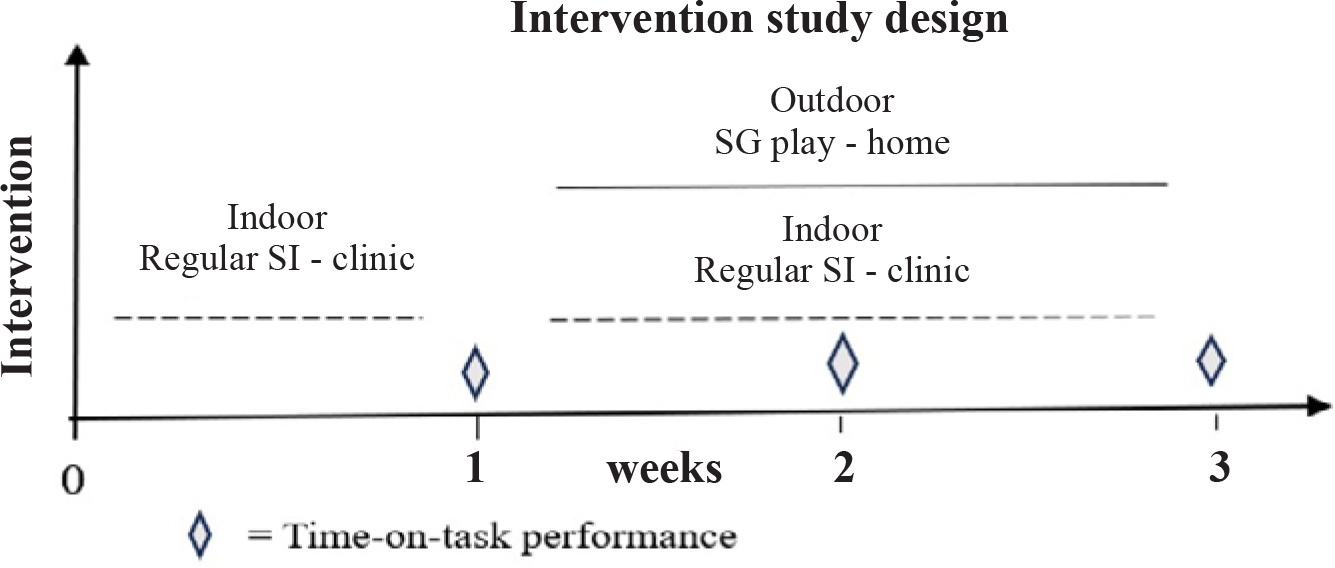
Figure 2
Intervention study design
Description of sensory gardens (homebased): The three SGs developed were redesigned from the existing outdoor spaces of respective home environments.
SG1: Existing home garden having a combination of shrubs, vegetables, and perennial plants was converted to SG. The space was enhanced with additional potted ornamentals and grounded herbal plants, creepers, hangers, and potted aromatic plants. SG was categorised into three zones: namely sensory (sight, sound, smell & taste), sensorymotor (walking pathway, push-pull & balance) and a resting zone. The walking pathway was made of different sensory stimulating materials (gravel, sand, dried leaves, and a patch of grass).
SG2: A portion of unused backyard garage was converted to an outdoor sensory garden with potted and grounded edible herbs, shrubs, and scented plants. A sensory pathway with a variety of surfaces, including sand, parking tiles, rounded pebbles, and plain tiles separated the plants. Combined hand-and-foot exploration was made possible by a mini-sand pit, mini-pebbled pit, mini-brick pit, and mini-water tub. The mini-brick pit encouraged piling and un-piling and recycled tyres promoted balance and climbing. There were no discrete zones in the garden; instead, it featured multisensory play exploration and active engagement.
SG3: A portion of vacant outdoor space was modified as a sensory garden enclosed by a sensory track. Potted plants and raised beds for aromatic herbs were regularly watered. Additionally, it provided a sprinkler fountain appearance. Horizontal and vertically placed wooden logs interrupted the walking areas for climbing, walking over, pushing-pulling, rolling, and stacking. Hanging planters enlivened the area.
Thus, the outdoor spaces of home environments were changed to “playable,” child-friendly areas to encourage children to explore and engage in safe, independent play. Playability was introduced through affordable natural elements to offer maximum sensory delight through fun-based sensory motor play activities. The sensory garden features are represented in Table 1.
Table 1
Features of Sensory gardens
| Outdoor space designed as SG | SG1 | SG2 | SG3 |
|---|---|---|---|
| Home garden | Backyard garage | Outdoor space | |
| SG with demarcated zones | Y | N | N |
| Inclusion of child in designing SG (Y/N) | N | Y | Y |
| Parental play participation (mother)(Y/N) | Y(occasionally) | Y(occasionally) | Y(occasionally) |
| Sibling play participation (Y/N) | Y(occasionally) | Y (mostly) | Y(mostly) |
| Sensory feature most frequently used | Water zone | balance area | Log area |
| Sensory feature promoted frequent sibling interaction | Water zone | Tyre balance area | Log area |
| Common sensory feature | Textured walking pathway | ||
Results
The subjects participated in a 3-week, intervention period with SG outdoor play for 2-weeks, week 2 & 3, a total of ten sessions in their respective homes. Time-on-task performance was recorded at the end of each week. Time-on-Task performance in minutes is outlined in table 2 and depicted figure 2.
Table 2
Time-on-task performance (writing & reading)
| Participant | Week 1 | Week 2 | Week 3 | |||
|---|---|---|---|---|---|---|
| Writing | Reading | Writing | Reading | Writing | Reading | |
| A | 6 | 4 | 11 | 8 | 20 | 14 |
| B | 6 | 5 | 15 | 11 | 28 | 20 |
| C | 5 | 6 | 12 | 13 | 24 | 20 |
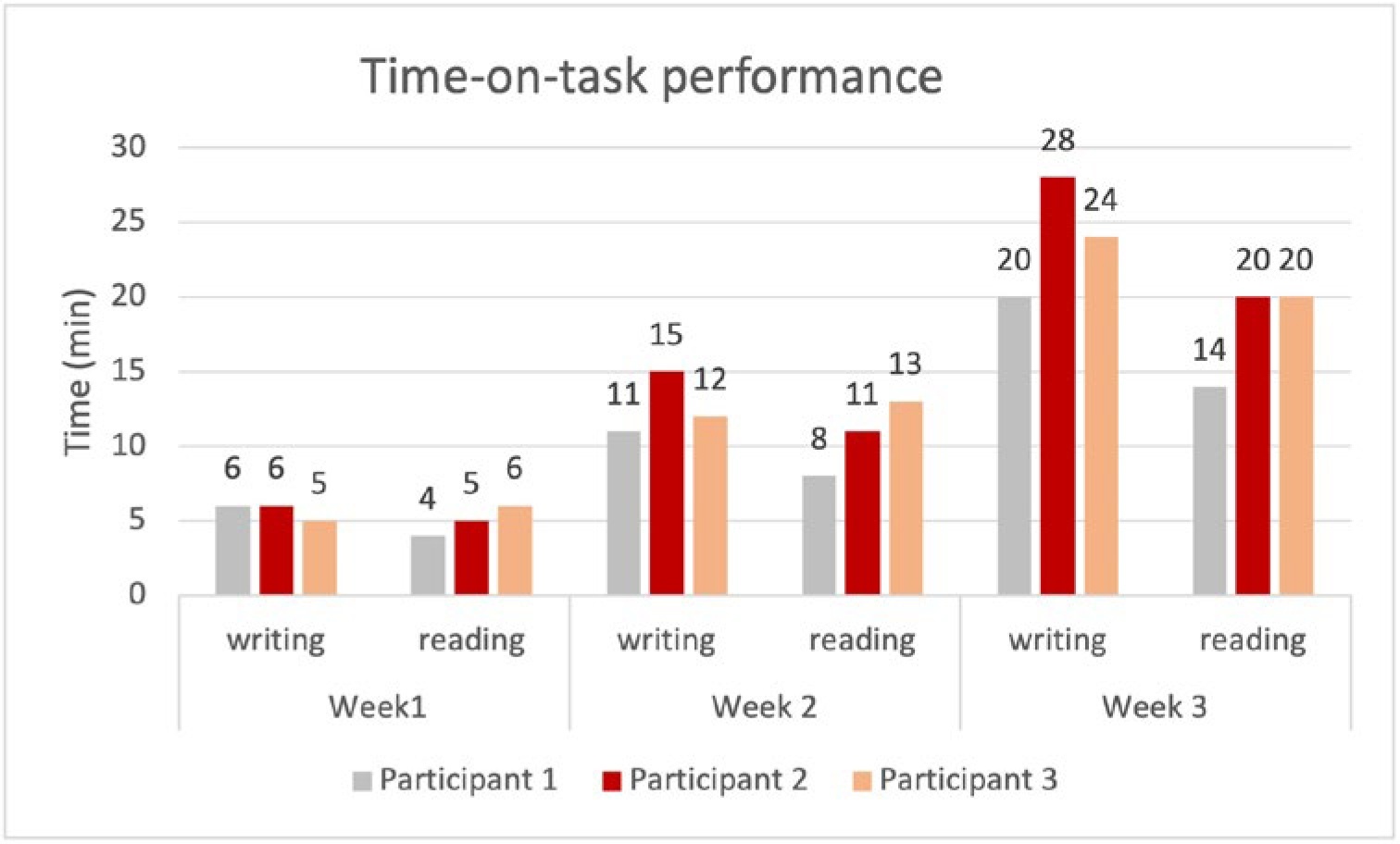
Figure 3
Time-on-task performance
Discussion
Sensory gardens within the home boundaries allow children to break a monotonous, daily, indoor routine and offer opportunities to spend time in outdoor active play. Interaction with children with disabilities in a comfortable play setting is also beneficial for family members. Using elements of the present study, it suggests that underutilized, outdoor places in the home can be transformed into a child-friendly, enriched play environment. The findings of this study support home-based SGs as a practical intervention tool to promote outdoor active play and a facilitatory tool for indoor, time-on-task participation with ease.
From the mothers’ daily recordings, it was noted that all the mothers were thrilled and excited to watch their children engage in various SG play activities on their own. Children spent maximum time at the sensory garden feature that afforded more than one sensory experience. For example, in one of the sites, logs afforded multiple uses such as climbing, balancing, stacking, tent-making, and clearing the waste. In another site the recycled trye area allowed the child to sit, stand, climb, balance, jump, push, pull, and unwind by laying down. Children chose to engage with these sensory features as they participated in a range of activities. The pebbled water area in the other site allowed the child to play, water the plants, and count and sort according to size and colour. Regardless of the size of the sensory gardens at various sites, participants attended and spent more time in the sections that offered better affordances. This concurred with the Hussein study which showed that the sensory garden used for special needs children enable greater functioning of the attributes, engaging the users to spend a longer time, but was not dependent on the size of the zone.21 The fixed and loose environmental features on the site such as logs, tyres, fence, etc. promoted physical play similar to previous studies.23,24 Two mothers expressed that SG play improved sibling interaction and shared play. The areas that offered varied affordances were the areas that promoted higher sibling play interactive zones. The fun activities afforded interaction and playing together or playing alongside. The healthy siblings expressed SG to be a place to explore and a better place to relax at the door step. Research supports that very often healthy siblings of children with disabilities experience psychological distress.25 All the children, those with ADHD and healthy siblings, looked forward to SG play every day. Furthermore, one of the interesting findings from this study was that participants improved the amount of time spent doing homework and amount of homework completion with ease, otherwise a source of mother-child conflict. Also, it has been shown to influence minimal improvements in on-task behaviours in the classroom. Interestingly, SG was used as a reinforcement strategy for completion of homework and household activities.
From the clinician’s observation and recordings, it was noted that the three participants performed with less distractions and completed varied indoor activities at the clinic. The children were relatively calmer and faster completing indoor tasks while enjoying them. Improved time-on-task performance may be attributed to exposure to natural elements in natural settings, home based sensory garden in this case, that may have de-stressed the child. Moreover, indoor monotonous stimulation can be a source of stress, in contrast to outdoor, multi-sensory experiences through diverse play engagement that enhanced participants’ alertness in task performance. In addition to affordance theory, the Attention Restoration Theory (ART) and the Stress Recovery Theory (SRT), two evidence-based, complementary theories on nature-based environments, state that nature-based-environments are more restorative than non-nature-based environments. SRT relieves psychological and behavioural damage caused by stressors whereas ART restores mental fatigue. In this way, nature-based environments contribute to improved performance.26-28 Activity involvement and participation is dependent on the child’s relaxed state. Only when a child is relaxed is performance at its best.29 The theoretical framework application holds significance not only in theory but also in practice in residential, outdoor, environmental settings.
This research has raised some valuable points concerning sensory gardens. Cost effective SGs could be created in home settings with professional guidance. Benefits of SG were also extended to mothers to relax and healthy siblings to engage in shared play. The mother’s journal provided insight into her perception of the child’s progress in the broader context of home, school, and rehabilitation clinic.
This was a pilot study based on a 3-subject, case study approach; hence, it does not yield results which are generalizable. Future pragmatic studies should include larger sample size and pre/post-test design with comparison groups and controlled variables. In addition, teacher assessments could provide an additional comprehensive, classroom evaluation. Finally, not enough objective measures were considered to ensure efficacy of this intervention. Yet, the current work provides preliminary evidence of the efficacy of sensory garden as a new approach to therapeutic mediation through outdoor, active play in home environments.
Conclusion
This study has shed light on the importance of home-based sensory play spaces showcasing their potential to facilitate adherence to intervention, time-on-task performance, active play, shared sibling play, mother-child interaction, and school performance. The sensory features that provided multiple affordances were the most active shared sibling play zones. Encouraging children to choose their play elements while designing prompts higher levels of play participation. Since there are no precise guidelines for the design of sensory gardens as play spaces, design often reflects the need of the user and designer’s perspective.
Funding
None
Competing Interests
None declared.