
Introduction
Children living outside of family care are a vulnerable group.1 Institutional care is defined as “residential care provided in a safe and protected environment which has been mandated by a competent administrative body or judicial authority.”2 Play is a fundamental right, ensuring health for all children and leaving no one behind.3 The Position Statement on Active Outdoor Play states, “Access to active play in nature and outdoors—with its risks— is essential for healthy child development,” and recommends outdoor, self-directed, play opportunities for children in all contexts, including the neighbourhood, home, school, child care centres, and natural setting.4 Quantity of time spent engaging in activities of outdoors is termed as outdoor play time.5 Young people engage in both outdoor organized sports and self-organized play. Organized sports have some form of structure and is coordinated by adults. On the other hand, self-organized play or free play is less structured and usually is coordinated by young people themselves.6 Playing develops key skills across wide developmental domains: physical (gross and fine motor skills), social, cognitive, and emotional.7
The literature suggests that using hands is fundamental to interact with the environment for an individual’s healthy development.8 Fine motor skills are the ability to make precise hand and finger movements for task execution of various everyday activities, ranging from writing and drawing to participating in sports and carrying out various household chores.9,10 Fine motor skills heavily rely on hand dexterity and hand grip strength. During school age, deficiencies in these hand functional skills may impact daily activities, neurological development, physical activity performance, and academic achievement of children.9,10 Based on this evidence, the importance of exploring hand grip strength and manual dexterity during school age is crucial.
Hand Grip Strength (HGS) refers to the maximal force generated by contracting the intrinsic and extrinsic hand muscles, which move hand joints to flexion.11 HGS is considered a predominant factor to optimise performance and control, as it is necessary for sports participation.12 Hand motor dexterity is the ability to manipulate objects through coordination of hands and fingers in a timely manner.13 Dexterity is a key skill in motor development and indicates a well-developed, neuromuscular function.14 Skills of dexterity can be assessed with tasks that require one hand/unimanual (e.g., pencil grasp) or the tasks that require coordinated activity of both hands/bimanual (e.g., knitting). These developmental skills are influenced by environmental stimuli, play experiences, and proximate settings in which the children live and grow. Hence, the main objective of this study was to compare hand grip strength and hand motor dexterity skills among children living in 3 different residential institutions. We use the term “children home,” preferred term by the administrators of the institutions as an alternative to “orphanage” from here.
Materials and Methods
Study design
This research is a comparative crosssectional study in which hand grip strength and manual dexterity was assessed. Residential care children 10-12 years of age from the three registered children homes in Chennai were sampled by enrolling the first 20 boys who arrived at the assessment room on the study day. Firstly, the procedure and purpose of the study were explained to the home administrators and home supervisors. Following the accession of the residential home, the study was presented to the children. Because of the participants’ ages, consent was obtained from the supervisors and assent was obtained from the children themselves. The research was approved by ethics committee of SRMIST-School of Public Health.
Participants
A total of sixty boys (10-12 years) (N=60, mean age: 11.20±0.66 years; height: 139.87±5.97 cm; weight: 33.94±7.03kg; BMI:17.23± 2.77 kg/m2) from three children’s homes were recruited: double orphan (a child who lost both the parents), single orphan (a child who lost one parent), or social orphan (a child with one or both living parents but has been left in the institution as they cannot care for the child due to poverty, sickness, or drug or alcohol addiction). Orphan status was obtained from the home supervisor. All the subjects were physically normal and were not suffering from any chronic diseases at the time of collection of data. Subjects with less than 6 months residency in children’s home, presence of any sickness, history of upper limb injuries within six months, physical disability, or cognitive impairments were excluded.
Study procedure
Data collection took place in each children home premises and was carried out by the same investigator. A semi-structured questionnaire was designed to collect information related to sociodemographic data, relevant variables of the children containing outdoor play frequency, outdoor playing time, and participation in outdoor activities. Height, weight, and dominant upper limb was obtained. Thereafter, grip strength (right and left), box and block (right and left), and Purdue peg board test (right, left, and both) were administered, sequentially. All the subjects received standardized instructions and a trial before each test. Dominant hand followed by non-dominant hand was tested on the same day in the same room. All the data was collected using the same test equipment. A rest period of 5 minutes was ensured between each category of test administered.
Examination
Body weight and height Standing Height was recorded using stadiometer and Omron HBF 214 body composition monitor was used to measure body weight. Body Mass Index (BMI) was calculated as weight in kilograms divided by the square of the height in meters (kg/m2).
Hand dominance Dominant hand was determined by asking the participants to write their name on paper.15
Hand grip strength HGS was measured in kilograms (kg) using CAMRY electronic dynamometer (Model EH101). The following measuring procedures were implemented: 1) participants stay seated; 2) flex their elbows to a 90-degree angle; 3) grasp the dynamometer first the right and then the left; 4) hold and squeeze the dynamometer for 3 to 5 s, thrice, as hard as they could with a one-minute break in between measures; 5) participants received verbal encouragement on each effort; 6) The force in kg of the maximal effort, the highest measurement on each side, was the measurement in this study.16
Hand dexterity
The Box & Block Test (BBT) measures gross hand manual dexterity. The participants were asked to transfer 1 inch cube blocks from one compartment of the box having 150 cubes to another compartment. The total number of blocks moved in 60 seconds was the outcome score of the test of each hand.17
The Purdue peg board test (PPT) measures fine manual dexterity and bimanual coordination that largely relies on coordination of eye -hand and motor speed. It consists of a long board with 2 vertically aligned 25 holes in series. The test has four subtests. First two subtests (subtest 1- right/preferred hand and subtest 2-left/less preferred hand) are unimanual tasks. The participants were asked to take one pin at a time and insert into the holes correctly as fast as possible within a time limit of 30s. Incorrectly placed pegs were excluded from scoring. The next two subtests are bimanual tasks (subtest 3- both hands, subtest 4-assembly). For subtest 3, the participants were asked to simultaneously insert pins with both hands within 30s. The assembly test included building small assemblies which involved pins, collars, and washers with both hands simultaneously over a 1-minute time period. The Purdue Pegboard has shown good reliability (correlations range from .60 to .91) and validity (coefficients for 14 studies range from .07 to .76).18
Semi structured questionnaire
Outdoor play frequency Children responded to the question “Think about the past 1 month. On average, how often did you play outside such as playing games or sports at your children’s home? On a 5-point scale:1= “never;” 2= “one day per week;” 3= “2-3 days per week;” 4= “4-6 days per week;” 5= “daily.” Based on WHO recommendations that children must play outdoors on a daily/everyday basis, the responses were dichotomized into “daily outdoor play” and “less than daily outdoor play.”19
Outdoor play time Children responded to the question “Think about last week. On average, in a day, how much time did you play outside such as games/sports at your children’s home? The boys answered by selecting one time slot among three gradational options ranging from none to more than one hour with intervals of half an hour. On a 3-point scale:1= “less than ½ hour;” 2= ½ hour to 1 hour;” 3= “more than 1 hour.” Based on WHO recommendations, children and adolescents aged under 18 years must spend playing outdoors for 60 minutes per day. Hence, the responses were dichotomized into outdoor play time at least 60 minutes per day “Yes” and “No.”20
Activity participation during scheduled outdoor play time Children responded to the question: On average how did they spend the time outdoors? Generally, physical activities(PA) can be divided into two categories: unstructured PA or free play (informal child-initiated physically active play) and structured or organized PA (deliberate engagement in sports games under supervision). The boys answered by marking one slot among six options such as prefer to spend in free play of one’s choice such as run and catch or tag; team sports with rules such as volley ball, basketball, cricket; mixed included both free play & sports; play with park equipment; hang out with friends and chit chat; prefer to stay indoors. Participation in free play and team sports exclusively indicates engagement in a single kind of activity. Hence, for analysis, the responses were grouped under participation in only one activity type. Outdoor play in this study was defined as any time that children were outside playing, including free play/unstructured activity and organised sport/structured activity.
Statistical Analysis
Data are expressed as means and standard deviations. Differences between groups was determined by One-way ANOVA. Post-hoc tests with Bonferroni correction were implemented when the differences between groups were significant after the one-way ANOVA. A difference was considered to be statistically significant if the P-value was <0.05. All the collected data was analysed with statistical package of social sciences (SPSS,16).
Results
Sixty boys from three institutions participated. Characteristics of children and children’s homes are presented in Table 1. Summary of hand strength and hand dexterity skills of the participants is shown in Table 2. Of the 60 children participating, there were those in home1 (n=20, mean age=11.05± 0.70 years), home2 (n=20, mean age=11.75±0.57 years), and home3 (n=20, mean age=11.15± 0.58 years). Overall, 9 boys (15%) were 10 years old, 31(52%) were 11 years and 20 (33%) were 12 years of age. More than half of the participants, 38(63%), were staying in respective institutions for a period less than 5 years. Based on orphan status, majority 35(58%) were single orphans followed by social orphans,18(30%) and least were double orphans,7(12%) (Table 1).
Table 1
Characteristics of boys and children’s homes (N=60)
| Home1 | Home2 | Home3 | Total | |
|---|---|---|---|---|
| Number of study participants | n=20 | n=20 | n=20 | N=60 |
| Average age of participants, years (SD) F(p-value) | 11.05 ± 0.70 | 11.75 ± 0.57 | 11.15 ± 0.58 | 11.20± 0.66 1.021(0.366) |
| Height(cm) F(p-value) | 140.77±5.5 | 138.8 ± 6.4 | 140.05±6.09 | 139.87±5.97 0.551(0.579) |
| Weight(kg) F(p-value) | 34.52± 7.43 | 33.79 ± 7.38 | 33.51 ±6.57 | 33.94±7.03 0.105(0.900) |
| BMI (kg/m2) F(p-value) | 17.29 ± 2.91 | 17.43 ± 3.03 | 16.98 ±2.45 | 17.23±2.77 0.137(0.871) |
| Participants age category, years N(%) | ||||
| 10 | 5 (25) | 1 (5) | 3 (15) | 9 (15) |
| 11 | 9 (45) | 11 (55) | 11(55) | 31 (52) |
| 12 | 6 (30) | 8 (40) | 6 (30) | 20 (33) |
| Average duration of stay, years (SD) | 4.35 ± 1.59 | 3.90 ± 1.51 | 4.55 ± 2.01 | 4.26 ± 1.71 |
| Participants length of stay category, years N(%) | ||||
| < 5 years | 13(65) | 14(70) | 11(55) | 38(63) |
| > 5 years | 7 (35) | 6 (30) | 9 (45) | 22(37) |
| Participants orphan status N(%) | ||||
| Double orphan | 2 (10) | 3 (15) | 2 (10) | 7(12) |
| Single orphan | 12(60) | 10(50) | 13(65) | 35(58) |
| Social orphan | 6 (30) | 7 (35) | 5 (25) | 18(30) |
| Outdoor play area sufficient for all activities, including running (by warden report)? (Y/N) | Y | Y | Y | |
| Outdoor demarcated sport area? (volley ball, basketball) (Y/N) | N | N | Y | |
| Indoor board games | Y | Y | Y | |
| Fixed Park equipment | Y | Y | N | |
| Child discretion allowed in choosing outdoors or indoors? (Y/N) | Y | Y | N | |
| Outdoor play frequency N(%) | ||||
| Daily | 0(0) | 2(10) | 20(100) | 22(37) |
| Less than daily | 20(100) | 18(90) | 0(0) | 38(63) |
| Outdoor play time at least 60 min/day | ||||
| Yes | 2(0) | 4(20) | 20(100) | 26(43) |
| No | 18(90) | 16(80) | 0(0) | 34(57) |
| Time spent playing outdoors/day N(%) | ||||
| T≤ ½ hour | 17(85) | 13(65) | 0(0) | 30(50) |
| ½ hour < T ≤ 1 hour | 3(15) | 7(35) | 18(90) | 28(47) |
| T > 1 hour | 0(0) | 0(0) | 2(10) | 2 (3) |
| Activity participation during scheduled outdoor play time N(%) | ||||
| Only one activity type (free play/ team sports) | 9(45) 8(40)/1(5) | 12(60) 9(45)/3(15) | 9(45) 4(20)/5(25) | 30(50) 21(35)/9(15) |
| Mixed | 1(5) | 4(20) | 11(55) | 16(27) |
| Play on fixed equipment | 3(15) | 1(5) | 0(0) | 4(7) |
| Sedentary (hang out with friends) | 2(10) | 0 (0) | 0(0) | 2(3) |
| Stay indoors | 5(25) | 3(15) | 0(0) | 8(13) |
[i] Note. Values are presented as mean standard deviation or number (%). BMI, body mass index
Table 2
Hand grip strength and hand dexterity (gross motor & fine motor) of boys across three children’s homes
| Home1 | Home2 | Home3 | F (P value) | ||
|---|---|---|---|---|---|
| Hand Grip Strength | DHGS | 15.35 ± 1.86 | 15.70 ± 1.46 | 16.72 ± 1.10a, b | 4.572 (0.014)* |
| NDHGS | 13.89 ± 2.05 | 14.80 ± 1.67 | 15.95 ± 0.85a, b | 8.313 (<0.001)** | |
| Gross hand manual dexterity | BBT-R | 53.35 ± 7.37 | 58.20 ± 4.94 | 61.05 ± 6.27a, b | 7.683 (0.0011)* |
| BBT-L | 48.45 ± 7.47 | 53.60 ± 5.95 | 59.00 ± 6.71a, b | 12.232 (<0.001)** | |
| Fine hand manual dexterity | PPT-R | 12.50 ± 1.73 | 13.05 ± 2.35 | 14.75 ± 1.80a, b | 7.011 (0.0018)* |
| PPT-L | 11.50 ± 1.14 | 12.01 ± 0.91 | 13.25 ± 2.11a, b | 10.070 (<0.001)** | |
| PPT-B | 15.00 ± 2.71 | 18.60 ± 3.11a | 22.05 ± 3.17a, b | 27.469 (<0.001)** | |
| PPT-A | 8.05 ± 2.60 | 9.95 ± 2.13a | 11.40 ± 1.72a, b | 29.088 (<0.001)** | |
Notes. Values are presented as mean standard ± deviation.
DHGS, dominant hand grip strength: NDHGS, non-dominant hand grip strength; BBT, box and block test; PPT, Purdue peg board test; L, left hand; R, right hand; B, both hands; A, assembly task
Differences in hand grip strength of children across the children homes Home1, home 2 & home 3 showed significant differences in grip strength scores in both right/dominant hand (F= 4.57, df=2,57, p<0.05) and left/nondominant hand, (F= 12.23, df=2,57, p<0.001) respectively. The post hoc pair-wise comparison revealed that boys of home 3 had stronger grip in both the hands when compared to the boys of home1 and home2 (Table2).
Differences in gross and fine hand motor dexterity of children across the children homes Gross motor dexterity as measured by box & block test showed a significant difference in means of right hand (F= 7.68, df=2,57, p<0.05) and left hand (F= 12.23, df=2,57, p<0.001) between the three homes. Differences for groups revealed that boys in home 3 were much faster in performance by both right and left hands than boys of home1 and home 2. Moreover, boys of home 1 performed worse than boys of other 2 groups (Table 2).
Fine motor dexterity scores as measured by the four subtests of Purdue pegboard task, namely right hand (F= 7.01, df=2,57, p<0.05), left hand (F= 10.07, df=2,57, p<0.001), both hands (F= 27.46, df=2,57, p<0.001), and assembly (F= 29.08, df=2,57, p<0.001) revealed a significant difference in means between the three homes. Pair wise comparison showed that boys in home 3 had a quicker performance in all the unimanual and bimanual tasks of fine motor dexterity than boys of home 1 and home 2. Out of the three homes, home 1 had lower performance than other two groups in all the subtests (Table 2).
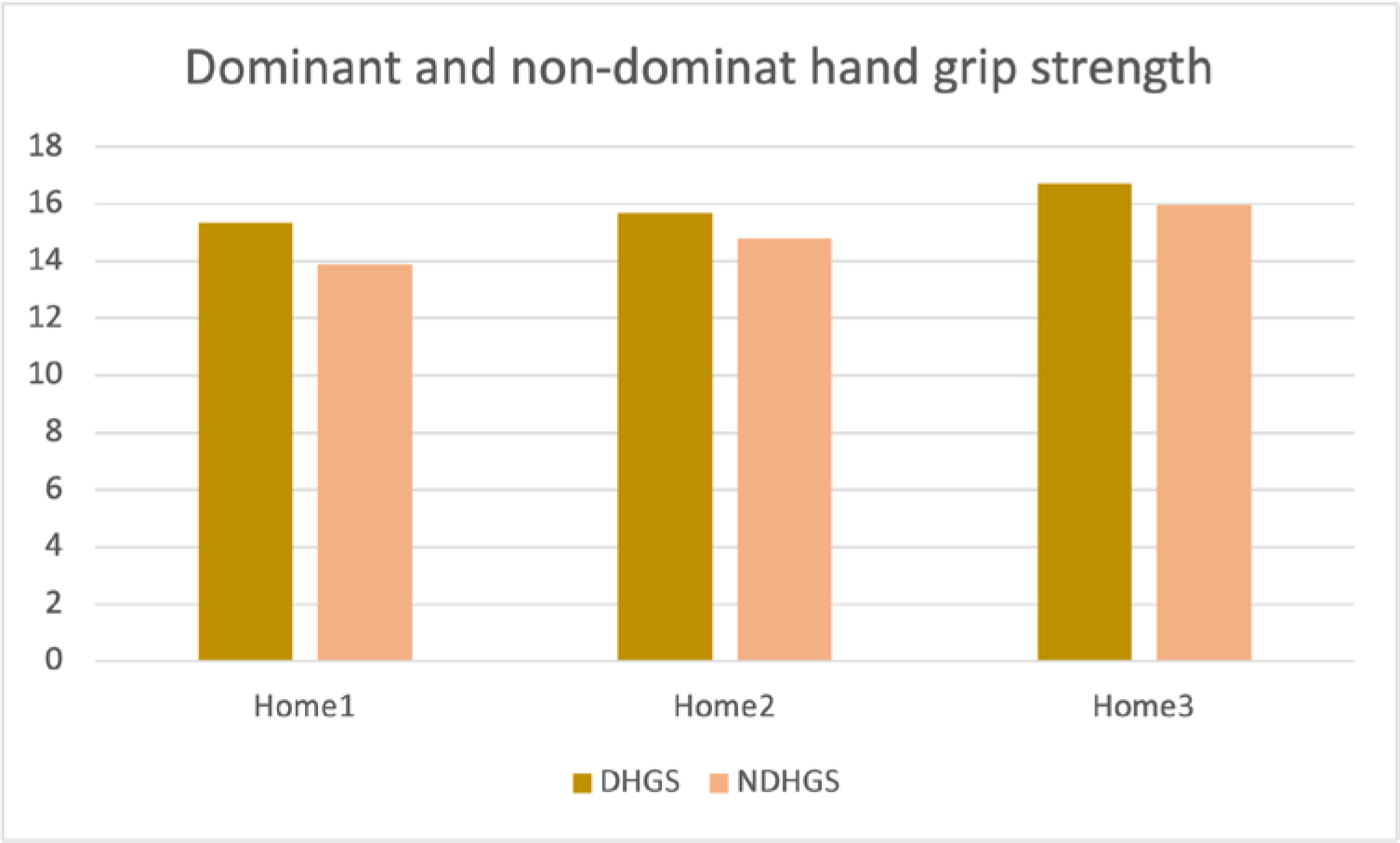
Figure 1
Comparison of hand grip strength
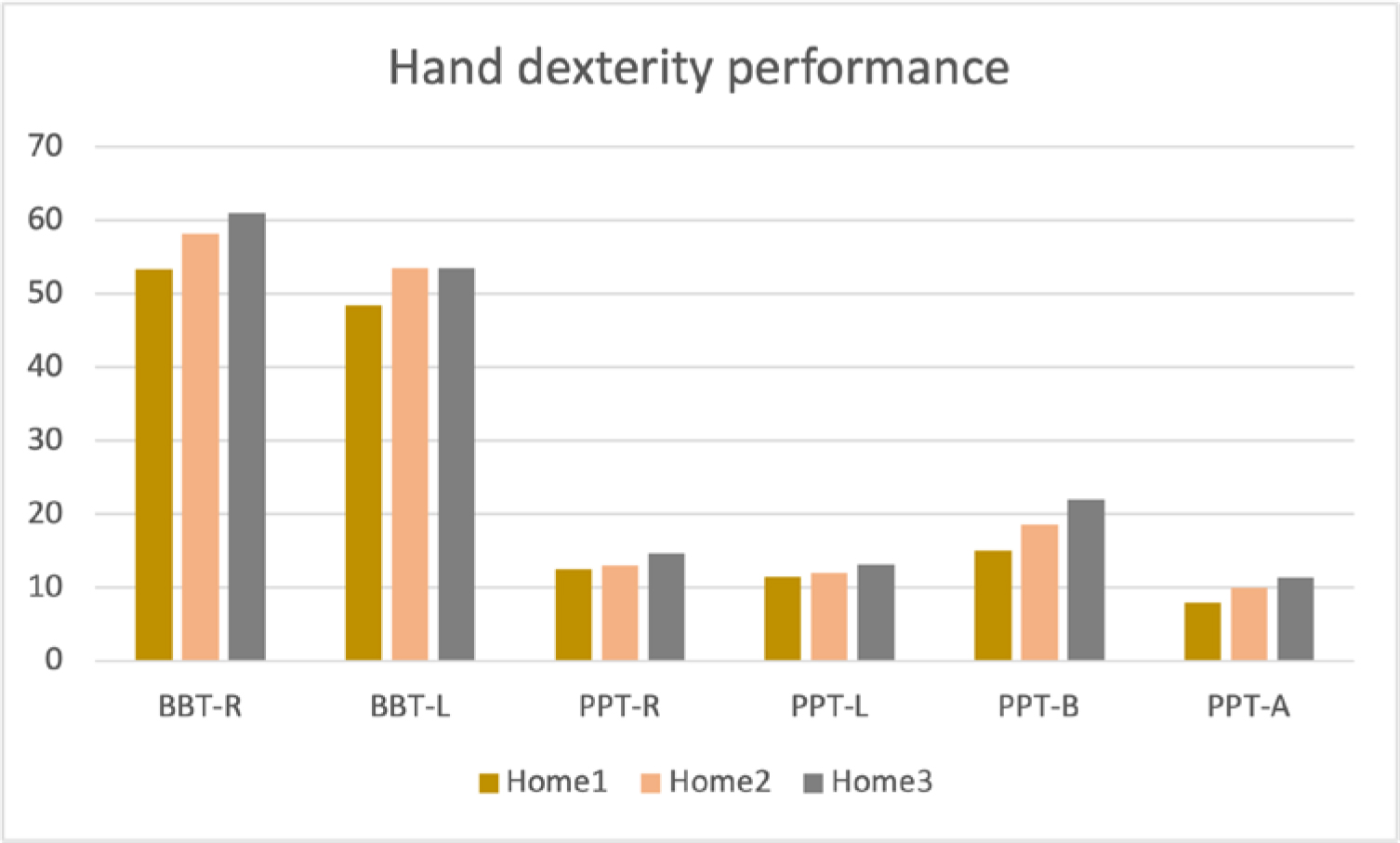
Figure 2
Comparison of hand dexterity test performance
Discussion
The purpose of this study was to analyse the differences in hand strength and hand dexterity skills in 10–12-year-old boys residing in 3 different children’s homes. Based on one way ANOVA and pair wise comparison, it was found that there were significant differences between the groups of boys residing in 3 different residential care facilities. The main findings of this study suggest that boys of home 3 outperformed in dexterity skills, both gross (BBT) and fine (PBT), with strong grip bilaterally than their counterparts residing in home 1 and home 2. On the other hand, boys of home 1 had least skill performance in motor dexterity (both gross and fine) and weaker grip strength of all. The variations in the outcomes may be explained by the outdoor play experiences the boys had at their residential care setting, including frequency & duration of their outdoor play and type of outdoor activities they were engaged at their institutions.
Participation in sports positively influence all the bodily systems—motor, cardiovascular, respiratory, hormonal, immunological, and nervous. Thus, it stimulates brain’s motor regions, enhancing child’s motor skills and overall development.20-26 Play needs to be age appropriate, keeping in mind that the peak age range for sports involvement is between 10 and 14 years of age.27 Children 12 years and under who participate in sports for more than 3 hours per week outperform in motor performance than children who have less than 3-hour, sport participation.28 Participation in a variety of unstructured and structured activities promote motor skills.29
Daily outdoor play for at least 60 minutes All the boys (100%) from home 3 have engaged in minimum daily, 60-minute, outdoor playtime within their children’s home following school hours. WHO recommends that children and adolescents aged under 18 years spend 60 minutes playing outdoors.30,31 Besides being outdoors daily, all the boys of home 3 participated in free play and structured sports such as volley ball and cricket. Being and doing in the outdoors adds extra motor skill efficiency. Children experience well known physical, social, emotional, and cognitive benefits with regular participation in recommended amounts of active play.32-34
Unlike the boys from the other two homes, home 3 did not allow child discretion; thus, all the boys stepped outdoors and eventually engaged in play activities. As a result, every boy from home 3 spent the designated outdoor playtime outside, daily engaging in sports and games involving moderate to intense physical activity. This may have contributed towards a stronger grip and quicker skills of dexterity in the boys from home 3. In contrast, boys from home 1 and home 2 were allowed discretion to stay indoors or play outdoors. One-fourth of the boys from 1st home and one-sixth from 2nd home preferred to remain indoors. Hence, all the boys of home 1 (100%) and 90% from home 2 lagged in recommended daily outdoor activity participation. Compared to children from home 3, who engaged in outdoor active games and sports for at least 60 minutes per day, children from homes1 and 2 exhibited weaker grip strength and slower dexterity skills. Evidence supports children who spend playing outdoors less often have fewer opportunities to reap the many benefits from outdoor play4 and moderate-to vigorous physical activity32 than those who choose to play outdoors frequently. It is a concern to note when the duration and frequency to spend at outdoor declines, then subsequent chance for participation in active games lessens. In general, children engage in more physical activity while they are outdoors as opposed to indoors.
Mixed physical activity is an optimal approach. Physical activity is highly crucial during childhood, especially in late childhood.35 N.Wiium and R. Säfvenbom36 reported that a combination of different activities seemed more developmentally beneficial than only one activity. Moreover, a combination of activities could be the optimal approach to achieve efficient motor skills.37 Against this background, a majority (55%) of boys from home 3 participated in regular mixed physical activities, a combination of both structured sports and unstructured free play. These boys had stronger grips, faster manipulative skills in unimanual and bimanual tasks and better bimanual coordination and fine motor as was evident in PPT-bimanual-assembly task performance. The mix of activities possibly encouraged children of home 3 to stay more active throughout the whole 60-minute outdoor session. On the other hand, boys from homes 1 (45%) and 2 (60%) preferred single type activity over mixed activities. Free play was more favoured than team sports. Home 2 boys had better fine motor bimanual dexterity performance than home 1 boys as majority (80%) engaged in active play outdoors. Home 1 boys (5%) participated the least in combined free play with sports.
Despite these insights, results must be interpreted with caution as this study did not take into account other variables such as school environmental factors (e.g., frequency & duration of outdoor playtime and type of play activities) and social factors (e.g., having friends).
Conclusion
Children who spend time daily in outdoor play outperform those who do not. Furthermore, engaging in combined activities of free play and sport games better assists manual dexterity and grip strength than only one activity type. In particular, team sport participation best promotes the development of fine motor coordination, bilateral coordination, and manual dexterity. Children are more active and play more when they are outdoors. Therefore, the residential care environment should encourage regular physical activity. The best approach will be one that involves both sport participation and free play without child discretion, encouraging all children to step out and engage in mixed activities to enhance motor skill efficiency in late childhood.
Acknowledgement
We appreciate and thank the children home administrators, staff, and children who supported and participated in this study.
Funding
The authors received no financial support for this article.
Conflicts of interest
No potential conflict of interest.