
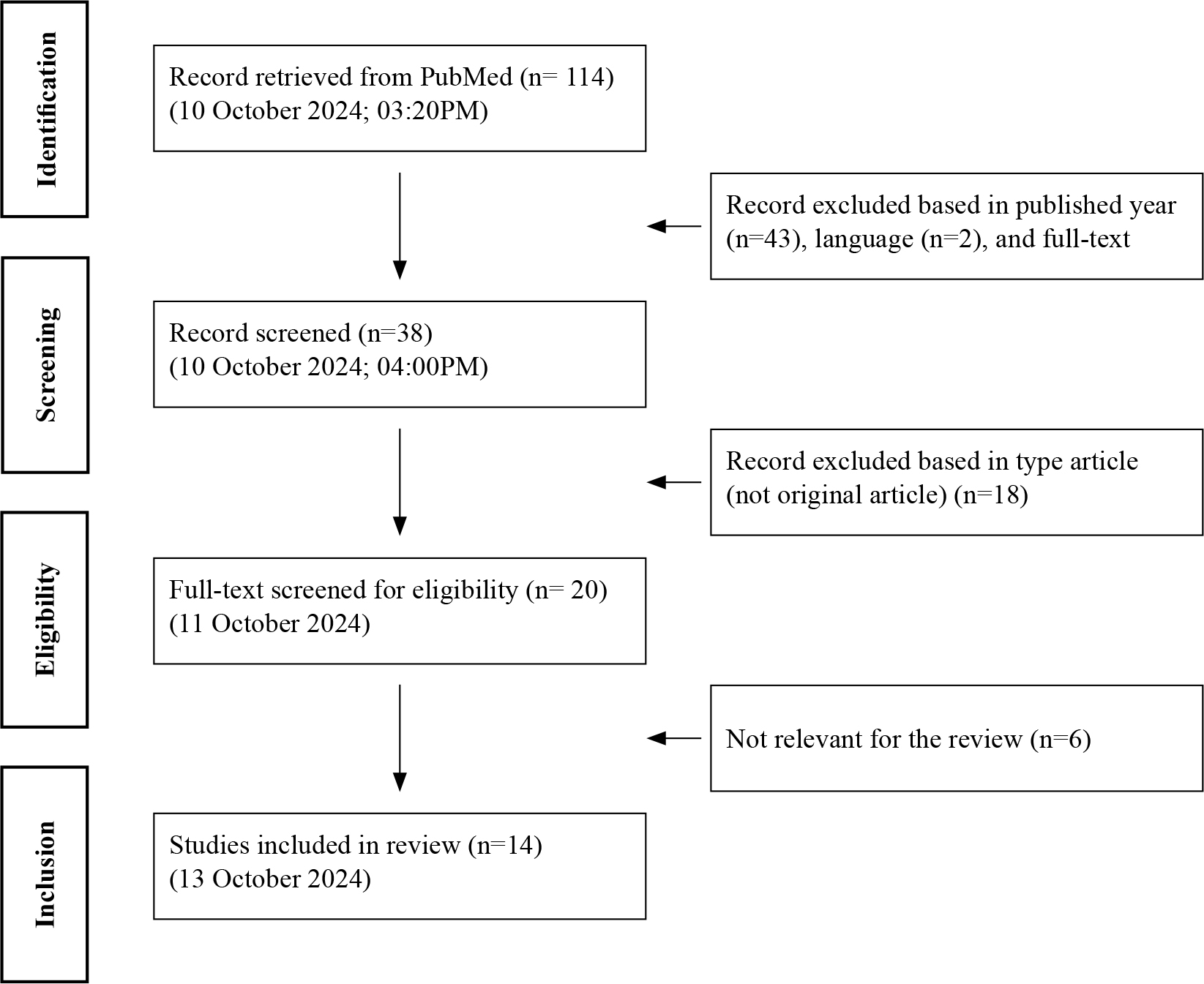
Figure 1
Study selection process
Table 1
Challenges and Recommendations for Privacy and Data Confidentiality in Telemedicine Services
| Topics | Challenges | Recommendations |
|---|---|---|
| Privacy | The system is not integrated, and national telemedicine standards are lacking.17 | Establish national standards for telemedicine to ensure patient privacy.17,18 |
| Regular evaluations are needed to maintain service quality.17 | ||
| Patients express concerns that privacy is not guaranteed during consultations.17–19 | Obtain informed consent before telehealth sessions to address patient concerns regarding privacy and data handling.20–22 | |
| Healthcare providers may lack adequate preparation for telemedicine, impacting privacy assurance.17,19 | Provide training for healthcare providers on telemedicine procedures to uphold patient privacy.17,18,23 | |
| Patients worry that consultations may not be private, with the possibility of being overheard or seen by others.19 | Identify all individuals present with both the patient and physician during consultations, maintaining their presence only with patient consent.18,19 | |
| There may be a third party around the patient who is not visible on the screen but can hear the consultation.19 | Physicians should inquire about any accompanying individuals and obtain permission before discussing sensitive information.19,20 | |
| Sensitive health information may be unintentionally disclosed.24 | Adjust communication to match each patient's comfort level with sharing personal information.24 | |
| Confidentiality | Patients worry about the confidentiality of their data in telemedicine.18,19,25 | Establish national standards for telemedicine with a strong focus on data confidentiality.17,18 |
| Ensure practitioners are informed and committed to upholding confidentiality standards throughout the process.18 | ||
| Encourage the use of anonymous health records where appropriate to enhance confiden-tiality.20,25 | ||
| Physicians should take reasonable steps to ensure confidentiality and inform patients of any identifiable risks.22 | ||
| Physicians should assess data security and confidentiality before collaborating with third parties or using cloud storage.22 | Inform patients that confidentiality measures are in place to protect their data throughout the telemedicine process.10,22 | |
| Ethical standards should be upheld by industry developers creating telemedicine applications.23 | Developers should prioritize ethical standards to protect data confidentiality.23 | |
| Electronic prescriptions must remain confidential.18 | Use secure electronic signatures and passwords to protect the confidentiality of prescriptions.18,26 | |
| Telemonitoring devices may contain malware that threatens patient data.27 | Implement certification processes to secure data in electronic health records (EHR).28,29 |