
Introduction
Telemedicine is the provision of medical care and general health services remotely through telephone, video conference, or messaging. This practice has been in use for decades, with growing evidence showing its potential to improve patient care quality, reduce hospital readmissions, and increase cost savings for both patients and providers.1 The COVID-19 pandemic significantly increased the use of telemedicine and telehealth services. Advancements in telemedicine should complement existing healthcare practices, aiming to enhance areas that may not be fully optimized rather than completely digitizing the healthcare system.2
Telemedicine’s ability to provide care while encouraging social distancing to reduce disease spread has prompted considerable adjustments by stakeholders. Initial data from outpatient practices indicate that telemedicine visits have increased, although not sufficiently to compensate for the decrease in in-person visits.3 Advancing technologies enable patients to receive care remotely via telemedicine applications, providing opportunities for those who are homebound, reside in rural or underserved areas, or face other barriers to accessing care.4 Additionally, new technologies allow patients with rare medical conditions to consult distant specialists, making telemedicine a convenient option even for those with access to in-person care.5,6
In the present context, healthcare surveillance is essential for maintaining the quality of care. The integration of digital, health tracking technologies and services has facilitated the development of smart connectivity systems. These advancements enable direct patient management through simple video conferencing, providing greater insight into patient conditions. The doctor's catalogue saves time for both patients and healthcare providers, enhancing the precision of treatment procedures. The appointment scheduling feature keeps doctors updated on their schedules, allowing them to review requests and patient profiles before consultations. This system displays the patient queue and enables patient profiling filters, allowing doctors to reschedule appointments easily in emergencies.7
Telemedicine has proven very useful in disadvantaged communities that lack adequate clinical services, such as isolated areas. Referring patients to specialist doctors has become a common practice to utilize technology to spread knowledge about specialists to needy patients.8–10 However, the progressive adoption of telemedicine raises new legal, ethical, and regulatory issues, significantly impacting healthcare policies.11 Telemedicine data, including patient information and video consultations, are securely stored in cloud-based medical records, ensuring data protection. Medical records can be easily shared with specialists or caregivers for insurance purposes. Patients can discuss their symptoms with doctors via teleconference with photographs and video consultations replacing in-person evaluations.12,13
Despite the many advantages of telemedicine, the ethical concerns around privacy and confidentiality remain critical.14–16 Telemedicine applications rely on cloud technologies for storing and sharing sensitive patient data, making privacy protections paramount. The potential for unauthorized access to personal health information, especially in telemedicine environments where data is transmitted through public or insecure networks, necessitates a strong focus on workflow adjustments to enhance security and safeguard patient confidentiality.1
Given these challenges, it is essential to consider the ethical implications related to privacy within telemedicine workflows. Ensuring that patients' data remains secure during consultations and that their consent is fully informed is crucial. Healthcare providers must ensure that they adhere to privacy laws and implement best practices for maintaining confidentiality during telemedicine interactions.4 This involves proper handling of data, securing patient information through encryption, and ensuring that patients are fully aware of the risks and protocols in place to protect their privacy. Additionally, workflow considerations like informed consent processes, appropriate platform selection, and secure communication methods must be prioritized to maintain ethical standards in telemedicine practices.5
This literature review will specifically focus on the workflow processes related to privacy and confidentiality in telemedicine and provide recommendations for improving these processes. It aims to ensure that these critical concerns are effectively managed as telemedicine becomes increasingly integrated into healthcare systems.
Method
This article is a literature review that searched for relevant articles using the PubMed database with the keywords: Telemedicine AND Ethics AND Confidentiality AND Privacy. The search was conducted on October 10, 2024, at 3:20 PM. The inclusion criteria were articles published in English, available as free full-text, and published within the last ten years (2015-2024). Articles were excluded if they were not original articles and irrelevant to the review, such as those focused on animal studies (n=1), interventions related to health applications (n=2), or telemedicine not directly involving doctor-patient consultation—such as technology used for health research (n=1), interventions or promotions involving technology (n=1), or evaluations of internet-based population health initiatives (n=1). The article search process is illustrated in Figure 1 below.
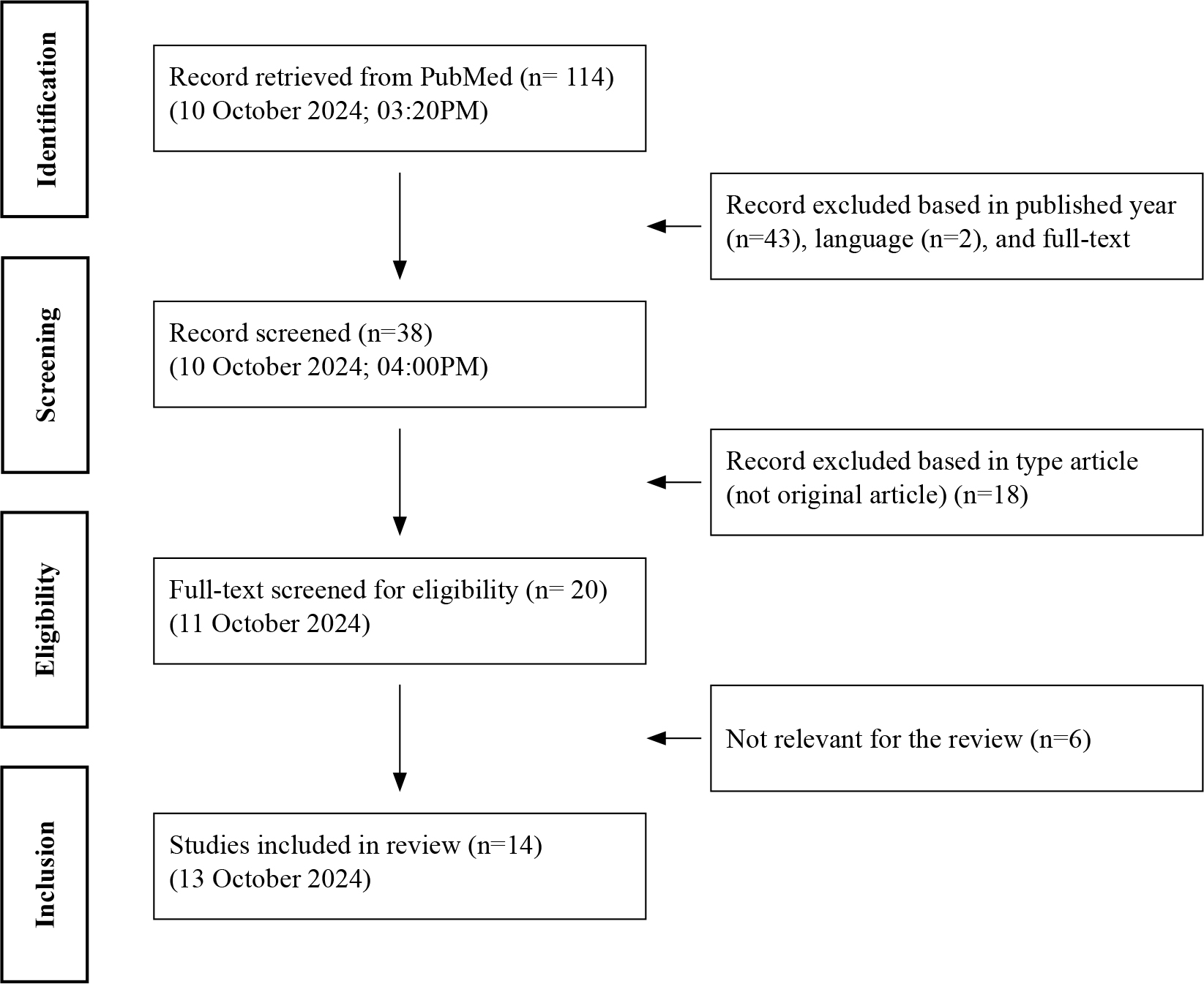
Figure 1
Study selection process
Results
A search of the PubMed database identified fourteen relevant articles that met the established inclusion criteria. The summarized findings from this literature review are presented in Table 1 below.
Table 1
Challenges and Recommendations for Privacy and Data Confidentiality in Telemedicine Services
| Topics | Challenges | Recommendations |
|---|---|---|
| Privacy | The system is not integrated, and national telemedicine standards are lacking.17 | Establish national standards for telemedicine to ensure patient privacy.17,18 |
| Regular evaluations are needed to maintain service quality.17 | ||
| Patients express concerns that privacy is not guaranteed during consultations.17–19 | Obtain informed consent before telehealth sessions to address patient concerns regarding privacy and data handling.20–22 | |
| Healthcare providers may lack adequate preparation for telemedicine, impacting privacy assurance.17,19 | Provide training for healthcare providers on telemedicine procedures to uphold patient privacy.17,18,23 | |
| Patients worry that consultations may not be private, with the possibility of being overheard or seen by others.19 | Identify all individuals present with both the patient and physician during consultations, maintaining their presence only with patient consent.18,19 | |
| There may be a third party around the patient who is not visible on the screen but can hear the consultation.19 | Physicians should inquire about any accompanying individuals and obtain permission before discussing sensitive information.19,20 | |
| Sensitive health information may be unintentionally disclosed.24 | Adjust communication to match each patient's comfort level with sharing personal information.24 | |
| Confidentiality | Patients worry about the confidentiality of their data in telemedicine.18,19,25 | Establish national standards for telemedicine with a strong focus on data confidentiality.17,18 |
| Ensure practitioners are informed and committed to upholding confidentiality standards throughout the process.18 | ||
| Encourage the use of anonymous health records where appropriate to enhance confiden-tiality.20,25 | ||
| Physicians should take reasonable steps to ensure confidentiality and inform patients of any identifiable risks.22 | ||
| Physicians should assess data security and confidentiality before collaborating with third parties or using cloud storage.22 | Inform patients that confidentiality measures are in place to protect their data throughout the telemedicine process.10,22 | |
| Ethical standards should be upheld by industry developers creating telemedicine applications.23 | Developers should prioritize ethical standards to protect data confidentiality.23 | |
| Electronic prescriptions must remain confidential.18 | Use secure electronic signatures and passwords to protect the confidentiality of prescriptions.18,26 | |
| Telemonitoring devices may contain malware that threatens patient data.27 | Implement certification processes to secure data in electronic health records (EHR).28,29 |
Discussion
The implementation of telemedicine brings numerous benefits, such as providing faster and better medical care, especially during critical periods like the COVID-19 pandemic.17 It also offers clinicians the opportunity to save time and patients access to specialized medical services remotely, which enhances the overall efficiency and quality of healthcare.17,18,25 Furthermore, telemedicine can serve as a cost-effective solution that ensures continuity of care.20,23,26 However, these benefits are accompanied by significant ethical concerns, particularly around privacy and confidentiality.21,24 A critical workflow challenge in telemedicine is ensuring that personal data remains protected during consultations, which is especially difficult in virtual environments where data can be intercepted or mishandled. Many healthcare professionals and patients express concerns about the safeguarding of personal information, stemming from the fear of unauthorized access or inadequate protection. Current technical capabilities, such as advanced encryption and secure authentication, have made strides in addressing these concerns. However, persistent threats like data theft highlight the need for robust security measures, not just in telemedicine but across the broader healthcare industry, where data breaches remain prevalent.25,30 Cultural nuances, such as those in regions like Saudi Arabia, further amplify these concerns, emphasizing the need for telemedicine systems to implement privacy protections aligned with both global and local ethical standards.17
To address these concerns, the establishment of national standards is essential. These standards ensure consistency, mandate security measures, and provide ethical guidelines for healthcare professionals to prevent data breaches.17,18,22 Without such standards, the risk of unauthorized data access or breaches increases significantly. Regular evaluations of these systems are essential to maintain high standards of care and ensure continuous improvements in privacy protections.17,18,29
In addition to these standards, addressing legal and regulatory challenges is crucial. This includes state licensing requirements and national data-sharing regulations. While clinicians are responsible for clinical care, many may not recognize their role in securing data or complying with legal regulations. State licensing laws, for instance, require healthcare providers to be licensed in the patient’s state, creating barriers for cross-state services. Discrepancies in data-sharing regulations also complicate the secure exchange of information. Comprehensive training is needed to ensure that clinicians understand both their clinical responsibilities and their obligations under frameworks like the Health Insurance Portability and Accountability Act (HIPAA).18 Furthermore, many healthcare providers lack sufficient training in implementing telemedicine securely. This gap leaves patient data vulnerable to breaches. Implementing structured training programs ensures that healthcare professionals can adhere to privacy and confidentiality standards during telemedicine consultations.17,19,23 Key challenge in the swift adoption of telehealth during the COVID-19 pandemic was the insufficient formal training for healthcare professionals.19 Many practitioners had to depend on limited, informal training or knowledge shared by peers, leading to feelings of unpreparedness and uncertainty. The lack of comprehensive training and standardized procedures caused confusion and hesitation among some, highlighting the importance of implementing more structured and consistent training approaches for future telehealth services.
Privacy concerns during telemedicine consultations present several challenges that require careful attention to ensure patient confidentiality and trust. The potential for privacy breaches, such as unauthorized recordings, is acknowledged as a serious issue. Practitioners often lack clear guidance on whether and how to record telehealth sessions, which can lead to ambiguity and discomfort for both parties.19 Telepsychiatry can offer an advantage by allowing patients to avoid visiting physical facilities, thus promoting privacy and reducing stigma, though securing conversations from being overheard remains a concern.22 Additionally, it is important that practitioners be mindful of other parties who may be present but unseen during consultations, advising that patients should introduce anyone accompanying them and that consent must be obtained before discussing sensitive information. To mitigate these privacy risks, telemedicine platforms must ensure robust security measures, practitioners should receive clear guidelines on recording and data management, and proactive steps should be taken, such as verifying the patient’s environment and securing explicit consent to maintain privacy throughout the consultation process.20
According to qualitative research by Pasipanodya some patients express discomfort with the use of specific terms that can expose their medical conditions, particularly in relation to sensitive health information. For instance, one patient stated, "Just don’t say HIV. A lot of people aren’t comfortable with that," indicating a fear of stigma and potential social consequences if such information becomes known. This underscores the necessity of customizing communication to align with individuals' varying comfort levels regarding disclosure, as some patients may be more private about their HIV or AIDS status than others.24
Patient privacy and confidentiality must be respected in telemedicine just as in face-to-face consultations, with no information shared without the patient's authorization. Additionally, during telemedicine consultations, all individuals present with the patient or physician should be identified, and their participation should only continue with the patient's consent.18 Informed consent plays a critical role in safeguarding privacy and confidentiality during telemedicine consultations, ensuring that patients fully understand how their data is handled and can exercise their autonomy.21 Informed consent is essential for upholding respect for individuals, but communicating complex information, especially about data collection and technology, can be challenging. Traditional written forms of consent often fail to effectively convey key details even when simplified. Informed consent should go beyond a mere checkbox acceptance, as is common with internet services, and instead involve active patient engagement.22 Clinicians must ensure patients are fully aware of who is present during the consultation, including at both the patient’s and clinician’s sites, and understand the technical setup, security measures, and confidentiality limits. Additionally, the benefits and risks of telemedicine should be clearly explained, along with alternative options, if available. Informed consent should be treated as an ongoing clinical process, where physicians are regularly assessing the patient’s comfort level throughout the session and revisiting the discussion at its conclusion to ensure the patient feels secure and well-informed. This comprehensive approach is essential to maintain patient trust and ensure their data privacy in the digital healthcare setting.22 There is a need for a multifaceted approach to informed consent, recommending that information be delivered through multiple formats—written, video, or live conversation—to ensure clarity. Additionally, it is crucial to explain potential risks, such as data breaches in simple and neutral terms, and to provide patients with the option to withdraw consent and retrieve their personal data. This comprehensive approach to informed consent is vital for protecting patient privacy and confidentiality in the context of telemedicine where sensitive data handling requires transparency and ongoing communication.10
Data confidentiality is another critical area of concern. With the rise of telemedicine, patients are increasingly concerned about the confidentiality of their electronic health records (EHRs) and other personal data. These concerns are exacerbated by the use of third-party services, such as cloud storage systems, which introduce additional risks. To safeguard patient data, there must be stringent national standards and ethical guidelines governing the use of technology in telemedicine. Healthcare providers must be fully informed and committed to these standards, ensuring that patient data is protected at all times.27–29
In conclusion, while telemedicine offers numerous advantages, it also brings forth ethical challenges related to privacy and confidentiality. Addressing these challenges requires the establishment of national standards, regular evaluations, proper training for healthcare providers, and a focus on patient-informed consent. By adhering to these recommendations, the healthcare sector can ensure that telemedicine services remain secure, ethical, and trustworthy.
Conclusion
The implementation of telemedicine presents several challenges related to patient privacy and data confidentiality. Privacy challenges include the lack of an integrated system and the absence of established national standards for telemedicine, leading to concerns about unauthorized access to sensitive information during consultations. Patients often express unease regarding the potential for being overheard or seen by others, which necessitates identifying all individuals present during consultations and obtaining patient consent for their participation. Furthermore, the need for adequate training for healthcare providers is critical to ensure they can uphold privacy standards effectively.
On the other hand, confidentiality challenges are highlighted by patients' worries about the security of their electronic health records and personal data, especially when utilizing third-party services. The establishment of robust national standards focused on data confidentiality is essential, as well as ensuring healthcare providers are well-informed and committed to maintaining these standards throughout the telemedicine process. Overall, addressing these privacy and confidentiality challenges is vital for fostering trust and safeguarding sensitive patient information in telemedicine.
Acknowledgement
Acknowledgement is extended to Septiana Purwandini for providing invaluable assistance in supporting this research.
Author Contribution
IR: concepts or ideas, design, the definition of intellectual content, literature search, literature analysis, manuscript preparation, manuscript editing, manuscript review; CH: concepts or ideas, design, manuscript preparation; JLS: literature search, literature analysis, manuscript preparation, manuscript editing; M: literature search, manuscript editing, manuscript review; SN: literature search, literature analysis, manuscript review; EN: literature search, literature analysis, manuscript review; SIP: literature search; NSA: literature search.
Competing Interests
None declared.