
Introduction
The country of Malawi is located in Southern Africa and home to over 18 million people.1 Approximately 10% of adults in Malawi report having a disability, with disability rates higher among those with no education.2 The Malawi Disability Act was revised in 2012 in response to United Nations efforts to advance the rights of persons with disabilities (PWDs), and the Malawian government has continued to develop new policies to ensure disability access in the education and economic sectors.3 However, there is limited evidence about the access to rehabilitation services that could optimize the functioning of PWDs, especially in low- and middle-income countries (LMICs), including Malawi.4
Community-Based Rehabilitation (CBR) is a broadly defined concept, initially developed by the World Health Organization (WHO) in 1978, to improve access to rehabilitation for PWDs in developing countries.5 It has expanded to include the provision or restoration of a particular function, as well as education, advocacy, and social inclusion of PWDs taking place within the home or community; it is accomplished by the family or grassroots workers rather than trained medical providers.6 CBR has been defined as a matrix with five major components: health, education, livelihood, social participation, and empowerment.7 While many community-based efforts to support PWDs have been implemented worldwide, there are a limited number of published results on CBR in LMICs which does not provide adequate evidence to guide policy or practice.6,8 In Malawi, a limited number of CBR initiatives are included in the work accomplished by the Malawi Council for the Handicapped (MACOHA), which is a statutory organization tasked with facilitating the empowerment of PWD in the country.9
In addition to government-led efforts, another community-based approach to improve functional status and quality of life for PWDs is through church ministries that provide spiritual care, access to community events, and opportunities to socialize with family and friends.10 However, establishing an outreach to PWDs in the church setting can be challenging, especially in LMICs. A qualitative study in Ghana to understand the personal experiences of PWDs in the church setting found that despite local church policies to protect the welfare of those with disabilities, there was limited access to church facilities due to transportation and architectural barriers, as well as a perception of discrimination by church leadership.11 Another qualitative study in the United States (US) found that church-based, disability ministries can be costly and result in disruption and discomfort, but also identified positive outcomes for the church as a whole, including improved morale and resilience of the congregation, expanded membership, and new opportunities to witness within the community.12
From the perspective of the PWDs and family members that participate in churchbased, disability ministry, a qualitative study in the US identified spiritual care as an important element, with spiritual beliefs providing stabilization for family life, meaning for the experience of disability and assistance with coping.13 The value of spiritual care for PWDs and caregivers is consistent with a subsequent quantitative study among older adults in the US that found spiritual support having the most impact on feelings of personal control despite higher levels of functional disability over time.14 Together with the philosophical observation of a critical interaction between disability and spirituality,15 current evidence suggests that spiritual care is an important element of CBR for PWDs. However, spiritual care for PWDs has not been described or quantified in an African context. Therefore, the purpose of sharing the results from this program evaluation is to identify the physical, social, and spiritual impacts of a spiritual-based, disability ministry in Malawi.
Program Description
The Malawi Disability Program is a congregation-led ministry located in all three (Southern, Central, and Northern) regions of Malawi jointly supported by the Lutheran Church of Central Africa-Malawi Synod (LCCA-M) and Kingdom Workers, an international, non-government organization. The main purpose of the ministry is to support congregations in reaching and serving PWDs in rural Malawi by providing adapted worship service and community-based rehabilitation. The vision of this program is to fully integrate people with disabilities into church and community life.
The program was established in 2012 and the result of LCCA-M pastors attending a Confessional Evangelical Lutheran Conference global convention in 2011 where Kingdom Workers representatives gave a presentation about disability ministries. This led to a follow-on discussion among LCCA-M pastors about whether people with disabilities had souls and if they need to be saved. After prayer and deliberation, the LCCA-M synod representatives invited Kingdom Workers to Malawi, and in 2012, Kingdom Workers deployed its first field manager to establish a disability ministry in Malawi.
The adapted worship service, Worship at the Cross, is designed to encourage participation for persons with both physical and learning disabilities. The service is conducted in the communities where PWDs live and in formats that are reasonably accessible, especially for those with attention deficit disorder, autism, and other developmental and learning disabilities. Key elements for a Worship at the Cross service are listed in Table 1, and include the use of visual aids and active participation, is deliberately slower paced, and runs for a maximum of 30 minutes. Usually, these services have only one theme that can be remembered by PWDs as they return home. Unlike in many mainstream church services in Malawi where services are often long and fast paced, these services have had good feedback from the participants and the communities where they are conducted.
Table 1
Techniques Used for Worship at the Cross as listed in the Training Manual
| Key Elements | Activity |
|---|---|
| Songs | Select common and simple songs to sing together. |
| Pace of speech | Use a slow pace of speech to ensure everyone is following. |
| Checking for understanding | Ask simple yes/no questions and repeat ideas if something isn’t understood. |
| Visual images | Use pictures, visual aids, or dramas to help grasp concepts or theme of the day. |
| Length of lessons | The lesson should be short (less than 20 minutes) to accommodate people with varying attention spans. |
| Simple language | Use simple words to make it easier for all people to remember the theme of the day. |
| Repetition | Repeat key points that need to stick into the minds of the participants. |
| Encourage participation | Allow participants to ring a bell, start a song, or take part in activities during the session. |
As seen in the photograph, volunteers often provide this mobile worship service near homes of people living with disabilities of all ages and nearby community members frequently join as well. Following the Worship at the Cross service, PWDs also have had an opportunity to build relationships with fellow PWDs and program volunteers. This has provided a safe space for people to talk about the challenges they face in their day-to-day lives ranging from failure to access medical and rehabilitation care, education, and livelihood. Participants and their family members have also often organized informal “support groups” in which they cooperate on income generating projects.
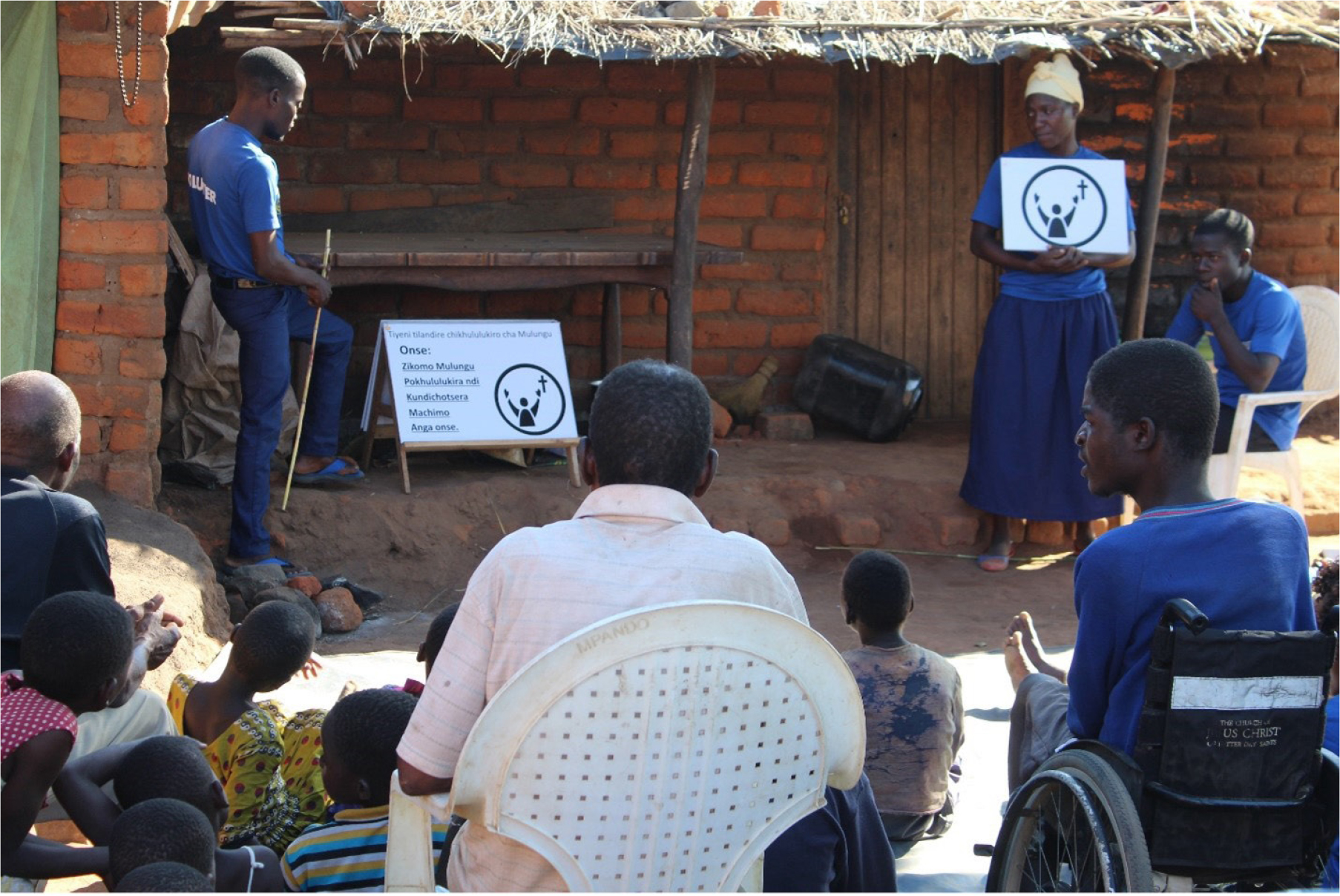
Photograph. Community based Worship at the Cross service held in rural Malawi
Home-Based Care is an additional program that was added to the Kingdom Workers Disability Ministry in Malawi to ensure that people with physical disabilities have access to healthcare services including rehabilitation, assistive devices, and education. The Home-Based Care program seeks to meet physical rehabilitation needs, especially for children, through trained lay volunteers. Volunteers receive training to provide basic exercises and activities and partner with caregivers of children with physical disabilities to ensure optimal functioning and independence of the children.
The Home-Based Care program is initiated in a congregation when volunteers identify a notable presence of children under the age of 18 with physical disabilities attending Worship at the Cross services and request support from Kingdom Workers to expand their congregational program. Kingdom Workers staff then complete an assessment to validate the need for the new program and determine if there is adequate support from volunteers and the church leadership. Once approved, a trained physiotherapist employed by Kingdom Workers visits the community, trains the volunteers, assesses the identified children, and helps set physical, social, educational, and spiritual goals with the family. The local volunteers then follow up with the child’s individualized goals through regular encouragement with caregivers. Annually, the Kingdom Worker physiotherapist returns to the community to re-evaluate the program, re-assess the children enrolled in the Home-Based Care program, and set new goals with the family. Kingdom Workers also helps these children with disabilities access health care services by assisting with transportation expenses to public clinics and hospitals, and also facilitates access to specialized education. Children who have been admitted to designated special education boarding schools may also receive financial assistance from Kingdom Workers.
In 2022, 1,478 PWDs across Malawi were served by Worship at the Cross and (or) the Home-Based Care program with 537 volunteers. The approximate cost for supporting both Worship at the Cross and Home-Based Care program was $100 per participant per year.
Methods
Data for this program evaluation was gathered from surveys with PWDs (if adults), caretakers (for children with disabilities), program volunteers, and church leaders which included either the pastor or a designated church leader if there was no pastor assigned to the congregation. Data collection tools were developed by the staff in Malawi in consultation with the organizations’ program evaluation staff in the US and then translated into Chichewa, which is the local language used in Malawi. Surveys were developed for program volunteers and participants or caregivers attending Worship at the Cross services. An interview guide was used to collect input from church leaders. A comprehensive physical assessment was used to evaluate the impact of the Home-Based Care program, which is the same format used for routine documentation of for children enrolled in that program.
Data were collected at 14 selected locations in September 2022 in the districts of Thyolo, Mulanje, Phalombe, Blantyre, Lilongwe, and Salima, located in Central and Southern Malawi, highlighted in Figure 1. Although there was a total of 32 active congregations with a disability ministry at the time, all 6 locations in the Northern region had started within the past year, and the remaining locations were either recently started or logistically challenging to visit in-person and did not have a Home-Based Care program established.
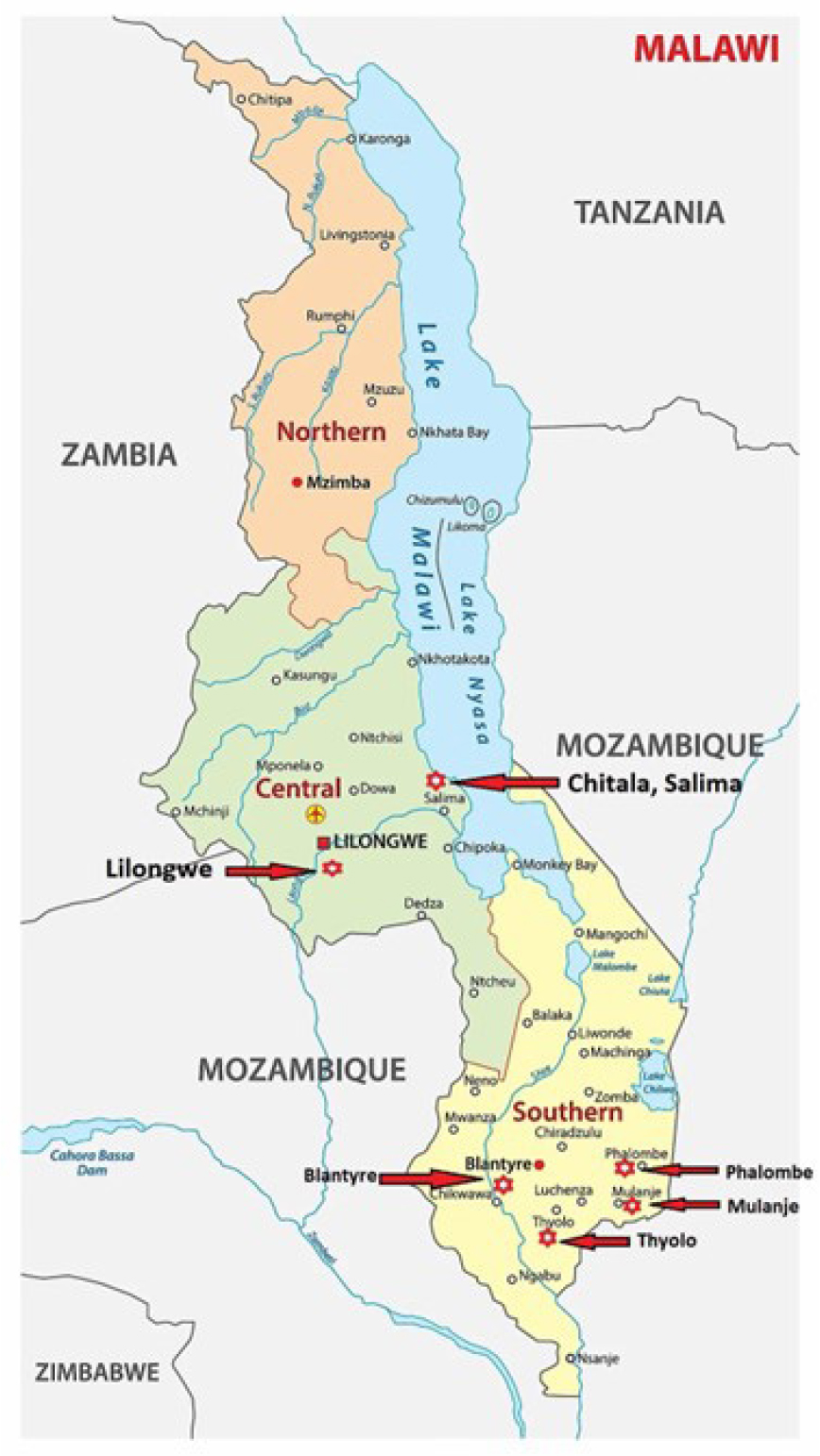
Figure 1
Map of Malawi with data collection districts highlighted (From https://www.worldatlas.com/maps/malawi)
For the selected sites, the pastor or church leader was asked to coordinate having at least 10% of the Worship at the Cross participants, and 10% of the volunteers meet at the church on the scheduled visit day to provide their input about the program. All caregivers and children enrolled in the Home Based Care program were also asked to be at the church on the scheduled day for a physical assessment. No monetary incentive was provided to those that reported to the church to complete the data collection process, although snacks were provided to all attendees by the Kingdom Worker staff, their usual practice for any site visit regardless of purpose.
Participants or caregivers and the volunteers answered survey questions verbally at the church, meeting with one of the three Kingdom Worker staff members, one at a time. Although formal ethics review and approval was not required for this program evaluation, the purpose of the data collection was explained to participants, and they were told they did not have to answer any of the questions if they did not want to.
Responses were entered directly into an iPad by the Kingdom Worker staff member and uploaded into Survey Analytics once internet access was available. The physical assessment was completed for all Home-Based Care participants that reported to the church by a trained physiotherapist using a paper assessment form. Interviews with church leaders were accomplished face-to-face at the end of the day by one of the staff members using a paper survey to capture the responses before the information was entered into Survey Analytics.
Results
A total of 73 responses were received from Worship at the Cross participants (adult PWDs or caregivers), exceeding the targeted 10% response rate at the selected sites. Just over half (51%) of respondents were disabled adults, while the remaining that answered the question (37%) were caregivers of children, with all results summarized in Table 2. Physical disabilities were the most common disability among Worship at the Cross participants with club foot most commonly reported by disabled adults who attended.
Table 2a
Worship at the Cross (WatC) Responses (N=73).
| Information about the Person with Disability | N (%) |
|---|---|
| Person Completing Survey | |
| Adult with Disability | 37 (51%) |
| Caregiver | 27 (37%) |
| Did not respond/missing | 9 (12%) |
| Type of Disability* | |
| Physical Disability | 24 (33%) |
| Epilepsy | 16 (22%) |
| Cerebral Palsy | 7 (10%) |
| Blind/Difficult to See | 7 (10%) |
| Deaf/Difficult to Hear | 5 (7%) |
| Intellectual Disability | 3 (4%) |
| Other | 3 (4%) |
| Did not respond/missing | 15 (21%) |
| Assistive Device* | |
| Crutches/Walker | 7 (10%) |
| Wheelchair/tricycle | 4 (5%) |
| Cane | 4 (5%) |
| Hearing aid | 1 (1%) |
| Adaptor chair | 1 (1%) |
| None | 41 (56%) |
| Did not respond/missing | 15 (21%) |
| How Often Attends WatC | |
| More than monthly | 42 (58%) |
| Monthly | 19 (26%) |
| Less than Monthly | 5 (7%) |
| Did not respond/missing | 7 (10%) |
| How Long to Travel to WatC | |
| Less than 30 minutes | 7 (10%) |
| 30 min but less than 1 hour | 41 (56%) |
| 1 hour or more | 14 (19%) |
| Did not respond/missing | 11 (15%) |
| Member of a church | |
| Yes, this church | 15 (21%) |
| Yes, another church | 41 (56%) |
| Did not respond/missing | 17 (23%) |
| Attend Regular Church Services | |
| Every Week | 20 (27%) |
| Occasionally | 45 (62%) |
| Never | 1 (1%) |
| Did not respond/missing | 7 (10%) |
| Believe Jesus Died for Sins | |
| Yes | 46 (63%) |
| Somewhat/Not Sure | 9 (12%) |
| Did not respond/missing | 18 (25%) |
| Been Baptized | |
| Yes | 44 (60%) |
| No | 11 (15%) |
| Did not respond/missing | 18 (25%) |
Table 2b
Worship at the Cross (WatC) Responses (N=73).
| Information about Program Impact | N (%) |
|---|---|
| How Participates in WatC* | |
| Sing | 60 (82%) |
| Clap Hands/Play Instrument | 4 (5%) |
| Answer Questions | 12 (16%) |
| None/missing | 9 (12%) |
| Why Attends WatC* | |
| Learn God’s Word | 63 (86%) |
| Worship God | 47 (64%) |
| Prayer/Seek God’s Intervention | 18 (25%) |
| Able to Attend with Disability | 15 (21%) |
| Did not respond/missing | 4 (5%) |
| Treated like others before WatC | |
| Yes | 24 (33%) |
| Sometimes | 35 (48%) |
| No | 4 (5%) |
| Did not respond/missing | 10 (14%) |
| Treated like others since WatC | |
| Yes | 54 (74%) |
| Sometimes | 9 (12%) |
| No | 0 (0%) |
| Did not respond/missing | 10 (14%) |
| Relationship with God Changed by WatC* | |
| Stronger Relationship with God | 56 (77%) |
| Learning God’s Word | 44 (60%) |
| Improved Spiritual Life | 22 (30%) |
| Receiving Blessings | 15 (21%) |
| Improved Physical/Social Life | 15 (21%) |
| Don’t Know | 1 (1%) |
| Satisfied with WatC Services | |
| Satisfied or Very Satisfied | 58 (79%) |
| Neutral | 7 (10%) |
| Unsatisfied or Very Unsatisfied | 0 (0%) |
| Did not respond/missing | 8 (11%) |
Survey responses were received from 82 program volunteers, with a 15% response rate. Results are summarized in Table 3. Of the 82 volunteers surveyed, 60% were female and 40% were male. All volunteered for the Worship at the Cross program, and half (50%) also volunteered for the Home-Based Care program. Some had been volunteering for many years, including 16 that began nine years prior.
Table 3
Volunteer Survey Responses (N=82)
| N (%) or Mean (SD) | |
|---|---|
| Program Volunteer | |
| Worship at the Cross | 82 (100%) |
| Home Based Care | 41 (50%) |
| How Long a Volunteer | |
| Less than a year | 5 (6%) |
| 1-2 years | 14 (17%) |
| 3-5 years | 29 (35%) |
| 6-8 years | 18 (22%) |
| 9-11 years | 16 (20%) |
| Satisfaction With (scale of 1=strongly agree to 5=strongly disagree) | |
| Training | 1.9 (0.69) |
| Volunteer Appreciation | 1.8 (0.96) |
| Community Acceptance of program | 1.5 (0.71) |
| Results of Home-based Care | 3.1 (2.4) |
| Comfortable Training Someone (scale of 1=very comfortable to 5=very uncomfortable) | |
| To Lead Worship at the Cross Service | 1.5 (0.76) |
| About Disabilities | 2.3 (0.83) |
| To Assess Disabilities | 2.5 (1.24) |
| To Design a Home Based Program | 3.9 (1.91) |
| To Provide Home Based Care | 4 (1.96) |
| Agree with the following statements | |
| God loves everyone | 82 (100%) |
| Christians should serve those in need | 82 (100%) |
| Disabilities are punishments for sins | 22 (27%) |
| Because of my volunteer work, I am better at reaching people with disabilities | 81 (99%) |
| How often Gospel Shared | |
| Every Visit | 17 (21%) |
| Most Visits | 49 (60%) |
| Occasionally | 14 (17%) |
| Never | 2 (2%) |
All 16 church leaders, one from each congregation, completed an interview, for a 100% response rate. These included 12 LCCA-M pastors and 4 Church elders, all male and from Malawi. The pastors are trained at the Lutheran Bible Institute in Malawi and the Lutheran Seminary in Zambia for a total of 6 years, and hold a diploma; church leaders completed at least a secondary (high school) level of education in Malawi. For churches with a disability ministry, the pastors and the church leaders are responsible to make visits with the volunteers, teach evangelism, settle disputes, and ensure the group is active.
Caregiver surveys and physical assessments were completed with 47 households, which was a 59% participation rate among those currently enrolled in the Home-Based Care program within the locations identified for data collection. These results are summarized in Table 4. All but one of the caregivers were female, and 10 (21%) of the Home-Based Care participants also attended Worship at the Cross. Ages of the children with disabilities ranged from one-year to 20-years-old, with the median age being eight-years-old. Two-thirds of the children were identified as having cerebral palsy, with other disabilities including difficulty hearing and speaking, epilepsy, Down’s Syndrome, Spina Bifida, club foot, and hydrocephalus.
Table 4
Selected Home Based Care Evaluation Results (N-47).
| N (%) | |
|---|---|
| Age of Child | |
| Under 5 | 13 (28%) |
| 5 to 9 | 15 (32%) |
| 10 to 14 | 15 (32%) |
| 15 to 20 | 4 (9%) |
| Primary Disability | |
| Cerebral Palsy | 31 (66%) |
| Difficulty hearing/speaking | 4 (9%) |
| Epilepsy | 2 (4%) |
| Downs Syndrome | 2 (4%) |
| Other | 8 (17%) |
| Able to Sit | |
| Unaided | 34 (72%) |
| With assistance | 11 (23%) |
| Cannot | 2 (4%) |
| Stand | |
| Unaided | 14 (30%) |
| With assistance | 20 (43%) |
| Cannot | 13 (28%) |
| Feed Self | |
| Unaided | 18 (38%) |
| With assistance | 11 (23%) |
| Cannot | 17 (36%) |
| Did not answer/missing | 1 (2%) |
| Use Toilet | |
| Unaided | 10 (21%) |
| With assistance | 12 (26%) |
| Cannot | 24 (51%) |
| Did not answer/missing | 1 (2%) |
| Child responds to* | |
| Speaking | 47 (100%) |
| Touching | 44 (94%) |
| Recognizing Family | 40 (86%) |
| Watching/Playing with Others | 36 (78%) |
| Does not respond | 0 (0%) |
| Number of Words Able to Speak | |
| 0 | 17 (36%) |
| 1-10 | 11 (23%) |
| 11-25 | 4 (9%) |
| 26-50 | 3 (6%) |
| 51+ | 12 (26%) |
| Able to Move | |
| Walking | 15 (32%) |
| Crawling | 13 (28%) |
| Bottom Shuffling | 5 (11%) |
| Unable to move | 14 (30%) |
| Child Generally Feels | |
| Happy | 20 (42%) |
| Somewhat Happy | 14 (31%) |
| Neutral | 11 (23%) |
| Somewhat Sad | 2 (4%) |
| Sad | 0 (0%) |
| Household Belongs to Church | |
| Yes, this church | 7 (15%) |
| Yes, another church | 35 (74%) |
| No answer/missing | 3 (6%) |
| Did not answer/missing | 2 (4%) |
| Attend Worship at the Cross | |
| Yes | 10 (21%) |
| No | 37 (79%) |
| Child Attends School | |
| Too young | 12 (26%) |
| Yes | 13 (28%) |
| No/Did not answer | 22 (47%) |
| Frequency of Volunteer Visits | |
| A few times per week or weekly | 11 (23%) |
| A few times per month or monthly | 29 (62%) |
| A few times per year | 7 (15%) |
| Caregiver Confident with Exercises | |
| Yes | 39 (83%) |
| No/Did not answer | 8 (17%) |
| Child Improved | |
| Yes | 36 (77%) |
| No/Did not answer | 11 (23%) |
| Child Enjoys Visits | |
| A Lot | 22 (46%) |
| Mostly | 18 (38%) |
| Somewhat | 6 (13%) |
| Not very | 1 (2%) |
| Not at all | 0 (0%) |
| Trust the Volunteer | |
| A Lot | 20 (43%) |
| Mostly | 19 (41%) |
| Somewhat | 7 (14%) |
| Not very | 1 (2%) |
| Not at all | 0 (0%) |
As seen in Table 4, over 70% of the children enrolled in the Home-Based Care program could sit unaided while less than half could use the toilet. However, all (100%) of the children were responsive, by making noise, moving, or smiling, when spoken to, touched, watching or playing with others, or recognizing family. A third (32%) could move from one place to another by walking, while just less than a third couldn’t move (30%,). The remaining were able to crawl or bottom shuffle, as seen in Table 4. A majority (89%, n=42) of households reported belonging to a church in the community, although only 17% were members of the church sponsoring the program. The remaining households either don’t belong to a church or declined to respond, with at least one household identified as Muslim.
Program Impact
For the Worship at the Cross service, most participants (96%) reported feeling accepted in the community. As seen in Figure 2, 86% of caregivers and adult PWD’s reported that community members treated them like other children/others their respective age since the church started the Worship at the Cross ministry.
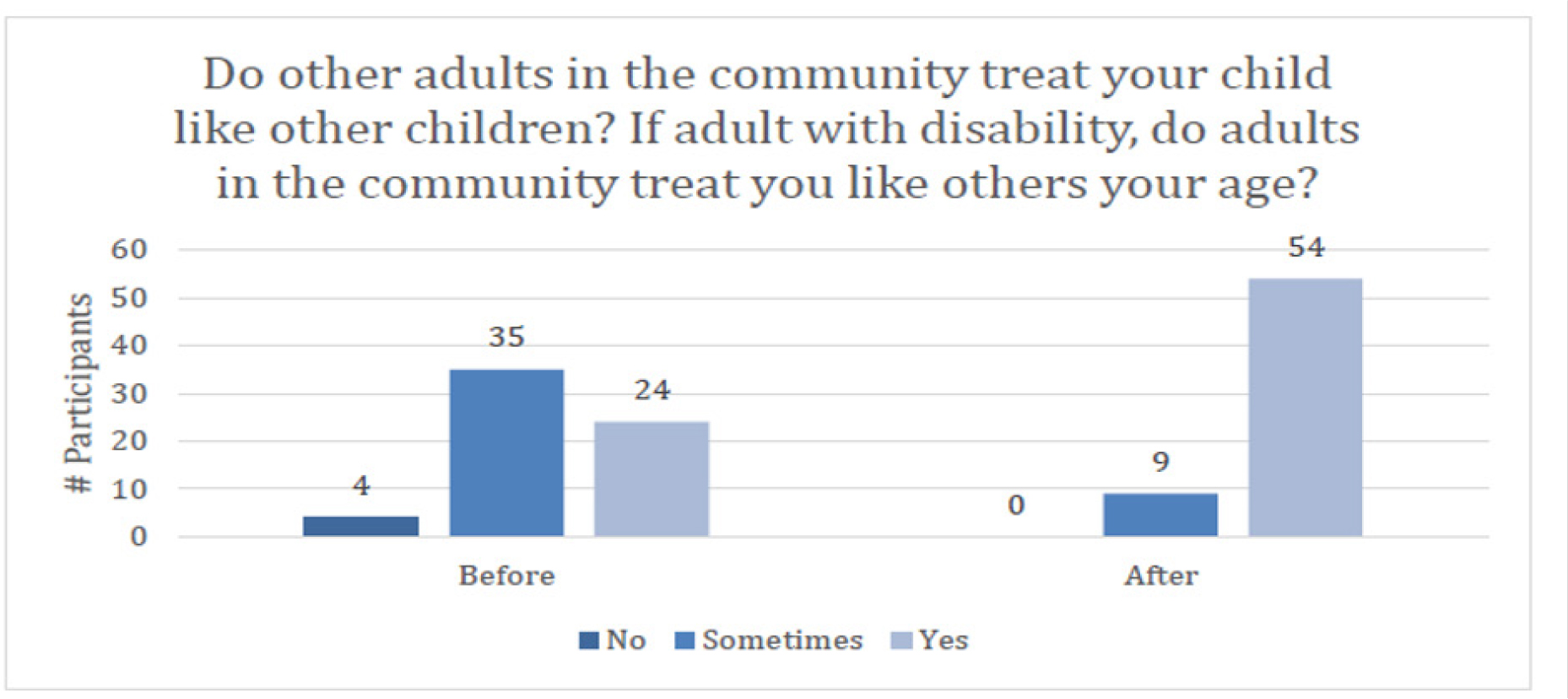
Figure 2
Social inclusion among PWDs since attending Worship at the Cross
From the volunteer perspective, 81 (of 82) the volunteers surveyed agreed that since completing their training and time spent volunteering, they were better at reaching out to people with disabilities in their community; the remaining respondent identified no change to their prior level of reaching people with disabilities. Church leaders echoed that perception; one commented, “There’s less discrimination now, and people with disability are now included in most of the things” and another stated, “Some people are amazed at how we reach out to the vulnerable populations.”
For the Home-Based Care program, over three quarters (77%) of participating caregivers reported that their child improved as a result of the care they received. Specific comments indicated improvements in standing, walking, communicating, bathing, using the toilet, feeding, housework, being able to hold things, head control, following instructions, sitting, moving by bottom shuffling, interacting with others, cessation of seizures, and understanding more. Among the 35 children in the Home-Based Care program old enough to attend school, 21 (60%) did not attend school. The reasons stated for not attending included a lack of transportation, bullying, fear of child getting hit by a car, low cognition, nonacceptance, too tired to take child, fearful behavior toward others, accessibility, mobility, lack of bowel control, and lack of funding.
Of the 80 volunteers surveyed, 98% (n=79) affirmed they were more comfortable sharing their faith with others since volunteering with Kingdom Workers. Although not a requirement for volunteering with the program, 100% of volunteers agreed with both of the following statements: “God loves everyone, even those with a disability” and “Christians should serve those in need in their community.” When asked how often they prayed with children they visit, 84% of volunteers who responded said either “Most” or “Every” visit, 14% “Occasionally” or “About every other visit,” and only one respondent (2%) said “Never.” Responses were similar when asked how often they shared the Gospel with children they visit; 81% of volunteers said either “Most” or “Every” visit, 17% “Occasionally” or “About every other visit,” and only one respondent (2%) said “Never.”
Discussion
The Worship at the Cross ministry demonstrated an impact at the community level, with PWDs, caregivers, church leaders, and volunteers all reporting a higher level of acceptance by members of their own family and members of the community. While the focus of the program is to provide spiritual care to PWDs that otherwise might not be able to worship in a disability-friendly environment, the results appear to have a much broader effect on the community as a whole. This outcome is consistent with a key element of CBR focused on “empowerment,” which includes social inclusion and advocacy for PWDs.6,7 Even without additional efforts to organize educational sessions or coordinate new social activities, providing a weekly worship experience that deliberately includes PWDs seems to be an effective way to empower the disabled in a community.
The Home-Based Care program, as expected, appeared to be effective at improving physical function, or “health,” another key element of CBR.6,7 Additional studies may be helpful to better quantify the impact the program is having in rural communities where rehabilitation services are limited. It is interesting, however, that overall school attendance of the children with disabilities was relatively low (38%) despite existing government policies that support educational support for PWDs in Malawi,6 so that topic may need to be deliberately incorporated into volunteer training and routine visits.
Based on the responses from the volunteers, it does appear the Home-Based Care program has been effective at providing spiritual care within the home through prayer and sharing the gospel, even among households that do not belong to a church. As voiced by PWDs and caregivers, spiritual care is essential for coping with disabilities13,15 and maintaining feelings of personal control.14 Including additional mental health outcome measures of the HomeBased Care program may provide a valuable insight into the impact of spiritual care by the volunteers. It is also interesting to note that that the CBR matrix does not specifically address spiritual care for PWDs, which may be a critical gap in that community-based model.
There is also an opportunity for further training for both volunteers and caregivers on how best to provide additional mental and spiritual support. Although volunteers receive training on the basic causes of disabilities (not a result of sin, witchcraft, etc.) and a basic standard of care for PWD, additional training might help the volunteers or church leaders to properly handle other complicated situations they might encounter. Increased knowledge about spiritual care on disability topics would help both the parents and volunteers understand that a disability is a will of God and that they have a God-directed responsibility to help those in need.
Since data were collected for this program evaluation, there has been further expansion of the disability ministry, as well as at the government level. In 2023, the program almost doubled, serving 3,698 PWDs, with a small increase in volunteers. The significant growth in people served since 2021 has largely been attributed to an increased number of support groups and the opportunity to participate in community income generating projects. Within Malawi, the president also assented to the Persons with Disabilities Act 2023. The new Act makes provision for the establishment of Malawi Council for Disability Affairs (MACODA) replacing Malawi Council for the Handicapped (MACOHA). This new council not only empowers disability care, but can also track and enforce compliance with the Act, which is expected to improve the landscape of disability practice.
Limitations
While a concerted effort was made to collect representative data across multiple congregations and districts across Malawi, respondents for this program evaluation were invited to churches by local pastors rather than randomly selected, which may have created selection bias. Additionally, social desirability bias may also have influenced the results as respondents were aware the program evaluation was being accomplished by Kingdom Workers, which funds the program. Thirdly, bias on the basis of availability of participants may also be at play among respondents in both programs, as those less able to work due to their own physical limitations, or demands by their dependents, may have been more likely to have shown up for data collection. Despite these identified limitations, the comprehensive data from multiple PWDs, caregivers, volunteers, and church leaders across 14 different communities provides a valuable perspective on the impact the program is having across the country of Malawi. However, more rigorous research is needed to measure and understand the value of incorporating spiritual care into CBR efforts globally. The use of validated measurement instruments, larger sample sizes, and comparative study of different programs or communities would provide valuable evidence to the continued development in this area of study.
Conclusion
The results of this program evaluation demonstrate the Malawi disability program continues to reach a vulnerable population of PWD and their caregivers with the saving news of the Gospel as well as providing physical, emotional, and social support. In addition to the physical impact of the Home-Based Care program, there are further opportunities to measure mental health outcomes, increase school attendance, and an opportunity for further training for both volunteers and caregivers on how to provide mental and spiritual support to adults and children with disabilities.
Acknowledgements
The authors wish to acknowledge the tremendous work accomplished by the volunteers and congregations of the Lutheran Church of Central Africa in Malawi to serve their community by reaching out to adults and children with disabilities.
Funding
Financial support for the Malawi Disability ministry and this program evaluation was coordinated through Kingdom Workers, including funds received from the Batterman Family Foundation, the Raabe Family Foundation, and many others.
Competing Interests
None declared.