
Introduction
Artificial intelligence (AI) is increasingly recognized as a transformative force in global health. From diagnostic imaging to epidemic forecasting, AI-driven tools promise to reshape the delivery of care, particularly in contexts marked by shortages of health workers and limited resources. For example, machine learning systems have demonstrated accuracy comparable to expert clinicians in detecting conditions such as diabetic retinopathy and tuberculosis.1,2 During the COVID-19 pandemic, AI-supported surveillance platforms enhanced governments’ ability to track infection patterns, anticipate resource needs, and inform public health strategies.3 These advances highlight AI’s potential to extend the reach of scarce expertise, reduce diagnostic delays, and support preventive care in underserved regions.1,2,3
Yet alongside these promises lie serious concerns. AI is not a neutral tool; it reflects the biases and values embedded in the data on which it is trained and the systems that deploy it. Studies have shown that medical AI trained primarily on Western populations may underperform when applied to African or Asian contexts, risking misdiagnosis and reinforcing inequities.4,5 Digital divides in infrastructure and access mean that wealthier countries and urban hospitals are better positioned to benefit from AI, while poorer settings risk being left further behind.6 Ethical dilemmas also emerge around privacy, surveillance, and the commodification of health data, particularly when commercial interests dominate system design.7
While secular frameworks of bioethics and human rights offer guidance, there remains a gap in engaging explicitly theological perspectives. This absence is striking, given the historical and continuing role of Christian organizations in delivering healthcare worldwide. In sub-Saharan Africa, for instance, faith-based health providers account for a substantial share of care across multiple countries.8 Christian hospitals, NGOs, and universities are already adopting digital health technologies, often without a robust theological framework to assess their implications. Christian ethics are, therefore, not peripheral but essential to the future of AI in global health.
This commentary argues that Christian theological principles, particularly stewardship, justice, and the imago Dei, offer a vital framework for evaluating AI’s dual capacity to advance health or deepen inequity. The paper proceeds in four steps: first, outlining the promises of AI in global health; second, analyzing its risks; third, exploring Christian principles for responsible adoption; and fourth, offering practical recommendations for stakeholders.
AI’s promise in global health
AI has delivered measurable benefits in diagnostics, surveillance, education, and efficiency. In ophthalmology, a landmark trial showed that an AI-based system detected diabetic retinopathy with specialist-level accuracy in primary care, expanding access in underserved areas.1 In tuberculosis screening, deep learning algorithms applied to chest radiographs have achieved diagnostic accuracy comparable to radiologists across multiple low- and middle-income settings.2 These gains are strongest when systems are tested in the populations and workflows where they will be used. These tools can extend scarce expertise when validated locally.
AI also strengthens epidemic preparedness. Platforms like BlueDot analyzed news and flight data to detect unusual patterns and issued alerts about COVID-19 before World Health Organization announcements.9 Machine learning applied to genomic sequencing has accelerated detection of viral variants, informing public health responses.10 Even unstructured data, such as Twitter posts, have been mined to detect self-reported COVID-19 symptoms and barriers to testing, offering timely insights where formal surveillance was slow.¹¹ For low- and middle-income countries, these tools offer foresight that can prevent crises from escalating.9,10,11
In education, AI-powered adaptive learning platforms and virtual simulations are supporting formation of health workers in contexts where training opportunities are limited.12 Chatbots have also been deployed to disseminate accurate health information during pandemics, countering misinformation and supporting mental health.13 For Christian universities and mission hospitals, such technologies represent compassion in practice, multiplying the reach of educators and extending service to communities.
Finally, AI contributes to efficiency in strained health systems. Predictive algorithms can forecast demand for vaccines, medicines, and hospital beds, enabling more equitable distribution. Triage algorithms can help prioritize patients in overcrowded emergency departments, potentially reducing preventable deaths. Yet here, too, justice must remain the measure. Optimization is faithful stewardship only when it prioritizes the vulnerable.
Together, these applications suggest AI could play a role in advancing universal health coverage, provided it is implemented with equity. For Christian institutions delivering significant portions of care in Africa, Asia, and Latin America, responsible adoption offers the chance to embody innovation as solidarity rather than exclusion.
AI’s perils in global health
The same features that make AI powerful also create risk. Algorithmic bias remains a central concern. A widely used United States algorithm underestimated the needs of Black patients because it relied on healthcare spending as a proxy for health status.4 In dermatology, AI trained primarily on lighter skin tones performed poorly on darker skin, risking inequitable outcomes.5 These cases illustrate a broader issue of representativeness, where models trained on one context may not generalize to others, especially in low- and middle-income settings. Such disparities directly contradict the Christian conviction that all people bear God’s image.
The digital divide further threatens justice. Wealthier nations and urban hospitals have the infrastructure to implement AI, while poorer settings risk exclusion. UNESCO has warned that without deliberate inclusion, AI may reinforce rather than reduce global inequities.6 This reflects what theologians describe as structural sin, where systems perpetuate injustice.
Surveillance misuse compounds the risks. During COVID-19, some digital contact-tracing apps blurred the line between health protection and authoritarian control.14 Biometric data collected for care could be repurposed for political monitoring. Privacy breaches are not simply technical issues but violations of trust, commodifying lives made in God’s image.
The commodification of health data is another peril. Corporations increasingly view health information as an asset, often extracted from vulnerable populations without meaningful consent.7 This mirrors patterns of exploitation in global trade, where resources are taken from poorer regions and resold at high cost. Such practices contradict stewardship and justice, reducing health to a market commodity.
Finally, overreliance on AI risks eroding the human dimension of care. Efficiency, prediction, and optimization are valuable, but they cannot replace empathy and presence. Healing in the Christian tradition is holistic, encompassing body, mind, and spirit. Recent analyses underscore that equity hinges on representative data, transparent evaluation, and accountability across the AI pipeline.15 Recent reviews outline practical fairness controls across the model lifecycle, including subgroup performance reporting, threshold optimization by group, pre-deployment bias audits, and post-deployment monitoring.16
Christian ethical framework for balanced adoption
Christian theology offers resources for navigating these tensions. Stewardship frames technology as a gift entrusted by God to be used responsibly for human flourishing.17,18 Justice demands prioritizing the marginalized, resisting digital colonialism and ensuring equitable access. Imago Dei affirms the dignity of all persons, requiring that data be handled with reverence and systems designed inclusively. Compassion insists that technology serves the love of neighbors, not efficiency alone. Together these principles orient discernment toward persons first and systems second.
These principles converge in practical questions. Does an AI tool extend care to the underserved, consistent with justice? Does it respect patient autonomy and dignity, consistent with imago Dei? Is it sustainable and context-appropriate, consistent with stewardship? Does it promote care of the vulnerable, consistent with compassion? By embedding these questions in practice, Christian actors can resist both uncritical adoption and blanket rejection. Instead, they can shape AI as a tool for healing and solidarity. These guardrails align with recent World Health Organization (WHO) guidance on the ethics and governance of large multimodal models (LMM) in health.19 Standards for health datasets, including documentation, provenance, and representativeness requirements, are central to equitable performance.20 Table 1 pairs common promises and perils with the corresponding principles and operational guardrails.
Table 1
AI promises, perils, guiding principles, and guardrails. Examples are illustrative and align with cited literature. LMM guidance refers to WHO ethics and governance recommendations.
| AI dimension | Promise in global health | Peril or risk | Guiding Christian principle | Practical guardrail |
|---|---|---|---|---|
| Diagnostics & triage | Faster screening and decision support | Bias from non-representative datasets | Justice and imago Dei | Dataset diversity standards and external bias audits before deployment |
| Surveillance & preparedness | Earlier outbreak signals and resource targeting | Misuse for excessive surveillance | Human dignity and subsidiarity | WHO LMM guidance, proportional use, privacy protections, community oversight |
| Education & workforce support | Scalable training and patient education | Hallucinations and over-reliance on automation | Stewardship and prudence | Human-in-the-loop and clear disclosure of AI use |
| System efficiency & access | Better allocation and reduced wait times | Digital colonialism and inequitable benefit | Solidarity and preferential option for the poor | LMIC co-design, open documentation, shared governance |
[i] Note. This pairing becomes a pathway in Figure 1. Promises and perils flow through Christian principles toward concrete policy and practice controls.
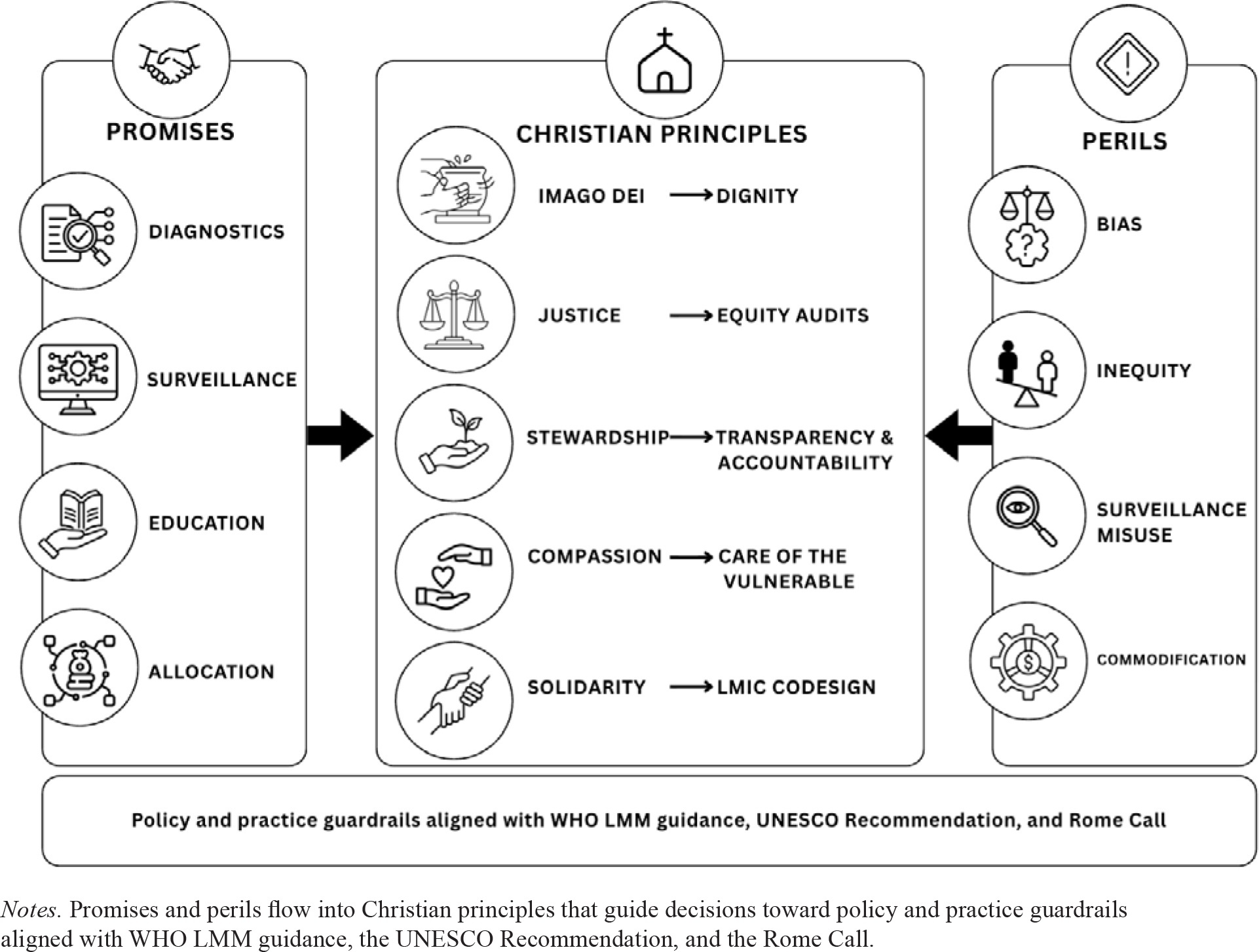
Figure 1
Christian discernment of AI in global health.
Practical recommendations
To translate these principles into action, stakeholders must take concrete steps. Policymakers should require inclusive validation of AI on diverse populations, mandate pre-deployment bias and safety audits with public reporting, legislate transparency and accountability, and enact strong data protection laws, and adopt dataset documentation and provenance standards for health AI.20 Implementation should follow WHO’s LMM guidance for governance and oversight.19 Internationally, they should foster solidarity so that AI does not become another form of global health injustice, as vaccine hoarding demonstrated during COVID-19.21 Investments in local data infrastructure and capacity in low- and middle-income countries are essential for equitable benefit.
Faith-based health organizations can model ethical innovation by procuring well-documented, transparent, and sustainable systems, engaging communities in decision-making and advocating for fair partnerships with technology companies. Shared governance and clear benefit-sharing can align partnerships with stewardship and justice. Health systems should operationalize fairness controls through subgroup audits, recalibration or reweighting where indicated, and continuous monitoring with public reporting.16 By doing so, they embody stewardship and justice in practice.
Christian universities should integrate AI ethics into curricula, training students not only to use technology but to interrogate its assumptions. Programs should combine technical proficiency with case-based formation in virtue ethics and patient-centered care. Service-learning projects can highlight how AI intersects with social determinants of health, forming professionals who are both technically skilled and morally discerning.
Churches, though not developers, play a prophetic role. They can advocate for equity in AI adoption, educate congregations about digital ethics, accompany those affected by health challenges, and use their global networks to demand solidarity across borders. Church networks can also convene dialogues among communities, clinicians, and developers to surface concerns early and promote trustworthy use.
These steps track closely with recent equity-focused guidance in the literature.15 Across all these settings, the test of AI’s success cannot be efficiency alone. It must be judged by whether it reduces inequities, protects dignity, and embodies love for neighbor. In short, require human oversight in clinical uses, conduct bias and safety audits with public reporting, invest in LMIC data and capacity, and embed virtue formation so that innovation serves persons first.
Conclusion
Artificial intelligence is already shaping global health. Its ability to improve diagnostics, anticipate outbreaks, and optimize resources reveals great potential. Yet algorithmic bias, inequitable access, surveillance misuse, and commodification of data expose its dangers. AI reflects the values of those who design and deploy it.
For Christians, the task is clear; embrace AI as a gift of human creativity while holding it accountable to theological commitments of stewardship, justice, imago Dei, and compassion. Faith-based institutions can model ethical use, educators can form discerning professionals, churches can raise prophetic voices, and policymakers can legislate with equity in mind. In practical terms, require human oversight in clinical uses, conduct pre-deployment bias and safety audits with public reporting, invest in low- and middle-income data and capacity, and embed virtue formation across training and ministry.
The future of AI is not fixed. It will be shaped by the values that guide its adoption. If pursued without ethical grounding, it may deepen injustice. Guided by Christian ethics, AI can become an instrument of shared responsibility. The question is not whether AI will influence health systems, since it already is. The question is whether it will serve equity, dignity, and love of neighbors. For those who follow Christ, that choice must be pursued with courage, intentionality, and hope.
Ethics and consent
Ethics approval was not required for this commentary because no human participants, identifiable data, or animals were involved. No patient or participant identifiable information is included.
Funding information
None.
Competing interests
The author has no competing interests to declare.
Author’s contributions
Conceptualization, drafting, critical revision, and approval of the final manuscript by the author.
Acknowledgements
Generative artificial intelligence was used to improve grammar and sentence flow.
Data accessibility
No datasets were generated or analyzed for this commentary.