
Table 1
Inclusion and Exclusion Criteria
| Inclusion criteria | Exclusion criteria |
|---|---|
| 1. Study population or sub-population identified as having an existing or diagnosed disability; 2. Majority of study population <18 years of age 3. Research that described, measured, or reported the demographic or behavioral characteristics of familial or volunteer caregivers; 4. Research that described, measured, or reported developmental outcomes; 5. Research that discussed the relationship between 3) and 4); 6. Quantitative, qualitative, mixed methods studies and systematic reviews; 7. Population drawn from India, or multi-country datasets isolating an Indian sub-population. | 1. Population studied for risk factors or contributors to disability only; 2. Research on paid or professional caregivers; 3. Opinion pieces, editorial guidelines, blog posts, and social media posts; 4. Literature published in local, non-English languages. |
Table 2
Search Strategies in MEDLINE and CINAHL
| MEDLINE |
|---|
| 1. child* or infan* or toddler* or newborn or neonat* or baby or babies or preschool* or pre school* or boy or boys or girl or girls or schoolchild* or school age or adolescen* or pediatric* or paediatric* or youth* or juvenile* or teen* or minors 2. [mh pediatrics] 3. {or #1-#2} 4. (neurodegenerative or Huntington* or Parkinson* or amyotrophic lateral sclerosis or multiple sclerosis or motor neuron* disease). ti,ab,kw 5. (down* adj2 syndrome).ti,ab,kw 6. (palsy or paralys* or quadriplegi* or tetraplegi* or paraplegi* or locked in syndrome).ti,ab,kw 7. ((communication or learning or consciousness or language or speech or voice or vision or visual or hearing) adj disorder*).ti,ab,kw 8. (hearing loss or hearing aid* or deaf* or blind* or stutter*).ti,ab,kw 9. ($arthritis or rheumati* or fibromyalgia).ti,ab,kw 10. ((mental* or psychiatr* or psychological* or behavioral*) adj (ill* or disorder* or disease* or distress or disab* or dysfunction* or problem* or health* or patient* or treatment*)).ti,ab,kw 11. ((personality or mood or dysthymic or cognit* or anxiety or stress or eating or adjustment or reactive or somatoform or conversion or behavior* or percept* or thought or psycho* or impulse control or development* or attention deficit or hyperactivity or conduct or motor skills or movement or tic or substance related) adj disorder*).ti,ab,kw 12. (psychosis or psychoses or psychotic* or paranoi* or schizo* or neurosis or neuroses or neurotic* or delusion* or depression or depressive or bipolar or mania or manic or obsessi* or compulsi* or panic or phobic or phobia or anorexia or bulimia or neurastheni* or dissociative or autis* or Asperger* or Tourette or dyslex* or affective or borderline or narcissis* or suicid* or self injur* or self harm or adhd).ti,ab,kw 13. (disabled or disabilit* or handicap* or impaired or impairment* or dysfunction*).ti,ab,kw 14. ((behavio* or emotion*) adj1 (problem* or disorder*)).ti,ab,kw 15. (sensory dysfunction* or sensory system disorder*).ti,ab,kw 16. special education.mp. or Education, Special/ 17. (special need* or special children) 18. (parent* or carer* or caregiv* or caregiver*) 19. India* or Andra Pradesh or Arunachal Pradesh or Assam or Bihar or Chattisgarh or Chattisgadh or Goa or Gujarat or Haryana or Himachal Pradesh or Jharkhand or Karnataka or Kerala or Madhya Pradesh or Maharashtra or Manipur or Meghalaya or Mizoram or Nagaland or Orrisa or Oddisha or Punjab or Rajasthan or Sikkim or Tamil Nadu or Tripura or Telangana or Uttar Pradesh or Uttarakhand or West Bengal or Southern India or Northern India or Western India or Eastern India 20. 3 and (4 OR 5 OR 6 OR 7 OR 8 OR 9 OR 10 OR 11 OR 12 OR 13 OR 14 OR 15 OR 16 OR 17) and 18 and 19 21. limit 20 to yr="2013 -Current |
| CINAHL |
| Limiters - Published Date: 20140101-20241201 Search modes - Boolean/Phrase S1 child* or infan* or toddler* or newborn or neonat* or baby or babies or preschool* or pre school* or boy or boys or girl or girls or schoolchild* or school age or adolescen* or pediatric* or paediatric* or youth* or juvenile* or teen* or minors S2 MH pediatrics S3 S1 OR S2 S4 (neurodegenerative or Huntington* or Parkinson* or amyotrophic lateral sclerosis or multiple sclerosis or motor neuron* disease) S5 (down* N2 syndrome) S6 (palsy or paralys* or quadriplegi* or tetraplegi* or paraplegi* or locked in syndrome) S7 ((communication or learning or consciousness or language or speech or voice or vision or visual or hearing) N1 disorder*) S8 (hearing loss or hearing aid* or deaf* or blind* or stutter*) S9 $arthritis or rheumati* or fibromyalgia S10 ((mental* or psychiatr* or psychological* or behavioral*) N1 (ill* or disorder* or disease* or distress or disab* or dysfunction* or problem* or health* or patient* or treatment* S11 (personality or mood or dysthymic or cognit* or anxiety or stress or eating or adjustment or reactive or somatoform or conversion or behavior* or percept* or thought or psycho* or impulse control or development* or attention deficit or hyperactivity or conduct or motor skills or movement or tic or substance related) N1 disorder* S12 (psychosis or psychoses or psychotic* or paranoi* or schizo* or neurosis or neuroses or neurotic* or delusion* or depression or depressive or bipolar or mania or manic or obsessi* or compulsi* or panic or phobic or phobia or anorexia or bulimia or neurastheni* or dissociative or autis* or Asperger* or Tourette or dyslex* or affective or borderline or narcissis* or suicid* or self injur* or self harm or adhd) S13 (disabled or disabilit* or handicap* or impaired or impairment* or dysfunction* S14 ((behavio* or emotion*) N1 (problem* or disorder*)) S15 sensory dysfunction* or sensory system disorder* S16 special need* or special children S17 (parent* or carer* or caregiv* or caregiver*) S18 India* or Andra Pradesh or Arunachal Pradesh or Assam or Bihar or Chattisgarh or Chattisgadh or Goa or Gujarat or Haryana or Himachal Pradesh or Jharkhand or Karnataka or Kerala or Madhya Pradesh or Maharashtra or Manipur or Meghalaya or Mizoram or Nagaland or Orrisa or Oddisha or Punjab or Rajasthan or Sikkim or Tamil Nadu or Tripura or Telangana or Uttar Pradesh or Uttarakhand or West Bengal or Southern India or Northern India or Western India or Eastern India S19 S3 and (S4 OR S5 OR S6 OR S7 OR 8 OR 9 OR 10 OR 11 OR 12 OR 13 OR 14 OR 15 OR 16) and S17 and S18 |
Table 6
JBI Critical Appraisal of Studies and associated Questionnaires
| Qualitative studies | |||||||||||
|---|---|---|---|---|---|---|---|---|---|---|---|
| Author and date | 1 | 2 | 3 | 4 | 5 | 6 | 7 | 8 | 9 | 10 | Total score |
| Kaniamattam et al. 202143 | Y | Y | Y | Y | Y | N | N | Y | Y | Y | 8 |
| Kathuria 202244 | Y | Y | Y | Y | Y | N | N | Y | Y | Y | 8 |
| Naik et al. 201945 | Unclear | Y | Y | Y | Y | N | N | Y | Y | Y | 7 |
| Noori et al. 202346 | Unclear | Y | Y | Y | Y | N | N | Y | Y | Y | 7 |
| Samuel et al. 202347 | Y | Y | Y | Y | Y | Y | N | Y | Y | Y | 9 |
| Krupa et al. 201948 | Not applicable | Y | Y | Y | Y | N | N | N | Y | Y | 6 |
[i] Questionnaire39
[ii] Is there congruity between the stated philosophical perspective and the research methodology?
[iii] Is there congruity between the research methodology and the research question or objectives?
[iv] Is there congruity between the research methodology and the methods used to collect data?
[v] Is there congruity between the research methodology and the representation and analysis of data?
[vi] Is there congruity between the research methodology and the interpretation of results?
[vii] Is there a statement locating the researcher culturally or theoretically?
[viii] Is the influence of the researcher on the research, and vice- versa, addressed?
[ix] Are participants, and their voices, adequately represented?
[x] Is the research ethical according to current criteria or, for recent studies, and is there evidence of ethical approval by an appropriate body?
[xi] Do the conclusions drawn in the research report flow from the analysis, or interpretation, of the data?
| Analytical cross-sectional studies | |||||||||
|---|---|---|---|---|---|---|---|---|---|
| Author and date | 1 | 2 | 3 | 4 | 5 | 6 | 7 | 8 | Total score |
| Arya et al. 201449 | Y | Y | N | Y | Y | N | Y | Y | 6 |
| Das et al. 201750 | Y | Y | N | N | N | N | Y | Y | 4 |
| Gupta et al. 201851 | Y | Y | N | Y | Y | Y | Y | Y | 7 |
| Jacob et al. 202152 | Y | Y | Y | Y | Y | N | Y | Y | 7 |
| Karande et al. 202253 | Y | Y | Y | Y | Y | Y | Y | Y | 8 |
| Manikandan et al. 202255 | Y | Y | N | Y | Y | N | Y | Y | 6 |
| Mhatre et al. 201657 | Y | Y | Y | Y | Y | N | Y | Y | 7 |
| Nagabushana et al. 201958 | Y | Y | Y | Y | Y | Y | Y | Y | 8 |
| Saha et al. 201660 | Y | Y | Y | Y | Y | Y | Y | Y | 8 |
| Shah et al. 201961 | N | Y | N | N | Y | Y | Y | Y | 5 |
| Sharawat et al. 202363 | Y | Y | Y | Y | Y | N | Y | Y | 7 |
| Thiyagarajan et al. 201965 | Y | Y | N | Y | Y | N | Y | Y | 6 |
| Sud et al. 202368 | Y | Y | Y | Y | Y | N | Y | Y | 7 |
[i] Questionnaire39
[ii] Were the criteria for inclusion in the sample clearly defined?
[iii] Were the study subjects and the setting described in detail?
[iv] Was the exposure measured in a valid and reliable way?
[v] Were objective, standard criteria used for measurement of the condition?
[vi] Were confounding factors identified?
[vii] Were strategies to deal with confounding factors stated?
[viii] Were the outcomes measured in a valid and reliable way?
[ix] Was appropriate statistical analysis used?
| Randomized controlled trials | ||||||||||||||
|---|---|---|---|---|---|---|---|---|---|---|---|---|---|---|
| Author and date | 1 | 2 | 3 | 4 | 5 | 6 | 7 | 8 | 9 | 10 | 11 | 12 | 13 | Total score |
| Manohar et al. 2019 56 | Y | Y | Unclear | N | N | Y | N | N | Unclear | Y | Y | Y | Y | 7 |
| Pareek et al. 2015 59 | Unclear | Unclear | Unclear | Y | N | Y | N | Y | Unclear | Y | Y | Y | N | 6 |
[i] Questionnaire40:
[ii] Was true randomization used for assignment of participants to treatment groups?
[iii] Was allocation to treatment groups concealed?
[iv] Were treatment groups similar at the baseline?
[v] Were participants blind to treatment assignment?
[vi] Were those delivering the treatment blind to treatment assignment?
[vii] Were treatment groups treated identically other than the intervention of interest?
[viii] Were outcome assessors blind to treatment assignment?
[ix] Were outcomes measured in the same way for treatment groups?
[x] Were outcomes measured in a reliable way?
[xi] Was follow up complete and if not, were differences between groups in terms of their follow up adequately described and analysed?
[xii] Were participants analysed in the groups to which they were randomized?
[xiii] Was appropriate statistical analysis used?
[xiv] Was the trial design appropriate and any deviations from the standard RCT design (individual randomization, parallel groups) accounted for in the conduct and analysis of the trial?
Table 7
List of Disabilities Studied and their Geographic Distribution
| Disabilities studied | Number | ||
|---|---|---|---|
| Autism/ASD | 11 | ||
| ADHD | 2 | ||
| CP | 3 | ||
| Depression | 1 | ||
| Epilepsy | 2 | ||
| Hearing impairment | 3 | ||
| Intellectual disability/borderline intellectual functioning | 2 | ||
| Thalassaemia | 2 | ||
| Geographic distribution of studies | |||
| Author and date | Location | State | Region |
| Gupta et al. 201851 | Two study centers, i.e., Manovikas special school, Ujjain and Prateksha ITC, Nagda, are located in Ujjain district and two centers, i.e., Udaan, Agar, and Navjeevan, Shujalpur ITCs are located in Shajapur district of Madhya Pradesh. | Madhya Pradesh | Central |
| Saha et al. 201660 | Burdwan Medical College, West Bengal | West Bengal | Eastern |
| Arya et al. 201449 | Pediatric outpatient department of a tertiary care teaching hospital of north India | Haryana | Northern |
| Das et al. 201750 | Child Development Clinic of a tertiary care hospital of north India. | Delhi | Northern |
| Kathuria 202244 | Government inclusive schools in the Delhi region | Delhi | Northern |
| Kumari et al. 202054 | Department of Psychiatry, PGIMER-Dr. RML Hospital, New Delhi | Delhi | Northern |
| Pareek et al. 201559 | Government institute for hearing impaired and mute children in Jaipur, | Rajasthan | Northern |
| Shah et al. 202162 | Child and Adolescent Psychiatry Services, Department of Psychiatry of a tertiary level postgraduate teaching hospital with superspecialization course in Child and Adolescent Psychiatry | Chandigarh | Northern |
| Sharawat et al. 202363 | AIIMS, Rishikesh | Uttarakhand | Northern |
| Sud et al. 202368 | PGIMER, Chandigarh | Chandigarh | Northern |
| Jacob et al. 202252 | NIMHANS, Bangalore, India | Karnataka | Southern |
| Kaniamattam et al. 202143 | Rehabilitation center (RC) located in a semi-urban village in South India | - | Southern |
| Krupa et al. 201948 | medical care center in Southern India | Tamil Nadu | Southern |
| Manikandan et al. 202255 | The Child and Adolescent Unit of Psychiatry, Christian Medical College | Tamil Nadu | Southern |
| Manohar et al. 201956 | Child Guidance Clinic (CGC) of a non-funded tertiary care hospital in India, | Tamil Nadu | Southern |
| Nagabushana et al. 201958 | Bangalore Medical College and Research Institute, Bengaluru catering to patients predominantly from the state of Karnataka, India | Karnataka | Southern |
| Noori et al. 202346 | special school in Kerala | Kerala | Southern |
| Samuel et al. 2023 | Child and Adolescent Unit of Psychiatry, Christian Medical College, Vellore | Tamil Nadu | Southern |
| Singhal et al. 201864 | NIMHANS, Bangalore, India | Karnataka | Southern |
| Thiyagarajan et al. 201965 | Voluntary Health Services in Chennai | Tamil Nadu | Southern |
| Karande et al. 202253 | Learning Disability (LD) clinic of a public medical college in Mumbai, | Maharashtra | Western |
| Mhatre et al. 201657 | P.D. Hinduja National Hospital, Mumbai, India | Maharashtra | Western |
| Naik et al. 201945 | Goa Medical College, Goa, India | Goa | Western |
| Shah et al. 201961 | Vadodara city, Gujarat | Gujarat | Western |
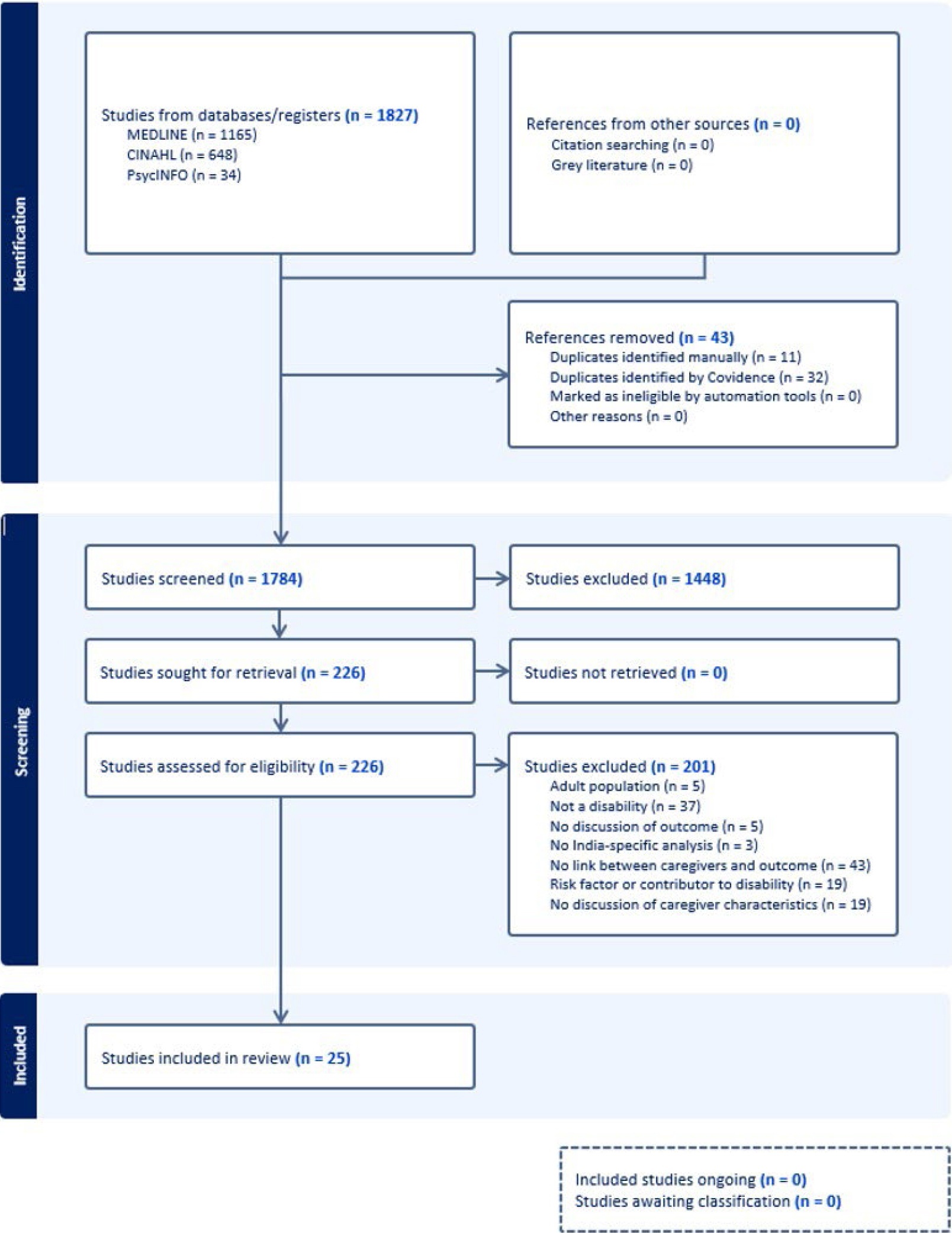
Figure 1
PRISMA diagram
Table 3
Summary of Characteristics of Qualitative Studies
| Author and date | Theoretical basis and method | Disability studied | Outcomes observed | Key findings |
|---|---|---|---|---|
| Kaniamattam et al. 202143 | Interpretive phenomenological analysis, open-ended semi-structured interviews | Intellectual and developmental disabilities | Communication, educational outcomes, toileting | Parent interviews highlighted the following themes: (1) unmet or undermet needs and expectations from rehabilitation; (2) changing needs and expectations of parents as their children grow older; (3) a significant inadequacy of communicative participation and interaction opportunities for the participant’s children. |
| Kathuria 202244 | Explorative descriptive study, questionnaire and unstructured interview | Hearing impairment | Identity formation | Educated parents were better with respect to the identity formation and self- image of their children, as compared to the parents who had low educational backgrounds. |
| Naik et al. 201945 | Unspecified qualitative descriptive study, in-depth semi structured interviews | Autism | Executing ADLs (feeding, toileting) | It was found that parents encountered difficulty executing ADLs for their children, that they are finding their own strategies to manage the difficulties in executing ADLs; and that most parents reported that eating and toileting activities are the most affected areas in execution and difficulty. |
| Noori et al. 202346 | Unspecified qualitative design, in-depth interviews | Autism spectrum disorder | Executing ADLs (feeding, personal hygiene), sexuality, behavioral problems | Parents have a range of reasons for the discontinuation of rehabilitation services (such as logistic difficulties, financial difficulties, family commitments, difficulty handling the child, lack of satisfaction with the existing treatment, and lack of improvement). There exist multiple barriers to accessing rehabilitation services, including parenting challenges and child-related factors. |
| Samuel et al. 202347 | Interpretive phenomenological analysis, focus group discussion | Developmental disabilities | Feeding | The failure of caregivers to recognize sensory and behavioral issues in feeding acts as a barrier to seeking help, responsive feeding practices are difficult when children are not able to indicate food preferences, and familial factors disproportionately impede mothers' ability to facilitate feeding. |
| Krupa et al. 201948 | Mixed methods study | Autism | Communication | Better and more natural communication behaviors of children were observed at home than at clinic. Greater joint engagement at home indicated better representation of communication profile at home. |
Table 4
Thematic Analysis of Qualitative Studies
| Theme | Quotes |
|---|---|
| Direct caregiver intervention assists child behavioral and communication outcomes | “Parents’ narratives reflected prioritization of children uttering words over communicating ideas.” 43 “One mother said, “I use visual schedules to teach him about toileting activity.” 45 “As reported by most of the parents, use of various strategies makes it easy for the parents as well as the child to manage their daily routine.” 45 “I have to take his food along if travelling long distances. He only eats if I show him rhymes on the phone. While travelling, I will wait 10–12 hours till he is really hungry so that he will eat without the phone.” 47 “Greater joint engagement at home indicated better representation of communication profile at home.” 48 |
| Caregiving capacity reduces with lower SES | “At the RC, it was common to see mothers taking on a case manager’s role and coordinating multiple medical and rehabilitation services for their children, while fathers worked to pay for these services.” 43 “The families with poor socio-economic status are not able to pay much attention to the personal and identity needs of their deaf child.”44 “It was an enormous expense for the family to meet the cost of the individual therapy session(s) with the father’s low income. Some parents expressed financial constraints to meet travel expenses and accommodation costs, in order to avail of therapy at distant places, in addition to the therapy charges.”46 |
| Disapproval from the extended family hinders caregivers | “[T]he therapist would say that my son should be given opportunities to speak often… even when this was said to them, they never did anything supportive to help him progress.”43 “The child who is neglected by the family would have poor self-image and identity crises as compared to the child who has a loving and caring home environment.”44 “A mother (M10) recollected an incident where she felt miserable that her own family members accused her of being careless and unresponsive to her child’s injurious behaviors toward other children.”46 “I don’t compel her to eat, but my mother-in-law insists that I give her extra. She believes giving her extra will make her healthy. She says it’s not good for children to be skinny. For me, she is already hyperactive, this weight is enough, I don’t want her to gain weight also. Usually, after 10 mouthfuls, she starts crying, so I feel bad forcing her to eat. After that, she eats only because she is scared of me.”47 |
Table 5
Summary of Characteristics of Quantitative Studies
| Author and date | Type of study | Disability studied | Sample size | Objective |
|---|---|---|---|---|
| Arya et al. 201449 | Cross-sectional study | Epilepsy (generalized and partial) | n(children)= 110. | 1. To assess self‑reported QOL in children with epilepsy using a Hindi translation of QOL in children with epilepsy questionnaire. 2. To assess the demographic factors and clinical factors which influence the QOL in children with epilepsy. |
| Das et al. 201750 | Cross-sectional study | Cerebral palsy | n(children) = 50, age 4-12 | To determine the QOL in Indian children with CP using CP‑QOL questionnaire and to correlate QOL scores with demographic details of the patient. |
| Gupta et al. 201851 | Cross-sectional follow-up study | Autism spectrum disorder | n(children) = 204. | To analyse the effect of the demographic variables related to disabled child, his/her parents and the family; their schooling pattern and types of study settings and the associated comorbidities on improvement in the performance score of students attending these study settings in one academic year. |
| Jacob et al. 2021 52 | Cross-sectional study | ADHD, comorbidities: ODD = 20 (52.6%), SLD = 19 (50%), dissociative disorder, OCD = 2 (5.3%), none = 6 (15.8%) | n(children)= 38, age 8-16 | To examine perceived parenting and its correlation with emotional and behavioral problems in children and adolescents with a diagnosis of ADHD |
| Karande et al. 202253 | Cross-sectional questionnaire | Borderline intellectual functioning | n(parents)=100, n(children) = 100 | 1. To evaluate the parental‑perceived health‑related quality of life (HRQoL) of these students. 2. to analyze the impact of sociodemographic variables on their HRQoL. |
| Kumari et al. 202054 | Pre-post development of module | Autism, intellectual disability | n(autism and intellectual disability) = 16, n(intellectual disability alone) = 14, age = 3-18 | The aim of this study was to develop the test efficacy of a simple, short manualized PE module for parents of children with autism with/without comorbid ID and for ID alone. We focused on both autism and ID (A-ID) because we felt that both the groups could benefit from this module. |
| Manikandan et al. 202255 | Cross-sectional study | Intellectual Development Disorder, Autism spectrum disorder, motor disorder, | n(children)= 79, mean age = 5.1 (SD = 2.01) | To examine the relationship between oromotor deficits, behavior problems related to feeding, and caregiver perception of the behavior in children with special needs. |
| Manohar et al. 201956 | Randomized controlled trial | Autism spectrum disorder | intervention n=26, control n=24. | To evaluate the acceptability and feasibility of an ASD-specifc behavioral intervention, deliverable in resource limited settings, over a brief time frame. |
| Mhatre et al 201657 | Cross-sectional survey | Autism spectrum disorder | n(children) = 150. | To investigate long-term outcomes in children with diagnosis of autism spectrum disorders based on Childhood Autism Rating Scale (CARS score). |
| Nagabushana et al. 201958 | Cross-sectional prospective study | Epilepsy | n(children)= 40. | To assess the impact of epilepsy and antiepileptic medications on the child's development, health, scholastic performance, and QOL and to identify the predictors of QOL. |
| Pareek et al 201559 | Randomized controlled trial- single blind parallel design | Hearing impairment/mutism | n = 105 in each of three groups. | To assess the dental health outcomes following supervized tooth brushing among institutionalized hearing impaired and mute children in Jaipur, Rajasthan. |
| Saha et al. 201660 | cross sectional descriptive study | Thalassemia | n(children) = 365, age 5-12 | To assess the school activity of thalassemic children and to reveal the relationship between school activity with the socio-demographic factors as well as clinicotherapeutic profile. |
| Shah et al. 201961 | Cross-sectional questionnaire | Autism | n(children) = 58, n(caregivers) = 58 | To investigate the relationship between oral health‑related behaviors of autistic children and SOC of their caregivers. |
| Shah et al. 202162 | Non-randomized pre-post intervention study | ADHD | n(children) = 36, mean age = 9 (SD = 2.61) | To describe the development and effectiveness of a culturally-contextualized parent skills training intervention for Indian families. |
| Sharawat et al. 202363 | Prospective longitudinal study | Cerebral Palsy | n(children)=569, age = 2-17.5 years | To assess the prevalence, severity, and predictors of malnutrition in children with cerebral palsy and its impact on quality of life. |
| Singhal et al. 201864 | Two group comparison design with repeated baseline assessments | Depression | n(intervention) = 51, n(control) = 49, age = 13-18 | To study the efficacy of a school-based group coping skills program for Indian adolescents with subclinical depression |
| Thiyagarajan et al. 201965 | Cross-sectional study | Thalassaemia | n(children)= 125, n(parents) = 125, mean age = 6 (SD = 3.67) | 1. To assess the factors influencing the healthrelated quality of life. 2. To hypothesize whether the parent’s psychological wellbeing, sociodemographic characteristics and transfusion interval have an impact on children’s quality of life |
| Sud et al. 202368 | Cross-sectional study | Hearing loss | n(parents) = 50, n(children) = 50 | To understand the parental views regarding stress, and its effect on language, and auditory outcomes. The study also aims to understand the relationship between parental stress, and child's age. |
| Arya et al. 201449 | QOLCE score: physical function, emotional wellbeing, cognitive function, social function, and behavior | Maternal education, paternal education, SES | None | No significant association of the total QOLCE score with gender, residence, socioeconomic status, paternal/maternal education, or family type. |
| Das et al. 201750 | CP-QOL | Maternal education | The QOL score of children whose mothers were literate was computed to be 36.2 ± 5.47 as against a QOL score of 39.8 ± 5.17 for those with uneducated mothers. | None |
| Gupta et al. 201851 | improvement in school performance scores, functional assessment checklist developed by NIMHS | Family type, religion, urban/rural, income, parental education, SES, caregiver status, time allotted by parents to child, working status | Statistically significant difference in mean scores between parents giving no time to their children at home then the parents giving 1–2 h (P = 0.015 on ANOVA). | The effect of family type, size, religion, income on acquisition of skills was also not found significant. Our finding also depicts nonsignificant relation of family income and acquisition of skills in one academic year. |
| Jacob et al. 202152 | SDQ domains, ADHD-RS-IV (severity of ADHD symptoms) | Urban/rural, involvement (mother and father), positive parenting, discipline, supervision, corporal punishment | Parental involvement significantly negatively correlated with SDQ (total problem score correlation P = 0.002) as well as individual scores with respect to peer and conduct problems. Positive parenting significantly correlated with both the total problem scores on SDQ as well as the individual scores on emotional problems. | The other domains of poor supervision, inconsistent disciplining as well as corporal punishment did not correlate significantly with the problem scores on the SDQ. |
| Karande et al. 202253 | HRQOL score (DISABKIDS long version) | Age, gender, education status, work status, SES, family type | A longer duration of poor school performance and higher parental age were significantly associated with a lower “independence” facet score respectively. Higher IQ and higher socioeconomic status were associated with lower social exclusion facet score | No sociodemographic variable was significantly associated with emotion and limitation facet and the total scores |
| Kumari et al. 202054 | ISAA (autism), BASIC-MR, Developmental Screening Test (behavioral characteristics of respective age levels) | None | A significant improvement was observed in ISAA after parental education in the intellectual group in social relationships and reciprocity emotional responsiveness , speech and communication total ISAA score. various domains of violent behavior, hyperactivity, and total BASIC-MR Part B score (P = 0.05). For intellectual disability only group: violent behavior (0.06), self-injurious behavior (0.02), repetitive behavior (0.024), and odd behavior (0.03) decreased significantly after parental education. | None |
| Manikandan et al. 202255 | BPFAS (feeding behavior). SOMA (oral-motor skills) | Age, gender, employment, religion, cultural background, education, type of family, relationship to child | When we compared caregivers who were employed with those who were homemakers, there was a statistically significant difference between groups (F= 2.506, p= .038) when compared with the Total Problem Score- total of the BPFAS. Increased feeding-related behavior problems were attributable to parent-related factors. | No significant associations between caregiver gender, religion, cultural background, educational qualification, type of family, relationship to the child, and number of children with the various subscores of the BPFAS. |
| Manohar et al. 201956 | CARS score (autism severity), VSMS (social proficiency), FISC (stress and coping strategies), 10 point visual analog scale (parent’s and clinician’s perception of child’s response) | Changes in CARS total score positively correlated with the number of hours of intervention (p = 0.001) as well as parental understanding and competence. | Parental stress at 12 weeks did not have correlations with severity of the child’s developmental disorder. | |
| Mhatre et al 201657 | CARS score (autism severity), VSMS (social proficiency), speech, ADLs, motor milestones, social interaction | Maternal education, parent participation | Parent participation, that is, practising skills taught at therapy in the home environment may have played a bigger role in the child’s speech development when compared to other factors, as is evident by its greater effect size. | None |
| Nagabushana et al. 201958 | QOLCE score: physical function, emotional wellbeing, cognitive function, social function, and behavior | SES, parental education, family type | None | No statistical significance of socio‑economic status or parental education on QOL. |
| Pareek et al 201559 | Plaque score, gingival index | Twice‑a‑week tooth brushing supervision program performed by the caregivers and investigator was less effective as compared to daily supervision by parents. The assumed reason is that the caregivers did not impart the required skills needed for tooth brushing, suggesting their inactive participation. | None | |
| Saha et al. 201660 | school functioning score | Religion, caste, type of family, residence, SES, parental education | Thalassemic child who were growing up in the environment of joint family, had 3.4 times more risk to develop worse school activity. | None |
| Shah et al. 201961 | frequency of sugar/sugary item intake, toothbrushing frequency, having used dental services (yes/no). | Caregiver gender, marital status, education, occupation, frequency of sugar intake, family income, oral health knowledge score | Children whose mothers had high sense of coherence were more likely to have greater toothbrushing frequency (CI = 1.0–1.28, P = 0.035). Higher family income correlated with increased frequency of toothbrushing. | None |
| Shah et al. 202162 | VADPRS scores (core symptoms of ADHD, rating of performance, and classroom behavior) | Religion, family type, education, urban/rural | Significant improvement in inattention (p < 0.001), hyperactivity/impulsivity (p = 0.007) and conduct problems (p < 0.002). Functional improvement in terms of significant reduction in problem areas in the domains of academic performance (p < 0.001), and classroom behavior (p = 0.001). Education of primary participating parent had significant negative correlation with both preand post- intervention VADPRS hyperactivity/impulsivity scores. | None |
| Sharawat et al. 202363 | CP-QOL: social well‑being and acceptance, functioning, participation and physical health, emotional well‑being and self‑esteem, access to services, pain and impact of disability, and family health), anthropometric data (height, weight) | SES, urban/rural, maternal education, paternal education | Children with CP belonging to lower SES had a greater prevalence of wasting, stunting, and underweight, as well as severe wasting, stunting, and underweight (p=0.03, 0.001, and 0.004 respectively). | The educational level of the parents had no statistically significant impact on the undernutrition status of participants (p>0.05). |
| Singhal et al. 201864 | Various measures of depression, coping and academic stress | Parental baseline depression | Adolescents with fathers having low baseline depression scores showed greater improvement in coping. | None |
| Thiyagarajan et al. 201965 | HRQOL score, RPWBS: psychological wellbeing | Gender, age, education, religion, monthly income, psychological wellbeing | Positive correlation between parents’ psychological well-being and children’s HRQoL (r = 0.329, n = 125, p < 0.001). Educational qualification (R = 1.109), monthly income (R = 1.023) correlated with HRQOL. | None |
[i] Notes. (a) Caregiver characteristics correlated with a developmental outcome have been listed in bold.