
Introduction
It is estimated that there are 240 million children with disabilities worldwide, and 7.8 million in India alone.1 Children with disabilities constitute a particularly vulnerable subset of the disabled population, as they are substantially more likely to not complete their education, face discrimination, and suffer from various comorbidities.2 This is especially true in low- and middle-income countries (LMICs), where access to rehabilitation services is generally poor, and poverty is both a contributor to, and result of, disability.3-4
Caregivers are an important stakeholder in the development of children with disabilities, where a large body of literature in high-income countries (HICs) has consistently found that parental caregivers have a positive impact on neurodevelopmental and behavioral outcomes in the general pediatric population.5-7 This “caregiver effect” is not limited to parents, however. A 2019 multi-country systematic review described the influence of grandparent caregivers on children’s physical health, socio-emotional health, and cognitive development.8 More recent literature has specifically characterized the “caregiver effects” for children with disabilities in HICs;9 for example, caregiver-child interaction has been found to improve child language development in autism,10-12 and parental physical activity has been correlated with child physical activity in children with cerebral palsy.13
Existing literature in HICs also suggests that “caregiver effects” can be correlated with a wide range of caregiver demographic characteristics, especially in children with developmental disabilities.9,14 For instance, Klaas et al.15 correlate caregiver education to increased social participation among children with spinal cord injuries. Other studies in HICs have isolated the effect of caregiver gender on children's development and wellbeing. A thematic analysis of interviews conducted by Sekaran outlines the increasingly active role of the father in positively influencing adolescents’ social and emotional development, while a multi-country, cross-sectional study by Hillekens noted that conflict with fathers was associated with externalizing problem behaviors.16,17
By contrast, little evidence exists on this phenomenon among Indian caregivers, indicative of a relative neglect of this topic in the broader literature. A review was conducted by the authors explicitly identifying male caregivers—fathers, other male relatives or male volunteers—of children with disabilities aged 18 years and under in India, which found neither peer-reviewed nor grey literature focusing on their connection to developmental outcomes. Some studies were identified to outline the role of fathers and the difficulties they face in the context of a child with disability, but did not explore the impact on child development.
As the most populous country in the world, India contributes significantly to the global burden of disability. However, there is a relative paucity of literature on the existence of a “caregiver effect” for children with disabilities in India, and in LMICs at large. Limited findings from South Asian countries generally align with HICs; for example, an observational study in Pakistan revealed statistically significant correlations between maternal education, increased mother-child interaction, and child socioemotional outcomes, and a caregiver training program in Bangladesh was observed to result in improvements to the feeding behavior of children with cerebral palsy.18,19
Moreover, children with disabilities in India are disproportionately affected by their families’ socio-economic disadvantage, which impacts their access to care and integration into the educational system.20,21 This has been examined in detail for children with locomotor, developmental, and sensory disabilities—the most prevalent categories of childhood disability in India—as well as in geographically diverse settings.22-24 Furthermore, although the family unit remains the established source of long-term care for children with disabilities in India, it is reported that some families have poor comprehension of disability, and may respond to children and their caregivers with exclusion and ignorance.23,25,26,27
There is also a large body of research on the perception of Indian caregivers regarding their children, both positive and negative, and the negative impact of caregiving on caregiver health.28-30 Nevertheless, connections between these caregiver-centered factors and developmental outcomes in children remain largely speculative. A comprehensive characterization of caregiver and child development is infrequently found in older sources, such as a 2010 qualitative study that described the experiences and outcomes of paternal involvement for children with disabilities in Mumbai.31
In short, a sufficiently recent synthesis of evidence on caregiver influence on Indian children’s developmental outcomes is absent in the existing literature. This review aims to begin filling the gap. A search on Ovid Medline, the Cochrane Database of Systematic Reviews and JBI Evidence Synthesis did not reveal any reviews examining the intersection of caregivers, childhood disability, and developmental outcomes in India. Given the inaccessibility of clinical care for many children with disabilities in India, comprehensive knowledge of the extent of caregiver influence is likely to inform more targeted intervention and research in the future.
Review question
This review will aim to answer the question: what does existing research reveal about the role of caregivers in the developmental outcomes of children with disabilities in India? It aims to address the following sub-questions:
What is known about caregiver demographic and behavioral characteristics that influence the development of children with disabilities?
What is the nature of the relationships between caregiver characteristics and developmental outcomes?
What directions for future research or policy development can be identified from the current literature?
Methods
The review was conducted with a modified JBI methodology for scoping reviews.32 The process of searching and applying inclusion criteria can be found in Figure 1 in the Appendix.
Eligibility Criteria
A study was included if it met all of the inclusion criteria as listed in Table 1. A broad scope of disability was adopted for the purposes of this study, adapting the United Nations Convention on the Rights of Persons with Disabilities’ (CRPD) definition of “longterm physical, mental, intellectual or sensory impairments which in interaction with various barriers may hinder [a child’s] full and effective participation in society on an equal basis with others.”33 Although historically classified under medical or functional deficits alone, more recent literature has converged on a social model.34,35 Under this interpretation, disability manifests as sufficiently severe impairments to bodily structure and function, limitations to executing activities, or restrictions on participation in various areas of life such as education and employment.36
Table 1
Inclusion and Exclusion Criteria
| Inclusion criteria | Exclusion criteria |
|---|---|
| 1. Study population or sub-population identified as having an existing or diagnosed disability; 2. Majority of study population <18 years of age 3. Research that described, measured, or reported the demographic or behavioral characteristics of familial or volunteer caregivers; 4. Research that described, measured, or reported developmental outcomes; 5. Research that discussed the relationship between 3) and 4); 6. Quantitative, qualitative, mixed methods studies and systematic reviews; 7. Population drawn from India, or multi-country datasets isolating an Indian sub-population. | 1. Population studied for risk factors or contributors to disability only; 2. Research on paid or professional caregivers; 3. Opinion pieces, editorial guidelines, blog posts, and social media posts; 4. Literature published in local, non-English languages. |
This was supplemented by an India-specific legal understanding of disability in the Rights of Persons with Disabilities Act that outlines 21 specific conditions eligible for state assistance.37 Based on this understanding, thalassemia was included as a disability. However, populations diagnosed with chronic medical conditions such as HIV and cancer alone were not sufficient to be considered for inclusion, unless the study characterized the subsequent impairment or exclusion as a result of these conditions.
Likewise, developmental outcomes were broadly defined as the goals attained in the domains of language, cognitive, physical, social, and approach to learning domains as proposed by UNICEF.38
Types of sources
Both quantitative and qualitative data concerning developmental behaviours and outcomes were included for the purpose of this review. This included experimental (including randomized controlled trials, non-randomized trials, before and after studies, and time series studies) and non-experimental (cohort studies, case-control studies, analytical cross-sectional studies) quantitative studies, as well as case series, reports, and descriptive cross-sectional studies. Qualitative studies considered included phenomenological, grounded theory, and ethnographic studies. Systematic reviews were also considered, while non-peer reviewed literature, including opinion pieces, editorial guidelines, and social media posts, were not.
Search strategy
The search strategy was designed by the authors. Initially, a search of MEDLINE and CINAHL was undertaken to identify titles and abstracts of relevant articles on the topic. Search terms for disabilities were adapted from Appendix 1 of a systematic review conducted by Sartore et al. on parents and carers of children with complex needs,39 which characterized a broad range of physical, sensory, and developmental disabilities in a caregiving context.
Key words used in the search included terms relating to children, disabilities (including alternative terminology for physical, mental and developmental disabilities), caregivers, and Indian states. A full overview of key words and Boolean operators used can be found in Table 2. Due to the varying structures of the MEDLINE and CINAHL search functions, the strategy was adapted with minor variations between databases.
Table 2
Search Strategies in MEDLINE and CINAHL
| MEDLINE |
|---|
| 1. child* or infan* or toddler* or newborn or neonat* or baby or babies or preschool* or pre school* or boy or boys or girl or girls or schoolchild* or school age or adolescen* or pediatric* or paediatric* or youth* or juvenile* or teen* or minors 2. [mh pediatrics] 3. {or #1-#2} 4. (neurodegenerative or Huntington* or Parkinson* or amyotrophic lateral sclerosis or multiple sclerosis or motor neuron* disease). ti,ab,kw 5. (down* adj2 syndrome).ti,ab,kw 6. (palsy or paralys* or quadriplegi* or tetraplegi* or paraplegi* or locked in syndrome).ti,ab,kw 7. ((communication or learning or consciousness or language or speech or voice or vision or visual or hearing) adj disorder*).ti,ab,kw 8. (hearing loss or hearing aid* or deaf* or blind* or stutter*).ti,ab,kw 9. ($arthritis or rheumati* or fibromyalgia).ti,ab,kw 10. ((mental* or psychiatr* or psychological* or behavioral*) adj (ill* or disorder* or disease* or distress or disab* or dysfunction* or problem* or health* or patient* or treatment*)).ti,ab,kw 11. ((personality or mood or dysthymic or cognit* or anxiety or stress or eating or adjustment or reactive or somatoform or conversion or behavior* or percept* or thought or psycho* or impulse control or development* or attention deficit or hyperactivity or conduct or motor skills or movement or tic or substance related) adj disorder*).ti,ab,kw 12. (psychosis or psychoses or psychotic* or paranoi* or schizo* or neurosis or neuroses or neurotic* or delusion* or depression or depressive or bipolar or mania or manic or obsessi* or compulsi* or panic or phobic or phobia or anorexia or bulimia or neurastheni* or dissociative or autis* or Asperger* or Tourette or dyslex* or affective or borderline or narcissis* or suicid* or self injur* or self harm or adhd).ti,ab,kw 13. (disabled or disabilit* or handicap* or impaired or impairment* or dysfunction*).ti,ab,kw 14. ((behavio* or emotion*) adj1 (problem* or disorder*)).ti,ab,kw 15. (sensory dysfunction* or sensory system disorder*).ti,ab,kw 16. special education.mp. or Education, Special/ 17. (special need* or special children) 18. (parent* or carer* or caregiv* or caregiver*) 19. India* or Andra Pradesh or Arunachal Pradesh or Assam or Bihar or Chattisgarh or Chattisgadh or Goa or Gujarat or Haryana or Himachal Pradesh or Jharkhand or Karnataka or Kerala or Madhya Pradesh or Maharashtra or Manipur or Meghalaya or Mizoram or Nagaland or Orrisa or Oddisha or Punjab or Rajasthan or Sikkim or Tamil Nadu or Tripura or Telangana or Uttar Pradesh or Uttarakhand or West Bengal or Southern India or Northern India or Western India or Eastern India 20. 3 and (4 OR 5 OR 6 OR 7 OR 8 OR 9 OR 10 OR 11 OR 12 OR 13 OR 14 OR 15 OR 16 OR 17) and 18 and 19 21. limit 20 to yr="2013 -Current |
| CINAHL |
| Limiters - Published Date: 20140101-20241201 Search modes - Boolean/Phrase S1 child* or infan* or toddler* or newborn or neonat* or baby or babies or preschool* or pre school* or boy or boys or girl or girls or schoolchild* or school age or adolescen* or pediatric* or paediatric* or youth* or juvenile* or teen* or minors S2 MH pediatrics S3 S1 OR S2 S4 (neurodegenerative or Huntington* or Parkinson* or amyotrophic lateral sclerosis or multiple sclerosis or motor neuron* disease) S5 (down* N2 syndrome) S6 (palsy or paralys* or quadriplegi* or tetraplegi* or paraplegi* or locked in syndrome) S7 ((communication or learning or consciousness or language or speech or voice or vision or visual or hearing) N1 disorder*) S8 (hearing loss or hearing aid* or deaf* or blind* or stutter*) S9 $arthritis or rheumati* or fibromyalgia S10 ((mental* or psychiatr* or psychological* or behavioral*) N1 (ill* or disorder* or disease* or distress or disab* or dysfunction* or problem* or health* or patient* or treatment* S11 (personality or mood or dysthymic or cognit* or anxiety or stress or eating or adjustment or reactive or somatoform or conversion or behavior* or percept* or thought or psycho* or impulse control or development* or attention deficit or hyperactivity or conduct or motor skills or movement or tic or substance related) N1 disorder* S12 (psychosis or psychoses or psychotic* or paranoi* or schizo* or neurosis or neuroses or neurotic* or delusion* or depression or depressive or bipolar or mania or manic or obsessi* or compulsi* or panic or phobic or phobia or anorexia or bulimia or neurastheni* or dissociative or autis* or Asperger* or Tourette or dyslex* or affective or borderline or narcissis* or suicid* or self injur* or self harm or adhd) S13 (disabled or disabilit* or handicap* or impaired or impairment* or dysfunction* S14 ((behavio* or emotion*) N1 (problem* or disorder*)) S15 sensory dysfunction* or sensory system disorder* S16 special need* or special children S17 (parent* or carer* or caregiv* or caregiver*) S18 India* or Andra Pradesh or Arunachal Pradesh or Assam or Bihar or Chattisgarh or Chattisgadh or Goa or Gujarat or Haryana or Himachal Pradesh or Jharkhand or Karnataka or Kerala or Madhya Pradesh or Maharashtra or Manipur or Meghalaya or Mizoram or Nagaland or Orrisa or Oddisha or Punjab or Rajasthan or Sikkim or Tamil Nadu or Tripura or Telangana or Uttar Pradesh or Uttarakhand or West Bengal or Southern India or Northern India or Western India or Eastern India S19 S3 and (S4 OR S5 OR S6 OR S7 OR 8 OR 9 OR 10 OR 11 OR 12 OR 13 OR 14 OR 15 OR 16) and S17 and S18 |
The searches of the two databases were performed in December 2024. To ensure recency, only studies published in the 10 years prior, between January 1, 2014 and December 1, 2024, were included. Furthermore, only studies published in English were included. Neither a citation search of the included articles nor a search of the gray literature was conducted as part of this review.
Selection of papers subsequent to the search of key terms
Following the search, citations were exported into Covidence and duplicates were removed. Titles and abstracts were screened by the author against the inclusion criteria, with full text for the relevant sources retrieved for further screening. Ambiguities for inclusion and exclusion at this stage were clarified amongst the authors, with reasons for exclusion noted. The results of the search and inclusion process were reported on a modified PRISMA-ScR flow diagram.40 A total of 1683 articles were retrieved from the two databases. Of these, 226 were selected for full-text analysis, of which 24 satisfied the inclusion criteria.45-68
Data extraction from remaining papers
From the remaining 24 papers that satisfied inclusion criteria, a spreadsheet was created from the data with headings developed by the authors. This included the number of caregiver participants, number of children, study design, caregiver and child demographics, and a summary of the key findings. Qualitative studies were further summarized and thematically analyzed, while quantitative studies were grouped by key findings and disability(ies) studied. The results of this extraction can be found in more detail in Tables 3-5 in the Appendix.
Table 6
JBI Critical Appraisal of Studies and associated Questionnaires
| Qualitative studies | |||||||||||
|---|---|---|---|---|---|---|---|---|---|---|---|
| Author and date | 1 | 2 | 3 | 4 | 5 | 6 | 7 | 8 | 9 | 10 | Total score |
| Kaniamattam et al. 202143 | Y | Y | Y | Y | Y | N | N | Y | Y | Y | 8 |
| Kathuria 202244 | Y | Y | Y | Y | Y | N | N | Y | Y | Y | 8 |
| Naik et al. 201945 | Unclear | Y | Y | Y | Y | N | N | Y | Y | Y | 7 |
| Noori et al. 202346 | Unclear | Y | Y | Y | Y | N | N | Y | Y | Y | 7 |
| Samuel et al. 202347 | Y | Y | Y | Y | Y | Y | N | Y | Y | Y | 9 |
| Krupa et al. 201948 | Not applicable | Y | Y | Y | Y | N | N | N | Y | Y | 6 |
[i] Questionnaire39
[ii] Is there congruity between the stated philosophical perspective and the research methodology?
[iii] Is there congruity between the research methodology and the research question or objectives?
[iv] Is there congruity between the research methodology and the methods used to collect data?
[v] Is there congruity between the research methodology and the representation and analysis of data?
[vi] Is there congruity between the research methodology and the interpretation of results?
[vii] Is there a statement locating the researcher culturally or theoretically?
[viii] Is the influence of the researcher on the research, and vice- versa, addressed?
[ix] Are participants, and their voices, adequately represented?
[x] Is the research ethical according to current criteria or, for recent studies, and is there evidence of ethical approval by an appropriate body?
[xi] Do the conclusions drawn in the research report flow from the analysis, or interpretation, of the data?
| Analytical cross-sectional studies | |||||||||
|---|---|---|---|---|---|---|---|---|---|
| Author and date | 1 | 2 | 3 | 4 | 5 | 6 | 7 | 8 | Total score |
| Arya et al. 201449 | Y | Y | N | Y | Y | N | Y | Y | 6 |
| Das et al. 201750 | Y | Y | N | N | N | N | Y | Y | 4 |
| Gupta et al. 201851 | Y | Y | N | Y | Y | Y | Y | Y | 7 |
| Jacob et al. 202152 | Y | Y | Y | Y | Y | N | Y | Y | 7 |
| Karande et al. 202253 | Y | Y | Y | Y | Y | Y | Y | Y | 8 |
| Manikandan et al. 202255 | Y | Y | N | Y | Y | N | Y | Y | 6 |
| Mhatre et al. 201657 | Y | Y | Y | Y | Y | N | Y | Y | 7 |
| Nagabushana et al. 201958 | Y | Y | Y | Y | Y | Y | Y | Y | 8 |
| Saha et al. 201660 | Y | Y | Y | Y | Y | Y | Y | Y | 8 |
| Shah et al. 201961 | N | Y | N | N | Y | Y | Y | Y | 5 |
| Sharawat et al. 202363 | Y | Y | Y | Y | Y | N | Y | Y | 7 |
| Thiyagarajan et al. 201965 | Y | Y | N | Y | Y | N | Y | Y | 6 |
| Sud et al. 202368 | Y | Y | Y | Y | Y | N | Y | Y | 7 |
[i] Questionnaire39
[ii] Were the criteria for inclusion in the sample clearly defined?
[iii] Were the study subjects and the setting described in detail?
[iv] Was the exposure measured in a valid and reliable way?
[v] Were objective, standard criteria used for measurement of the condition?
[vi] Were confounding factors identified?
[vii] Were strategies to deal with confounding factors stated?
[viii] Were the outcomes measured in a valid and reliable way?
[ix] Was appropriate statistical analysis used?
| Quasi-experimental studies | ||||||||||
|---|---|---|---|---|---|---|---|---|---|---|
| Author and date | 1 | 2 | 3 | 4 | 5 | 6 | 7 | 8 | 9 | Total score |
| Kumari et al. 202054 | Y | Y | Unclear | N | N | Y | Y | Y | Y | 6 |
| Shah et al. 202162 | Y | Y | Unclear | N | N | N | Y | Y | Y | 5 |
| Singhal et al. 201864 | Y | Y | Y | Y | Y | Y | Y | Y | Y | 9 |
| Randomized controlled trials | ||||||||||||||
|---|---|---|---|---|---|---|---|---|---|---|---|---|---|---|
| Author and date | 1 | 2 | 3 | 4 | 5 | 6 | 7 | 8 | 9 | 10 | 11 | 12 | 13 | Total score |
| Manohar et al. 2019 56 | Y | Y | Unclear | N | N | Y | N | N | Unclear | Y | Y | Y | Y | 7 |
| Pareek et al. 2015 59 | Unclear | Unclear | Unclear | Y | N | Y | N | Y | Unclear | Y | Y | Y | N | 6 |
[i] Questionnaire40:
[ii] Was true randomization used for assignment of participants to treatment groups?
[iii] Was allocation to treatment groups concealed?
[iv] Were treatment groups similar at the baseline?
[v] Were participants blind to treatment assignment?
[vi] Were those delivering the treatment blind to treatment assignment?
[vii] Were treatment groups treated identically other than the intervention of interest?
[viii] Were outcome assessors blind to treatment assignment?
[ix] Were outcomes measured in the same way for treatment groups?
[x] Were outcomes measured in a reliable way?
[xi] Was follow up complete and if not, were differences between groups in terms of their follow up adequately described and analysed?
[xii] Were participants analysed in the groups to which they were randomized?
[xiii] Was appropriate statistical analysis used?
[xiv] Was the trial design appropriate and any deviations from the standard RCT design (individual randomization, parallel groups) accounted for in the conduct and analysis of the trial?
Table 7
List of Disabilities Studied and their Geographic Distribution
| Disabilities studied | Number | ||
|---|---|---|---|
| Autism/ASD | 11 | ||
| ADHD | 2 | ||
| CP | 3 | ||
| Depression | 1 | ||
| Epilepsy | 2 | ||
| Hearing impairment | 3 | ||
| Intellectual disability/borderline intellectual functioning | 2 | ||
| Thalassaemia | 2 | ||
| Geographic distribution of studies | |||
| Author and date | Location | State | Region |
| Gupta et al. 201851 | Two study centers, i.e., Manovikas special school, Ujjain and Prateksha ITC, Nagda, are located in Ujjain district and two centers, i.e., Udaan, Agar, and Navjeevan, Shujalpur ITCs are located in Shajapur district of Madhya Pradesh. | Madhya Pradesh | Central |
| Saha et al. 201660 | Burdwan Medical College, West Bengal | West Bengal | Eastern |
| Arya et al. 201449 | Pediatric outpatient department of a tertiary care teaching hospital of north India | Haryana | Northern |
| Das et al. 201750 | Child Development Clinic of a tertiary care hospital of north India. | Delhi | Northern |
| Kathuria 202244 | Government inclusive schools in the Delhi region | Delhi | Northern |
| Kumari et al. 202054 | Department of Psychiatry, PGIMER-Dr. RML Hospital, New Delhi | Delhi | Northern |
| Pareek et al. 201559 | Government institute for hearing impaired and mute children in Jaipur, | Rajasthan | Northern |
| Shah et al. 202162 | Child and Adolescent Psychiatry Services, Department of Psychiatry of a tertiary level postgraduate teaching hospital with superspecialization course in Child and Adolescent Psychiatry | Chandigarh | Northern |
| Sharawat et al. 202363 | AIIMS, Rishikesh | Uttarakhand | Northern |
| Sud et al. 202368 | PGIMER, Chandigarh | Chandigarh | Northern |
| Jacob et al. 202252 | NIMHANS, Bangalore, India | Karnataka | Southern |
| Kaniamattam et al. 202143 | Rehabilitation center (RC) located in a semi-urban village in South India | - | Southern |
| Krupa et al. 201948 | medical care center in Southern India | Tamil Nadu | Southern |
| Manikandan et al. 202255 | The Child and Adolescent Unit of Psychiatry, Christian Medical College | Tamil Nadu | Southern |
| Manohar et al. 201956 | Child Guidance Clinic (CGC) of a non-funded tertiary care hospital in India, | Tamil Nadu | Southern |
| Nagabushana et al. 201958 | Bangalore Medical College and Research Institute, Bengaluru catering to patients predominantly from the state of Karnataka, India | Karnataka | Southern |
| Noori et al. 202346 | special school in Kerala | Kerala | Southern |
| Samuel et al. 2023 | Child and Adolescent Unit of Psychiatry, Christian Medical College, Vellore | Tamil Nadu | Southern |
| Singhal et al. 201864 | NIMHANS, Bangalore, India | Karnataka | Southern |
| Thiyagarajan et al. 201965 | Voluntary Health Services in Chennai | Tamil Nadu | Southern |
| Karande et al. 202253 | Learning Disability (LD) clinic of a public medical college in Mumbai, | Maharashtra | Western |
| Mhatre et al. 201657 | P.D. Hinduja National Hospital, Mumbai, India | Maharashtra | Western |
| Naik et al. 201945 | Goa Medical College, Goa, India | Goa | Western |
| Shah et al. 201961 | Vadodara city, Gujarat | Gujarat | Western |
A critical appraisal of the sources of evidence was performed with the relevant JBI Critical Appraisal Tool which measured study quality by evaluating internal validity and risk of bias.41-44 The results of this appraisal are reported in Table 6. For qualitative and mixed methods studies, quality ranged from 7 to 9 out of 10 relevant questions.43 The two randomized controlled trials had relatively poor study designs, scoring 7 and 8 out of 13 relevant questions.42 Crosssectional studies ranged from 4 to 8 out of 8 and generally lacked controlling for confounding variables in their design. Quasi-experimental studies ranged from 5 to 9 out of 9 and overall lacked blinding to treatment assignment.
Exclusions
Two hundred and one papers were excluded, where 75 did not discuss developmental outcomes, 43 did not establish a connection between caregivers and developmental outcome, 37 studied chronic, non-disabling conditions, 19 studied risk factors or contributors to disabilities only, 19 did not discuss caregiver characteristics, five exclusively studied an adult population with disabilities, and three were multi-country studies that did not isolate an Indian population.
Results
The literature review yielded findings pertaining to disability type, carer profiles and various other demographics. They were both qualitative and quantitative in nature. Thus, the results comprise demographic and quantitative summaries, as well as the outputs of the thematically analyzed qualitative data.
Demographics
Included studies focused on a broad range of disabilities affecting children and adolescents as seen in Table 7. The majority (n=10) focused on autism spectrum disorder, after separately tallying studies that involved multiple disabilities or comorbid disabilities in a single population. Most frequently, studies involved a combination of mothers and fathers (n=20), with two studies involving mothers only,49,52 and one study involving other, non-parental caregivers.50 Most studies were from Southern India (n=10), followed by eight studies from Northern India, of which four were from Delhi. A further four studies were from Western India, and one each from Eastern and Central India.
Study design
Five studies were qualitative, one was a mixed-methods study, and 18 were quantitative studies of various methodologies.
Qualitative and mixed methods studies
Two qualitative studies reported on the execution of activities of daily living (ADLs) as a developmental outcome, and one further study specifically reported on feeding behavior.45,46,47 One study focused on communication outcomes, which was also analyzed in the mixed-methods study by Krupa et al.48,50 The final qualitative study focused on deaf culture and identity formation, where higher education in parents was correlated with heightened identity formation in children.46
Thematic analysis of the qualitative and mixed-methods studies revealed three salient themes: 1) direct caregiver intervention assists child behavioral and communication outcomes; 2) caregiving capacity reduces with lower SES; and 3) disapproval from the extended family hinders caregivers.
Quantitative studies
Of the quantitative studies included, 13 were cross-sectional studies, two were randomized controlled trials, and three were non-randomized pre-post intervention studies. A range of caregiver characteristics were measured, including age, educational backgrounds, education, employment, and socio-economic statuses (SES) was reported, not controlled for in the majority of studies. The most common outcome measures were measurements of health-related quality of life (HRQoL), adapted for various disabilities including cerebral palsy and epilepsy.
Sixteen studies reported statistically significant correlations between outcomes and caregiver characteristics. Parental involvement at home, quantified as time spent with the child or performing a caregiving intervention, was correlated to improved developmental outcomes in five studies.53,54,57,58,65 One study correlated language development outcomes to parental stress.68 Conversely, two studies did not identify statistically significant correlations between caregiver characteristics and HRQoL in children with epilepsy.51,60 Given the heterogeneity of the reported outcome measures and caregiver characteristics examined, a meta-analysis of the quantitative studies was unfeasible.
Discussion
Overall, the databases searched returned limited literature at the intersection of caregiver role, disability, and developmental outcome in the context of India. Studies that did characterize these factors discussed a range of disabilities, although it was not possible to quantify the strength of the relationship between caregiver characteristics and developmental outcome.
Effect of caregiver behaviors
Various studies in this review identified the effect of caregiver behaviors, including performing direct interventions, on developmental outcomes. Literature from HICs describes this phenomenon in detail for children with intellectual disabilities, especially with respect to the development of the child’s communication.9-12 Identity formation is another developmental outcome impacted by caregiver involvement; for example, it is known that caregiver behaviors can promote self-determination in children with autism.71 Among the qualitative studies reviewed, Kathuria extends on this field through highlighting the role of family behavior and acceptance in identity formation for deaf children, as well as the negative impacts of familial neglect.46
This intersects with a broader body of literature on attachment style in developmental studies. Disability is known to complicate the formation of secure attachment styles for both child and caregiver and has a wellestablished impact on the child’s psychological wellbeing.73,74 Preliminary work by John et al. in the Indian context indicates that maternal emotional availability is directly linked to child attachment, and consequently functioning, for children with intellectual disabilities;75 however, more concrete correlations between attachment and specific caregiver behaviours did not emerge in this review.
Quantitative studies also provided limited evidence for the effect of caregiver behaviors. Mhatre et al. highlight the significance of parental participation, as seen by practicing skills taught at therapy in the home environment, on the speech development of children with ASD, and note that no other parental factor had a statistically significant influence on this outcome.51 Gupta et al. further demonstrated that parents giving 1-2 hours of time to children at home was a significant predictor of their academic achievement.57 However, the impact of caregiver behavior on other developmental outcomes, if any, was not described in the studies reviewed.
Some divergence with existing literature was also present. Notably, the role of external support such as therapy, medical treatment, or other forms of professional intervention was only reported incidentally. This is distinct from HICs, where such services are more readily available and are, therefore, prioritized by caregivers. For example, Tschida et al. demonstrated that American parents favored medications and formal psychological interventions rather than informal techniques to regulate the behavioral difficulties of their children with autism.69 In the literature reviewed, all relevant studies, except for Noori et al.48 which examined rehabilitation services directly, demonstrated that caregivers did not prioritize referral to these services or view their role as an intermediary between the child and further clinical intervention.
Effect of caregiver demographics
Caregiver demographic characteristics, especially SES and education, were identified across studies as having a significant influence on developmental outcome. For instance, Manikandan et al.57 identified a statistically significant relationship on one-way ANOVA (F = 2.506, p = 0.038) between caregiver employment status and total problem score on the Behavioral Pediatrics Feeding Assessment Scale (BFPAS), reflecting a greater frequency of problematic feeding behaviors encountered by non-homemakers.70 While the authors do not explain this correlation in full, Samuel et al. provides a qualitative overview of feeding difficulties in a demographically comparable population of Indian caregivers and children.49 The majority of the parents were homemakers, who encountered some success in changing their children’s feeding practices through direct intervention, possibly indicating that working parents lack the time to implement the dedicated intervention required in children with developmental disabilities.
Other recurring salient caregiver characteristics included caregiver SES and psychological wellbeing. Lower SES was correlated with a range of negative developmental outcomes, including malnutrition in children with cerebral palsy65 as well as a greater dropout rate in parental intervention.56 SES and parental education are known to impact developmental outcomes in various domains is HIC settings, and there is also an emerging body of literature that captures the impact of caregiver psychological wellbeing on the healthy development of the child.8
Notably, while existing Indian literature describes the effect of caste—especially lowcaste background—on children’s health and development, only Saha et al. in this review identified correlations between caste and reduced development outcomes in children with thalassemia. This may reflect a broader, caste-based, systemic bias in Indian medical literature, although further investigation would be required to corroborate the prevalence of this phenomenon in disability studies specifically.
It is important to note that correlations between demographic factors and developmental outcomes were not universal in the studies included. Similar findings to Arya et al. and Nagabushana et al.51,60 have been made in HICs, with a lack of influence of caregiver characteristics in epilepsy reported both quantitatively and qualitatively.75,76 This contradicts an earlier Indian study that revealed correlations between caregiver education and HRQoL in epilepsy.77 While the significance of this heterogeneity is unknown, further investigation may be needed to reconcile this with the large treatment gap for pediatric epilepsy in India, which is widened in areas of economic deprivation.78,79
Strengths
Overall, this review indicates a salient gap in the research on pediatric disability in the Indian setting and in low-resource contexts more generally. The paucity of evidence is a possible indication that the intersection of caregivers, children with disability, and developmental outcomes is rarely studied, and indeed, the identification of long-term outcomes in children with autism was identified by Mhatre et al. as a lacuna in previous research.59
This review was supported by a systematic search with a broad definition of disability. A range of conditions was specified in the search strategy, allowing for a broader inclusion than may have resulted from using disability-related MeSH headings alone. Moreover, the inclusion of qualitative and quantitative data allowed for a richer conception of disability care than a purely quantitative approach.
Limitations
The review was limited methodologically in several aspects. It did not adhere completely to the JBI scoping review protocol; most notably, only one reviewer determined inclusion and exclusion on criteria, which may have compromised the representativeness of the studies selected. Moreover, the literature selected may not have reflected the full scope of disability literature, as MEDLINE and CINAHL are predominantly aimed at medical, nursing, and allied health professionals. Databases containing literature from a development, anthropological, and educational perspective on disability, such as PsycInfo or ProQuest Social Science Database, were not specifically searched, which may have resulted in literature that reflects a broader conception of disability as social exclusion.
The exclusion of gray literature and local language studies also affected the representativeness of the studies included, increasing the risk of publication and language bias. This is particularly important in an LMIC setting such as India, where previous literature has demonstrated that statistically significant results are more likely to be published in English, and subsequently selected for international publication.80,81
The results may also be an inaccurate reflection of the state of childhood disability in India. According to the 2011 census, a majority of child disabilities are sensory in nature; over 1.7 million children have hearing deficits, and a further 1.4 million have visual loss.19 However, very few studies reviewed addressed visual or hearing loss, which may reflect a further gap in the established literature in the Indian context. Moreover, childhood disability was shown to be most prevalent in the most populated states, such as Uttar Pradesh and Bihar.21 In this context, the prevalence of South India-centric studies on intellectual disability may be a result of publication bias from major mental health research centers such as CMC Vellore and NIMHANS in Bangalore.
Studies selected were of varying quality and did not present strong, homogenous evidence on the influence of caregiver characteristics on developmental outcomes. Therefore, it is difficult to draw definitive conclusions on the extent or direction of this relationship, and existing literature has remarked on the multidirectional correlation between caregiver-related factors, such as stress and SES, and developmental outcomes.79 The large number of cross-sectional studies included for review further compromises the ability to determine the direction of influence. Furthermore, the randomized controlled trials included in this review had a limited utility in determining the caregiver’s role, as they were interventional rather than observational. As such, it can only be concluded that caregivers were able to perform the given interventions to a satisfactory standard; therefore, related findings cannot be extrapolated to their behavior at home outside of an intervention, where the majority of disability care remains.
Conclusion
This review identified diverse developmental outcomes affected by caregiver characteristics, and may indicate an overall constructive experience of pediatric caregiving in India despite various impediments to disability care. Most studies analyzed developmental and intellectual disabilities, which points to the need for better characterization of the composition of childhood disability in India. The relationships identified largely corresponded to existing literature in HICs, although divergence in the approach to management may have reflected existing structural barriers to care.
The results also demonstrate that further research on developmental outcomes is required to inform policy and intervention planning. It is recommended that interdisciplinary research bridging education, anthropology, and social work be conducted to address the regional and representational bias identified in this review.
Longitudinal cohort studies, in particular, would provide richer observational data on the long-term influence of caregivers in the home environment in the absence of a specific caregiving intervention. Prospective research of this nature could evaluate the effect of caregiver behavior and attention across multiple time points and the impact it has on the achievement of developmental milestones. It might also plan and assess culturally sensitive interventions to improve caregiver behavior in the medium- to long-term. Practically, given that low education and SES appear to be correlated with adverse child development outcomes, these factors should be addressed with targeted financial and social support, whether from government or private-sector stakeholders.
As addressing the effects of childhood disability is a critical component of global health and development, this review contributes to the existing work on child disability care in India, as well as the LMIC setting at large, by providing a preliminary synthesis of the most recent knowledge in the field.
Appendices
Appendix
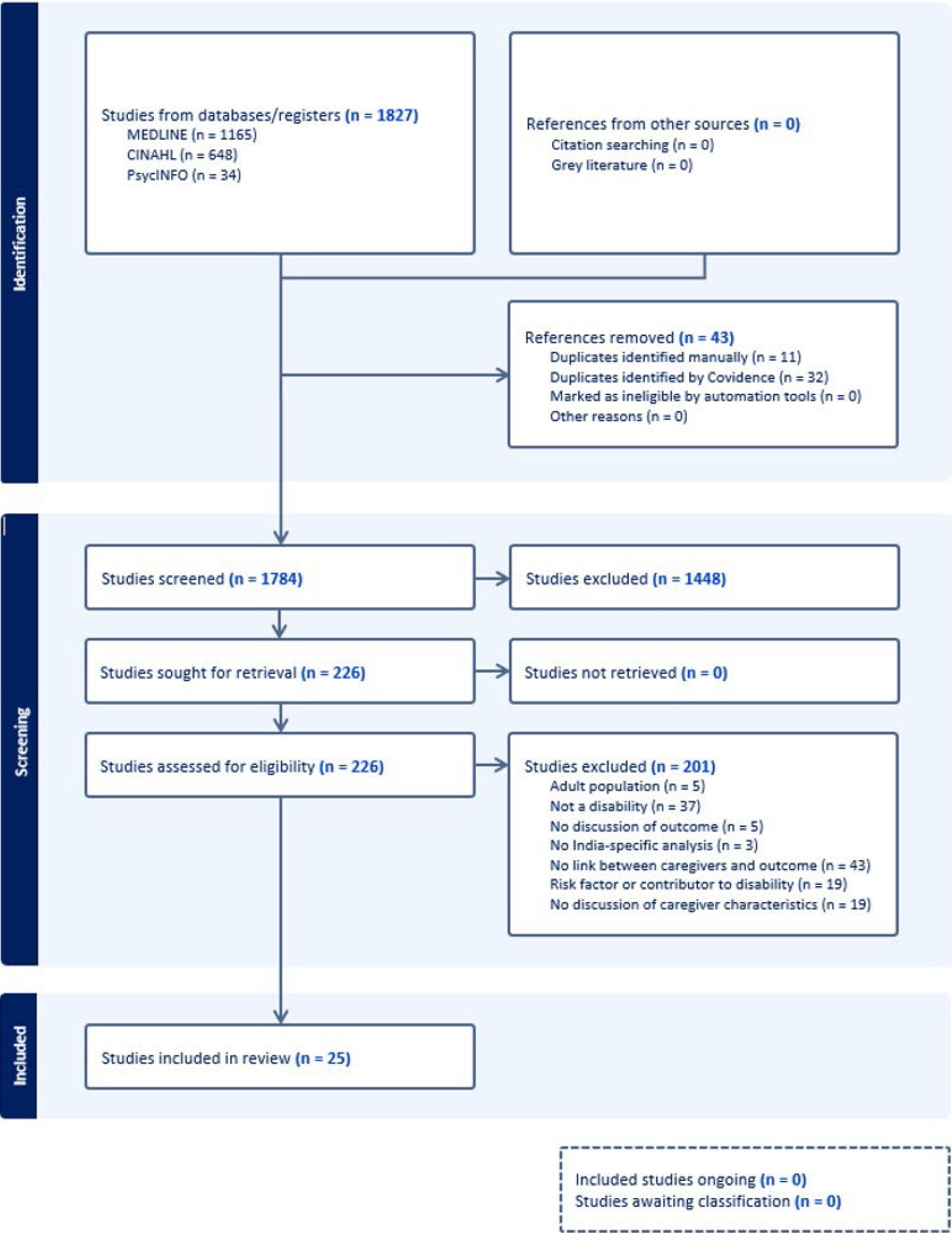
Figure 1
PRISMA diagram
Table 3
Summary of Characteristics of Qualitative Studies
| Author and date | Theoretical basis and method | Disability studied | Outcomes observed | Key findings |
|---|---|---|---|---|
| Kaniamattam et al. 202143 | Interpretive phenomenological analysis, open-ended semi-structured interviews | Intellectual and developmental disabilities | Communication, educational outcomes, toileting | Parent interviews highlighted the following themes: (1) unmet or undermet needs and expectations from rehabilitation; (2) changing needs and expectations of parents as their children grow older; (3) a significant inadequacy of communicative participation and interaction opportunities for the participant’s children. |
| Kathuria 202244 | Explorative descriptive study, questionnaire and unstructured interview | Hearing impairment | Identity formation | Educated parents were better with respect to the identity formation and self- image of their children, as compared to the parents who had low educational backgrounds. |
| Naik et al. 201945 | Unspecified qualitative descriptive study, in-depth semi structured interviews | Autism | Executing ADLs (feeding, toileting) | It was found that parents encountered difficulty executing ADLs for their children, that they are finding their own strategies to manage the difficulties in executing ADLs; and that most parents reported that eating and toileting activities are the most affected areas in execution and difficulty. |
| Noori et al. 202346 | Unspecified qualitative design, in-depth interviews | Autism spectrum disorder | Executing ADLs (feeding, personal hygiene), sexuality, behavioral problems | Parents have a range of reasons for the discontinuation of rehabilitation services (such as logistic difficulties, financial difficulties, family commitments, difficulty handling the child, lack of satisfaction with the existing treatment, and lack of improvement). There exist multiple barriers to accessing rehabilitation services, including parenting challenges and child-related factors. |
| Samuel et al. 202347 | Interpretive phenomenological analysis, focus group discussion | Developmental disabilities | Feeding | The failure of caregivers to recognize sensory and behavioral issues in feeding acts as a barrier to seeking help, responsive feeding practices are difficult when children are not able to indicate food preferences, and familial factors disproportionately impede mothers' ability to facilitate feeding. |
| Krupa et al. 201948 | Mixed methods study | Autism | Communication | Better and more natural communication behaviors of children were observed at home than at clinic. Greater joint engagement at home indicated better representation of communication profile at home. |
Table 4
Thematic Analysis of Qualitative Studies
| Theme | Quotes |
|---|---|
| Direct caregiver intervention assists child behavioral and communication outcomes | “Parents’ narratives reflected prioritization of children uttering words over communicating ideas.” 43 “One mother said, “I use visual schedules to teach him about toileting activity.” 45 “As reported by most of the parents, use of various strategies makes it easy for the parents as well as the child to manage their daily routine.” 45 “I have to take his food along if travelling long distances. He only eats if I show him rhymes on the phone. While travelling, I will wait 10–12 hours till he is really hungry so that he will eat without the phone.” 47 “Greater joint engagement at home indicated better representation of communication profile at home.” 48 |
| Caregiving capacity reduces with lower SES | “At the RC, it was common to see mothers taking on a case manager’s role and coordinating multiple medical and rehabilitation services for their children, while fathers worked to pay for these services.” 43 “The families with poor socio-economic status are not able to pay much attention to the personal and identity needs of their deaf child.”44 “It was an enormous expense for the family to meet the cost of the individual therapy session(s) with the father’s low income. Some parents expressed financial constraints to meet travel expenses and accommodation costs, in order to avail of therapy at distant places, in addition to the therapy charges.”46 |
| Disapproval from the extended family hinders caregivers | “[T]he therapist would say that my son should be given opportunities to speak often… even when this was said to them, they never did anything supportive to help him progress.”43 “The child who is neglected by the family would have poor self-image and identity crises as compared to the child who has a loving and caring home environment.”44 “A mother (M10) recollected an incident where she felt miserable that her own family members accused her of being careless and unresponsive to her child’s injurious behaviors toward other children.”46 “I don’t compel her to eat, but my mother-in-law insists that I give her extra. She believes giving her extra will make her healthy. She says it’s not good for children to be skinny. For me, she is already hyperactive, this weight is enough, I don’t want her to gain weight also. Usually, after 10 mouthfuls, she starts crying, so I feel bad forcing her to eat. After that, she eats only because she is scared of me.”47 |
Table 5
Summary of Characteristics of Quantitative Studies
| Author and date | Type of study | Disability studied | Sample size | Objective |
|---|---|---|---|---|
| Arya et al. 201449 | Cross-sectional study | Epilepsy (generalized and partial) | n(children)= 110. | 1. To assess self‑reported QOL in children with epilepsy using a Hindi translation of QOL in children with epilepsy questionnaire. 2. To assess the demographic factors and clinical factors which influence the QOL in children with epilepsy. |
| Das et al. 201750 | Cross-sectional study | Cerebral palsy | n(children) = 50, age 4-12 | To determine the QOL in Indian children with CP using CP‑QOL questionnaire and to correlate QOL scores with demographic details of the patient. |
| Gupta et al. 201851 | Cross-sectional follow-up study | Autism spectrum disorder | n(children) = 204. | To analyse the effect of the demographic variables related to disabled child, his/her parents and the family; their schooling pattern and types of study settings and the associated comorbidities on improvement in the performance score of students attending these study settings in one academic year. |
| Jacob et al. 2021 52 | Cross-sectional study | ADHD, comorbidities: ODD = 20 (52.6%), SLD = 19 (50%), dissociative disorder, OCD = 2 (5.3%), none = 6 (15.8%) | n(children)= 38, age 8-16 | To examine perceived parenting and its correlation with emotional and behavioral problems in children and adolescents with a diagnosis of ADHD |
| Karande et al. 202253 | Cross-sectional questionnaire | Borderline intellectual functioning | n(parents)=100, n(children) = 100 | 1. To evaluate the parental‑perceived health‑related quality of life (HRQoL) of these students. 2. to analyze the impact of sociodemographic variables on their HRQoL. |
| Kumari et al. 202054 | Pre-post development of module | Autism, intellectual disability | n(autism and intellectual disability) = 16, n(intellectual disability alone) = 14, age = 3-18 | The aim of this study was to develop the test efficacy of a simple, short manualized PE module for parents of children with autism with/without comorbid ID and for ID alone. We focused on both autism and ID (A-ID) because we felt that both the groups could benefit from this module. |
| Manikandan et al. 202255 | Cross-sectional study | Intellectual Development Disorder, Autism spectrum disorder, motor disorder, | n(children)= 79, mean age = 5.1 (SD = 2.01) | To examine the relationship between oromotor deficits, behavior problems related to feeding, and caregiver perception of the behavior in children with special needs. |
| Manohar et al. 201956 | Randomized controlled trial | Autism spectrum disorder | intervention n=26, control n=24. | To evaluate the acceptability and feasibility of an ASD-specifc behavioral intervention, deliverable in resource limited settings, over a brief time frame. |
| Mhatre et al 201657 | Cross-sectional survey | Autism spectrum disorder | n(children) = 150. | To investigate long-term outcomes in children with diagnosis of autism spectrum disorders based on Childhood Autism Rating Scale (CARS score). |
| Nagabushana et al. 201958 | Cross-sectional prospective study | Epilepsy | n(children)= 40. | To assess the impact of epilepsy and antiepileptic medications on the child's development, health, scholastic performance, and QOL and to identify the predictors of QOL. |
| Pareek et al 201559 | Randomized controlled trial- single blind parallel design | Hearing impairment/mutism | n = 105 in each of three groups. | To assess the dental health outcomes following supervized tooth brushing among institutionalized hearing impaired and mute children in Jaipur, Rajasthan. |
| Saha et al. 201660 | cross sectional descriptive study | Thalassemia | n(children) = 365, age 5-12 | To assess the school activity of thalassemic children and to reveal the relationship between school activity with the socio-demographic factors as well as clinicotherapeutic profile. |
| Shah et al. 201961 | Cross-sectional questionnaire | Autism | n(children) = 58, n(caregivers) = 58 | To investigate the relationship between oral health‑related behaviors of autistic children and SOC of their caregivers. |
| Shah et al. 202162 | Non-randomized pre-post intervention study | ADHD | n(children) = 36, mean age = 9 (SD = 2.61) | To describe the development and effectiveness of a culturally-contextualized parent skills training intervention for Indian families. |
| Sharawat et al. 202363 | Prospective longitudinal study | Cerebral Palsy | n(children)=569, age = 2-17.5 years | To assess the prevalence, severity, and predictors of malnutrition in children with cerebral palsy and its impact on quality of life. |
| Singhal et al. 201864 | Two group comparison design with repeated baseline assessments | Depression | n(intervention) = 51, n(control) = 49, age = 13-18 | To study the efficacy of a school-based group coping skills program for Indian adolescents with subclinical depression |
| Thiyagarajan et al. 201965 | Cross-sectional study | Thalassaemia | n(children)= 125, n(parents) = 125, mean age = 6 (SD = 3.67) | 1. To assess the factors influencing the healthrelated quality of life. 2. To hypothesize whether the parent’s psychological wellbeing, sociodemographic characteristics and transfusion interval have an impact on children’s quality of life |
| Sud et al. 202368 | Cross-sectional study | Hearing loss | n(parents) = 50, n(children) = 50 | To understand the parental views regarding stress, and its effect on language, and auditory outcomes. The study also aims to understand the relationship between parental stress, and child's age. |
| Arya et al. 201449 | QOLCE score: physical function, emotional wellbeing, cognitive function, social function, and behavior | Maternal education, paternal education, SES | None | No significant association of the total QOLCE score with gender, residence, socioeconomic status, paternal/maternal education, or family type. |
| Das et al. 201750 | CP-QOL | Maternal education | The QOL score of children whose mothers were literate was computed to be 36.2 ± 5.47 as against a QOL score of 39.8 ± 5.17 for those with uneducated mothers. | None |
| Gupta et al. 201851 | improvement in school performance scores, functional assessment checklist developed by NIMHS | Family type, religion, urban/rural, income, parental education, SES, caregiver status, time allotted by parents to child, working status | Statistically significant difference in mean scores between parents giving no time to their children at home then the parents giving 1–2 h (P = 0.015 on ANOVA). | The effect of family type, size, religion, income on acquisition of skills was also not found significant. Our finding also depicts nonsignificant relation of family income and acquisition of skills in one academic year. |
| Jacob et al. 202152 | SDQ domains, ADHD-RS-IV (severity of ADHD symptoms) | Urban/rural, involvement (mother and father), positive parenting, discipline, supervision, corporal punishment | Parental involvement significantly negatively correlated with SDQ (total problem score correlation P = 0.002) as well as individual scores with respect to peer and conduct problems. Positive parenting significantly correlated with both the total problem scores on SDQ as well as the individual scores on emotional problems. | The other domains of poor supervision, inconsistent disciplining as well as corporal punishment did not correlate significantly with the problem scores on the SDQ. |
| Karande et al. 202253 | HRQOL score (DISABKIDS long version) | Age, gender, education status, work status, SES, family type | A longer duration of poor school performance and higher parental age were significantly associated with a lower “independence” facet score respectively. Higher IQ and higher socioeconomic status were associated with lower social exclusion facet score | No sociodemographic variable was significantly associated with emotion and limitation facet and the total scores |
| Kumari et al. 202054 | ISAA (autism), BASIC-MR, Developmental Screening Test (behavioral characteristics of respective age levels) | None | A significant improvement was observed in ISAA after parental education in the intellectual group in social relationships and reciprocity emotional responsiveness , speech and communication total ISAA score. various domains of violent behavior, hyperactivity, and total BASIC-MR Part B score (P = 0.05). For intellectual disability only group: violent behavior (0.06), self-injurious behavior (0.02), repetitive behavior (0.024), and odd behavior (0.03) decreased significantly after parental education. | None |
| Manikandan et al. 202255 | BPFAS (feeding behavior). SOMA (oral-motor skills) | Age, gender, employment, religion, cultural background, education, type of family, relationship to child | When we compared caregivers who were employed with those who were homemakers, there was a statistically significant difference between groups (F= 2.506, p= .038) when compared with the Total Problem Score- total of the BPFAS. Increased feeding-related behavior problems were attributable to parent-related factors. | No significant associations between caregiver gender, religion, cultural background, educational qualification, type of family, relationship to the child, and number of children with the various subscores of the BPFAS. |
| Manohar et al. 201956 | CARS score (autism severity), VSMS (social proficiency), FISC (stress and coping strategies), 10 point visual analog scale (parent’s and clinician’s perception of child’s response) | Changes in CARS total score positively correlated with the number of hours of intervention (p = 0.001) as well as parental understanding and competence. | Parental stress at 12 weeks did not have correlations with severity of the child’s developmental disorder. | |
| Mhatre et al 201657 | CARS score (autism severity), VSMS (social proficiency), speech, ADLs, motor milestones, social interaction | Maternal education, parent participation | Parent participation, that is, practising skills taught at therapy in the home environment may have played a bigger role in the child’s speech development when compared to other factors, as is evident by its greater effect size. | None |
| Nagabushana et al. 201958 | QOLCE score: physical function, emotional wellbeing, cognitive function, social function, and behavior | SES, parental education, family type | None | No statistical significance of socio‑economic status or parental education on QOL. |
| Pareek et al 201559 | Plaque score, gingival index | Twice‑a‑week tooth brushing supervision program performed by the caregivers and investigator was less effective as compared to daily supervision by parents. The assumed reason is that the caregivers did not impart the required skills needed for tooth brushing, suggesting their inactive participation. | None | |
| Saha et al. 201660 | school functioning score | Religion, caste, type of family, residence, SES, parental education | Thalassemic child who were growing up in the environment of joint family, had 3.4 times more risk to develop worse school activity. | None |
| Shah et al. 201961 | frequency of sugar/sugary item intake, toothbrushing frequency, having used dental services (yes/no). | Caregiver gender, marital status, education, occupation, frequency of sugar intake, family income, oral health knowledge score | Children whose mothers had high sense of coherence were more likely to have greater toothbrushing frequency (CI = 1.0–1.28, P = 0.035). Higher family income correlated with increased frequency of toothbrushing. | None |
| Shah et al. 202162 | VADPRS scores (core symptoms of ADHD, rating of performance, and classroom behavior) | Religion, family type, education, urban/rural | Significant improvement in inattention (p < 0.001), hyperactivity/impulsivity (p = 0.007) and conduct problems (p < 0.002). Functional improvement in terms of significant reduction in problem areas in the domains of academic performance (p < 0.001), and classroom behavior (p = 0.001). Education of primary participating parent had significant negative correlation with both preand post- intervention VADPRS hyperactivity/impulsivity scores. | None |
| Sharawat et al. 202363 | CP-QOL: social well‑being and acceptance, functioning, participation and physical health, emotional well‑being and self‑esteem, access to services, pain and impact of disability, and family health), anthropometric data (height, weight) | SES, urban/rural, maternal education, paternal education | Children with CP belonging to lower SES had a greater prevalence of wasting, stunting, and underweight, as well as severe wasting, stunting, and underweight (p=0.03, 0.001, and 0.004 respectively). | The educational level of the parents had no statistically significant impact on the undernutrition status of participants (p>0.05). |
| Singhal et al. 201864 | Various measures of depression, coping and academic stress | Parental baseline depression | Adolescents with fathers having low baseline depression scores showed greater improvement in coping. | None |
| Thiyagarajan et al. 201965 | HRQOL score, RPWBS: psychological wellbeing | Gender, age, education, religion, monthly income, psychological wellbeing | Positive correlation between parents’ psychological well-being and children’s HRQoL (r = 0.329, n = 125, p < 0.001). Educational qualification (R = 1.109), monthly income (R = 1.023) correlated with HRQOL. | None |
[i] Notes. (a) Caregiver characteristics correlated with a developmental outcome have been listed in bold.