Have a personal or library account? Click to login
Anatomical variations of the cervical vagus nerve on ultrasonography: a cross-sectional study Cover

Anatomical variations of the cervical vagus nerve on ultrasonography: a cross-sectional study

Open Access
|Sep 2025

Figures & Tables

Fig. 1.

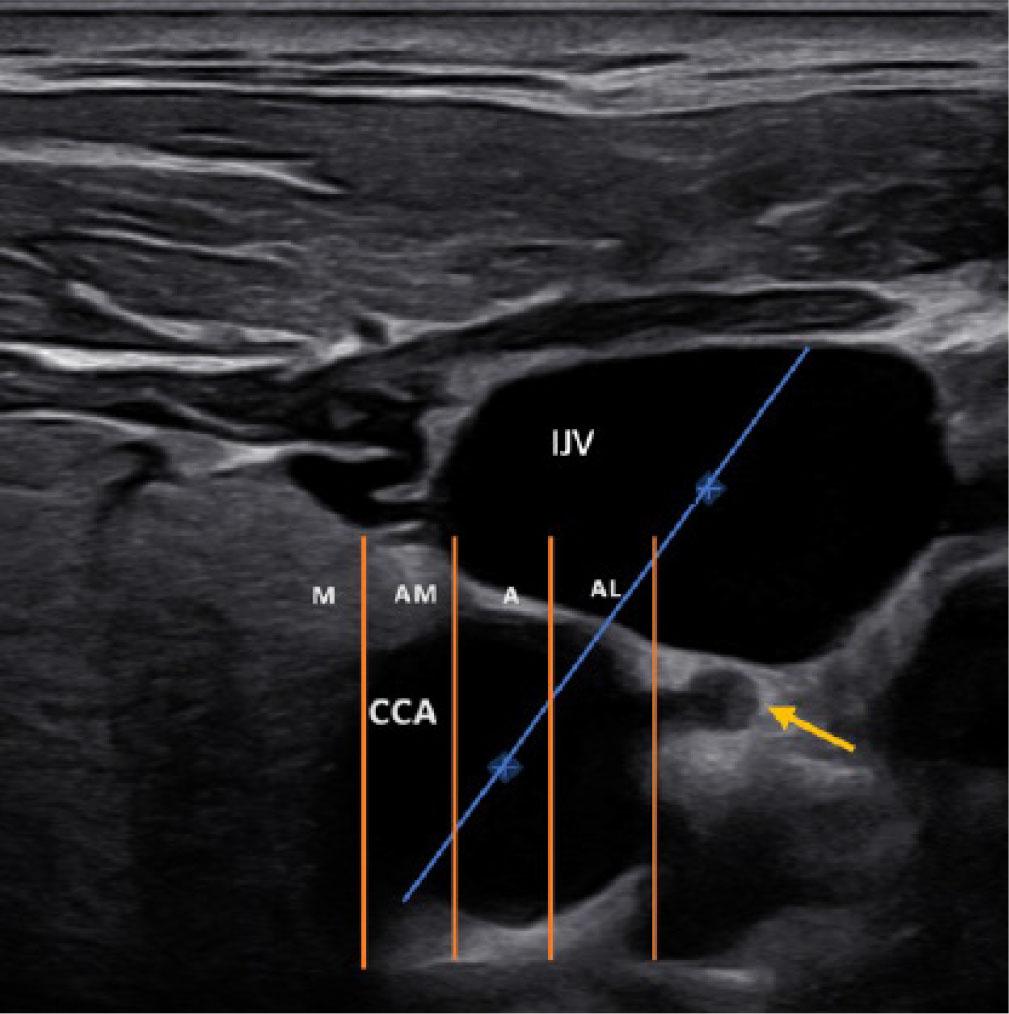
Ultrasound of the neck showing the usual position of the VN (yellow arrow). The VN is located posterior or lateral to the reference axis that joins the centers of the CA and IJV (blue line). A variation in position is defined as the VN being located anterior or medial to the C-I axis. Variations are classified into four types: anterolateral (AL), anteromiddle (A), anteromedial (AM), and medial(M) – based on the relative location of the VN to the carotid artery

Fig. 2.

Transverse gray-scale ultrasonographic images of the right (A) and left (C) carotid sheaths in a 24-year-old female, showing the CVN relative to the reference axis (C-I axis). The right VN (yellow arrow) shows an anteromiddle variation (A). Image B shows the shortest distance of 3.3 mm between the right VN and the ipsilateral thyroid lobe (represented by “T”). The left VN is in the typical textbook anatomical location i.e. posterolateral to the CCA and posteromedial to the IJV on the right side, as demonstrated in image C

Fig. 3.

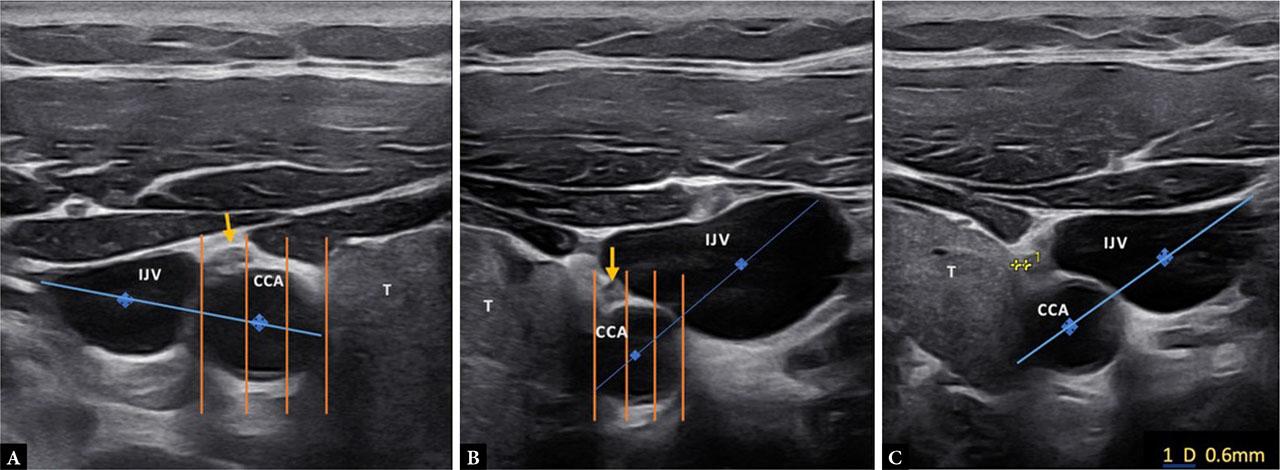
Transverse gray-scale ultrasonographic images of the right (A) and left (B) carotid sheaths in a 40-year-old female, showing the CVN relative to the reference axis (C-I axis). The right VN (yellow arrow) shows anterolateral variation, as demonstrated in image A. The left VN (yellow arrow) shows anteromedial variation, as demonstrated in image B. Image C shows the shortest distance of 0.6 mm of the left VN from the ipsilateral thyroid lobe (represented by “T”)

Vagus nerve variations according to patient demographics

Variable, n (%)No.Variation (+) (n = 132)Variation (−) (n = 215)P-value

Sex
  Male10348 (36.4)55 (25.6)0.033
  Female24484 (63.6)160 (74.4)

Age
  <20385 (3.8)33 (15.3)
  20–3913127 (20.5)104 (48.4)<0.001
  40–5913170 (53.0)61 (28.4)
  >604730 (22.7)17 (7.9)

Prevalence of vagus nerve variations by side and variation characteristics

Variable, n (%)Right (n = 347)Left (n = 347)P-value

Position of the vagus nerve
  Normal326 (94.0)114 (32.9)<0.001
  Variation21 (6.0)233 (67.1)

Types
  Anterolateral5 (1.4)63 (18.1)
  Anteromiddle9 (2.6)114 (32.9)0.040
  Anteromedial3 (0.9)42 (12.1)
  Medial4 (1.1)14 (4.0)

Level of variation
  Variation at Level III8 (2.3)112 (32.3)<0.001
  Variation at Level IV13 (3.7)121 (34.9)

Proximity to the thyroid gland
  Significant proximity (<2 mm, including abutting)8 (2.3)61 (17.6)
  • Abutting thyroid gland (0 mm)3 (0.9)10 (2.9)0.071
  • Within <2 mm but not abutting5 (1.4)51 (14.7)
  >2 mm (safe distance)8 (2.3)109 (31.4)
DOI: https://doi.org/10.15557/jou.2025.0025 | Journal eISSN: 2451-070X | Journal ISSN: 2084-8404
Language: English
Submitted on: Apr 20, 2025
Accepted on: Sep 16, 2025
Published on: Sep 30, 2025
Published by: MEDICAL COMMUNICATIONS Sp. z o.o.
In partnership with: Paradigm Publishing Services
Publication frequency: 4 issues per year

© 2025 Sukhmani Randhawa, Kunwar Pal Singh, Arvinder Singh, Pooja Pal, Sukhdeep Kaur, published by MEDICAL COMMUNICATIONS Sp. z o.o.
This work is licensed under the Creative Commons Attribution-NonCommercial-NoDerivatives 4.0 License.