Have a personal or library account? Click to login
An assessment of the relationship between urethral hypermobility as measured by ultrasound and the symptoms of stress urinary incontinence in primiparous women 9–18 months postpartum Cover

An assessment of the relationship between urethral hypermobility as measured by ultrasound and the symptoms of stress urinary incontinence in primiparous women 9–18 months postpartum

Open Access
|Mar 2024

Figures & Tables

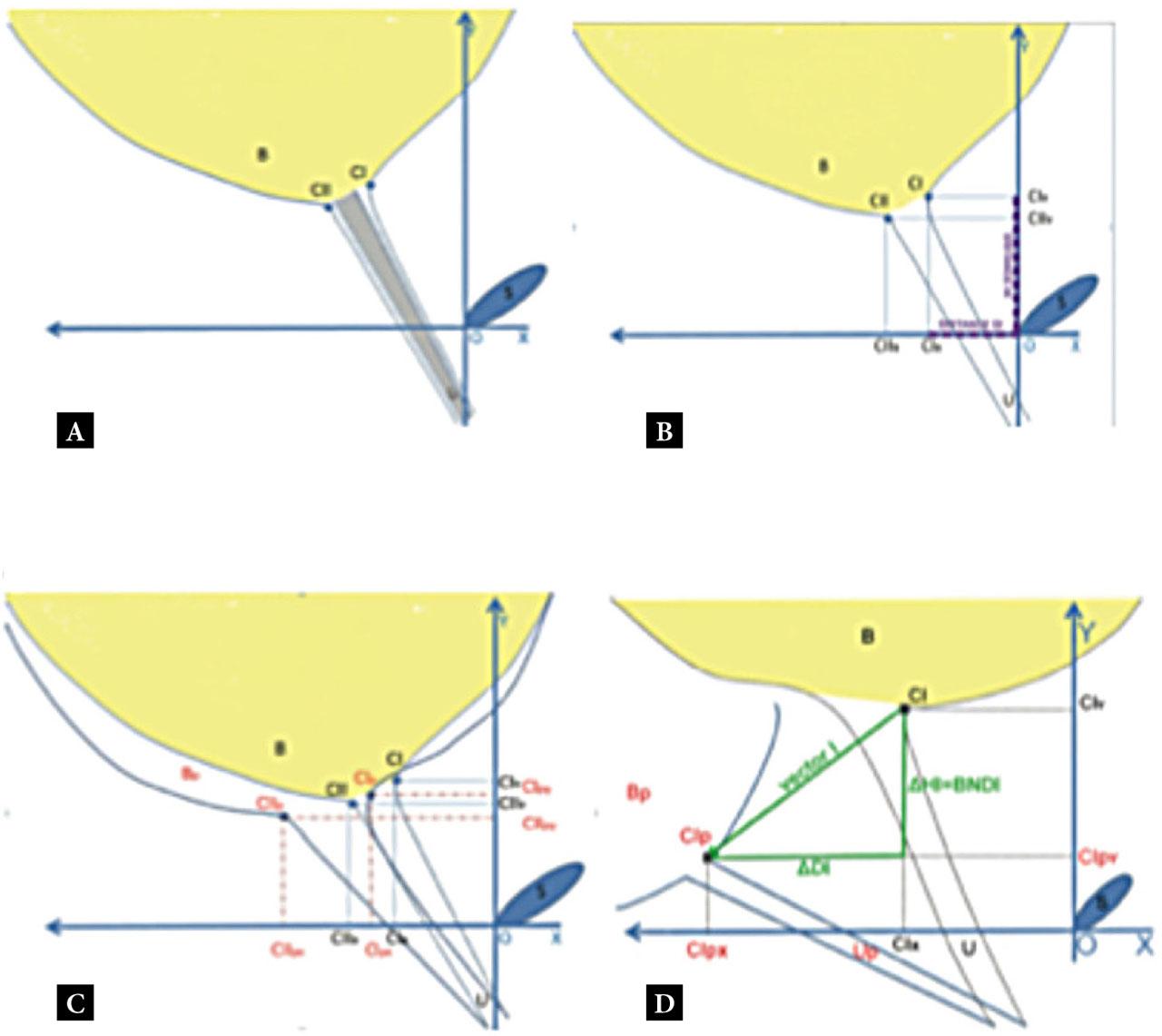
Fig. 1.

A diagram showing ultrasound parameters of the internal urethral opening at rest and during the Valsalva maneuver. A. Location of CI and CII points within the internal urethral opening. B. Location of points CI and CII on the OY and OX axes. C. Location of points CI and CII (at rest), as well as Ci p and CII p (during the Valsalva maneuver) on the OY and OX axes. D. Calculation of bladder neck descent parameters: BND and vector; S – pubic symphysis; B – urinary bladder; U – urethra; CI and CII – points referring to the internal urethral opening at rest; CI x and CII x – projection of CI and CII points on the OX axis; CI y and CII y – projection of CI and CII points on the OY axis; B p – urinary bladder at maximum pressure; Ci p and CII p – points locating the internal urethral opening during the Valsalva maneuver; CI px and CII px – projection of the points CI p and CII p on the OX axis; CIpy and CII p – projection of CIp and CIIp points on the OY axis; ∆HI – BND for the CI point during the Valsalva maneuver; Vector I – vector for the CI point during the Valsalva maneuver

Voiding symptoms (UDI-6)

Do youNOYES
1. Urinate frequently?01234
2. Usually experience urine leakage related to urgency?01234
3. Usually experience urine leakage related to coughing, sneezing, laughing?01234
4. Usually experience minor urine leakage (small amounts, drops)?01234
5. Usually experience difficulty emptying your bladder?01234
6. Usually experience pain or discomfort in your lower abdominal, pelvic, or genital area?01234

Demographics for groups: I – study group, II – control group, III – total sample

VariableGroup IGroup IIGroup IIIp-value
Age – median (IQR)30 (27–31)30 (29–33)30 (28–32)0.1972
RaceCaucasianCaucasianCaucasian
Body weight during the examination – median (kg) (IQR)65 (54–74)60 (56–70)62 (51–70)0.713
Height (cm) – median (IQR)169 (163–172)166 (164–172)167 (164–172)0.4694
Body weight at delivery (kg) – median (IQR)83 (67–90)74 (70–85)75 (70–86)0.3171
BMI at delivery – median (IQR)25.62 (24.22–32.25)27.34 (24.68–29.14)27.31 (24.68–29.18)0.802
Type of work, N(%)
Manual3 (16%)0 (0%)5 (5%)
Intellectual15 (79%)79 (98%)94 (94%)
Housewife1 (5%)0 (0%)1 (1%)
Education, n(%)
Primary0 (0%)0 (0%)0 (0%)
Secondary4 (21%)7 (9%)11 (11%)
Higher15 (79%)74 (91%)89 (89%)
Pre-delivery SUI0%0%0%
Child’s birthweight – median (g) (IQR)3500 (3,210–3,895)3,420 (3,200–3,720)3,430 (3,200–3,735)0.3722
DOI: https://doi.org/10.15557/jou.2024.0010 | Journal eISSN: 2451-070X | Journal ISSN: 2084-8404
Language: English
Submitted on: Feb 25, 2023
Accepted on: Jul 25, 2023
Published on: Mar 14, 2024
Published by: MEDICAL COMMUNICATIONS Sp. z o.o.
In partnership with: Paradigm Publishing Services
Publication frequency: 4 issues per year

© 2024 Paulina Maria Pająk, Edyta Wlaźlak, Grzegorz Surkont, Jarosław Kalinka, published by MEDICAL COMMUNICATIONS Sp. z o.o.
This work is licensed under the Creative Commons Attribution-NonCommercial-NoDerivatives 4.0 License.