Have a personal or library account? Click to login
Sonographic assessment of the tarsal tunnel compared to cadaveric findings: a pictorial study Cover

Sonographic assessment of the tarsal tunnel compared to cadaveric findings: a pictorial study

Open Access
|Sep 2023

Figures & Tables

Fig. 1.

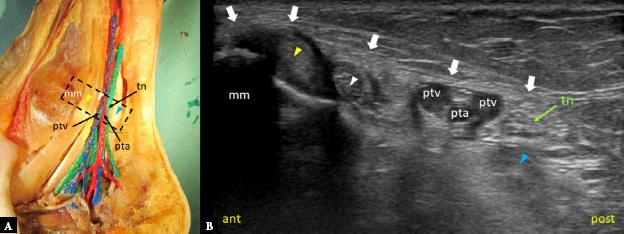
An anatomic section of the tarsal tunnel (A) and an axial ultrasound image showing the proximal tarsal tunnel (B). Dashed rectangle indicates probe placement. Anterior (ant) indicates the anterior part of the tarsal tunnel, and posterior (post) the posterior part. Tibial nerve (tn), posterior tibial artery (pta), posterior tibial veins (ptv), tibialis posterior tendon (yellow arrowhead), flexor digitorum longus tendon (white arrowhead), flexor hallucis longus tendon (blue arrowhead), medial malleolus (mm), flexor retinaculum (thick white arrows)

Fig. 2.

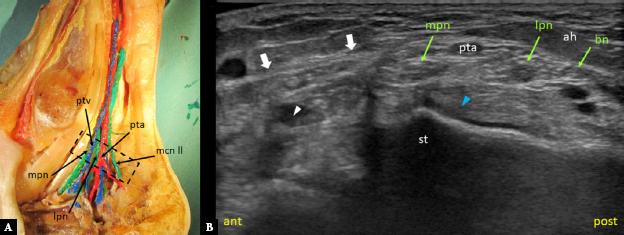
An anatomic section of the tarsal tunnel (A) and an axial ultrasound image showing the distal tarsal tunnel above the level of posterior tibial artery bifurcation (B). Dashed rectangle indicates probe placement. Anterior (ant) indicates the anterior part of the tarsal tunnel, and posterior (post) indicates the posterior part. Medial plantar nerve (mpn), lateral plantar nerve (lpn), Baxter’s nerve (bn), posterior tibial artery (pta), posterior tibial vein (ptv), calcaneal nerve second branch (mcn ll). Flexor digitorum longus tendon (white arrowhead), flexor hallucis longus tendon (blue arrowhead), flexor retinaculum (thick white arrows), sustentaculum tali (st), abductor hallucis muscle (ah). On Fig. 2 A, MPN and LPN run anterior to PTA. On Fig. 2 B, PTA runs between MPN and LPN

Fig. 3.

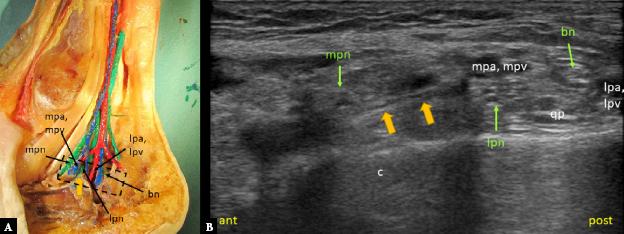
An anatomic section of the tarsal tunnel (A) and an axial ultrasound image showing the distal tarsal tunnel below the level of posterior tibial artery bifurcation (B). Dashed rectangle indicates probe placement. Anterior (ant) indicates the anterior part of the tarsal tunnel, and posterior (post) the posterior part. Medial septum (thick orange arrow), medial plantar nerve (mpn), lateral plantar nerve (lpn), Baxter’s nerve (bn), medial plantar artery and veins (mpa, mpv), lateral plantar artery and veins (lpa, lpv). Quadratus plantae muscle (qp), calcaneus (c). On Fig. 3 A, the Baxter’s nerve runs posteroinferior to LPA and LPV and anterosuperior on Fig. 3 B

Fig. 4.

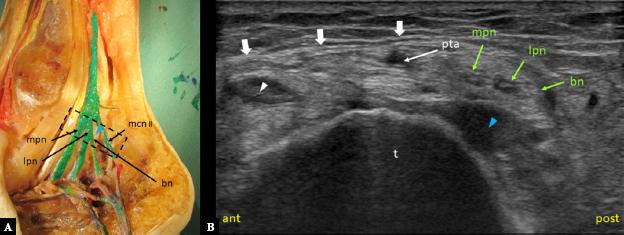
An anatomic section of the tarsal tunnel (A) and an axial ultrasound image showing the tarsal tunnel at the level of tibial nerve division (B). Dashed rectangle indicates probe placement. Anterior (ant) indicates the anterior part of the tarsal tunnel, and posterior (post) indicates the posterior part. Tibial nerve division site (white asterisk), medial plantar nerve (mpn), lateral plantar nerve (lpn), posterior tibial artery (pta), posterior tibial vein (ptv), calcaneal nerve second branch (mcn ll). Flexor digitorum longus tendon (white arrowhead), flexor hallucis longus tendon (blue arrowhead), tibialis posterior tendon (yellow arrowhead), flexor retinaculum (thick white arrows), talus (t). On Fig. 4 A, MPN and LPN run anterior to PTA. On Fig. 4 B, PTA runs anterior to MPN and LPN

Fig. 5.

Anatomic section of the tibial nerve and its branches (A) and an axial ultrasound image showing the tarsal tunnel at the level of Baxter’s nerve branching point (B). Dashed rectangle indicates probe placement. Anterior (ant) indicates the anterior part of the tarsal tunnel, and posterior (post) indicates the posterior part. Baxter’s nerve (bn) branched off lateral plantar nerve (lpn) just below the level of tibial nerve (tn) bifurcation. Baxter’s nerve (bn), medial plantar nerve (mpn), lateral plantar nerve (lpn), posterior tibial artery (pta). Flexor digitorum longus tendon (white arrowhead), flexor hallucis longus tendon (blue arrowhead), flexor retinaculum (thick white arrows), talus (t). Tibial nerve (tn), medial calcaneal nerve first branch (mcn l), medial calcaneal nerve second branch (mcn ll)

Fig. 6.

An anatomic section of the tibial nerve (A) and an axial ultrasound image showing the distal tarsal tunnel (B). Dashed rectangle indicates probe placement. Anterior (ant) indicates the anterior part of the tarsal tunnel, and posterior (post) indicates the posterior part. Baxter’s nerve (bn) can be seen between the abductor hallucis (ah) and the quadratus plantae (qp) muscle. In Fig. A, ah was cut from its posterior origin and its posterior portion is not visible. Tibial nerve (tn), medial plantar nerve (mpn), lateral plantar nerve (lpn), medial plantar artery and veins (mpa, mpv). Flexor digitorum longus tendon (white arrowhead), flexor hallucis longus tendon (blue arrowhead), flexor retinaculum (thick white arrow), calcaneus (c).

Fig. 7.

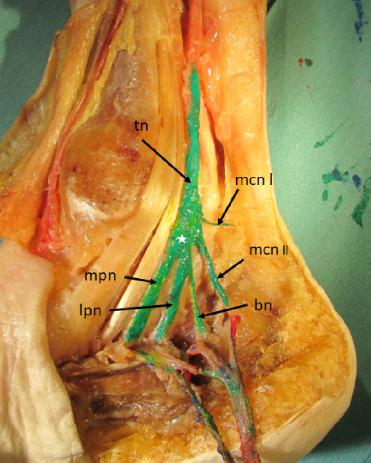
An anatomic section of the tibial nerve and its terminal branches. Neural structures are coloured green. Vascular structures are removed for better visualization. Tibial nerve (tn), medial calcaneal nerve first branch (mcn l), medial calcaneal nerve second branch (mcn ll), medial plantar nerve (mpn), lateral plantar nerve (lpn), Baxter’s nerve (bn), tibial nerve division site (white asterisk)

Fig. 8.

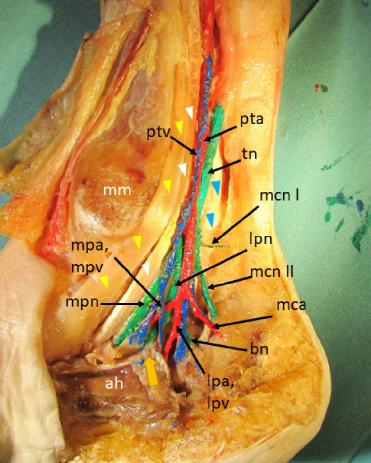
An anatomic section of the tarsal tunnel. Neural structures are coloured green; arteries are coloured red; veins are coloured blue. Tibial nerve (tn), posterior tibial artery (pta), posterior tibial vein (ptv), medial calcaneal nerve first branch (mcn l), medial calcaneal nerve second branch (mcn ll), medial plantar nerve (mpn), lateral plantar nerve (lpn), Baxters nerve (bn), medial plantar artery and medial plantar veins (mpa, mpv), lateral plantar artery and lateral plantar veins (lpa, lpv), medial calcaneal artery (mca), tibialis posterior tendon (yellow arrowhead), flexor digitorum longus tendon (white arrowhead), flexor hallucis longus tendon (blue arrowhead), medial intermuscular septum (thick yellow arrow), medial malleolus (mm), abductor hallucis muscle (ah)
DOI: https://doi.org/10.15557/jou.2023.0023 | Journal eISSN: 2451-070X | Journal ISSN: 2084-8404
Language: English
Page range: e144 - e150
Submitted on: Dec 15, 2022
Accepted on: Apr 11, 2023
Published on: Sep 11, 2023
Published by: MEDICAL COMMUNICATIONS Sp. z o.o.
In partnership with: Paradigm Publishing Services
Publication frequency: 4 issues per year

© 2023 Nežka Harej, Vladka Salapura, Erika Cvetko, Žiga Snoj, published by MEDICAL COMMUNICATIONS Sp. z o.o.
This work is licensed under the Creative Commons Attribution-NonCommercial-NoDerivatives 4.0 License.