Have a personal or library account? Click to login
Sonographic findings of a gynecological cause of acute pelvic pain – a systematic review Cover

Sonographic findings of a gynecological cause of acute pelvic pain – a systematic review

Open Access
|Sep 2022

Figures & Tables

Fig. 1.

Flow chart illustrating the selection of articles for the review (Preferred Reporting Items for Systematic Reviews and Meta-Analyses, PRISMA)

Fig. 2.

PID in various individuals. A. A transverse transvaginal pelvic scan reveals bilateral adnexal masses caused by PID (arrows). Because of the inflammatory material around the ovaries, the ovarian borders are not visible. B. A retroverted uterus demonstrates a dilated uterine cavity (long arrows) with a fluid-fluid level (short arrow) caused by layered purulent material(17,18)

Fig. 3.

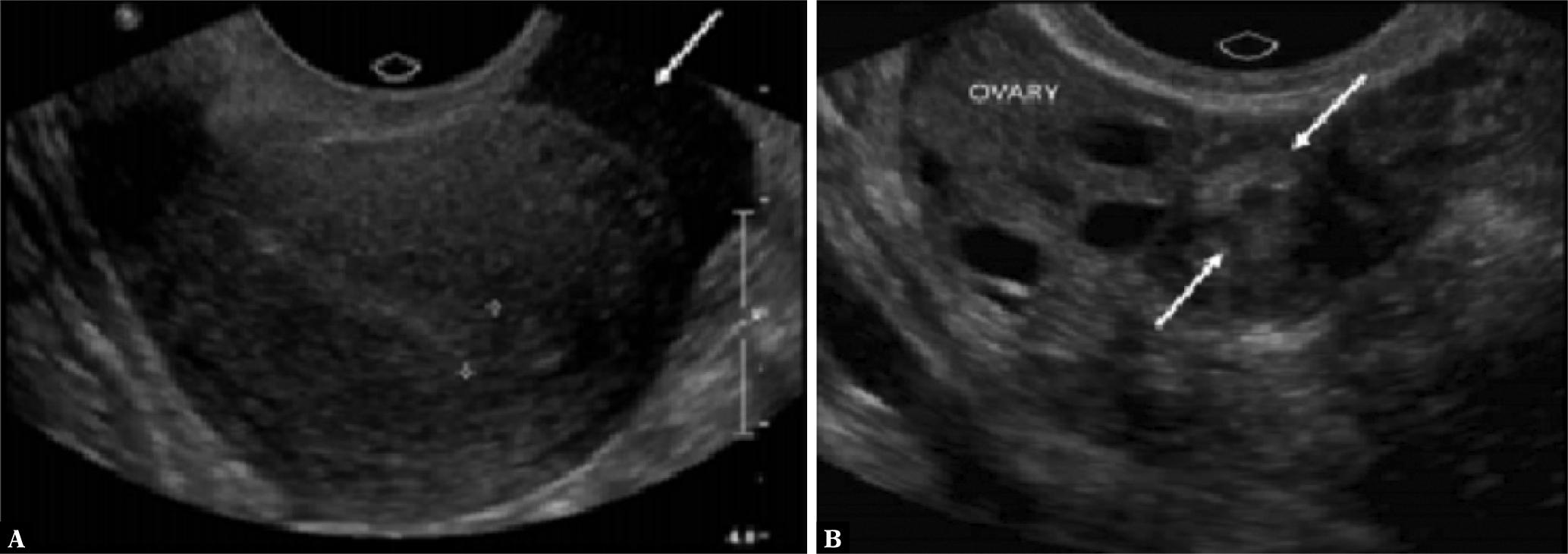
True ectopic pregnancy that was not ruptured, diagnosed in a patient with right adnexal pain. A. Transvaginal ultrasonography reveals a retroflexed uterus surrounded with minimally complicated pelvic fluid (arrow) and a thin endometrium (calipers(26)). B. An echogenic ring (arrows) next to the right ovary, the TEP (this shows the so-called sliding sign separate from the ovary)(27)

Fig. 4.

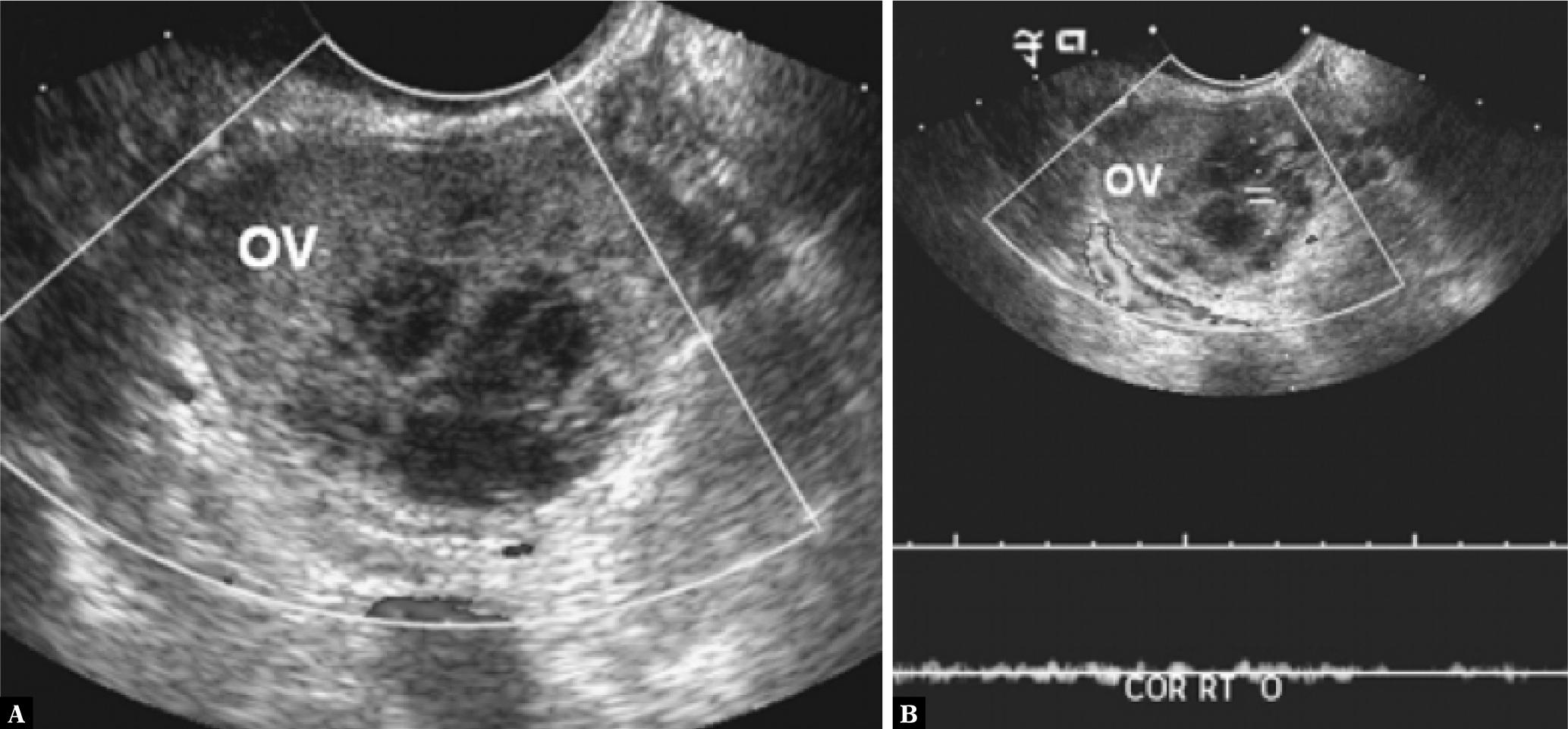
Torsion of the ovaries. Due to ovarian torsion, coronary transvaginal ultrasonography indicates an enlarged ovary with a hemorrhagic cyst and (A) no color flow and (B) no flow on duplex Doppler(34)

Fig. 5.

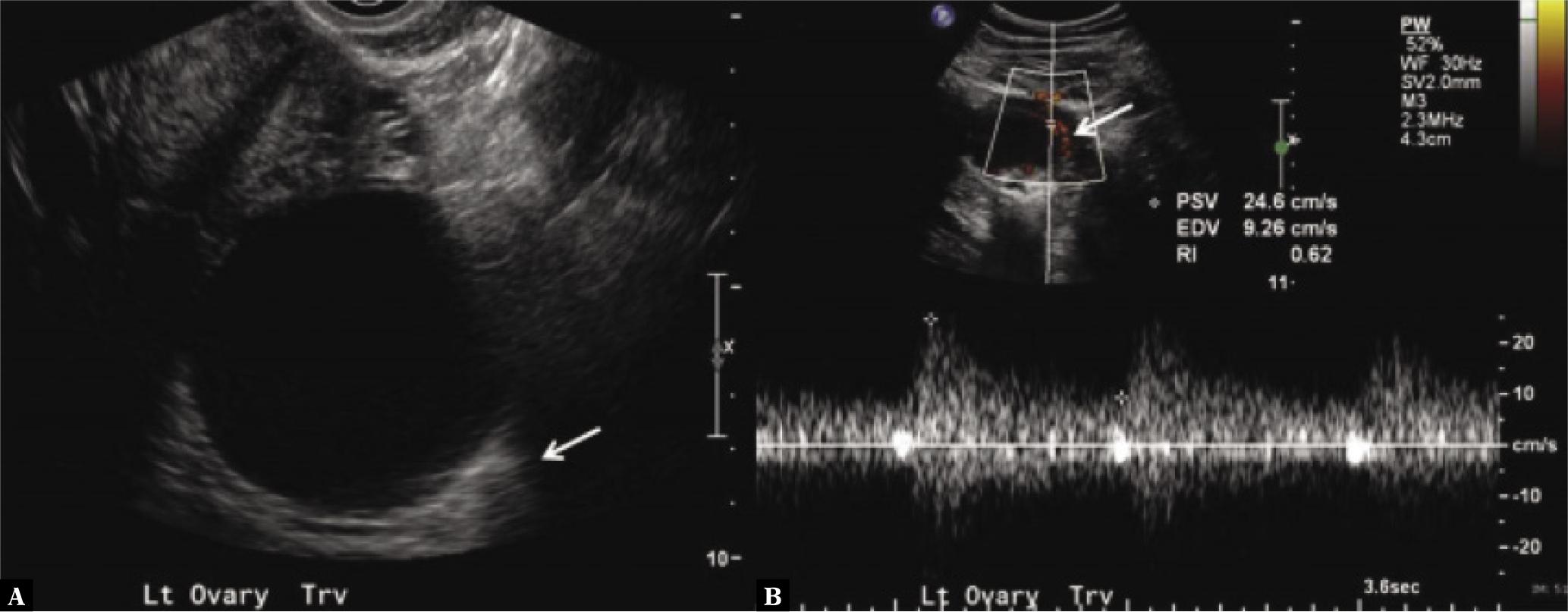
Ovarian cyst, simple/follicular. APP is brought in by a 31-year-old lady. A. A 6.0-cm anechoic cyst with a thin wall and posterior acoustic enhancement is revealed by TVS (arrow). B. Internal vascularity is not found on a pulsed Doppler examination. Normal low-velocity, low-resistance waveforms can be identified in the squeezed and thin margin of ovarian tissue (arrow). A one-year follow-up US examination was advised due to its significance(42)

Fig. 6.

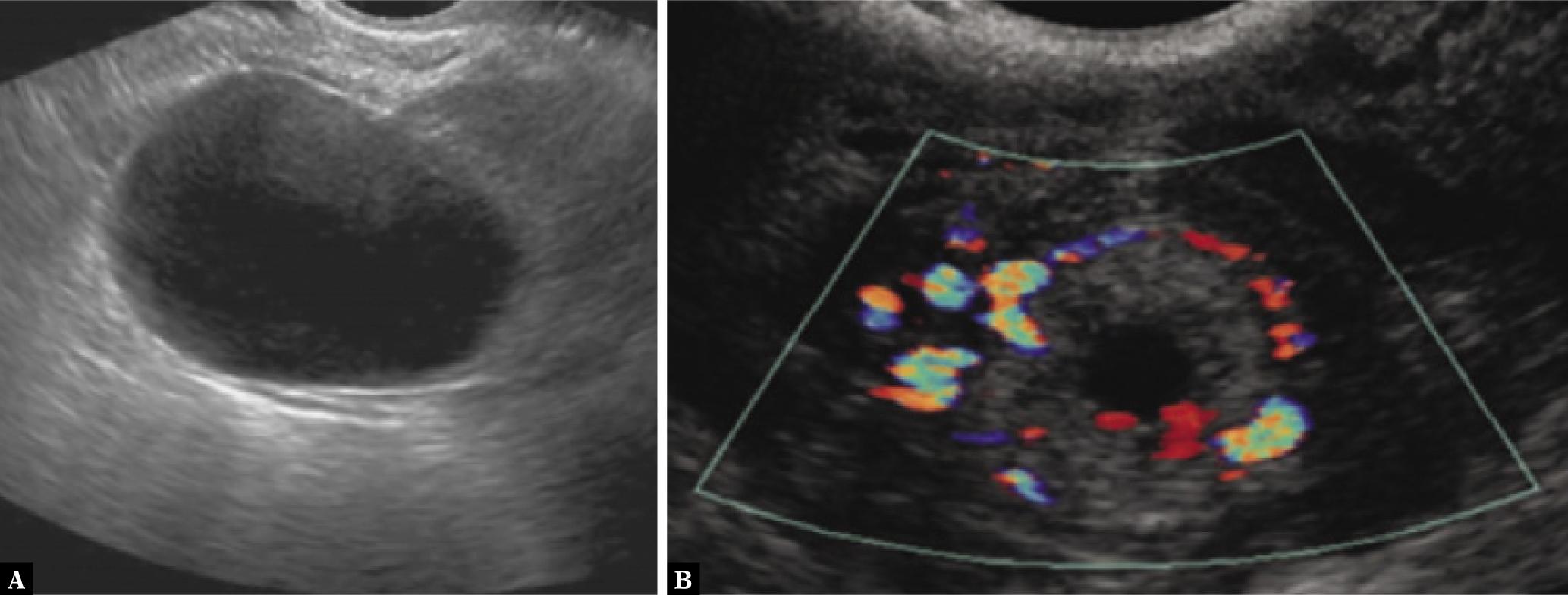
A simple ovarian cyst on the left side. A transverse transvaginal US image (A) shows a well-defined anechoic and hypoattenuating adnexal fluid accumulation. B. The corpus luteum is a Latin term that means “corpus of the luteum”. Color Doppler US shows the thick walls and improved peripheral vascularity of a newly established corpus luteum(18)

Gray-scale and Doppler ultrasound findings for the causes of acute pelvic pain

Causes of acute pelvic painGray-scale findingsDoppler findings
Pelvic inflammatory disease
  • Endometrial thickening or fluid as a result of endometritis

  • Internal echoes or fluid levels in a complicated purulent fluid in the pelvis

  • Pyosalpinx causes dilated fluid-filled fallopian tubes with internal echoes and elevated fluid levels due to purulent debris

  • A multiloculated, septated mass with poorly defined irregular boundaries, internal echoes, and difficulties distinguishing the ovary from the fallopian tube due to tissue degradation is seen on sonography of a tubo-ovarian abscess

  • Air from gas-producing organisms can be detected in TOA as echogenic foci with posterior dirty shadowing.

  • On color Doppler, blood flow may be detected in the tissues between the tubo-ovarian abscess loculations

Ectopic pregnancy
  • Enlargement of the uterus or a decidual response in the endometrium in the absence of a gestational sac

  • A diagnostic finding is a gestational sac in the adnexa containing a fetal pole with heart tones and a yolk sac.

  • Within the uterus, a cystic formation resembling a gestational sac may be observed. This decidual reaction has a single shape, but an early gestational sac has a twofold decidual reaction, though with a thin outer layer. Echogenic fluid due to blood often occurs within the pseudogestational sac.

  • The endometrial cavity echoes may also be exceptionally thick due to a decidual reaction without a pseudo sac.

  • Color Doppler may be helpful because a rim of vessels surrounds and supplies an ectopic pregnancy.

  • A low-resistance pattern at the center of a nonspecific extraovarian mass is typical of an ectopic pregnancy.

Adnexal torsionA big hemorrhagic cyst in an edematous ovary, an enlarged ovary with follicles scattered peripherally:
  • Heterogeneous ovarian echotexture

  • Whirlpool sign indicating the twisted pedicle appearing as a hypoechoic band

  • The cut-section of a twisted pedicle may resemble a snail shell or massive echogenic or hypoechoic masses

  • Lack of vascularity

  • No flow on duplex Doppler

  • Whirlpool sign indicating the vessels looping around the center axis

Ovarian cysts
  • A follicular cyst has a thin wall, posterior acoustic enhancement, and increased echogenicity posterior to the cyst.

  • The corpus luteum is usually unilocular, with a diameter of less than 3 cm and a thin wall. The cysts have internal echoes at low levels.

  • Cyst whose walls are thick or the fluid within the cyst is more echogenic than it is in a solid cyst.

  • A follicular cyst on pulsed Doppler reveals no internal vascularity

  • The core echogenic solid-looking regions of a corpus luteum cyst have considerable peripheral blood flow (“ring of fire” on Doppler) but little internal vascularity.

  • Duplex Doppler reveals prominent diastolic flow with low-velocity waveform throughout the luteal phase of the cycle.

Adhesions2D transvaginal ultrasound (suggestive features):
  • In the sagittal plane, there is an interrupted endometrial line.

  • Endometrium with punctate echogenic foci

  • Endo-myometrial junction is indistinct.

  • Endometrium indistinct or thin (6 mm), and failing to improve with hormone

    treatment instead of normal ovaries and hormonal profile

  • In the endometrium, there is a small amount of loculated fluid appearing as multiple small cystic areas.

  • Fibrosis is considered if there is a hyperechoic lesion with no posterior shadowing, while calcification is considered if there is posterior shadowing.

3D transvaginal ultrasound shows:
  • In the coronal plane, there is an irregular endometrial cavity outline.

  • Decreased endometrial thickness (<2 mm)

  • Narrowing of the endometrial cavity is considered when the trans-cornual diameter is <20 mm and the mid-cavity diameter <10 mm.

DOI: https://doi.org/10.15557/jou.2022.0030 | Journal eISSN: 2451-070X | Journal ISSN: 2084-8404
Language: English
Page range: e183 - e190
Submitted on: Dec 29, 2021
Accepted on: Feb 16, 2022
Published on: Sep 1, 2022
Published by: MEDICAL COMMUNICATIONS Sp. z o.o.
In partnership with: Paradigm Publishing Services
Publication frequency: 4 issues per year

© 2022 Hafsa Talat, Syeda Khadija Tul-Sughra Murrium, Taiba Suleman, Easha Tallat, Fatima Naveed, Syed Joun Hussain Shah, Gull E Hina Zulfiqar, published by MEDICAL COMMUNICATIONS Sp. z o.o.
This work is licensed under the Creative Commons Attribution-NonCommercial-NoDerivatives 4.0 License.