
Introduction
Twenty-first century diseases constitute the greatest health problem in both developed and developing countries. The 2013 World Health Organization (WHO) worldwide study revealed that 42 million children below 5 years of age were over-weight or obese [1]. Furthermore, it showed that the number of obese children increased in fast-developing countries. The obesity index in children from faster-developing countries (i.e. the USA, Great Britain, Australia, China) was 30% higher than in countries that were developing more slowly (South-East Asian countries and Sub-Saharan African countries). In Europe, being overweight is one of the most common childhood health problems, while obesity has already reached epidemic levels [2]. In turn, the 2013 UNICEF report showed that Polish children put on weight at the highest pace in Europe. In the last decade, the number of overweight children has doubled and now they constitute as many as 17% of individuals aged 11, 13 and 15. The highest risk of overweight development occurs at the age of 1-2 and 5-7 years as well as in the puberty period [3].
Contemporary lifestyle as well as the pace of life lead to an increase in the number of obese people. No physical activity, sedentary lifestyle, fatty food consumption, stress, smoking and excessive drinking increase the risk of obesity [4,5]. According to WHO, obesity may lead to a number of dangerous diseases, e.g. cardiovascular diseases like myocardial infarction or stroke (according to WHO, such diseases were the most common causes of deaths in 2012) [1], musculoskeletal diseases (degenerative changes in joints), diabetes and cancer (breast, reproductive organ and colon cancer). Furthermore, obesity may result in sociological difficulties (social withdrawal, pathological release of emotional tension) and economic problems.
From a clinical viewpoint, adipose tissue is considered excessive when it brings about health-threatening effects and contributes to shortening life expectancy [6–8].Contrary to secondary obesity, simple obesity is a disease caused by positive energy balance [9,10].
There is a difference between how the BMI is calculated in the group of children and youth and in the group of adults. When it comes to adults, it is calculated according to the BMI formula [11], whereas in the group of children centile charts (taking into account age and sex) are used [12–14]. Such calculations enable reliable references to healthy individuals [15].
Kinesiotherapy for fitness (e.g. general conditioning or water exercises) performed on a regular basis may exert an influence on motor parameters. Participation in rehabilitation camps enables patients to perform therapeutic exercises with proper regularity. Therefore, this study sought to assess the effects of therapeutic interventions implemented during a 3-week rehabilitation camp on changes in fitness measured on the Leonardo dynamometric platform (Novotec Medical) and on body mass in children and youth with simple obesity.
Material and methods
A group of 102 children were included in the research. The study group consisted of 32 persons, i.e. 17 girls (53%) and 15 boys (47%) aged 7-16 with simple obesity. The children were referred to a rehabilitation camp by a pediatrician (a specialist in medical rehabilitation). The subjects were assigned to one of the two age groups: younger children (aged 7-10) and older children (aged 11-16). The following study inclusion criteria were applied: simple obesity, parents’ consent to participate in the research, health status (physical and mental well-being), age. The exclusion criteria were as follows: secondary obesity, the lack of parents’ consent to participate in the research, mental disorders.
The control group included 70 children, i.e. 29 girls (41%) and 41 boys (59%) aged 7-16 (x = 11±2.3 years) with proper body mass. The healthy controls were assigned to one of the two age groups: younger children (aged 7-10) and older children (aged 11-16). The following inclusion criteria were applied: proper body mass and participation in physical education classes. The research was carried out on randomly selected children and youth from primary schools and lower-secondary schools.
The examinations were conducted between June 2013 and March 2014 at the Clinic of Neurology, Epileptology and Paediatric Rehabilitation of the Children’s Memorial Health Institute in Warsaw.
Each participant was weighed on an electronic scale and their body height was measured. The BMI was calculated and centile charts were used in order to interpret results properly (taking into consideration sex and age of children). The children’s age was either rounded up to a full number (when above 6 months) or rounded down (when below 6 months). The children were assigned to respective groups according to the classification of Jodkowska et al., where the values ≥ 95th centile were treated as obesity indicators [16].
Classification of the group of children with simple obesity and respective centile ranges with reference to the BMI are presented in table 1.
Tab. 1.
Distribution of the study group in terms of obesity (≥ 95th centile) taking into account sex and age as well as percentage values of the distribution
| Wiek (lata)/Age (years) | Płeć/Sex | % | |||
|---|---|---|---|---|---|
| Dziewczęta/Girls | Chłopcy/Boys | Ogółem/Total | Dziewczęta/Girls | Chłopcy/Boys | |
| 7 | 0 | 1 | 1 | 0,0 | 100,0 |
| 8 | 1 | 2 | 3 | 33,3 | 66,7 |
| 9 | 3 | 0 | 3 | 100,0 | 0,0 |
| 10 | 4 | 2 | 6 | 67,7 | 32,3 |
| 11 | 2 | 3 | 5 | 40,0 | 60,0 |
| 12 | 3 | 4 | 7 | 42,9 | 57,1 |
| 13 | 2 | 0 | 2 | 100,0 | 0,0 |
| 15 | 1 | 2 | 3 | 33,3 | 66,7 |
| 16 | 1 | 1 | 2 | 50,0 | 50,0 |
| Ogółem/Total | 17 | 15 | 32 | 53,1 | 46,9 |
In order to assess motor parameters, a two-legged vertical jump was performed on the Leonardo GRFP (Ground Reaction Force Platform) produced by Novotec Medical. Three trials were performed and a mean result was used for analysis. The details are illustrated in figure 1. The following motor parameters were analysed: jump velocity, maximum jump height, strength, power, power with reference to body mass and the Esslinger Fitness Index (EFI) measured as the quotient of peak power in relation to 1 kg of body mass, taking into account age and sex. The measurements in the study group were made twice, i.e. at the beginning (1st day) and at the end (20th day) of a rehabilitation camp that lasted 21 days. As far as healthy controls are concerned, examinations were performed once only. The aim of the healthy group examination was to compare their motor test results with the values obtained by obese children.
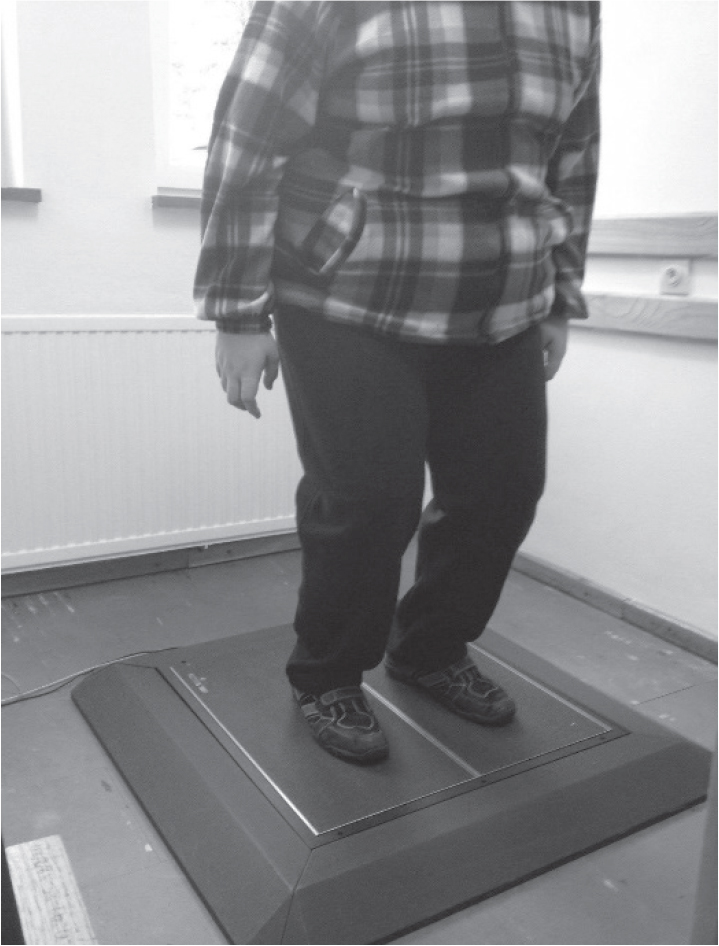
Fig. 1.
The subject’s starting position while performing a vertical jump (the authors’ own material)
Therapeutic procedure
Children from the study group underwent daily group exercises during a 3-week rehabilitation camp (excluding Saturdays and Sundays). The patients started with strength exercises (fig. 2) that lasted 1.5 hours every day. All the subjects performed the same number of repetitions. Afterwards, they did 1-hour aerobic exercises (fig. 3) followed by general conditioning exercises in water that lasted 45 minutes a day.
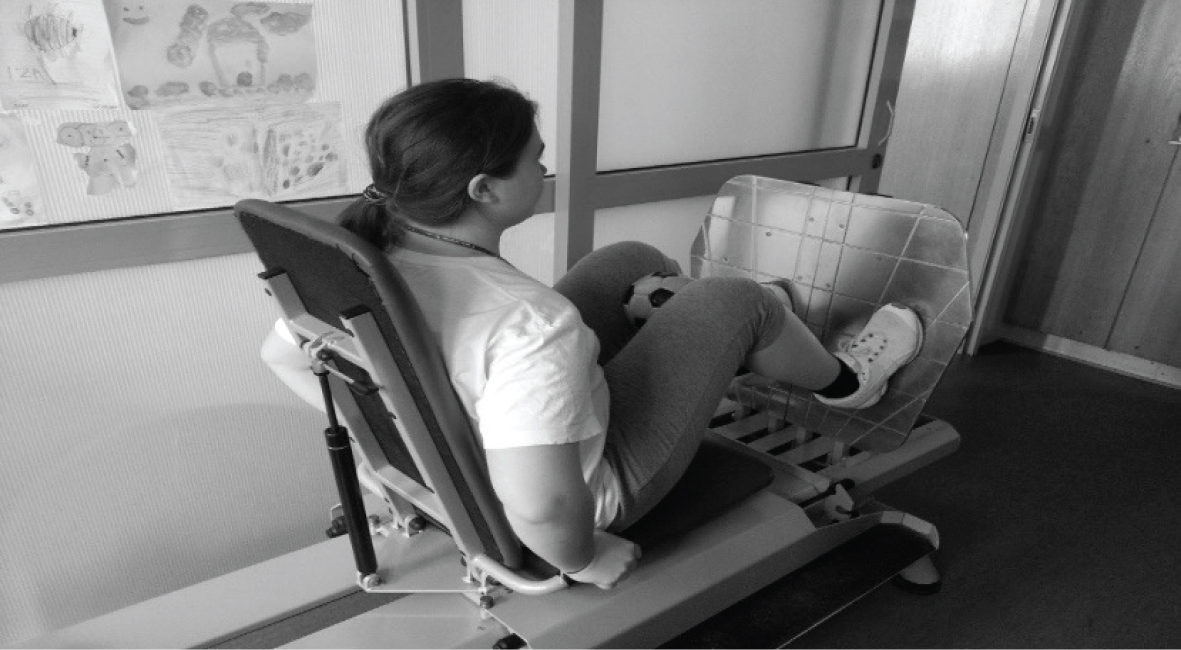
Fig. 2.
An example of a strength exercise (the authors’ own material)
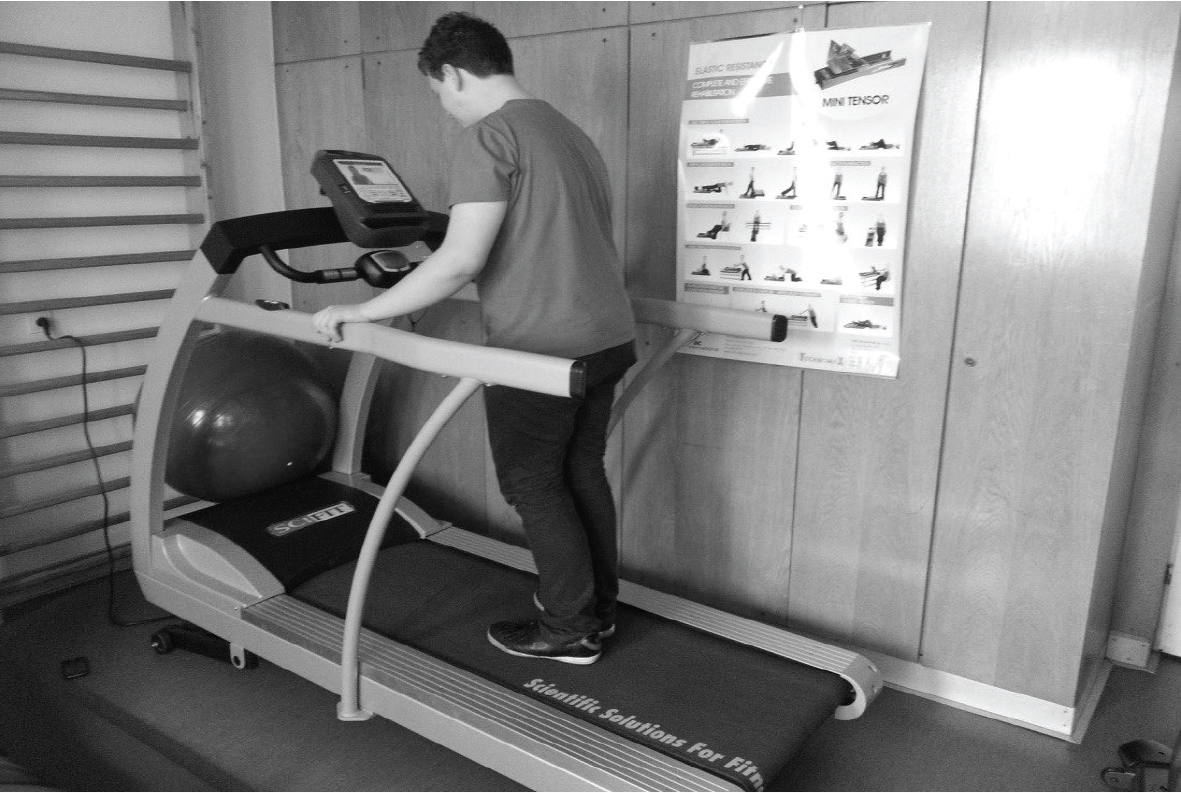
Fig. 3.
An example of an aerobic exercise (the authors’ own material)
The participants of the therapeutic camps followed a programme of increased physical activity that resulted in greater energy expenditure. At the same time, their awareness of young age obesity was being raised. Therefore, through numerous consultations with specialists of pediatrics, psychology and dietetics the subjects learnt how to reduce and prevent the formation of excessive adipose tissue that leads to the aforementioned harmful consequences. Moreover, nutritionists taught the study participants how to prepare their daily meals. It was significant owing to its educational values, since during the camp the patients helped to prepare meals based on healthy nutrition rules.
Statistical analysis
The following non-parametric tests were performed: Wilcoxon matched pairs test and the Mann-Whitney test. The calculations were made by means of computational and statistical packages (SPSS 21.0 and Windows Excel). The packages helped to determine the range of mutual correlations for variables. Statistical differences were set at the level of p<0.05.
Results
Due to large quantities of data, only statistically significant results are presented in this part of the work (tab. 2).
Tab. 2.
Results regarding anthropometric parameters and motor skills in the examined groups
| Parametry/Parameters 7-10 lat / (years) x±SD | Grupa badana / Group | ||||
|---|---|---|---|---|---|
| p | 11-16 lat / (years) | p | |||
| x±SD | |||||
| Cechy antropometryczne/Anthropometric features | Masa ciała (kg)/Body Mass (kg) | 0 ± 1 | 0,02* | 1,15 ± 1,19 | 0,01* |
| BMI (centyle)/BMI (centiles) | 0,24 ± 0,33 | 0,02* | 0,47 ± 0,46 | 0,002* | |
| Cechy motoryczne/Motor features | maksymalna wysokość wyskoku (cm) / maximum jump height (cm) | 0,46 ± 0,64 | 0,78 | 1,15 ± 1,19 | 0,45 |
| EFI | 0 ± 6,25 | 0,86 | 1,21 ± 6,96 | 0,53 | |
After a 3-week rehabilitation camp, a significant reduction in body mass was observed in 84.1% of the patients. In the group of younger children (aged 7-10), body mass reduction ranged from 200 g to 2 kg (p=0.02), while in the group of older children (aged 11-16), it ranged between 500 g to 3 kg (p=0.01).
The BMI: A reduction in the BMI was noted in 84.1% of the examined children with obesity. The reduction was significant both in the group of younger children (p=0.02) and in the group of older children (p=0.002). On average, the value decreased by 0.24 ± 0.33 in younger children and 0.47 ± 0.46 in older children.
Vertical jump: Both in younger and older children, no statistically significant changes were noted (p=0.78 and p=0.45, respectively). However, 45.4% of the patients obtained higher results compared to the measurements made on the 1st day of the camp. Children from the control group achieved much better results in the height of the vertical jump. The comparison between older obese children and healthy controls revealed significant changes (p=0.001). In turn, no significant changes were found when comparing younger obese children with children from the control group.
The EFI: No significant changes were observed either in the group of younger children (p=0.86) or in the group of older children (p=0.53). Nonetheless, 48.8% of the children improved their scores compared to the measurements made on the 1st day of the camp. In turn, the comparison between older obese children and children from the control group showed a significant difference in the EFI assessment at the level of p=0.001. Children from the control group achieved much better results regarding the EFI. On the other hand, the comparison between younger obese children and children from the control group revealed no significant differences compared to the scores obtained on the 1st day of the camp (p=0.39).
Discussion
According to the results of current research [16], regular physical activity during childhood and adolescence increases energy expenditure, reduces adipose tissue, strengthens the skeletal system and the musculo-ligamentous system, reduces overloads within the spine and limbs and exerts a positive influence on the emotional state through improving one’s own self-esteem. Przewęda emphasised the fact that the level of development of motor changes indicates health status. As a consequence, a low motor fitness level is the main factor that predisposes to health complications. Therefore, the development of motor abilities directly leads to an improvement regarding biological fundamentals, e.g. the musculoskeletal system and cardiovascular system as well as “indirectly affecting the quality of life”[7].
In their research, Jodkowska et al. revealed that over 1/3 of the students aged 13-15 did not participate in obligatory PE classes regularly, which resulted in their low levels of physical activity [17].
Physical activity as well as the effects of general conditioning exercises are the issues that are raised frequently [7,8,16]. Exercises implemented in our research (type, intensity, frequency) were based on recommendations regarding physiology of the development of children aged 7-16. As for the form, it was selected based on maximally increased energy expenditure. The rightness of this decision is confirmed by the study of Szymura et al., who concluded that anaerobic exercise performance combined with conditioning-related exercises constitute good and attractive supplementation of sports classes for overweight children [8].
In turn, Kasprzak et al. analysed the effects of regular physical activity on the normalisation of selected physiological parameters in 14-16-year-old children with simple obesity. The analysis revealed that aerobic performance exerts a therapeutic influence on the body of an obese person, as it leads to a normalisation of hormonal secretion and a reduction in body mass [18].
The main aim of the rehabilitation camp programme introduced at the Children’s Memorial Health Institute was to reduce body mass. The reduction proved to be significant both in the group of younger and older children. Similar conclusions regarding body mass reduction in patients with simple obesity during increased physical activity can be found in the scientific literature. A good example is Archacka’s study into motor abilities of children aged 7-17. She applied the EUROFIT test, which enabled her to note a significant decrease in body mass (from 2.1 kg to 5 kg) [16]. At the same time, our research revealed a significant decrease in the BMI, which is closely connected with body mass reduction. A similar observation was also made by Archacka [16]. However, there is a scarcity of studies where the Esslinger Fitness Index (EFI) would be used as a reference point. One of them is the study by Płudowski et al., who assessed changes in the muscular system function in children aged 10-13 treated with the growth hormone. The study revealed significant changes in the EFI [19]. Still, the group analysed by Płudowski et al. was not heterogeneous compared to the subjects examined at the Children’s Memorial Health Institute. Therefore, the results cannot be compared objectively. The fact that this index was implemented in a limited number of studies may stem from the costs of the Leonardo dynamometric platform. In turn, explosive power is a parameter that often appears in the scientific literature. Archacka’s work is a good example, as it showed that this ability improved significantly in 7-18-year-old children with simple obesity. It was only in the group of children aged 7-8 that no significant changes were observed [16]. In her research on 12-18-year-old children with simple obesity, Barańska et al. proved that the best results regarding explosive power were obtained by older age groups [20]. However, it was a single study only and this ability was assessed based on the EUROFIT test, which was not applied in our study.
There are some limitations to the study. Objective comparable assessment of this work and the studies carried out so far is difficult due to the fact that currently, studies are conducted once and they do not include progress-related analysis of changes in children with simple obesity. It is likely that the lack of both detailed research and long-term supervision of obese children does not encourage them to engage in increased physical activity after finishing the rehabilitation camp. Therefore, it is necessary to carry out further research and observations concerning an improvement in physical fitness and performance that would lead to a change in health status among obese children.
Conclusions
Regular physical activity performed during a 3-week rehabilitation camp resulted in a significant reduction in body mass. However, this activity did not lead to positive changes in motor skills. Due to the fact that not all assumptions were met, it is worth considering a correction to the programme that would include detailed procedures and long-term care of obese children.