
Introduction
Gonarthritis is a type of osteoarthritis and is the second most common condition in this group of diseases. It is also the most common cause of disability, as about 60% of the population above the age of 65 suffer from the disease. [1–6] Patients who have been diagnosed with a degenerative disease of the knee experience increasing pain. The dysfunction of joint stability also occurs, causing a sense of knee instability and limitation of the range of mobility resulting from the destruction of the articular surfaces. As a result of these changes, there occurs a disorder of statics and efficiency of locomotion, in conjunction with pain and reduced function of the knee. This leads to disability, which becomes the reason for deterioration in a patient’s quality of life [7].
At an initial stage of the disease, it is possible to apply conservative methods of treatment. However, in the advanced form of gonarthrosis they are not sufficient. In this case, a surgery being an effective form of treatment is applied. Studies have confirmed the effectiveness of invasive treatment of knee osteoarthritis in the form of total knee replacement. The quality of life of patients subjected to this form of treatment increased by 90%, their motor skills improved and subjective pain sensation decreased [8–10].
In the assessment of functional status after surgical procedures, decisions on clinical proceedings ceased to be based exclusively on empirical evidence of experts. Also highlighted was the role of scientific evidence supported by reliable research that was in line with the principles of evidence-based medicine (EBM). It offered the possibility to choose the best therapeutic procedure [11,12].
The aim of the study was to carry out a functional assessment of patients in the early period after knee replacement surgery.
Material and methods
Forty patients were qualified for the study but eventually, the sample group consisted of 35 patients aged 54-86 (mean age 69.17 ± 8). It included 26 women aged 54-82 (mean age 68.6 ± 7) and 9 men aged 54-86 (mean age 70.8 ± 9). The characteristics of the group are shown in Table 1.
Tab. 1.
Characteristics of selected anthropometric variables of the study group
| Zmienna | X±SD | Min–Max |
|---|---|---|
| Wiek/Age | 69.2±7.6 | 54–86 |
| Masa ciała/Weight [kg] | 84.6±12.7 | 58–110 |
| Wysokość ciała/Height [cm] | 164.9±7.9 | 148–184 |
The study inclusion criteria were as follows:
– diagnosed gonarthrosis (qualification by an orthopaedist for total knee replacement),
– ability to move independently before and after the surgery (without the use of orthopaedic supports),
– no other injuries or illnesses that may affect the outcome of the measurements (e.g. acute injuries to the ligaments/menisci, coxarthrosis),
– a voluntary consent of the patients to participate in the study,
– the patients had not taken any medications affecting motor coordination.
The study exclusion criteria were:
– postoperative complications,
– retraining for implantation of total knee replacement,
– intraoperative decision to change the implantation of knee other than total endoprosthesis.
All patients who had given their informed consent to participate in the project were examined one day before the scheduled operation and after 6 weeks following the procedure. The measurements were made in hospitals in Krakow between January and May 2015. Each measurement was performed by the same therapist (the author of the project).
Each eligible patient underwent a unified rehabilitation program that lasted until the end of hospital stay (about a week). The program included CPM exercises (continuous passive motion) – after leaving the hospital, the patient gained about 110° of the knee flexion (passive and active). In addition, the rehabilitation program consisted of isometric exercises of the quadriceps muscle of the operated knee joint and learning to walk on crutches as well as exercises of the unoperated limb and upper limbs. After leaving the hospital, none of the patients received ambulatory rehabilitation.
Functional assessment was made on the basis of subjective and objective tools. To evaluate knee diseases by subjective methods, the following tools were used: the Lysholm-Gillquist scale [13], the Visual Analogue Scale (VAS) [14] assessing aches and pains, the Lovett scale [15] for the evaluation of muscle strength as well as the authors’ own scale of assessing life quality.
The Lysholm-Gillquist knee scoring scale is a form of 8 categories of questions, where a tested person can get a maximum of 100 points and an appropriate number of points is assigned to each group of questions. The obtained results allow to qualify a patient to the appropriate group, where the assessed function is defined as excellent (90-100), very good (80-89), good (70-79), sufficient (60-69) or insufficient (< 60) [16].
The Visual Analogue Scale is used for the evaluation of pain intensity. A patient is asked to identify a point on the line about 10 cm long, where 0 means no pain and 10 is the strongest pain that the patient can imagine [17,18].
The 6-grade Lovett scale allows the examiner to subjectively assess the patient’s muscle strength, where 0 means no muscle contraction and 5 is a full range movement with submaximal resistance. In each of the study participants the measurement of the strength of knee extensors and flexors while lying down was conducted, starting from test number 3 [19].
As for objective methods, the Timed Up and Go test was used to evaluate the functional efficiency of the patient and the measurement of the range of movement in the knee was performed with a goniometer. The Timed Up and Go test measured the time in which the subject was able to walk the distance of 3 meters, starting from getting up from a chair, walking the arranged distance, turning around 180˚ in the place indicating the end of the measured section, returning the same way and sitting down on a chair [20,21].
To measure the scope of extension and flexion in the knee joint, a goniometer was used. During the test, the patient was lying, the axis of the goniometer was in the vicinity of the head of the fibula, the stationary arm was placed along the long axis of the thigh, while the moveable arm was along the long axis of the lower leg and was moving with it during the flexion in the knee joint. The arrangement for the measurement of the extension in the knee joint was analogous to the study of flexion. Additionally, the limbs were placed outside the bed in order to examine hyperextension. The reading error was within 5° [22].
In the assessment of the quality of life, the original three-grade scale was applied, where 0 meant no change, 1 - improvement and 2 - deterioration in the quality of life. The patient used this scale to mark each of the 12 questions divided into 4 categories: morning toilet, preparing meals, cleaning activities and free time.
For statistical analysis, Statistica10 and Excel were used. Statistical analysis of the collected material was carried out on the basis of the principles of descriptive statistics and mathematics. Methods of descriptive statistics were used to present the results in the form of tables containing arithmetic means or medians, standard deviations, minimum and maximum values. Methods of mathematical statistics included the T-test for dependent variables. The level of significance was set at p<0.05.
Results
The functional assessment before and after the total knee replacement revealed the existence of statistically significant differences for the following measurements: active knee flexion (p = 0.009), active knee extension (p<0.001), knee flexors strength (p=0.031), knee extensors strength (p=0.001), the VAS scale (p<0.001) and the Lysholm-Gillquist scale (p<0.001). The conducted analyses showed that it was only in the case of the comparison of the Timed Up and Go test that the measurements did not differ significantly (p = 0.60). (tab. 2–5)
Tab. 2.
Comparison of the results of the active and passive range of motion before and after total knee replacement
| Zakres ruchu/Range of motion [°] | ||||||||||
|---|---|---|---|---|---|---|---|---|---|---|
| Zgięcie/Flexion | Wyprost/Extension | |||||||||
| M | SD | Min | Max | p | M | SD | Min | Max | p | |
| Przed/Before | 83.1 | 19.5 | 30 | 112 | 0.009 | 0 | 3.5 | 0 | 15 | <0.001 |
| Po/After | 75.3 | 15.5 | 45 | 105 | 0 | 2.1 | 0 | 10 | ||
Tab. 3.
Comparison of muscular strength measurements before and after total knee replacement
| Siła mięśniowa/Muscle strength [Lovett] | ||||||||||
|---|---|---|---|---|---|---|---|---|---|---|
| Zginacze/Flexors | Prostowniki/Extensors | |||||||||
| M | SD | Min | Max | p | M | SD | Min | Max | p | |
| Przed/Before | 3.0 | 0.7 | 3 | 5 | 0.031 | 4.0 | 0.9 | 2 | 5 | 0.001 |
| Po/After | 4.0 | 0.7 | 3 | 5 | 5.0 | 0.7 | 3 | 5 | ||
Tab. 4.
Comparison of the results of measurements of the VAS and Lysholm scales before and after total knee replacement
| VAS [pts] | Lysholm [pts] | |||||||||
|---|---|---|---|---|---|---|---|---|---|---|
| M | SD | Min | Max | p | M | SD | Min | Max | p | |
| Przed/Before | 7.0 | 1.6 | 4 | 10 | <0.001 | 57.0 | 15.5 | 22 | 79 | <0.001 |
| Po/After | 4.0 | 2.5 | 0 | 10 | 74.0 | 10.3 | 47 | 88 | ||
Tab. 5.
Comparison of the results of measurements of the TUG test before and after total knee replacement.
| TUG [s] | |||||
|---|---|---|---|---|---|
| X | SD | Min | Max | p | |
| Przed/Before | 15.9 | 8.5 | 7 | 41 | 0.06 |
| Po/After | 14.4 | 6.6 | 7 | 33 | |
The subjective assessment of the quality of life in patients after total knee replacement showed an improvement in 63% of the patients, deterioration in 12% of the study participants and the lack of any changes in 26% of the respondents.
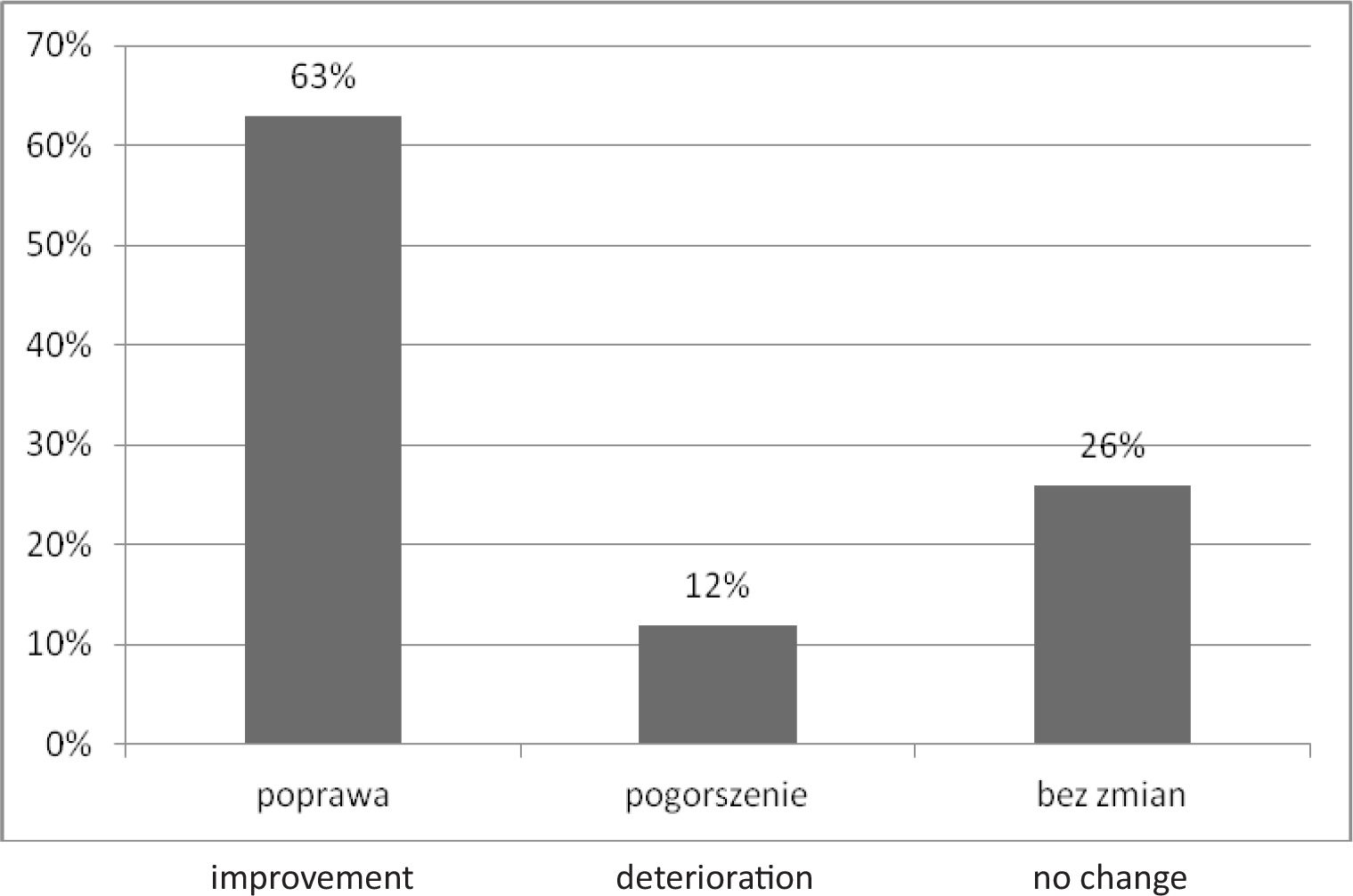
Fig. 1.
Subjective assessment of the quality of life after total knee replacement in the study group
Discussion
In the society of the 21st century, osteoarthritis is considered one of the primary causes of the occurrence of pain and disability. It most frequently affects the knee. It leads to limitations causing deterioration in a patient’s quality of life. In many cases, it results in a surgical procedure in the form of arthroplasty [1,5,8].
With regard to the quality of life and satisfaction after knee replacement, Bourne et al. [23] presented the results indicating an improvement in 81% of the respondents. A decrease in pain was declared by 72-86% of the respondents, while an improvement in ADLs (activities of daily living) was reported by 70-84% of the patients. In their study, Chesworth et al. [24] found that the degree of satisfaction felt after the surgery did not correlate with the occurrence of postoperative complications. Soeko et al. [25] associated patients’ negative assessment with pain and with the return to normal functioning in daily activities.
By verifying the subjective assessment of the quality of life and satisfaction after the surgery, the authors of the present study noted a significant improvement among the participants. A third of the patients felt the lack of satisfactory treatment effects in terms of the quality of life and satisfaction after the surgery. It is connected with the failure to meet the expectations from before the surgery.
When assessing the aches and pains of patients after knee replacement, Jaźwa et al. [26] observed pain reduction from 7 to 3 on the VAS scale. They also emphasised the need for early rehabilitation after the surgery as well as its division into phases targeted at the needs of the patient. Similar results were obtained by Szypuła et al. [27], who reported the reduction in pain among patients after knee replacement by 2° on the VAS scale. They also pointed to the relationship between the intensity of perceived pain and the age of patients undergoing the surgery. In the present study, the authors obtained the results proving a significant reduction in pain – the main reason for the surgery among the study group, which is indicated by the results of its measurement on the VAS scale before and after surgery.
Gaweł et al. [7] referred to the evaluation of knee conditions using the Lysholm-Gillquist scale. The patients after arthroplasty achieved a score of 75 points (sufficient), while before the surgery it was 52 points. Researchers obtained significant results in terms of limping, walking, pain and swelling. They also drew attention to the correlation of getting better results of the knee function during 4 weeks after the surgery in individuals who commenced rehabilitation immediately after the operation. In our own study, the greatest progress concerned the following categories: pain, clicking/locking and instability/the feeling of “the knee giving way”. The treatment resulted in the average increase on the Lysholm-Gillquist scale by 19 points, reaching the level of 74 points (good).
Szypuła et al. [26] reported the tendency to increase the range of extension and reduce the range of flexion in patients after knee replacement. Jones et al. [28] indicated that the range of 65° of the knee flexion made it possible to move freely. Similar results were obtained in the present study. The analysed range of motion in the examined group of patients showed an increase in the range of extension and a decrease in the range of flexion compared to the time before the surgery.
In the evaluation of muscle strength in patients after total knee replacement, Holm et al. [29] were among the first researchers to report that the direct cause of the decline in knee extensors strength was oedema that occurred directly after the surgery. In the study on a group of 28 patients after implantation, Nutton et al. [30] noted a slight increase in knee extensors strength 6 weeks after the surgery. Our own research confirmed the reports from the literature, as the examined subjects demonstrated an increase in knee extensors strength in the early period after the surgery.
In many publications, the evaluation of the activities of everyday life with the TUG test (Timed Up and Go) in patients undergoing knee replacement showed an increase in the time taken to complete the test compared to the results from before the surgery [29, 30, 31].
Holm et al. [29] found that the reduced speed of gait after the surgery is caused by reduced muscle strength. Mizner et al. [31] presented the results of the studies evaluating the results of a patient one month after knee replacement and one year after the surgery. They showed that a direct drop in tested parameters (i.e. the TUG) after the surgery had beneficial effects in the long term. Our findings are contrary to the results presented in the literature. The analysis of the time needed to perform the TUG test in the study group showed its reduction after surgery compared to the time before the procedure.
Osteoarthritis of the knee still affects an increasing number of people in the society. Due to its consequences causing reduction in a patient’s performance or the need for applying total knee replacement as the only form of treatment, the authors of the study find it necessary to carry out further research on this subject.
Conclusions
The functional status of patients improved as a result of total knee replacement surgery in the early rehabilitation period.
The study demonstrated the effectiveness of the treatment of advanced degenerative changes by total knee replacement surgery of the knee and showed an improvement in the function of the patient in the early rehabilitation period.