
Introduction
Breast cancer constituted 10.9% of all new cases of cancer registered in the Polish National Cancer Registry in the years 2001-2011 and, after lung cancer, is the second most common type of oncological disease diagnosed in Poland [1].
Due to its high prevalence, breast cancer is one of the most significant health problems among Polish women. It is the most commonly diagnosed type of cancer among women. According to the data from the Polish National Cancer Registry, breast cancer incidence has more than doubled in the last thirty years [2].
Cancer in an early development phase, with a lump that is non-palpable but can be diagnosed in imaging examinations (mammography, MRI or USG) gives the highest chance for curing the disease. When the lump is non-movable with regard to the mammary gland, has an irregular shape and is palpable, there is a risk of it being malignant. Early cancer symptoms include asymmetry of mammary glands, skin changes around nipples, single lump or nipple discharge. Late symptoms may include an increase in size or swelling of a nipple, big palpable non-movable lump, satellite lumps around a nipple, increased lymph nodes or swelling in the shoulder area [3].
Breast cancer is treated with the use of combination therapy including surgery, radiotherapy, chemotherapy, hormonotherapy and biological methods. The selection of the type of treatment is affected by numerous factors. The most significant ones include the level of cancer development, the level of malignancy, the state of regional lymph nodes, hormonal state and patient’s age [4].
In radical surgery treatment it is significant to remove changes together with regional lymph nodes. It limits the risk of cells migration, prevents the transmission of cancer cells to bloodstream and at the same time prevents the occurrence of metastases. In certain cases when cancer is diagnosed early, breast conserving treatment is applied [5–7].
Surgery treatment is supplemented with radiotherapy. It reduces the risk of relapse by approximately 50%. As a result of radiation, apart from cancer cells, healthy cells are also damaged [4].
Upper limb lymphoedema is a negative side effect of radical mastectomy and other therapeutic methods. Lymphoedema results from the accumulation of endolymph in extracellular and extravascular space in tissues. The main mechanism leading to lymphoedema after mastectomy is a disturbed lymph drainage. The main method of treating lymphoedema is complex physiotherapy promoting lymphatic drainage [8–13].
Due to a growing need for lymphoedema treatment, the knowledge of this issue should be spread taking into account the recommendations of the International Society of Lymphology.
The aim of the work was to assess the effectiveness of various physiotherapy methods applied in the treatment of post-mastectomy lymphoedema.
Material and methods
The research included 90 women after mastectomy who were patients of the Rehabilitation Department of the Independent Public Healthcare Centre in Stalowa Wola, the Rehabilitation Clinic of the University of Management and Administration in Zamość and the Reh-Mediq Rehabilitation Centre in Tyczyn in the period from January 2014 to July 2016. The patients underwent two weeks of outpatient physiotherapy. During the treatment, the patients followed recommendations received from specialists in the field of oncology, surgical oncology and rehabilitation as well as from general practitioners. They underwent such physiotherapeutic treatments as manual lymphatic drainage, compression therapy, vibration massage with the use of Aquavibron, active exercises as well as active exercises with the load taken off an upper limb. Each of the patients received an individual physiotherapy programme which included 2 to 5 of the above treatments.
In order to assess the effectiveness of lymphoedema treatment, circumference of upper limb was measured before and after physiotherapy. The results were analysed statistically with the use of student’s t-test. A statistical error was assumed at the level of 5% and significance level was set at p ≤ 0.05.
Results
In the study group, patients who underwent mastectomy less than 5 years before constituted 57% of the subjects [fig. 1]. The mean age of the study participants was 53 years.
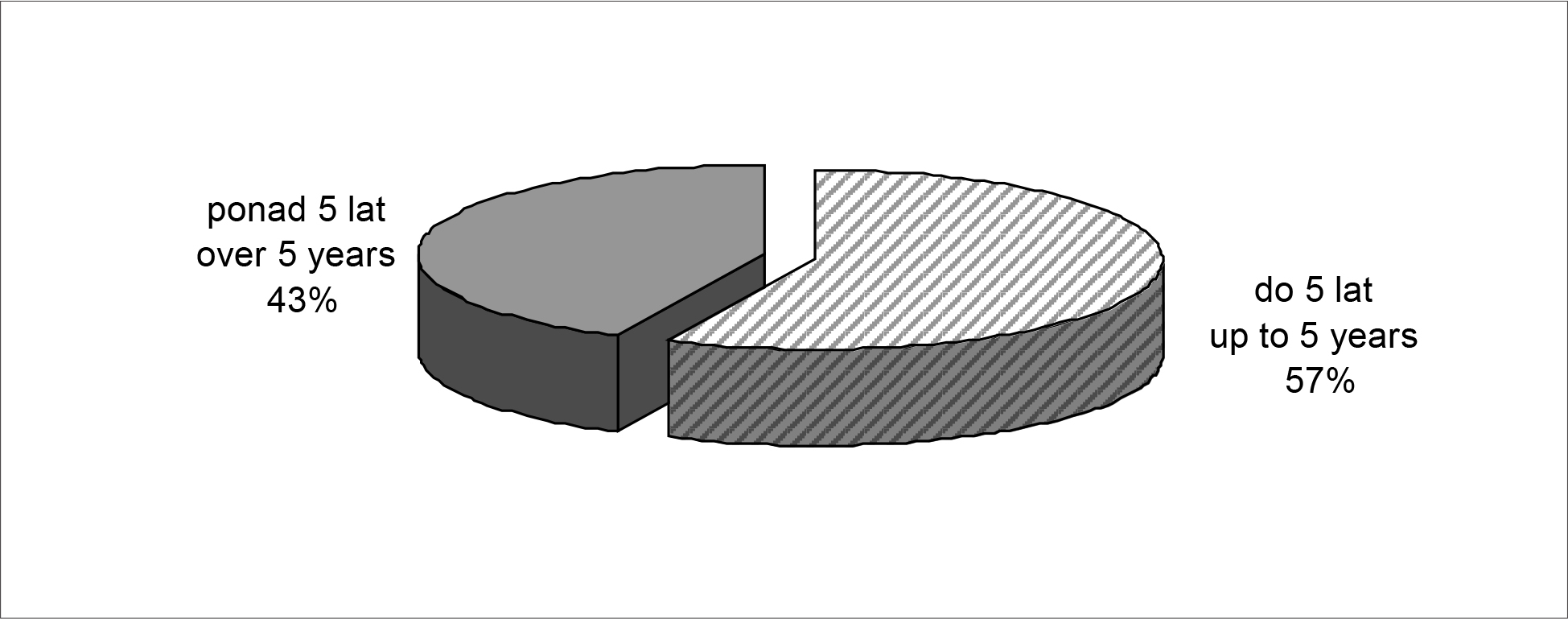
Fig. 1.
Time from mastectomy in the study group
Only 43% of the patients exercised regularly at home, while 17% responded that they exercised rarely and 40% of the patients did not exercise at all [fig. 2].
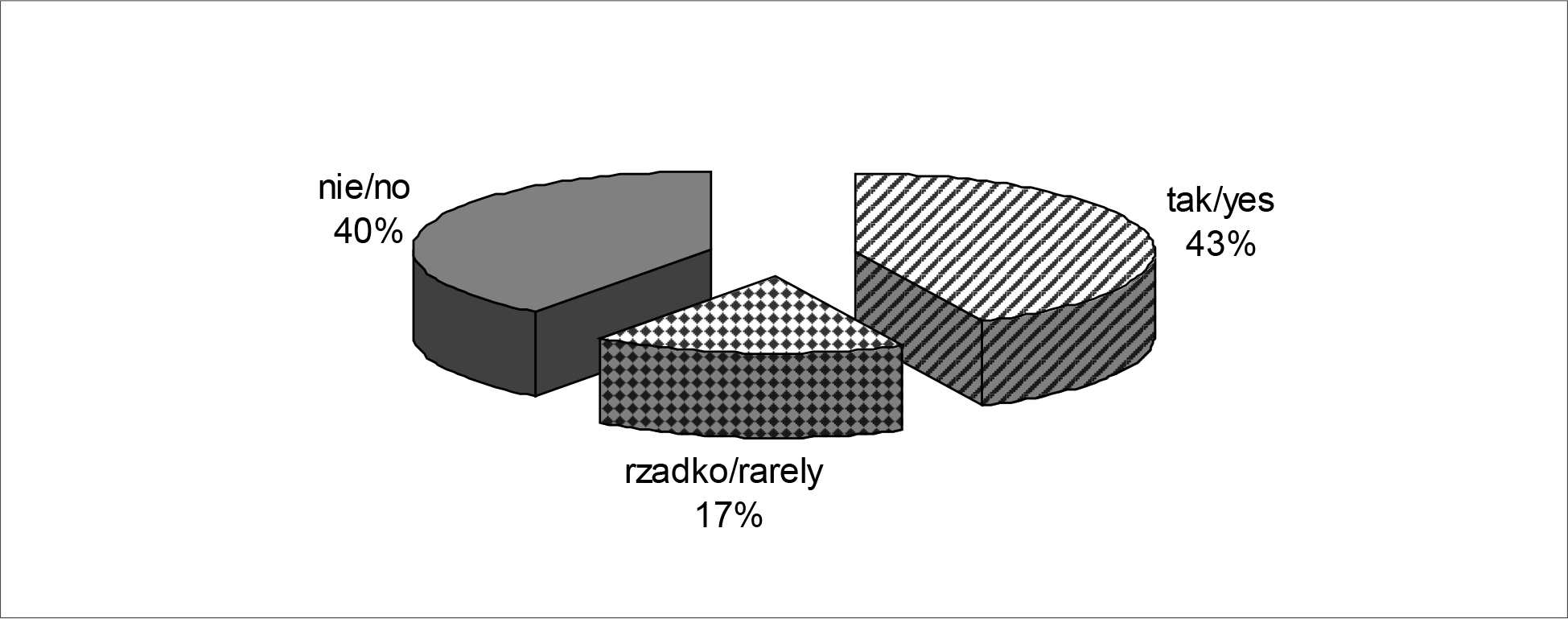
Fig. 2.
Physical activity in the study group
In the study group, a low level of professional activity was noted among women who underwent mastectomy. As many as 80% of the patients did not have a job [fig. 3].
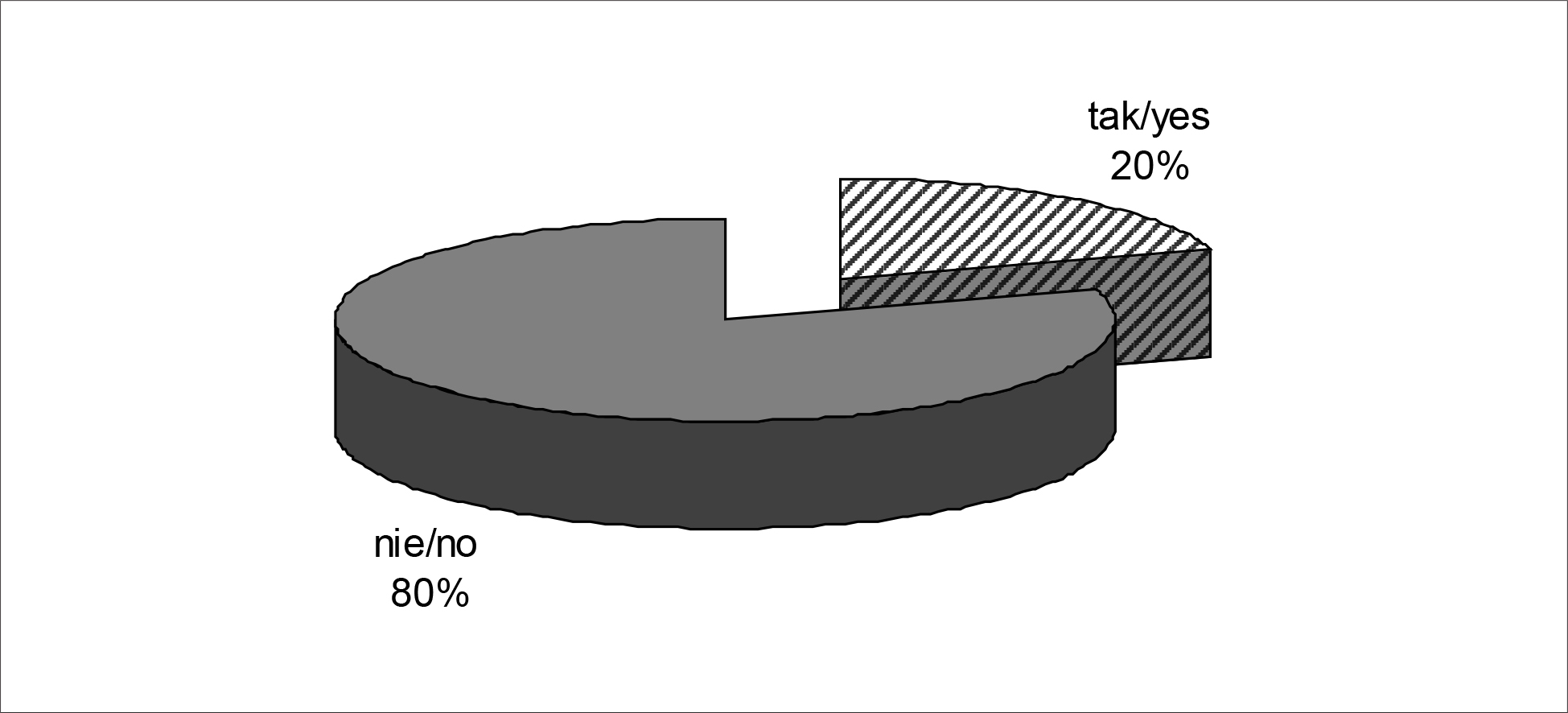
Fig. 3.
Professional activity in the study group
In the majority of the study participants (43%), lymphoedema occurred 1-3 months after the surgery, in 40% of the patients it occurred 4-6 months after the surgery, while in 17% it developed more than half a year after the surgery [fig. 4].
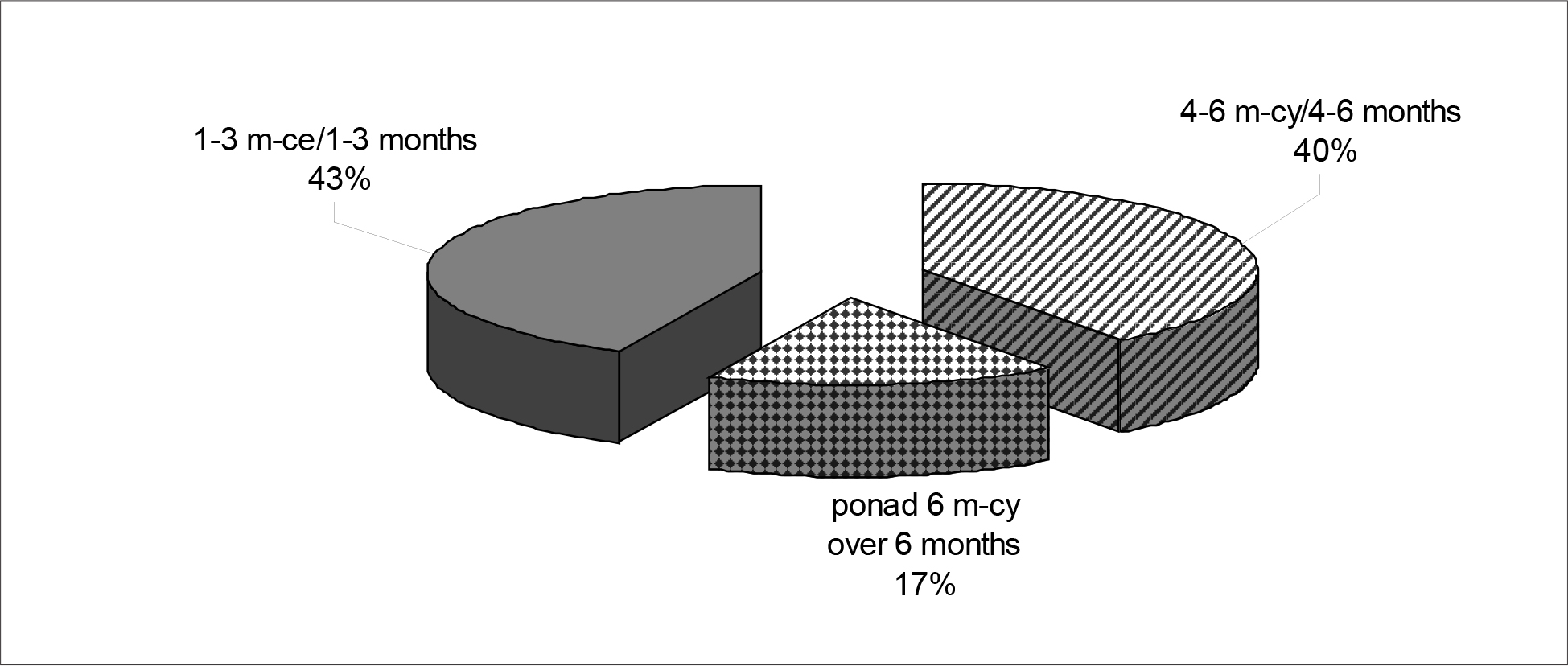
Fig. 4.
The period following the surgery after which upper limb lymphoedema occurred in the study group
Manual lymphatic drainage was the main type of treatment applied in the case of 67% of the patients during their therapy. In 53% of the subjects treatment with the use of Aquavibron was performed, 60% of the women underwent hydrotherapy treatments, while 53% underwent kinesiotherapy (mainly active exercises). Compression therapy was applied in the case of 70% of the study participants. The majority of the patients (60%) underwent 2-3 different treatments during one cycle.
Following a 2-week rehabilitation cycle, over half of the patients (53%) concluded that manual lymphatic drainage was the most effective type of treatment [fig. 5].
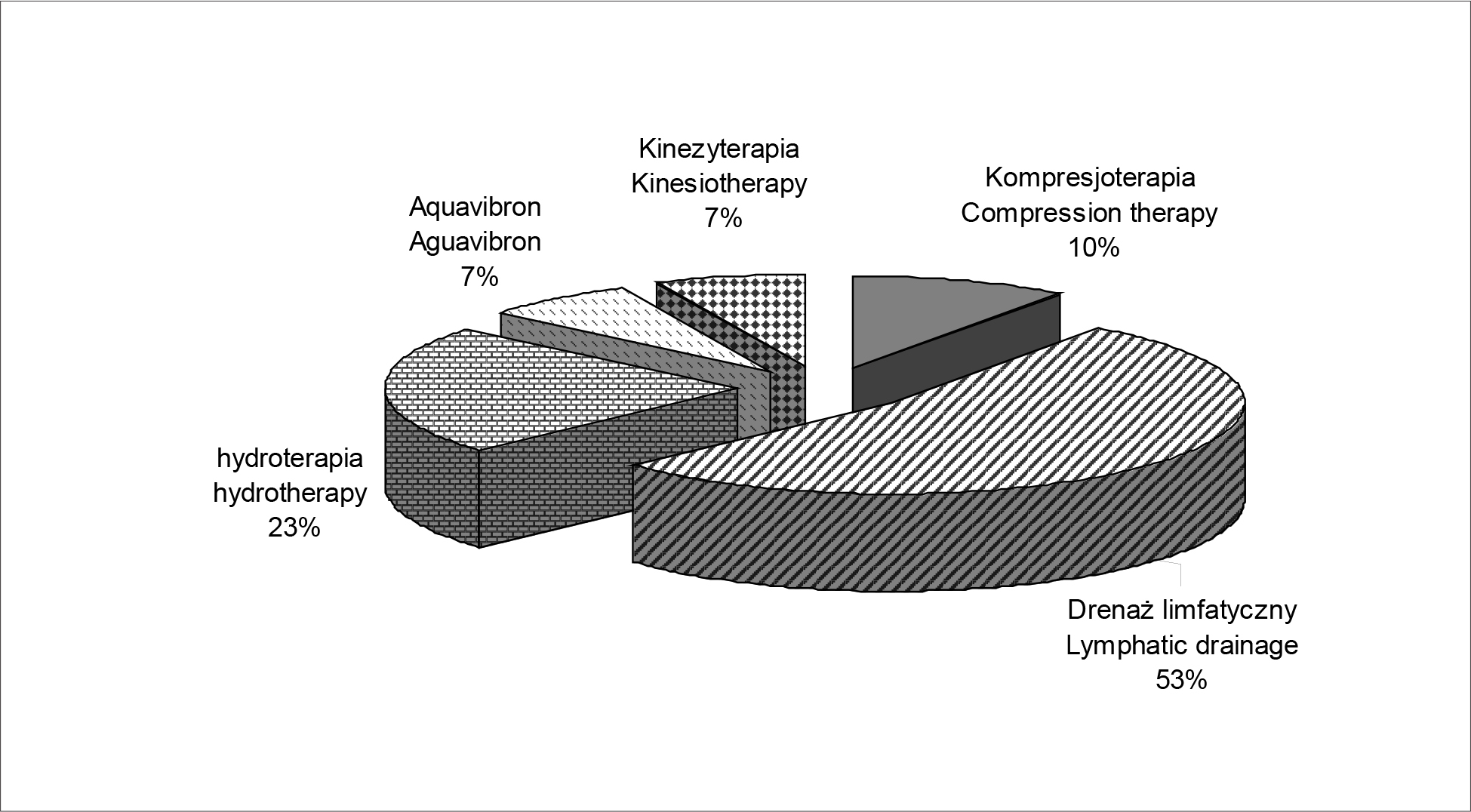
Fig. 5.
The most effective technique applied in lymphoedema treatment according to the patients
Significantly smaller upper limb circumferences were noted in the patients after physiotherapy, compared to the circumferences before physiotherapy (p<0.001). Statistical analysis did not reveal significant differences in the circumferences of forearm, wrist or metacarpus of the affected limb before and after physiotherapy (p=0.15, p=0.18, p=0.2) [tab.1].
Tab. 1.
Circumference of an affected limb before and after physiotherapy
| Obwód kończyny chorej przed i po fizjoterapii Circumference of an affected limb before and after physiotherapy | |||||||
|---|---|---|---|---|---|---|---|
| Śródręcze Metacarpus | Nadgarstek Wrist | Przedramię Forearm | Ramię Arm | ||||
| przed before | po after | przed before | po after | przed before | po after | przed before | po after |
| 19,6 | 19,5 | 17,0 | 16,9 | 25,8 | 25,6 | 31,0 | 30,3 |
| p=0,2 | p=0,18 | p=0,15 | P<0,001 | ||||
The study found significantly smaller arm circumferences after physiotherapy compared to circumferences of the same area before physiotherapy, both in the patients who underwent a surgery less than 5 years before and in those who were operated on earlier than 5 years before (p=0.01, p=0.01). No differences were found in other measurements depending on the time from the surgery [tab. 2].
Tab. 2.
The effectiveness of physiotherapy depending on the time from mastectomy
| Obwód kończyny górnej osób u których minęło do 5 lat od operacji Upper limb circumference in patients who underwent surgery less than 5 years before | |||||||
|---|---|---|---|---|---|---|---|
| Śródręcze Metacarpus | Nadgarstek Wrist | Przedramię Forearm | Ramię Arm | ||||
| przed before | po after | przed before | po after | przed before | po after | przed before | po after |
| 19,9 | 19,8 | 17,1 | 17,0 | 25,9 | 25,6 | 31,0 | 30,4 |
| p=0,01 | p=0,01 | p=0,03 | p=0,01 | ||||
| Obwody kończyny górnej osób u których minęło ponad 5 lat od operacji Upper limb circumference in patients who underwent surgery more than 5 years before | |||||||
| Śródręcze Metacarpus | Nadgarstek Wrist | Przedramię Forearm | Ramię Arm | ||||
| przed before | po after | przed before | po after | przed before | po after | przed before | po after |
| 19,2 | 19,2 | 16,8 | 16,7 | 25,7 | 25,6 | 31,0 | 30,3 |
| p=0,01 | p=0,01 | p=0,01 | p=0,01 | ||||
The study revealed a significant decrease in all the measured upper limb circumferences as a result of physiotherapy in patients who experienced lymphoedema for a period shorter than 3 months (p=0.03, p=0.04, p=0.03, p=0.01). In the subjects who suffered from lymphoedema for a period longer than 3 months a significant decrease was noted only in arm circumference (p=0.01) [tab. 3].
Tab. 3.
Upper limb circumferences before and after physiotherapy depending on the duration of lymphoedema
| Obwody kończyny górnej u osób z obrzękiem trwającym 1-3 miesięcy Upper limb circumferences in patients who suffered from lymphoedema for 1-3 months | |||||||
|---|---|---|---|---|---|---|---|
| Śródręcze Metacarpus | Nadgarstek Wrist | Przedramię Forearm | Ramię Arm | ||||
| przed before | po after | przed before | po after | przed before | po after | przed before | po after |
| 19,5 | 19,3 | 16,8 | 16,7 | 25,3 | 25,0 | 29,1 | 28,3 |
| p=0,03 | p=0,04 | p=0,01 | p=0,01 | ||||
| Obwody kończyny górnej u osób z obrzękiem trwającym dłużej niż 3 miesiące Upper limb circumferences in patients who suffered from lymphoedema for more than 3 months | |||||||
| Śródręcze Metacarpus | Nadgarstek Wrist | Przedramię Forearm | Ramię Arm | ||||
| przed before | po after | przed before | po after | przed before | po after | przed before | po after |
| 19,7 | 19,7 | 17,0 | 17,1 | 26,2 | 26,1 | 32,5 | 31,9 |
| p=0,01 | p=0,01 | p=0,01 | p=0,01 | ||||
The study showed significantly smaller arm circumferences after physiotherapy compared to circumferences before physiotherapy in patients who underwent 2-3 procedures (p=0.001). In contrast, no significant improvement in any of the measured areas was noted in the case of the patients who underwent 4-5 procedures [tab. 4].
Tab. 4.
Upper limb circumferences before and after physiotherapy depending on the number of applied procedures
| Pacjentki, u których wykonywano 2-3 zabiegów Patients who underwent 2-3 procedures | |||||||
|---|---|---|---|---|---|---|---|
| Śródręcze Metacarpus | Nadgarstek Wrist | Przedramię Forearm | Ramię Arm | ||||
| przed before | po after | przed before | po after | przed before | po after | przed before | po after |
| 19,8 | 19,7 | 16,9 | 16,8 | 25,2 | 25,1 | 30,0 | 29,5 |
| p=0,001 | p=0,001 | p=0,001 | p=0,001 | ||||
| Pacjentki, u których wykonywano 4-5 zabiegów Patients who underwent 4-5 procedures | |||||||
| Śródręcze Metacarpus | Nadgarstek Wrist | Przedramię Forearm | Ramię Arm | ||||
| przed before | po after | przed before | po after | przed before | po after | przed before | po after |
| 19,4 | 19,3 | 17,0 | 17,0 | 26,6 | 26,4 | 32,2 | 31,6 |
| p=0,001 | p=0,001 | p=0,001 | p=0,001 | ||||
The study revealed significantly smaller arm circumferences after physiotherapy compared to circumferences of the same area before physiotherapy both in the subjects who were physically active and in those who were not (p=0.01, p=0.004). No differences in the other measurements were noted depending on physical activity [tab. 5].
Tab. 5.
Measurements of circumferences depending on the patients’ physical activity
| Pomiar obwodów u pacjentów aktywnych fizycznie Circumferences in patients who were physically active | |||||||
|---|---|---|---|---|---|---|---|
| Śródręcze Metacarpus | Nadgarstek Wrist | Przedramię Forearm | Ramię Arm | ||||
| przed before | po after | przed before | po after | przed before | po after | przed before | po after |
| 19,1 | 19,0 | 16,5 | 16,5 | 25,3 | 25,0 | 30,7 | 30,1 |
| p=0,01 | p=0,01 | p=0,01 | p=0,01 | ||||
| Pomiar obwodów u pacjentów nieaktywnych fizycznie Circumferences in patients who were not physically active | |||||||
| Śródręcze Metacarpus | Nadgarstek Wrist | Przedramię Forearm | Ramię Arm | ||||
| przed before | po after | przed before | po after | przed before | po after | przed before | po after |
| 20,3 | 20,3 | 17,6 | 17,5 | 26,6 | 26,5 | 31,5 | 30,7 |
| p=0,004 | p=0,004 | p=0,004 | p=0,004 | ||||
Discussion
The significance of complex lymphoedema treatment is emphasised by numerous authors. What is particularly significant is the combination of kinesiotherapy with elements of physiotherapy [14,15]. However, a number of physical medicine procedures are contraindicated in cancer patients due to their stimulating character [16–21]. Physiotherapy applied in these clinical cases significantly lowers the intensity of lymphoedema [22,23]. The best results in the examined group were noted in the case of patients who underwent no more than three physiotherapy procedures during a day. E. Földi, who is a pioneer in the field of complex decongestive physiotherapy, highlighted the fact that the most crucial aspect of this type of treatment is combining kinesiotherapy, lymphatic drainage, bandaging techniques and skin care [24,25]. The best results in the examined group were achieved by patients who underwent lymphatic drainage combined with kinesiotherapy. In his research, Miroslav Bechyně noted that the success of the therapy depends mainly on the type of lymphoedema, when it occurred and when the therapy was commenced [26]. The research results indicated that in the group of patients who underwent physiotherapy early, lymphoedema decreased significantly after two weeks of treatment. In the case of patients who suffered from lymphoedema for more than three months, it decreased only in the arm area after a two-week period. According to M. Woods, physical activity lowers the risk of post-mastectomy lymphoedema, and therefore, it should be implemented as early as possible after the surgery [27]. However, in the analysed group, everyday physical activity among patients with lymphoedema did not affect its size. In both groups under examination (physically active and non-active patients), a similar level of decrease in lymphoedema was noted. In their research, Krukowska et al. noted significant influence of decongestive therapy on a decrease in upper limb circumferences and an improvement in upper limb range of motion [14]. Similar observations can be found in the study by Zwolińska et al., in which physiotherapy led to a decrease in lymphoedema, pain and sensory disorders and positively affected the range of motion in shoulder joints [28].
Conclusions
Low physical activity and low professional activity were noted in the examined population of women after mastectomy.
The highest extent of lymphoedema reduction in the examined group was noted in the arm area.
The time since the performance of the mastectomy had no impact on the effectiveness of lymphoedema treatment.
According to the post-mastectomy patients, manual lymphatic drainage was the most effective type of lymphoedema treatment.
Applying 2-3 types of physiotherapeutic procedures at the same time showed the best results.