
Introduction
Oncological diseases are one of the main problems of public health. In Poland, malignant tumor morbidity doubled between 1980 and 2010. In 2010, there were over 140,500 new cases of the disease. In the last decade, the morbidity rate under the age of twenty years has been approx. 11-13/105 for both sexes [1]. Negative changes in lifestyle and limiting physical activity in particular are considered to be one of the many causes of more widespread occurrence of cancer [2]. Sporting events for children and youth who have survived cancer as well as competition-related preparations may be elements of a healthy lifestyle. A sporting event known as the Onco-Olympics provides a good opportunity to increase physical activity. Athletes compete in 60 m and 100 m races, long jump, shot put, cricket ball throw, wheelchair races, swimming, table tennis and football. The competition has been held since 2007 and it is organised by the Foundation of Fulfilled Dreams in cooperation with the University of Physical Education in Warsaw. The 5th International Onco-Olympic Games 2014 were held between 21st and 24th August 2014 in Warsaw. The competition included 210 male and female athletes from 16 oncological centres in Poland, Romania, Ukraine, Lithuania and Hungary.
Positive effects of physical activity on human health are widely recognised and implemented when treating a number of diseases including cancer [2,3]. The first studies referring to the preventive role of physical activity in oncology date back to 1922. A lot of studies have focused on correlations between physical activity and cancer prevention; however, types, intensity and loads useful in cancer prevention have not been fully investigated as yet [4,5]. Researchers focus on prevention and potential cancer risk linked to the lack of physical activity [2]. The investigation of physical activity of cancer survivors is still a current scientific problem. Physical activity is probably the best yet the least recognised means of rehabilitation and improvement for persons with oncological problems. The scope of the research on intervention programmes and physical exercises in cancer survivors does not provide conclusive evidence regarding physical activity levels and obtained health-related effects [6,7].
The comparison between the levels of physical activity in athletes preparing to participate in the Onco-Olympics and recommended minimum physical activity levels for cancer survivors will help to recognise the potential of increasing physical activity also among those persons with oncological problems who do not practise any sports [2,6].
The cognitive aim of the study was to determine levels of weekly physical activity with reference to recommendations of the American College of Sports Medicine (ACSM) (5) of female and male athletes preparing to participate in the 2014 Onco-Olympics taking into consideration their sex. Another aim was to determine correlations between physical activity levels and age, body mass, body height, BMI and the type of cancer.
A practical objective was to provide the basis for developing physical activity guidelines for children and youth with oncological problems who practise sports.
Material and methods
The analysis included questionnaire responses provided by 169 out of 210 participants of the 2014 Warsaw Onco-Olympics (80 out of 92 girls and 89 out of 118 boys). The mean age was 13.05 years for girls and 13.08 years for boys. The study group consisted of the following participants: 62 out of 71 girls and 69 out of 88 boys from Poland, 6 girls and 4 boys from Lithuania, 4 girls and 8 boys from Romania and 8 girls and 8 boys from Ukraine. Hungarian athletes (3 girls and 10 boys) did not provide any questionnaire responses. Athletes between 6 and 23 years of age took part in the competition (table 1). The mean age of Polish female and male competitors was 12.81+3.68 and 12.67+3.34, respectively. Similar to their foreign female and male counterparts, there were no significant differences between Polish female and male athletes.
Tab. 1.
Number of persons and the characteristics of the age groups studied by gender
| Badani/Respondents | n | Maks. – Min. | |
|---|---|---|---|
| Dziewczęta Polska/Girls Poland | 62 | 12,81±3,68 | 23 – 6 |
| Chłopcy Polska/Boys Poland | 69 | 12,67±3,34 | 21 – 6 |
| Dziewczęta Litwa/Girls Lithuania | 6 | 11,17±3,29 | 17 – 8 |
| Chłopcy Litwa/Boys Lithuania | 4 | 12,75±1,09 | 14 – 11 |
| Dziewczęta Rumunia/Girls Romania | 4 | 15,25±1,48 | 17 – 13 |
| Chłopcy Rumunia/Boys Romania | 8 | 16,00±1,12 | 18 – 15 |
| Dziewczęta Ukraina/Girls Ukraine | 8 | 13,63±3,04 | 18 – 10 |
| Chłopcy Ukraina/Boys Ukraine | 8 | 13,75±2,82 | 17 – 10 |
The age structure of the Polish athletes (according to age categories used in the Onco-Olympics) was as follows: girls 6-9 years – 11.3%; 10-12 years – 16.1%; 13-15 years – 43.6%; 16 years and above – 29.0%, and boys 6-9 years – 15.9%; 10-12 years – 14.5%; 13-15 years – 45.0%; 16 years and above – 24.6%. As for the Polish athletes, they mainly belonged to age groups of 13-15 years and 16 years and above.
Leukemia was the most common disease in the study group (29 girls and 31 boys) followed by lymphoma (8 girls and 17 boys), bone cancer (7 girls and 7 boys), solid tumor (3 girls and 5 boys), neuroblastoma (4 girls and 2 boys), brain tumor (2 girls and 4 boys), eosinophilic granuloma (2 boys) and haemophilia (1 boy). Nine girls did not state the type of cancer.
The International Physical Activity Questionnaire (IPAQ) including questions regarding vigorous and moderate physical activity as well as time spent walking or sitting (at least 10 minutes) was employed in the study [8]. Its reliability and validity was determined on the basis of data gathered in 12 European countries [9]. The questionnaire was found to be one of the most valuable instruments for large-scale assessment of physical activity [10]. A diagnostic survey method made it possible to collect data on physical activity of the majority of 2014 Onco-Olympics participants. The study participants and their parents (legal guardians) gave their informed consent to take part in the study. After that, they filled in the questionnaire and sent it together with the competition registration form to the organisers of the event. The research was conducted within statutory activity DS. 227, which was approved by the Ethics Committee of the University of Physical Education in Warsaw.
Units expressed in MET (minutes per week) as well as activity defined by the number of days per week and the number of minutes per day were used to analyse physical activity levels. One metabolic equivalent of task (1 MET) refers to oxygen consumption at rest and is equal to 3.5 ml O2/kg of body mass/min. It was assumed that MET values ranged from 3.3 (walking) through 4.0 (moderate activity) to 8.0 (vigorous activity) [8, 11].
Physical activity of the study participants was placed at one of the three levels [12]:
– high – vigorous activity three times a week, with a minimum expenditure of 1500 MET (minutes per week) or daily moderate activity or walking with a minimum expenditure of 3000 MET (minutes per week).
– moderate – vigorous activity for 20 minutes at least three times a week or moderate activity five times a week or daily walking for at least 30 minutes, with energy expenditure of 600 to 1500 MET (minutes per week).
– low – activity with energy expenditure below 600 MET (minutes per week).
Due to a small number of foreign competitors, only comparisons of total physical activity indices between athletes from different countries were presented. In the case of the Polish competitors, though, detailed analyses of correlations between physical activity levels and sex, age, body mass, body height, BMI and the type of cancer were made.
All calculations and statistical analyses were performed using SPSS 20 software.
Results
Descriptive statistics of body mass, body height and BMI of athletes from different countries can be found in table 2. Female competitors were smaller and lighter than male athletes, yet the differences were not significant. BMI in girls and boys was at a similar level – 18.87+3.53 and 18.68+3.23, respectively.
Tab. 2.
Descriptive statistics weight, body height and BMI
| Badani/Respondents | Masa ciała/Body weight | Wysokość ciała/Body height | BMI | |||
|---|---|---|---|---|---|---|
| Maks. – Min. | Maks. – Min. | Maks. – Min. | ||||
| Dziewczęta Polska/Girls Poland | 44,20±14,91 | 90–16 | 150,64±17,15 | 178–104 | 18,87±3,53 | 30,42–11,55 |
| Chłopcy Polska/Boys Poland | 46,40±15,72 | 81–15 | 155,12±18,39 | 187–106 | 18,68±3,23 | 30,48–13,35 |
| Dziewczęta Litwa/Girls Lithuania | 33,33±10,32 | 50–20 | 142,67±19,31 | 176–120 | 16,02±2,00 | 19,53–13,89 |
| Chłopcy Litwa/Boys Lithuania | 43,75±16,54 | 67–21 | 150,00±20,24 | 173–122 | 18,54±3,14 | 22,39–14,11 |
| Dziewczęta Rumunia/Girls Romania | 51,75±2,86 | 55–48 | 161,00±3,94 | 165–155 | 19,95±0,25 | 20,20–19,53 |
| Chłopcy Rumunia/Boys Romania | 60,38±13,73 | 78–37 | 171,00±11,65 | 183–150 | 20,34±2,61 | 24,07–16,18 |
| Dziewczęta Ukraina/Girls Ukraine | 44,50±13,37 | 65–27 | 155,00±8,73 | 165–136 | 18,17±3,95 | 24,46–13,85 |
| Chłopcy Ukraina/Boys Ukraine | 53,88±18,11 | 90–34 | 163,75±17,98 | 195–142 | 19,68±4,31 | 29,39–15,33 |
Total physical activity of representatives of different countries (according to ACSM guidelines) expressed in MET (minutes per week) is illustrated in figure 1. All Onco-Olympians were physically active at a level which was a few times higher than activity-related recommendations for disease prevention. The highest levels of physical activity were noted in boys from Ukraine, followed by their counterparts from Romania and Lithuania, while the lowest levels were found in boys from Poland. As far as girls are concerned, the highest levels of physical activity were observed in athletes from Ukraine, followed by their peers from Poland, Lithuania and Romania.
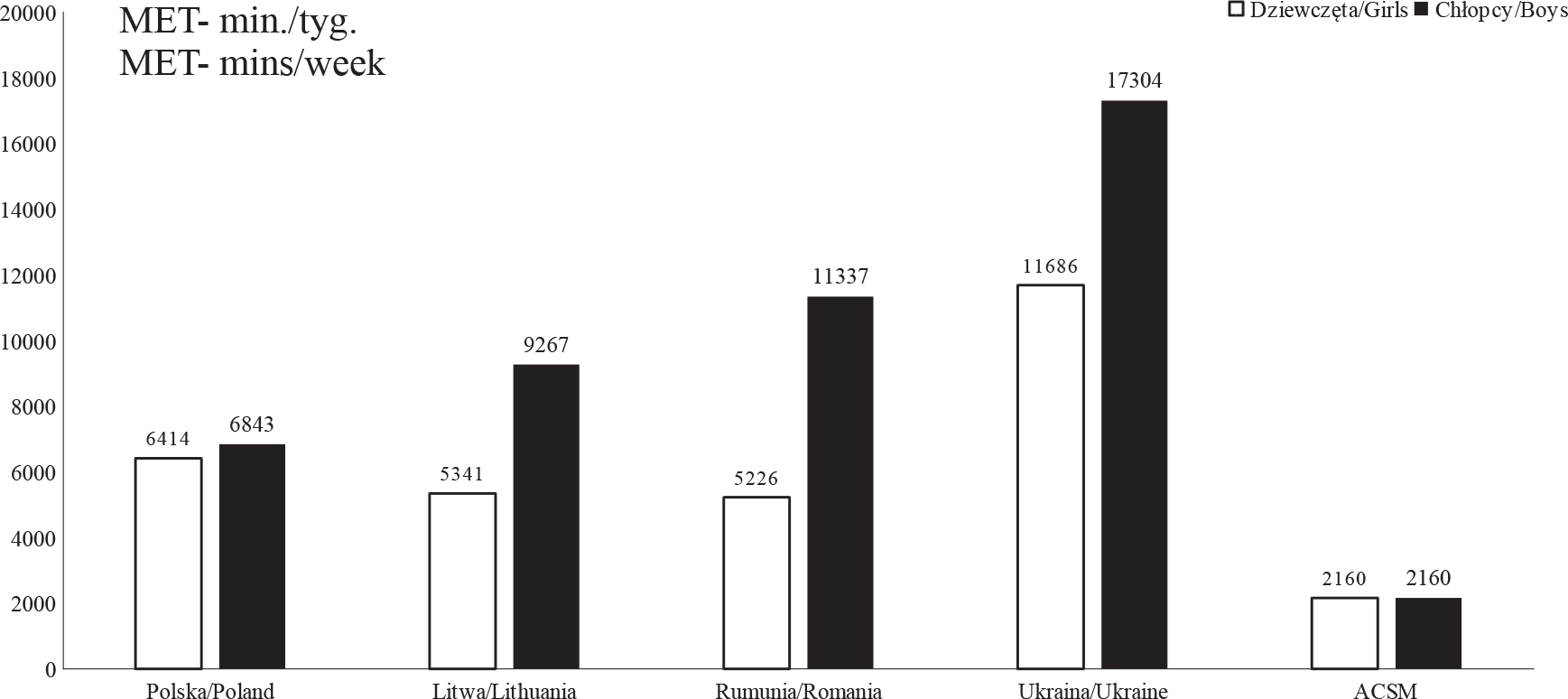
Fig. 1.
The total physical activity [MET mins/week] Onco Olympics participants from different countries in 2014
The percentage of Polish Onco-Olympians with regard to physical activity levels is presented in figure 2. Girls (66.7%) and boys (66.2%) were usually highly active. Moderate levels of physical activity were revealed by 23.8% of the girls and 32.4 % of the boys. Low levels of physical activity were found in 7.9 % of the girls and 2.9% of the boys.
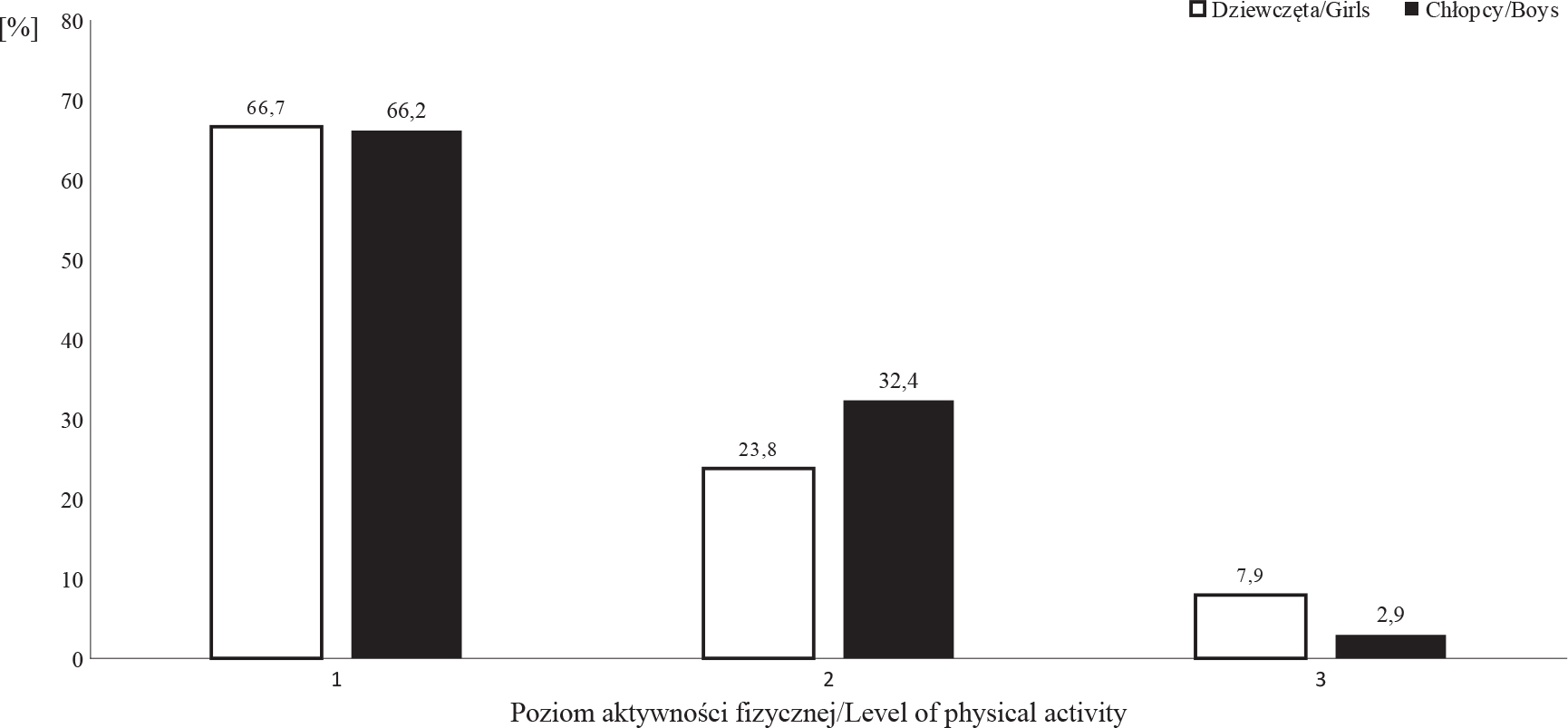
Fig. 2.
The percentage of Onco - Olympics participants from Polish by levels of physical activity
Correlations between the types of cancer and total physical activity levels of the Polish participants are shown in figure 3. In the case of the boys, it can be noted that persons with bone tumors and eosinophilic granuloma manifested the highest levels of physical activity. Lower physical activity levels were observed in persons with lymphoma, leukemia and neuroblastoma, while relatively the lowest physical activity levels were exhibited by persons with brain tumors, solid tumors and haemophilia.
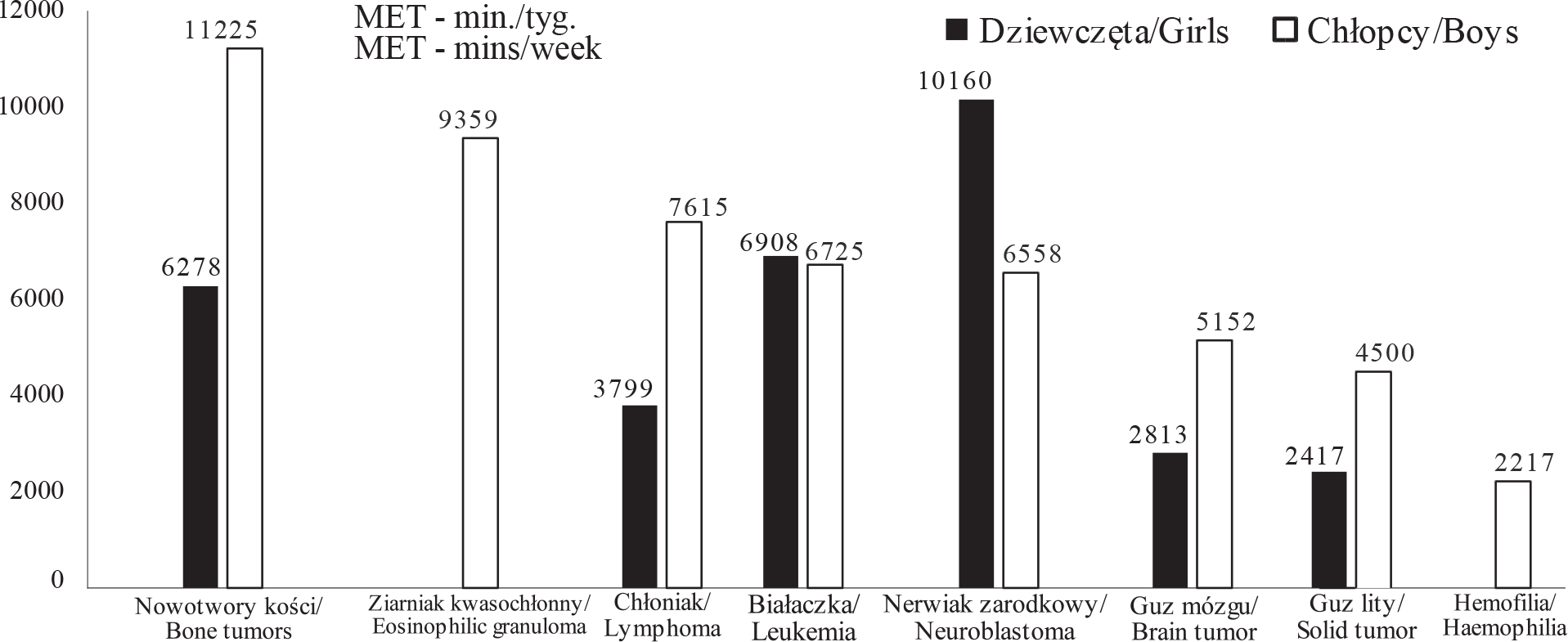
Fig. 3.
The total physical activity Onco-Olympics participants from Polish by type of cancer
Similar to the boys, the girls with brain tumors and solid tumors as well as the girls with lymphoma demonstrated the lowest levels of physical activity. High physical activity levels were found in the girls with neuroblastoma, whereas moderate levels were noted in the girls with bone tumors and leukemia.
Correlations between total physical activity and age, body mass, body height and BMI proved insignificant, with the exception of BMI in boys (table 3). All the examined correlations were negative in girls (from -0.275 to -0.178) and positive in boys (from 0.196 to 0.402).
Tab. 3.
Pearson correlation coefficients for total physical activity in MET – min./week and the variables examined
| Zmienna/Variable | Dziewczęta/Girls | Chłopcy/Boys |
|---|---|---|
| Wiek w latach/Age in yers | -0,266 | 0,196 |
| Masa ciała w kg/Body mass in kg | -0,275 | 0,259 |
| Wysokość ciała w cm/Body height in cm | -0,270 | 0,344 |
| BMI | -0,178 | 0,402* |
Table 4 shows physical activity expressed in days per week and minutes per day for vigorous activity, moderate activity, walking and sitting. In general, no significant differences between girls and boys were observed. However, boys devoted more days per week and more minutes per day to vigorous activity as well as more days per week to moderate activity. Girls spent more days and minutes per day walking, while boys spent more minutes per day sitting.
Tab. 4.
Number of days and time devoted to different levels of physical activity
| Poziom aktywności/The level of activity | Jednostka/Unit | Dziewczęta/Girls | Chłopcy/Boys | ||
|---|---|---|---|---|---|
| Maks. – Min. | Maks. – Min. | ||||
| Intensywna/Intense | Dni/tyg,/Days/weeks | 3,24+1,84 | 7-1 | 3,72+1,99 | 7-1 |
| Min./dzień/Min./Day | 79,00+65,11 | 300-10 | 88,49+66,82 | 300-10 | |
| Umiarkowana/Moderate | Dni/tyg,/Days/weeks | 3,62+1,84 | 7 1 | 4,11+1,91 | 7-1 |
| Min./dzień/Min./Day | 100,57+75,33 | 360 10 | 99,15+71,98 | 360-15 | |
| Chodzenie/Walk | Dni/tyg,/Days/weeks | 6,39+1,31 | 7-2 | 6,12+1,74 | 7-1 |
| Min./dzień/Min./Day | 162,03+150,23 | 600-10 | 150,79+157,75 | 600-15 | |
| Siedzenie/Seat | Dni/tyg,/Days/weeks | 7,00+0 | 7-7 | 7,00+0 | 7-7 |
| Min./dzień/Min./Day | 309,81+159,05 | 600-10 | 335,34+151,40 | 840-40 | |
Discussion
Over the past few decades, considerable progress was made in terms of assessing physical activity of persons with cancer [13]. Benefits of physical activity are more and more recognised [6]. According to ACSM guidelines, cancer survivors should perform moderate-intensity exercises for at least 150 minutes per week and vigorous exercises for at least 75 minutes per week. The duration of each workout should range from 20 to 60 minutes [5].
Our findings indicate that most girls and boys performed vigorous and moderate-intensity exercises in compliance with the above-mentioned recommendations. However, some study participants did not follow these guidelines. In general, girls were slightly less active than boys.
The data gathered in the course of the investigation concerned physical activity of athletes preparing to participate in a competition, i.e. individuals who are probably more active than untrained persons. The conclusions enable us to indicate possible ranges of physical activity also for those who do not practise any sports.
The results of the research on physical activity of the participants of the Onco-Olympics were analysed on the basis of their own subjective assessment, which is a limitation of the study. Furthermore, there was also a small percentage of the study participants from younger age categories, i.e. 6-9 years (girls 11.3%, boys 15.9%) and 10-12 years (girls 16.1%, boys 14.5%). In order to increase objectivity, the IPAQ questionnaire ought to be supplemented with more objective methods, e.g. monitoring with the use of electronic devices or physiological examinations. Further studies should include the age structure of the studied population and the number of persons with different types of cancer. Nevertheless, the analysis of opinions expressed by Onco-Olympians shows general trends and correlations. For instance, differences in physical activity levels depending on the type of cancer can be noted.
Conclusions
The data analysis led to the following conclusions:
Physical activity of Polish athletes with cancer does not depend on their sex, age (in the examined range), body mass, body height or BMI but it depends on the type of cancer.
Drawing on the example of the group of athletes under investigation, it is reasonable to assume that recommended physical activity levels (expressed in MET – minutes per week) ought to be different for persons with different types of oncological diseases.
In most cases, female and male competitors of the 2014 Onco-Olympics followed ACSM recommendations in terms of activity duration, which shows a great value and significance of participating in the Onco-Olympics movement.