
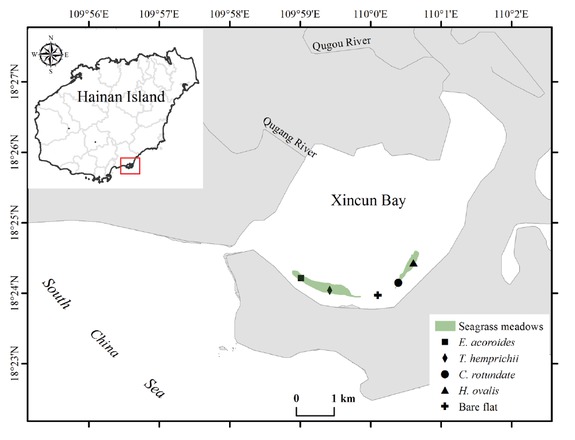
Figure 1
Location of five sampling sites with four monospecific meadows and the bare tidal flat at the intertidal zone of Xincun Bay
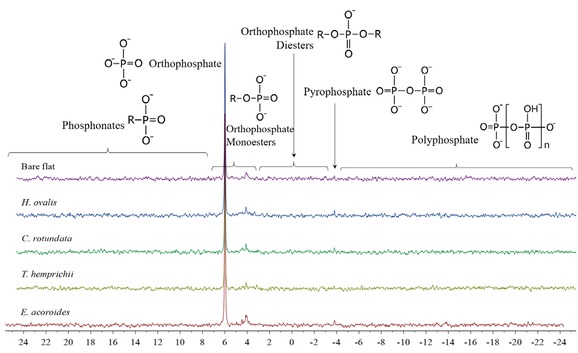
Figure 2
Solution 31P-NMR spectra for NaOH-EDTA extracts of the sediments from different seagrass meadows
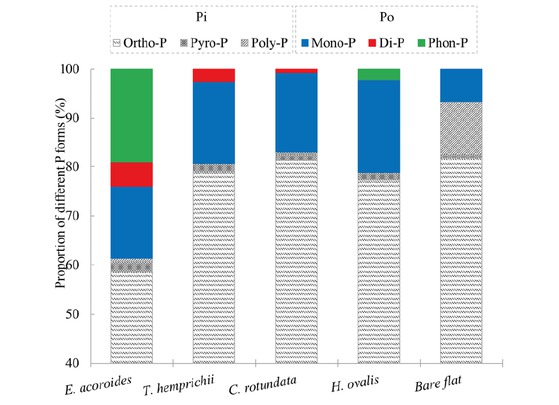
Figure 3
Proportion of P forms in solution 31P-NMR spectra for NAOH-EDTA
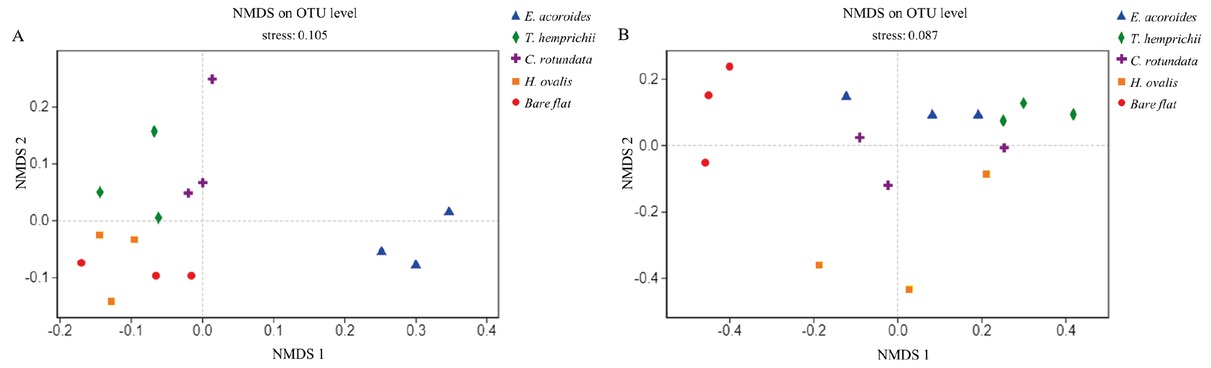
Figure 4
NMDS plots of the sediment bacterial (A) and fungal OTUs (B) based on the unweighted UniFrac metric for all samples
Table 1
The number of operational taxonomic units (OTUs) and Alpha diversity indices of bacterial and fungal communities. The values are means followed by a standard error. Different letters indicate statistically significant differences (p < 0.05) according to the Duncan test.
| Samples | OTUs | Shannon Index | Simpson Index | Ace Index | Chao Index | |
|---|---|---|---|---|---|---|
| E. acoroides | 1832 (124)a | 5.72 (0.24)a | 0.012 (0.004)a | 2147 (104)a | 2142 (99)a | |
| T. hemprichii | 2091 (6)b | 5.88 (0.22)a | 0.011 (0.005)a | 2426 (53)b | 2428 (59)b | |
| C. rotundata | 2081 (54)b | 5.72 (0.39)a | 0.019 (0.015)a | 2424 (15)b | 2414 (48)b | |
| Bacteria | H. ovalis | 2105 (103)b | 6.08 (0.11)a | 0.007 (0.001)a | 2392 (83)b | 2408 (95)b |
| bare tidal flat | 1937 (15)a | 5.93 (0.07)a | 0.009 (0.001)a | 2313 (38)b | 2316 (63)b | |
| F test | 7.427 | 1.233 | 1.058 | 9.295 | 7.555 | |
| p value | 0.005 | 0.357 | 0.426 | 0.002 | 0.005 | |
| E. acoroides | 299 (63)b | 3.91 (0.45)b | 0.064 (0.033)a | 303 (65)b | 303 (65)b | |
| T. hemprichii | 219 (40)ab | 2.82(0.48)a | 0.188 (0.093)b | 226 (41)ab | 231 (43)ab | |
| C. rotundata | 207 (58)a | 4.12 (0.41)b | 0.040 (0.023)a | 211 (58)a | 210 (57)a | |
| Fungi | H. ovalis | 251 (22)ab | 3.87 (0.19)b | 0.071 (0.007)a | 256 (21)ab | 259 (26)ab |
| bare tidal flat | 241 (27)ab | 4.37 (0.03)b | 0.029 (0.002)a | 246 (28)ab | 246 (29)ab | |
| F test | 1.907 | 8.451 | 5.796 | 1.810 | 1.694 | |
| p value | 0.186 | 0.003 | 0.011 | 0.203 | 0.227 |
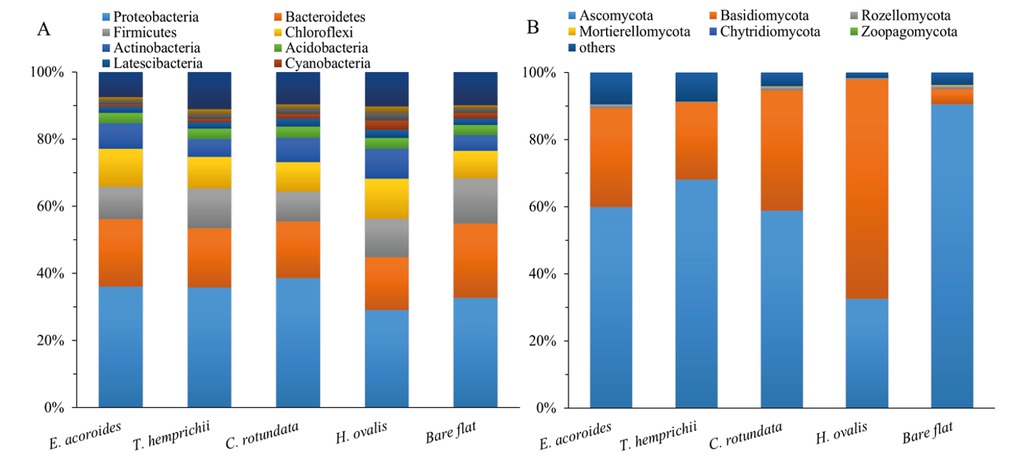
Figure 5
Relative abundance of bacterial (A) and fungal (B) phyla
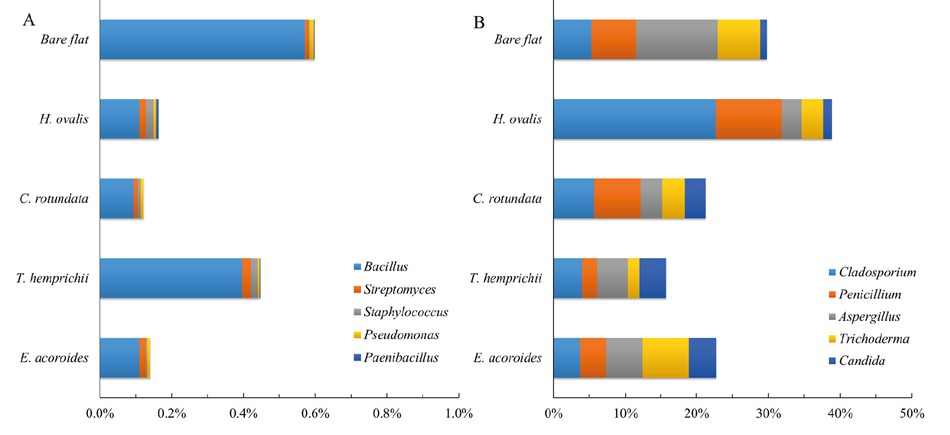
Figure 6
Relative abundance of the top five genus-level P-cycling-related bacteria (A) and fungi (B) detected by 31P-NMR. Blue arrows represent different genera of microbes, while red arrows represent P forms. Correlation between P forms and RDA axes is shown by both the length and angle of the arrows.
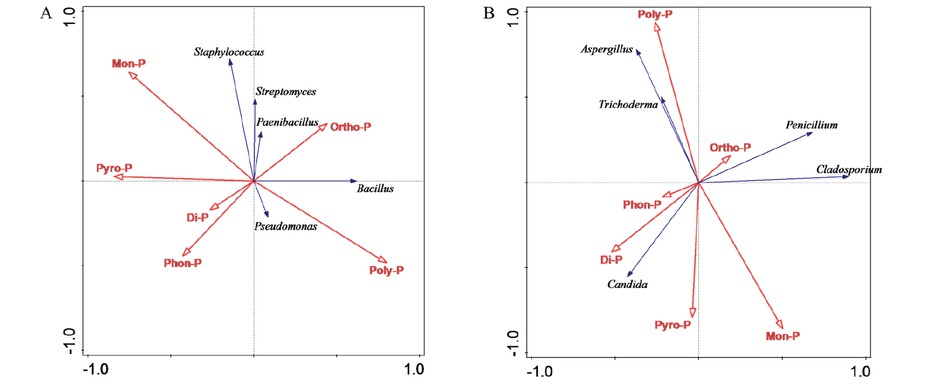
Figure 7
Redundancy analysis (RDA) for the top five genus-level P-cycling-related microbes (A for bacteria and B for fungi) and sediment P forms detected by 31P-NMR. The blue arrows represent different genera of microbes, whereas variables for P forms are shown with red arrows. The correlation between P forms and RDA axes are shown by both the length and angle of the arrows.
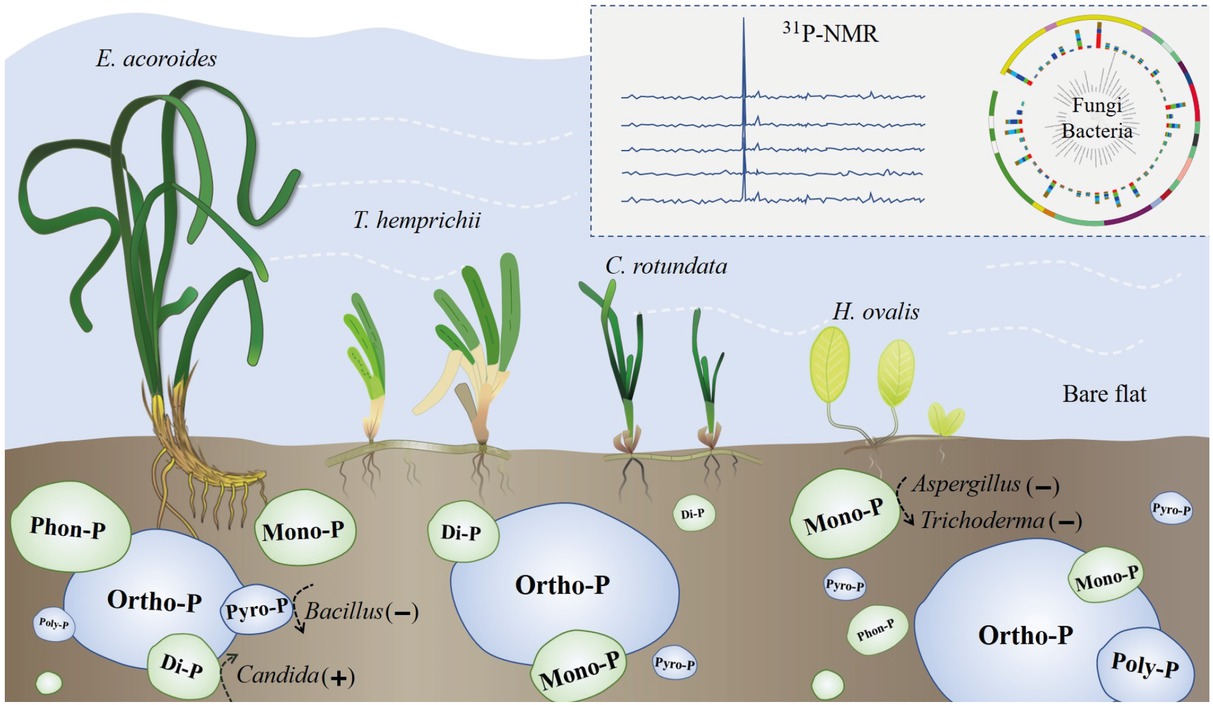
Figure 8
Main findings of this research