
Introduction
Floristic studies in the waters of the northern and eastern regions of Eurasia are very important because the formation of floras occurs in extremely contrasting environments. The Pole of Cold is located in this region, and most of the territory is occupied by permafrost. At the same time, its territory is abundant with a variety of lotic and lentic water bodies. The study of algae in lake-type water bodies is of special interest since the formation of their floras occurs under the conditions of flow from catchment basins and thus represents the effect of natural and anthropogenic conditions throughout the entire catchment area over many years.
The first information about algae of the lakes in Central Yakutia was provided in the study by I.A. Kiselev (Kiselev 1932) based on the results of fragmentary gatherings carried out by participants of complex expeditions engaged in the study of natural, climatic, and economic resources of the region.
Regular research on algae was started in 1948 by L.E. Komarenko, the founder of algological research in the Republic. She collected and processed interesting, in terms of regional floristics, material on the composition of algae of individual lotic and lentic water bodies in central and northern Yakutia.
Further research was conducted to study the composition, distribution, and ecological preferences of algae in various types of water bodies in different botanical and geographical regions of Yakutia. The results of inventory, floristic, and hydrobiological studies were published in a number of works on the algal flora of central Yakutia lakes (Komarenko & Vasilyeva 1975; 1978; Vasilyeva 1987; 1989; Kopyrina 2014; Pestryakova 2008; Troeva et al. 2010).
Our attention was focused on thermokarst (alas) lakes, which are numerous in the central Yakutsk region. Alas represents a special landscape type characterized by shallow depressions that occur primarily in Yakutia. Prior to our study, a total of 559 species of algae, including intraspecific taxa, were found in thermokarst taiga lakes, which represents 17.9% of the algal flora of Yakutia (Danilova 2005; Kuznetsova et al. 2010; Pestryakova 2008; Revin 2005).
The objective of the present work was to assess the current ecological conditions of the thermokarst lakes in Yakutia based on the composition and ecological preferences of freshwater algae taxa using bioindication and statistical methods.
Materials and methods
Description of the study site
At present, 26 unique lakes in Yakutia are recognized as important in the Republic (Decree 2016). Among the lakes studied, four lakes belong to the unique lakes of the Republic of Sakha (Yakutia): Lake Abalah, Lake Nidzhili, Lake Tungulu, and Lake Churapcha (algae in Lake Churapcha have never been studied before).
The studied lakes were located on four different terraces in the basin of the Lena River in Yakutia, the north-eastern Siberia region, Russia (Revin 2005; Fig. 1). The middle Lena basin is rich in thermokarst lakes, nine of which were surveyed in 1986–1994 and 2001–2015 (Fig. 2).
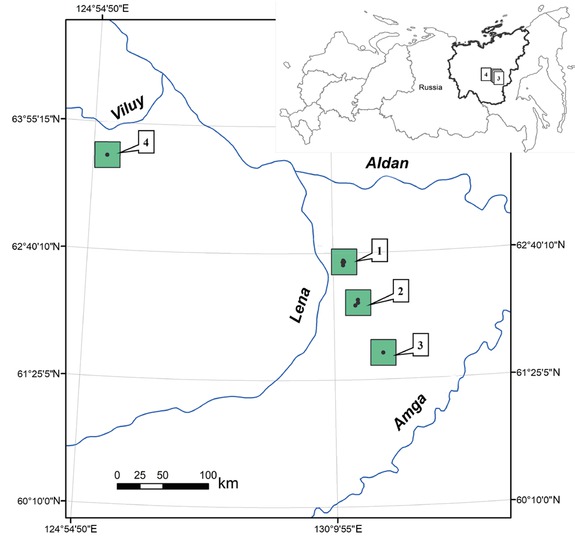
Figure 1
Map of the studied lakes in Yakutia. 1 – Bestyakhskaya terrace, lakes Aalah, Kurelah, Sullah, Dyiere; 2 – Tyungulyunskaya terrace, lakes Ynah, Nal Tungulu, Large and Small Tungulu; 3 – Abalah Lake, Abalah terrace; 4 – Nidzhili Lake, Lena-Viluyskaya terrace
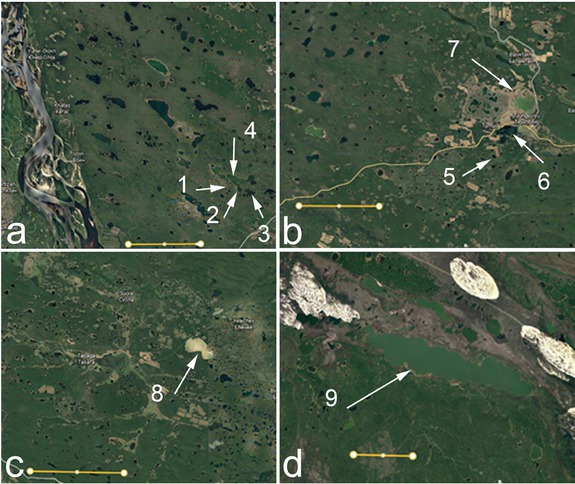
Figure 2
Geographical location of the studied lakes in Yakutia. Bestyakhskaya terrace (a): 1 – Lake Aalah, 2 – Lake Kurelah, 3 – Lake Sullah, 4 – Lake Dyiere; Tyungulyunskaya terrace (b): 5 – Lake Ynah, 6 – Lake Nal Tungulu, 7 – Lake Tungulu; Abalahskaya terrace (c): 8 – Lake Abalah; Lena-Viluyskaya terrace (d): 9 – Lake Nidzhili. Scale bar 10 km
Lake Aalah
Lake Aalah (Fig. 2a) is located on the Bestyakhskaya terrace (62°34’46”.276N; 130°22’12”.580E; Revin 2005). The lake surface area is about 0.052 km2 in spring and 0.023 km2 at the end of summer. The water volume fluctuates during the ice-free period from 62 400 to 27600 m3. The content of oxygen gradually decreases toward autumn, until it is completely absent, with an increase in the concentration of carbonates, which indicates a soda lake.
The salt regime of the lake represents the hydrocarbonate class and the magnesium group with moderate levels of total dissolved solids (TDS) and hardness. The permanganate oxidation index indicates a high concentration of organic matter. Since 1992, the class of water in Lake Aalah has changed from sulfate to bicarbonate.
One of the causes of such pollution is related to the removal of nitrogen and phosphate fertilizers from landfills located near the lake and the other – to the drying of the lake.
The lake is heavily anthropogenically polluted due to livestock grazing and fertilizer intake, and is exposed to secondary pollution due to the decomposition of organic matter.
Lake Kurelah
Lake Kurelah (62°34’55”.679N; 130°23’59”.492E) is located on the Bestyakhskaya terrace (Revin 2005) and has an irregular shape. The water surface area in spring is about 0.11 km2 and decreases to 0.08 km2 in autumn (Fig. 2a). The volume of water is 165000 and 120000 m3, respectively, in spring and autumn. The water in the lake represents the hydrocarbonate class and the magnesium group with high TDS. The Lake Kurelah catchment basin is used as grazing land for cattle and therefore its water is organically polluted.
Lake Sullah
There are two small lakes on the Bestyakhskaya terrace (Fig. 2a). Lake Sullah (62°32’59”.172N; 130°22’36”.815E) is the larger one (Revin 2005), with a water surface area decreasing during the open-water period from 500 to 240 m2. The water volume also changes from 850 to 360 m3, respectively. The other lake is small, about 3 m in diameter, and almost dries up in summer, turning into a swamp. The water in the lake is moderately enriched with total dissolved solids (TDS). The TDS values of Lake Sullah are the lowest compared to the other lakes of the Bestyakhskaya terrace. In general, the Bestyakhskaya terrace lakes are characterized by a more or less stable salt regime, as they are adjacent to river systems, which increases their water exchange compared to the drainage lakes of the Aalah terrace.
Lake Dyiere
Lake Dyiere (62°35’42”.263N; 130°22’58”.001E) on the Bestyakhskaya terrace (Revin 2005) is small in size, oval in shape and has a water surface area of 6100 m2 in spring, which is reduced in autumn to 3000 m2 (Fig. 2a). The volume of water during the open-water period is 9000 m3 in spring and 3600 m3 in autumn. The salt regime of the lake represents the hydrocarbonate class and the sodium group, with a moderate content of TDS in water. It is located near a livestock farm.
Lake Ynah
Lake Ynah (62°9’1”.440N; 130°37’10”.200E) on the Tyungulyunskaya terrace (Revin 2005) is small, round in shape and has a water surface area of 116.6 m2 in spring, which decreases to 97.1 m2 in autumn (Fig. 2b). The lake is about 1.19 m deep and becomes shallower in autumn – to 0.87 m. The salt regime of the lake represents the hydrocarbonate class and the sodium group, with a high content of TDS and moderate hardness.
Lake Nal Tungulu
Lake Nal Tungulu is located near the village of Tumul (62°10’39”N; 130°40’39”.223E) on the Tyungulyunskaya terrace (Revin 2005). It is large, irregularly shaped and reportedly represents a system of lakes during floods with Tungulu lakes (Fig. 2b). The area of the lake is 2.9 km2 and the catchment area is 82.1 km2. It is a soda-type lake in the hydrocarbonate class and the sodium group. The salinity increases in summer to 658.2 mg l−1. The water is hard. The content of biogenic and organic substances is slightly higher than in other lakes of this terrace, but compared to other studied lakes, Nal Tugulu is more fertile.
Lake Tungulu
Tungulu (Great Lake Khotun Tungulu) is the largest lake system that comprises about 58 lakes on the Tyungulyunskaya terrace, two of which are large, several kilometers wide and several kilometers long. Of the 58 lakes, about 40 are located on Alas Hotun (Great) Tungulu (Revin 2005). The Tungulu system of lakes is heavily polluted as one of the lakes has housed a large storage area of silicates and ammonia since the Soviet era. A large landfill is located near the other lakes.
Lake Tungulu (62°12’25”.092N; 130°40’41”.610E) is a drying thermokarst lake (Fig. 2b). The water surface area is 7.2 km2. The catchment area is 370 km2. The lake is 4.89 km long and 0.36–3.35 km wide. There are only small differences in the depth of the lake. The maximum depth of the water layer is 2.3 m. The shoreline is 22.2 km long. The height above sea level is 134 m. A watercourse flows out of Tungulu and continues into Lake Nal Tungulu. Lake Tungulu represents the hydrocarbonate class and the sodium and calcium groups. It is a highly mineralized lake with hard water.
Lake Tungulu presents special environmental, scientific, cultural, aesthetic, recreational, and health services, which in turn have significant economic, social, and historical values for present and future generations, and is an important natural habitat for biodiversity conservation.
Lake Abalah
Lake Abalah (Fig. 2c) is a saline thermokarst, located on the Abalahskaya terrace (61°40’48”.605N; 131°10’20”.910E; Revin 2005). It has a shape of a 3-petal flower with many islands in it. It is a salt lake without drainage, located 100 km east of Yakutsk (Fig. 2c). The following morphometric data were obtained for this lake in 2011. The water surface area is 1.09 km2. A streamlet from a hydrogen sulfide source flows into the lake. The length of the lake is 2.0 km; the width is 0.10–1.54 km, and the shoreline is significantly indented at 7.88 km. The depth varies, but basically it is a shallow lake. The maximum depth is 1.2 m and the depth in the remaining part of the lake ranges from 0.20 to 1.1 m. The depth of the alas basin is 14 m.
The lake has a high concentration of salts and is used for balneological purposes. Such a salt saturation is largely due to the natural water quality conditions.
The main natural healing factors of the lake are sulfide silt mud and chloride–hydrocarbonate sodium brine. From 1935 to the mid-1950s, a sanatorium operated on Lake Abalah and then mud baths were built.
Lake Nidzhili
Lake Nidzhili (Fig. 2d) is the largest natural water body located on the Central Yakutia Plain (Lena-Viluyisk interfluve, Lena-Viluyskaya terrace), 117 km east of the regional center of the village Sangar (63°35’49”.448N; 125°13’6”.496E; Revin 2005). The catchment area is 1010 km2, and the lake’s water surface is 119 km2. The length of the lake is 33.5 km and the maximum width is 6 km. The maximum depth reaches 7 m and the average depth is about 3 m (according to data from 1964). The lake stretches from west to east. The Künkey and Kharya-Yuryakh rivers flow into Lake Nidzhili, whereas the Sien River (the Vilyui River basin) leaves the lake. The water in the lake starts to freeze from late September to early October. The freezing occurs in mid-October with an average duration of about 240 days. The thickness of the ice, depending on the thickness of the snow cover, varies from 1.1 m to 1.7 m. In mid-June, Lake Nidzhili is free of ice. The water has a yellow tint and the transparency of about 1 m. The lake is rich in fish. The Nidzhilinsky crucian carp, recognized as the best in Yakutia, thrives in other lakes of the Republic. Marshy areas, thickets, and meadows used for nomadic-livestock rearing, which are common in headlands, are located near the lake.
Sampling and processing
The study of algae in thermokarst lakes was carried out on the original material collected from 1986 to 1994 (in stationary conditions from June to September by EV Pshennikova, Lake Bestyakhkoy and the Tyungulyunsky terraces) and during the summer period (July–August) from 2001 to 2015 (L.I. Kopyrina, E.V. Pshennikova: Bestyakhskaya, Tyungulyunskaya lakes, Lake Abalah, and Lake Nidzhili). A total of 2034 samples were collected and processed for the entire period of research.
Phytoperiphyton samples were collected by scratching filamentous algae from higher aquatic plants, mosses and plant debris in the littoral and pelagial zones of the lakes. The phytoplankton qualitative samples were collected by an Apstein net No. 77. For quantitative analyses of phytoplankton, 10 l of water was filtered through the Apstein net and placed in 25 ml plastic tubes. Algal samples were fixed in 4% neutral formaldehyde. Samples of water were collected at the same sites to determine water temperature, pH, Total Dissolved Solids (TDS), and chlorides. Coordinate referencing of the sampling locations was done by a Garmin eTrex GPS-navigator. All collected samples were transported to the laboratory in an icebox. Fixed algae samples were analyzed in the laboratory in three repetitions on wet and permanent slides (Guidance 1992) under a light microscope MIKMED-6 (LOMO, Russia), with a magnification of × 100–2000. Quantitative phytoplankton samples were processed by microscopic examination using Nageott and Fuchs-Rosenthal cameras in three repetitions.
Conventional methods of water chemical analysis were used (Semenov 1977; Fomin, 1995). Water samples for chemical analysis were collected during the open-water period. The gas regime was determined on site. The chemical composition of water was determined in the Laboratory of hydrobiology at the Institute of Applied Ecology of the North of the North-Eastern Federal University (NEFU), in the Laboratory of Soil Ecology and Ecological Ecosystems at the Institute of Biological Problems of the Cryolithozone of the Siberian Branch of the Russian Academy of Science, and in the laboratory of physicochemical analyses at the Institute of Geology of Diamond and Noble Metals of the Siberian Branch of the Russian Academy of Sciences according to generally accepted methods in hydrochemistry (Alekin et al. 1973; Lurie 1973; Semenov 1977).
International handbooks were used to identify algae (Genkal & Vekhov 2007; Genkal et al. 2011; 2015; Komulainen 2004; Krakhmalny 2011; Krammer 1997a,b; 2000; 2002; 2003; Krammer & Lange-Bertalot 1986; 1988; 1991a,b; Kulikovsky et al. 2016; Lange-Bertalot 2001; Lange-Bertalot et al. 2011; Lange-Bertalot & Genkal 1999; Levkov 2009; Levkov et al. 2013; Medvedeva & Nikulina 2014; Reichardt 1999; Voloshko 2017) and taxa names were adopted to the international system in Algaebase (Guiry & Guiry 2019).
Similarity calculations were performed using the BioDiversity Pro 2.0 program and network analyses were performed using JASP (Joint Analytical Support Program) graphical statistical software for common statistical designs in the R Statistica package (Love et al. 2019). Canonical Correspondence Analysis was performed using CANOCO Program 4.0 (Ter Braak & Šmilauer 2002).
Bioindication analyses were performed using environmental preferences of algae and cyanobacteria species (Barinova et al. 2006; 2019), including organic pollution indicators (Sládecek 1986; Watanabe et al. 1986).
Results
Chemical variables
Water chemistries of the nine studied Yakutian lakes are presented in Table 1. It can be seen that the lakes are small (Fig. 2) except for Lake Nidzhili from the Lena-Viluy terrace. The average water temperature did not exceed 20°C in summer (ice-free period). The water in the lakes was well oxygenated and alkaline with pH 7.5–9.84. The content of Total Dissolved Solids (TDS) in water fluctuated in a wide range. Lake Abalah contained higher levels of sulfates but not chlorides. Phytoplankton developed in the summer period mostly in the lakes of the Bestyakhskaya terrace and Lake Ynah, whereas phytoplankton in the other studied lakes was scarce.
Table 1
Average morphometry, water chemistry, and abundance and biomass of phytoplankton values in the nine Yakutian lakes. In the Code column, names of the lakes are abbreviated for statistical calculations (Bestyakhskaya terrace is yellow, Tyungulyunskaya terrace is gray, Abalah terrace is beige, and Lena-Viluyskaya terrace is green)
| Lake | Code | T °С | mg О2l−1 | pH | TDS | Cl− | Abundance | Biomass |
|---|---|---|---|---|---|---|---|---|
| mg l−1 | mg l−1 | × 106 cells l−1 | mg l−1 | |||||
| Aalah | B-Aal | 15.8 | 10.3 | 8.0 | 794.6 | 18.6 | 96.0 | 7.5 |
| Kurelah | B-Kur | 20.0 | 9 | 9.23 | 657.0 | 10.4 | 362.0 | 13.9 |
| Sullah | B-Sul | 17.0 | 12.4 | 8.6 | 390.2 | 9.2 | 267.8 | 3.5 |
| Dyiere | B-Dyi | 18.0 | 11.8 | 8.65 | 352.1 | 15.5 | 297.3 | 15.1 |
| Ynah | T-Yna | 19.5 | 7.2 | 8.0 | 617.8 | 15 | 628.4 | 28.8 |
| Nal Tungulu | T-NalT | 16.7 | 7.8 | 8.63 | 557.7 | 18.5 | 4.62 | 1.1 |
| Tungulu | T-Tun | 17.8 | 8.0 | 9.84 | 2602.1 | 591.3 | 3.51 | 0.9 |
| Abalah | A-Aba | 19.0 | 5.9 | 9.82 | 453034 | 13.5 | - | - |
| Nidzhili | L-Nid | 18.0 | 13.5 | 7.5 | 530 | - | 24.88 | 0.0006 |
Algal communities
A total of 437 species (453 with intraspecific taxa) of algae and Cyanobacteria were identified in the nine studied lakes in Yakutia (Appendix). The distribution of taxonomic content in each lake is presented in Table 2. Species marked with an asterisk are those found for the first time in the Yakutia region. This diversity is studied and presented for the first time, with the exception of algae from Lake Nidzhili, which were partly described by Pshennikova (1999; 2000; 2003). We analyzed the distribution of taxonomic groups of the identified diversity as well as ecological preferences of the species according to Barinova et al. (2019), as presented in Table 2. It can be seen that the highest species richness was found in the lakes Aalah (241), Kurelah (127), and Ynah (131). It is very interesting that Chlorophyta species dominated in most communities in the lakes of the Bestyakhskaya terrace, whereas Cyanobacteria dominated in the lakes of the Tyungulyunskaya terrace, and Bacillariophyta species dominated in Lake Abalah and Lake Nidzhili (Fig. 3a). Only the flora of Lake Aalah had equal proportions of these three major taxonomic groups.
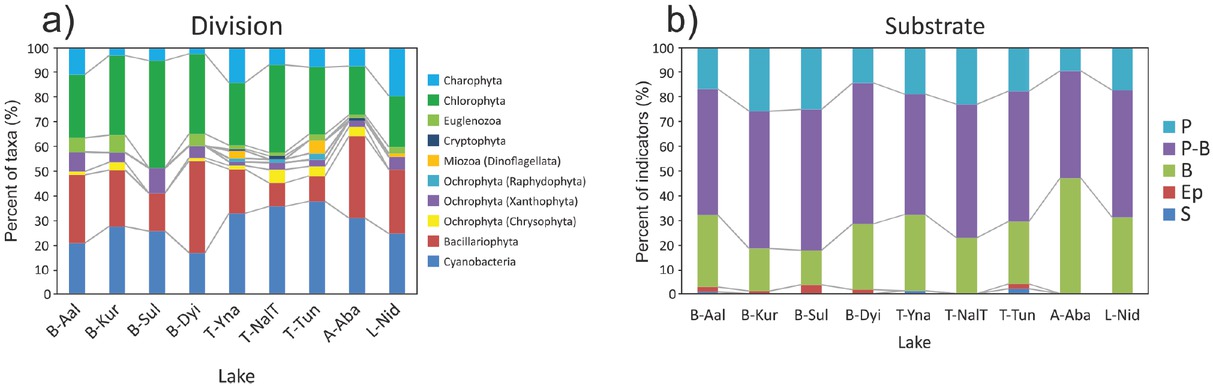
Figure 3
Distribution of the taxonomic content (a) and substrate preferences (b) in the studied lakes of Yakutia. Abbreviations of lake names are the same as in Table 1. Abbreviations of ecological groups of substrate preferences: S – soil; Ep – epiphytes; B – benthic as a whole; P-B – planktic-benthic; P – planktic
Table 2
Taxonomic saturation of algal communities, Subspecies/Species Index (Ssp/Sp Index), and taxa and indicators content of the nine studied lakes in Yakutia. Abbreviated names of the lakes are the same as in Table 1.
| Division | |||||||||
|---|---|---|---|---|---|---|---|---|---|
| Cyanobacteria | 50 | 35 | 10 | 14 | 44 | 26 | 29 | 25 | 19 |
| Bacillariophyta | 67 | 29 | 6 | 31 | 24 | 7 | 8 | 27 | 20 |
| Ochrophyta (Chrysophyta) | 3 | 4 | 0 | 1 | 2 | 4 | 3 | 3 | 0 |
| Ochrophyta (Xanthophyta) | 19 | 5 | 4 | 4 | 2 | 2 | 2 | 2 | 4 |
| Ochrophyta (Raphydophyta) | 0 | 0 | 0 | 0 | 2 | 1 | 2 | 0 | 0 |
| Miozoa (Dinofl agellata) | 0 | 0 | 0 | 0 | 4 | 0 | 4 | 0 | 1 |
| Cryptophyta | 0 | 0 | 0 | 0 | 1 | 1 | 0 | 1 | 0 |
| Euglenozoa | 14 | 9 | 0 | 4 | 2 | 1 | 2 | 1 | 2 |
| Chlorophyta | 62 | 41 | 17 | 27 | 34 | 26 | 21 | 16 | 16 |
| Charophyta | 26 | 4 | 2 | 2 | 19 | 5 | 6 | 6 | 15 |
| Number of taxa | 241 | 127 | 39 | 83 | 131 | 72 | 76 | 80 | 77 |
| Ssp/Sp Index | 1.034 | 1.024 | 1.026 | 1.012 | 1.047 | 1.058 | 1.041 | 1.025 | 1.013 |
| Number of species per area | 64.7 | 13.4 | 1054.1 | 182.4 | 1091.7 | 28.4 | 10.6 | 73.4 | 0.6 |
| Substrate | |||||||||
|---|---|---|---|---|---|---|---|---|---|
| S | 1 | 0 | 0 | 0 | 1 | 0 | 1 | 0 | 0 |
| Ep | 3 | 1 | 1 | 1 | 0 | 0 | 1 | 0 | 0 |
| B | 44 | 17 | 4 | 17 | 28 | 11 | 13 | 25 | 20 |
| P-B | 76 | 54 | 16 | 36 | 44 | 26 | 27 | 23 | 33 |
| P | 25 | 25 | 7 | 9 | 17 | 11 | 9 | 5 | 11 |
| Temperature | |||||||||
|---|---|---|---|---|---|---|---|---|---|
| cool | 3 | 2 | 0 | 0 | 1 | 0 | 0 | 0 | 0 |
| temp | 17 | 10 | 3 | 7 | 5 | 2 | 1 | 6 | 10 |
| eterm | 6 | 5 | 0 | 2 | 3 | 1 | 2 | 1 | 2 |
| warm | 6 | 5 | 0 | 1 | 1 | 1 | 1 | 1 | 1 |
| Oxygenation | |||||||||
|---|---|---|---|---|---|---|---|---|---|
| aer | 7 | 1 | 1 | 1 | 3 | 4 | 6 | 6 | 5 |
| str | 13 | 3 | 2 | 6 | 3 | 0 | 1 | 2 | 3 |
| st-str | 58 | 41 | 9 | 23 | 32 | 17 | 18 | 15 | 26 |
| st | 21 | 15 | 4 | 8 | 11 | 6 | 5 | 6 | 6 |
| H2S | 0 | 1 | 1 | 1 | 3 | 1 | 1 | 0 | 0 |
| pH | |||||||||
|---|---|---|---|---|---|---|---|---|---|
| acf | 10 | 1 | 1 | 2 | 2 | 1 | 1 | 1 | 5 |
| ind | 45 | 22 | 2 | 20 | 1 | 7 | 9 | 11 | 21 |
| alf | 28 | 14 | 4 | 12 | 11 | 4 | 4 | 11 | 6 |
| alb | 3 | 0 | 0 | 1 | 19 | 0 | 0 | 1 | 2 |
| Salinity | |||||||||
|---|---|---|---|---|---|---|---|---|---|
| hb | 3 | 2 | 0 | 1 | 3 | 2 | 1 | 1 | 1 |
| i | 92 | 58 | 15 | 44 | 45 | 24 | 27 | 25 | 46 |
| hl | 8 | 7 | 3 | 2 | 7 | 3 | 4 | 6 | 5 |
| mh | 6 | 4 | 0 | 3 | 1 | 1 | 1 | 2 | 0 |
| ph | 0 | 0 | 0 | 0 | 0 | 0 | 0 | 1 | 0 |
| Saprobity Watanabe | |||||||||
|---|---|---|---|---|---|---|---|---|---|
| sx | 12 | 4 | 1 | 5 | 4 | 1 | 1 | 1 | 3 |
| es | 24 | 12 | 3 | 9 | 10 | 2 | 1 | 6 | 14 |
| sp | 3 | 3 | 1 | 1 | 2 | 1 | 1 | 2 | 1 |
| Water Quality Class | |||||||||
|---|---|---|---|---|---|---|---|---|---|
| Class 1 | 5 | 2 | 0 | 0 | 1 | 0 | 0 | 1 | 5 |
| Class 2 | 37 | 26 | 10 | 17 | 20 | 11 | 11 | 15 | 25 |
| Class 3 | 69 | 49 | 16 | 32 | 45 | 25 | 28 | 17 | 27 |
| Class 4 | 15 | 10 | 1 | 8 | 8 | 3 | 3 | 5 | 0 |
| Class 5 | 2 | 2 | 0 | 0 | 2 | 0 | 0 | 0 | 0 |
| Trophic status | |||||||||
|---|---|---|---|---|---|---|---|---|---|
| o | 7 | 5 | 0 | 4 | 4 | 3 | 2 | 2 | 7 |
| o-m | 19 | 5 | 2 | 12 | 10 | 2 | 3 | 4 | 7 |
| m | 9 | 2 | 1 | 1 | 5 | 1 | 1 | 3 | 5 |
| me | 22 | 12 | 5 | 9 | 9 | 8 | 6 | 8 | 10 |
| e | 15 | 13 | 2 | 3 | 12 | 3 | 6 | 3 | 4 |
| o-e | 3 | 1 | 0 | 1 | 1 | 0 | 0 | 0 | 2 |
| he | 1 | 1 | 0 | 1 | 1 | 0 | 0 | 2 | 0 |
| Nutriti on type | |||||||||
|---|---|---|---|---|---|---|---|---|---|
| ats | 11 | 5 | 1 | 5 | 3 | 0 | 0 | 2 | 8 |
| ate | 20 | 10 | 3 | 7 | 11 | 4 | 5 | 6 | 6 |
| hne | 2 | 1 | 0 | 0 | 1 | 0 | 0 | 0 | 1 |
| hce | 2 | 3 | 0 | 1 | 1 | 0 | 0 | 1 | 1 |
[i] Note: Ecological groups. Substrate: S – soil; Ep – epiphytes; B – benthic as a whole; P-B – planktic-benthic; P– planktic. Temperature: cool – cold loving; temp – temperate temperature waters; eterm – eurythermal; warm – warm waters. Water disturbance and oxygenation: aer – aerophiles; str – streaming well-oxygenated waters; st-str – low streaming, moderately oxygenated waters; st– standing, low-oxygenated waters; H2S – sulfide indicators. Water pH: acf – acidophiles; ind – pH-indifferents; alf – alkaliphiles; alb – alkalibiontes. Salinity: hb – halophobes; i – chloride-tolerated (indiff erent); hl – halophiles; mh – mesohalobes; ph – polyhalobes. Saprobity according to Watanabe: sx – saproxenes; es – eurysaprobes; sp – saprophiles. Water Quality Classes: Classes 1–5 according to EU FWD. Trophic Status: o– oligotraphentes; o-m – oligo-mesotraphentes; m– mesotraphentes; me – meso-eutraphentes; e– eutraphentes; o-e – from oligo- to eutraphentes; he – hypereutraphentes. Nutrition types: ats – strong autotrophs; ate – autotrophic tolerant to low nitrogen load; hne – particular heterotrophs (mixotrophs); hce – mixotrophs constantly requiring a nitrogen load.
The highest abundance and biomass of the planktic communities were determined in Lake Ynah in August (Table 1). During the August peak of the maximum stagnation with a total abundance of 1067 × 106 cells l−1 and biomass of 35 mg l−1, Cyanobacteria dominated (629.6/15.4) with 44 species and were accompanied by Chlorophyta (312.5/11.4) represented by 34 species. The most abundant of the 131 species were: Microcystis aeruginosa, Microcystis flosaquae, Microcystis ichthyoblabe, Aphanocapsa grevillei, Merismopedia glauca, Merismopedia minima, Merismopedia tenuissima, Desmodesmus armatus, Scenedesmus ellipticus, Tetradesmus lagerheimii, Pseudopediastrum boryanum.
Lake Ynah on the Tyungulyunskaya terrace is followed by the lakes of the Bestyakhskaya terrace in terms of phytoplankton abundance – 362–96 106 × cells l−1, and biomass – 3.5–15.1 mg l−1. Thus, the phytoplankton abundance in Lake Kurelah during the August stagnation was twice as low as in Lake Ynah – 362.4 × 10⁶ cells l−1 and biomass – 13.9 mg l−1. The algal community was dominated by Chlorophyta (41), Cyanobacteria (35), and Bacillariophyta (29) species. Cyanobacteria (189/6.6) and Chlorophyta (173/6.9) reached the maximum abundance and biomass values during the August peak. The most abundant species were: Microcystis aeruginosa, Microcystis flosaquae, Microcystis firma, Aphanizomenon flosaquae, Aphanocapsa pulverea, Merismopedia elegans, Snowella rosea, Hindakia tetrachotoma, Mychonastes anomalus, Dictyosphaerium ehrenbergianum.
The algal community of Lake Abalah was represented by 80 taxa, most of which were diatoms (27), followed by Cyanobacteria (25). Phytoplankton quantitative characteristics were not studied here.
Lake Nidzhili represents only one of the lakes of the Lena-Viluyskaya terrace. Bacillariophyta dominated with 20 species, while Cyanobacteria (19), Chlorophyta (16), and Charophyta (15) occurred in diverse communities with 70 taxa in total. Nevertheless, diatoms were diverse, Chlorophyta and Charophyta species were represented by large numbers in the plankton: Pseudopediastrum boryanum, Pediastrum kawraiskyi, Tetradesmus lagerheimii from Chlorococcales, and Staurastrum avicula var. lunatum, Staurastrum oxyacanthum, Cosmarium botrytis, Cosmarium meneghinii, Cosmarium punctulatum, and Cosmarium reniforme from Charophyceae. This taxonomic composition of species reflects the lake-bog complex of species. A characteristic feature of the development of green and charophyte algae is the effect of shallow water, as well as overgrown littoral and grassy soils, which were formed for a long time and identified in large Nidzhili Lake.
Bioindication
Bioindication plots of algal species preferences for each lake are presented in Figures 3–7. Thus, algae in the studied lakes are mostly benthic and planktic–benthic inhabitants, with up to 25% of planktic species (Fig. 3b). Only the Abalah community was rich in benthic species up to 50%, which means that its environment was not favorable for plankton development.
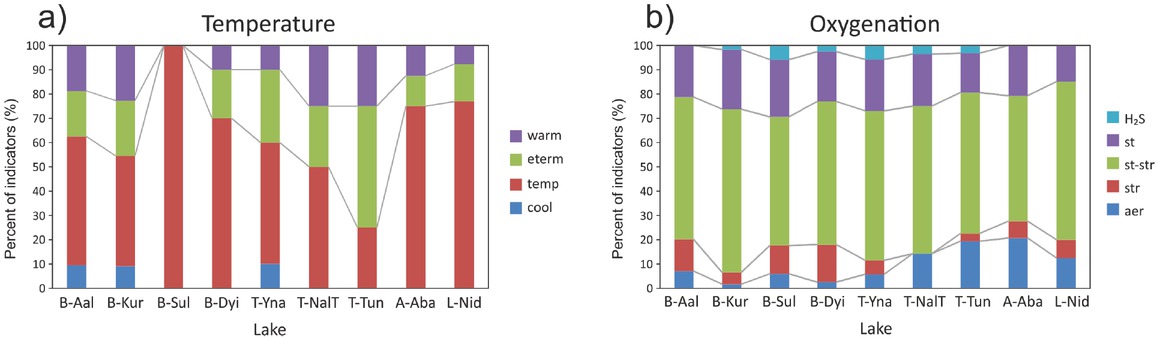
Figure 4
Ecological preferences of water temperature (a) and oxygenation (b) indicators in the studied lakes of Yakutia. For abbreviations of lake names see Table 1. Abbreviations of ecological groups relative to water temperature: cool – preferring low temperature; temp – temperate temperature waters; eterm – eurythermal; warm – warm waters. Indicators of water disturbance and oxygenation: aer – aerophiles; str – well-oxygenated streaming waters; st-str, low streaming, moderately oxygenated waters; st – standing, poorly oxygenated waters; H2S – sulfide indicators
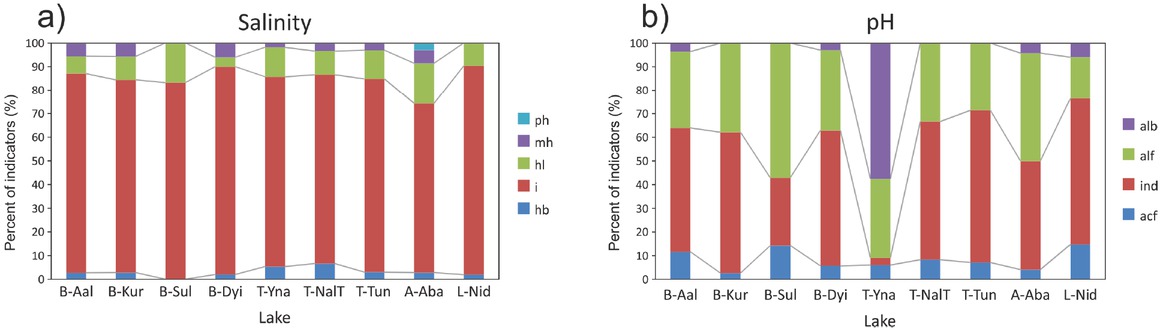
Figure 5
Ecological preferences of water salinity (a) and pH (b) indicators in the studied lakes of Yakutia. For abbreviations of lake names see Table 1. Abbreviations of ecological groups of salinity indicators: hb – halophobes; i – chloridetolerated (indifferent); hl – halophiles; mh – mesohalobes; ph – polyhalobes. Water pH indicators: acf – acidophiles; ind – pH-indifferents; alf – alkaliphiles; alb – alkalibiontes
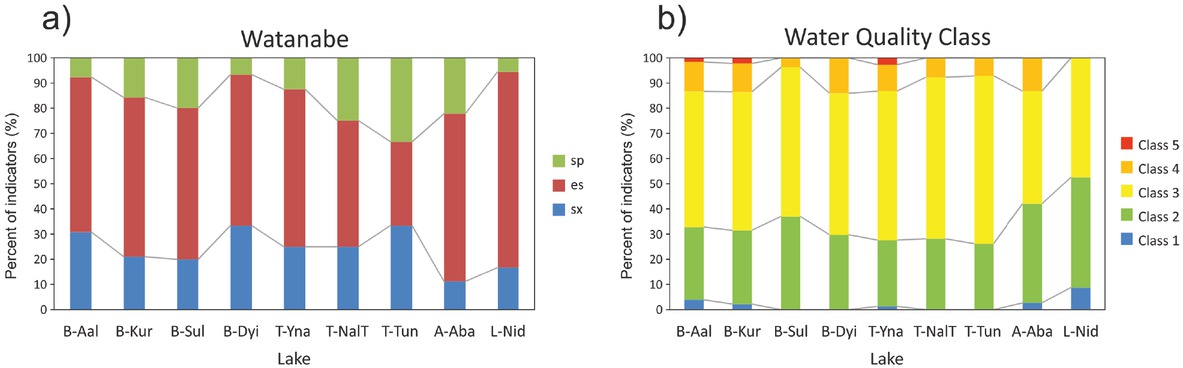
Figure 6
Ecological preferences of organic pollution indicators according to the Watanabe indicator system (a) and Water Quality Classes according to Indices of saprobity by Sládeček (b) in the studied lakes of Yakutia. Abbreviations of lake names are the same as in Table 1. Abbreviations of ecological groups of saprobity indicators according to Watanabe: sx – saproxenes; es – eurysaprobes; sp – saprophiles. Class of Water Quality indicators are according to Sládeček indices of saprobity: Classes 1–5 according to the EU color code
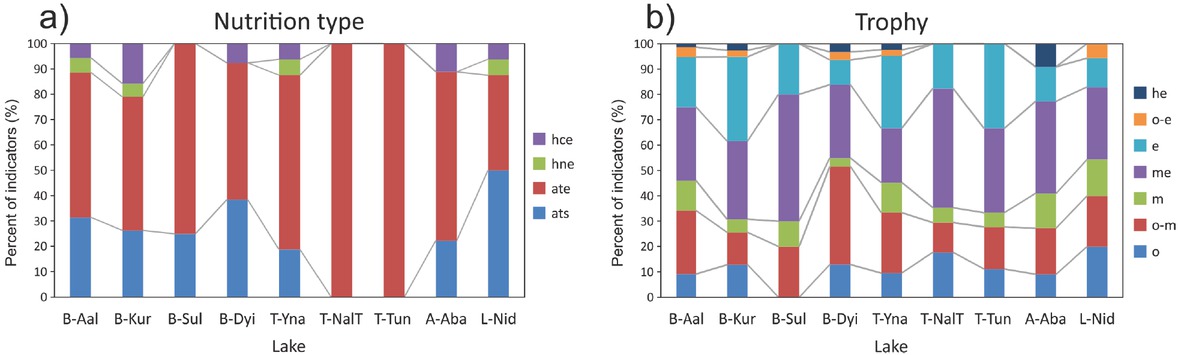
Figure 7
Ecological preferences of algal nutrition preferences (a) and water trophic states (b) in the studied lakes of Yakutia. Names of the lakes are abbreviated as in Table 1. Abbreviations of ecological groups of nutrition types: ats – strong autotrophs; ate – autotrophic, resistant to low nitrogen load; hne – particular heterotrophs (mixotrophs); hce – mixotrophs constantly requiring a nitrogen load. Indicators of the trophic state: o – oligotraphentes; o-m – oligomesotraphentes; m – mesotraphentes; me – meso-eutraphentes; e – eutraphentes; o-e – from oligo- to eutraphentes; he – hypereutraphentes
The distribution of temperature indicators in the studied lakes showed the dominance of temperate temperature species in the communities of Bestyakhskaya terrace lakes and lakes Abalah and Nidzhili, whereas algae species in the Tungulunskaya terrace lakes included few eurythermic and warm-water inhabitants (Fig. 4a). The algal community in the two lakes of the Tungulu system was characterized by the dominance of eurythermic species – up to 50%, accompanied by warm-water indicators (25%) and temperate-temperature inhabitants (25%). Thus, bioindication helps in determining that the water in the studied lakes had moderate temperatures in summer and was partly warmer in Lake Tungulu.
Oxygenation in all the studied lakes affected the development of the algae community, which was indicated by the dominance of indicators of moderately oxygenated water (st-str) as shown in Figure 4b. The presence of sulfide indicators in lakes Sullah and Ynah was remarkable; whereas communities in lakes Nal Tungulu, Tungulu, Abalsh, and Nidzhili were rich in aerophilic species and characterized by high oxygen content in water.
Salinity indicators in the studied lakes were mostly from indifferent groups, accompanied by halophilic species in all lakes, but mostly in Sullyah and Abalah – up to 18% (Fig. 5a). Mesohalobic species were also present in lake communities, but in small numbers. High-salinity indicators, like polyhalobes, were present in Lake Abalah only in 2%. Therefore, the water of the studied lakes can be described as containing small to moderate amounts of chlorides.
The distribution of water pH indicators shows the dominance of indifferent taxa and alkaliphiles in all lakes, except for Lake Ynah, where alkalibiontes accounted for about 60% of the algae species richness (Fig. 5b). Therefore, the waters of the studied lakes can be defined as low alkaline, and only Lake Ynah was alkaline.
Organic pollution indicators, according to the Watanabe system, demonstrate low to moderate organic enrichment of water in the studied lakes (Fig. 6a). Saproxenes and eurysaprobes represent about 70–95% of the algal community, but saprophiles, i.e. indicators of organic pollution in waters, accounted for up to 42% of the algal community in Lake Tungulu, which can be described as mostly polluted of the nine studied lakes. The same result can be observed in the indication of organic pollution by saprobity S indices (Fig. 6b). The dominance of class 2 and 3 indicators – up to 90% – indicates low organic pollution of water in all the studied lakes.
The activity of photosynthetic processes can be determined by algae nutrition type indicators. Figure 7a shows a strong dominance of autotrophic species (ats and ate) – up to 80–100% in the communities of the surveyed lakes. Indicators of the trophic state demonstrate the presence of diverse groups of algae – from oligotrophic to hypereutrophic (Fig. 7b). In these groups, oligotrophic + mesotrophic groups were present, up to 60–85% in different lake communities, which can be defined as mesotrophic. It is remarkable that the trophic state was higher in lakes Kurelah, Ynah, and Tungulu, where eutrophic indicators were found in 32–38% of the communities.
In order to demonstrate the difference in the species composition of the floras in the studied lakes, we calculated the percentage of similarity. The similarity tree (Fig. 8) shows that the communities in the Tungulunskaya terrace lakes were most similar to each other – with up to 50% of the similarity – and formed cluster 1, which was similar to the algae flora of Lake Abalah. The second cluster included communities from the lakes of the Bestyakhskaya terrace: Lake Dyiere, Lake Kurelah and Lake Aalah. The flora of Lake Sullah and Lake Nidzhili was different from the others. The flora of Lake Nidzhili was the most distinct from the floras of all other lakes.
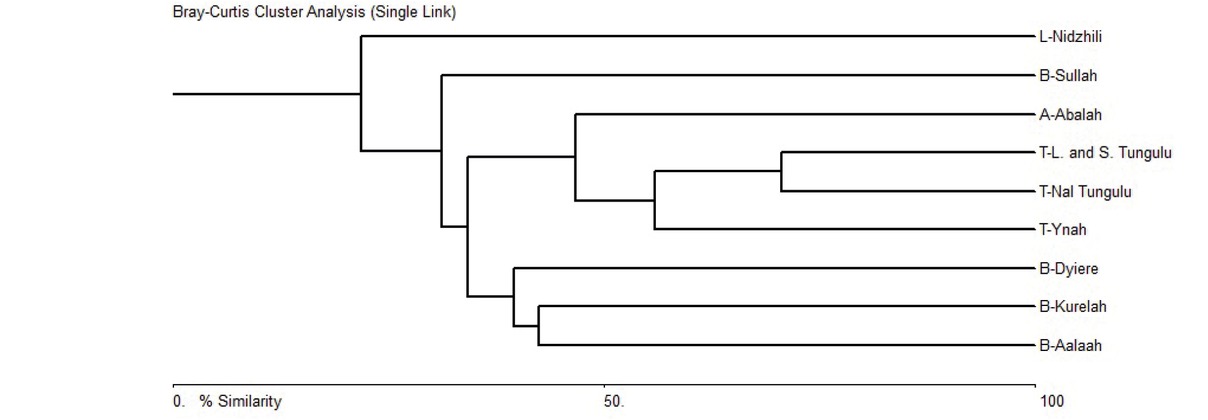
Figure 8
Similarity tree of algal species richness in the nine studied lakes of Yakutia. Lake names are abbreviated as in Table 1
Statistical analysis was performed to clarify the differences between the floras of all the lakes.
Therefore, the Canonical Correspondence Analysis (CCA) plot in Figure 9a shows that the environmental variables were divided into two different groups with respect to their effect on algal communities in the nine lakes. Cluster 1 combined all lakes of the Bestyakhskaya terrace, which were affected by oxygen saturation. Cluster 2 included the floras of the Tungulunskaya terrace, which were affected by water temperature, pH, and salinity. The flora of Lake Abalah (cluster 3) did not show any preferences for environmental factors. The algal community in Lake Nidzhili formed its own cluster, Cluster 4, which correlated with the lake’s surface only. It is remarkable that the quantitative characteristics of algal communities in the nine studied lakes did not show any specific preferences for environmental factors or geographical location of the lakes. We compared the CCA biplot and triplot in Figure 9a with taxonomic saturation in divisions in Figure 9b. This shows that the species richness in the major divisions did not have specific preferences for environmental factors, except Dinoflagellates and species-poor Raphidophytes in the Tungulunskaya terrace lakes, which preferred saline waters.
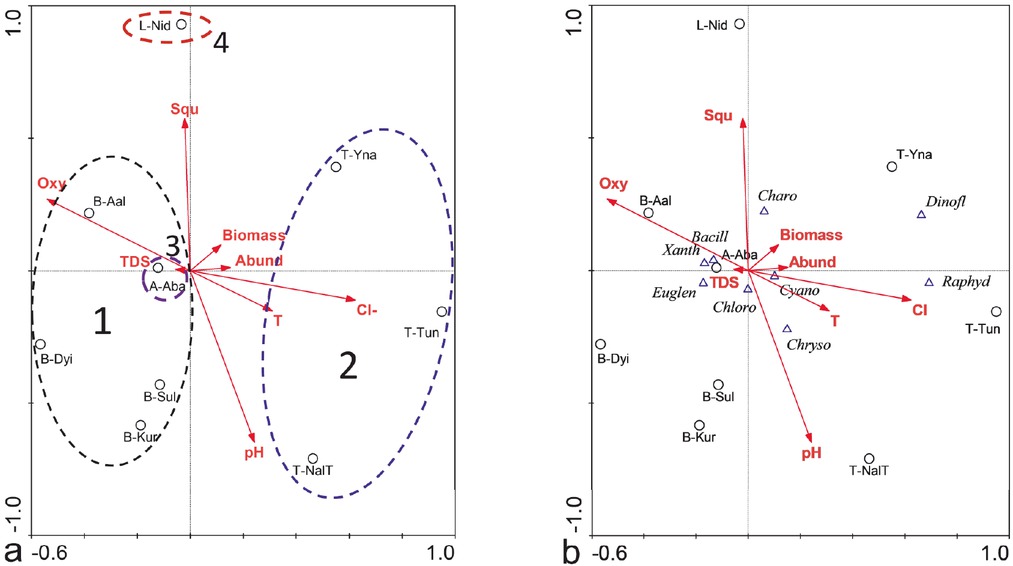
Figure 9
Canonical correspondence plots for species richness in the nine lakes in Yakutia and environmental variables (a), and taxonomic richness in algal divisions and environmental variables (b)
The results led us to compare the species composition of the floras in the surveyed lakes by calculating the correlation coefficient. The matrix in Table 3 demonstrates that algal communities in the lakes on the Tungulunskaya terrace were most similar. The correlation plot obtained using the R statistics helped us to link the species diversity in the studied lakes to the three different clusters with respect to their geographical location (Fig. 10): lakes of Tungulunskaya + Abalakskaya terraces (1), lakes of the Bestyakhskaya terrace (2), and the special cluster with Lake Nidzhili flora (3).
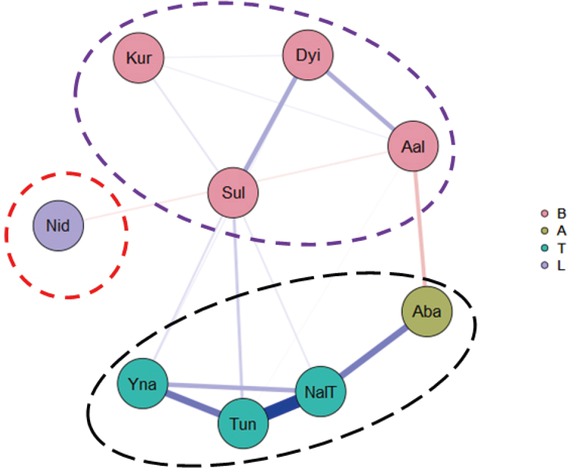
Figure 10
JASP network graph of correlation of species richness in the nine lakes of Yakutia. Blue lines indicate positive correlation; red lines indicate negative correlation. Line thickness corresponds to the value of the correlation coefficient. Floristic cores are in dashed lines. Abbreviations of terrace names are given in the legend: B, Bestyakhskaya; A, Abalahskaya; T, Tungulunskaya; L, Lena-Viluyskaya
Table 3
Correlation matrix for algae species richness in the thermokarst lakes of Yakutia. Abbreviations of the lake names are the same as in Table 1. The most similar algal communities with higher Pearson coefficients are marked in red bold font.
| B-Aal | B-Kur | B-Sul | B-Dyi | T-Yna | T-NalT | T- Tun | A-Aba | L-Nid | |
|---|---|---|---|---|---|---|---|---|---|
| B-Aalah | 1 | ||||||||
| B-Kurelah | 0.10 | 1 | |||||||
| B-Sullah | 0.00 | 0.12 | 1 | ||||||
| B-Dyiere | 0.23 | 0.11 | 0.24 | 1 | |||||
| T-Ynah | −0.07 | 0.02 | 0.20 | 0.12 | 1 | ||||
| T-Nal Tungulu | −0.06 | 0.07 | 0.21 | 0.09 | 0.41 | 1 | |||
| T-Tungulu | −0.11 | 0.03 | 0.24 | 0.04 | 0.47 | 0.65 | 1 | ||
| A-Abalah | −0.21 | −0.03 | 0.04 | −0.01 | 0.05 | 0.36 | 0.20 | 1 | |
| L-Nidzhili | −0.12 | −0.03 | 0.05 | −0.06 | 0.00 | −0.01 | 0.01 | −0.06 | 1 |
We calculated the index of number of algae taxa per lake area, which showed a negative correlation with the lake square surface and stabilized at 70 species per km2 (Fig. 11).
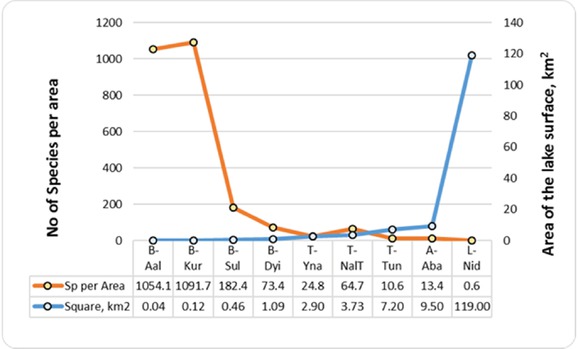
Figure 11
Diagram of species richness and the index of the number of species per area (1 km2) in the nine lakes of Yakutia. Abbreviations of lake and terrace names are the same as in Table 1
Discussion
In the previously studied algal floras of the lakes in Eurasia, it was revealed that diatoms dominated according to the specific saturation of taxonomic divisions (Barinova et al. 2013; 2014; 2019; Jiyenbekov et al. 2019; Medvedeva & Nikulina 2014). However, the distribution of species composition by taxonomic Divisions in the flora of the studied lakes was markedly differed. Therefore, the prevalence of Cyanobacteria and Chlorophyta species in five algal floras can be assessed as floristic peculiarities of the Yakutian lakes, which can be related to the short growing season with a high rate of algal development and rather high water temperature, as in the southern Eurasian lakes (Barinova et al. 2012; Ghosh et al. 2012).
Table 2 presents the variation of the Subspecies/ Species Index (Ssp/Sp Index), which demonstrates intraspecific polymorphism of algal floras in the nine studied lakes of Yakutia. Therefore, the highest values of the index were found for the lakes of the Tungulunskaya terrace – Ynakh, Nal Tungulu, and Tungulu, where they varied between 1.041 and 1.058. The index for the total identified flora of the studied lakes was 1.036. Compared to our calculations of the Ssp/Sp Index for different algal floras of Eurasia, the index for the Yakutian lakes is 1.01–1.05 and is related to low-altitude habitats of Turkey, Georgia, and southern habitats like Israel (Barinova 2011), whereas the high-altitude habitats of the Aragvi and Enguri river basins has an index of 1.14–1.22 (Barinova & Kukhaleishvili 2014; 2017), which is related to the Caucasus Mountains (1.15–1.19) (Barinova et al. 2011), and Pamir (1.15–1.42) (Barinova et al. 2015; Barinova & Niyatbekov 2018). The Ssp/Sp index was calculated on the basis of previous data (Barinova et al. 2014) for the Yakutian riverine algae communities and was higher (1.27) than in our nine studied lakes. This whole situation showed that local landscape positions as well as lentic types of water bodies, together with high summer water temperatures during the growing season, can play a major role in the flora forming processes in these lakes. Thus, low values of the Ssp/Sp index in the nine studied lakes can be seen as evidence of the climatic environmental stability and low stress for the thermokarst type of lakes in Yakutia.
Statistical methods with the Canonical Correspondence Analysis led to a strong division of species data and environmental variables into groups of lakes from the landscape terraces. Therefore, the lakes on the Bestyakhskaya terrace were affected by oxygen saturation, and lakes on the Tungulunskaya terrace were affected by water temperature, pH, and salinity. At the same time, the algae species diversity in the major divisions did not show any specific preferences for environmental factors. R statistical analyses grouped algae species in the studied lakes into three different clusters with respect to geographical location, with the richest floras found in the lakes of the Tungulynskaya terrace.
The index of algae taxa per lake area was stabilized at 70 species per km2, as can be seen on the calculation diagram. This number may be increased as a result of subsequent studies. The polymorphism of algae floras that evolved in the evolution process was revealed by the Subspecies/Species Index (Ssp/Sp Index), with the highest values for the lakes of the Tungulunskaya terrace – Ynakh, Nal Tungulu, and Tungulu (1.041–1.058), and the average of the total identified flora was 1.036. It is similar to low-altitude habitats of Turkey, Georgia, and southern habitats, such as Israel, but different from high-altitude habitats in the Caucasus Mountains, Pamir algae floras, and Yakutian riverine algae communities.
Conclusions
Nine thermokarst lakes in the central part of Yakutia have been studied for the first time to determine their algae species richness – excluding algae from Lake Nidzhili. A total of 437 species (453 with infraspecific taxa) of algae and Cyanobacteria were found. The largest number of species was found in Lake Aalah (241), Lake Kurelah (127) and Lake Ynah (131). It is noteworthy that in five out of the nine studied algae floras, Chlorophyta species dominated together with Cyanobacteria in the lakes of the Tyungulyunskaya terrace, whereas Bacillariophyta species dominated in Lake Abalah and Lake Nidzhili. Bioindication of water quality, with the help of species ecological preferences, demonstrated benthic and planktic–benthic life preferences of the identified algae, temperate temperature and moderately oxygenated waters (and even slightly warm in Lake Tungulu), as well as low to moderate chloride saturated. Nevertheless, the chemistry of water shows an enrichment with total dissolved solids, but more with sulfates than with chlorides. Both the bioindication method and chemistry helped us to characterize the lake waters as mostly low alkaline and alkaline in Lake Ynah. The level of organic pollution in the surveyed lakes is low and they can be described as mesotrophic.
Our research proved that local landscape positions as well as lentic types of water bodies can play a major role in the processes of algae flora formation in these lakes, together with high summer water temperature during the growing season. New data on the algae species richness in eight Yakutian lakes have been represented. Our results can also help in monitoring the water quality and restoring the ecosystems of the thermokarst lakes in Yakutia, which are under state protection as lakes Abalah and Tungulu of 2019, in the harsh climate of Northeastern Eurasia.
Acknowledgements
The work was performed within the framework of state assignments of IBPK SB RAS “Fundamental and applied aspects of studying the diversity of the plant world of Northern and Central Yakutia” (0376-2018-0001; No. AAAA-A17-117020110056-0). The expeditionary works were organized with the support of the Department of Biological Resources of the MNP RS (Y), Ust-Aldan, Churapchinsk, and Megino-Kangalassky inspections of nature conservation. This work was partially supported by the Israeli Ministry of Aliyah and Integration.
Appendix
List of algae and cyanobacteria taxa identified in the nine Yakutian lakes. Names of the lakes are abbreviated as in Table 1. Notes: – taxa are not present; * taxa new to the algal flora of Yakutia
| CYANOBACTERIA | |||||||||
|---|---|---|---|---|---|---|---|---|---|
| Anabaena laxa A. Braun | - | - | - | - | 1 | - | - | - | - |
| Anabaena oscillarioides Bory ex Bornet & Flahault | - | - | - | - | 1 | - | - | - | - |
| Anabaena sp. | 1 | 1 | - | - | - | - | - | - | - |
| Anabaena sphaerica Bornet & Flahault | - | - | - | - | - | - | - | - | 1 |
| Anabaena verrucosa J.B.Petersen | 1 | - | - | - | 1 | - | - | - | - |
| Anabaenopsis knipowitschii (Usachev) Komárek | - | 1 | - | - | 1 | - | - | - | - |
| Anagnosti dinema amphibium (C.Agardh ex Gomont) Strunecký, Bohunická, J.R.Johansen et J.Komárek | 1 | - | - | - | 1 | - | - | - | - |
| Anagnosti dinema tenue (Anisimova) Strunecky et al. | 1 | - | 1 | - | 1 | - | - | - | - |
| Aphanizomenon flosaquae Ralfs ex Bornet & Flahault | 1 | 1 | - | - | - | - | - | - | 1 |
| Aphanocapsa delicati ssima West & G.S.West | 1 | - | - | - | 1 | 1 | 1 | - | - |
| Aphanocapsa grevillei (Berkeley) Rabenhorst | 1 | 1 | - | - | 1 | 1 | - | - | - |
| Aphanocapsa parietina (Nägeli ex Kützing) Nägeli | 1 | - | - | 1 | - | - | - | - | - |
| Aphanocapsa pulverea (Wood) Koval. | 1 | 1 | - | - | 1 | 1 | 1 | - | 1 |
| Aphanothece salina Elenkin & Danilov | - | - | - | - | - | - | - | 1 | - |
| Borzia trilocularis Cohn ex Gomont | 1 | - | - | - | 1 | - | - | - | - |
| Calothrix flahauti i Frémy | 1 | 1 | - | - | - | - | - | - | - |
| Chondrocysti s sarcinoides (Elenkin) Komárek et Anagnostidis | - | - | - | - | - | - | - | 1 | - |
| Chroococcus cohaerens (Brébisson) Nägeli | - | - | - | - | - | 1 | 1 | 1 | - |
| Chroococcus minutus (Kützing) Nägeli | 1 | - | - | - | 1 | 1 | 1 | - | - |
| Chroococcus turgidus (Kützing) Nägeli | 1 | - | 1 | - | 1 | 1 | 1 | 1 | 1 |
| Chroococcus vacuolatus Skuja | 1 | - | - | 1 | - | - | - | - | - |
| Coleofasciculus chthonoplastes (Thuret ex Gomont) M.Siegesmund, J.R.Johansen & T.Friedl | - | - | - | - | - | - | - | 1 | - |
| Cyanothece aeruginosa (Nägeli) Komárek | - | - | - | - | - | - | - | 1 | - |
| Cyanothrix gardneri (Frémy) Kiselev | 1 | - | - | - | 1 | 1 | 1 | - | - |
| Dactylococcopsis irregularis G.M. Smith | 1 | - | - | - | - | - | - | - | - |
| Dactylococcopsis rupestris Hansgirg | 1 | 1 | - | - | - | - | - | - | - |
| Desmonostoc muscorum (C.Agardh ex Bornet & Flahault) Hrouzek & Ventura | - | - | - | - | - | - | 1 | - | - |
| Dolichospermum fl osaquae (Brébisson ex Bornet & Flahault) P.Wacklin, L.Hoffmann & J.Komárek | 1 | - | - | 1 | 1 | - | - | - | 1 |
| Dolichospermum jacuticum (Kiselev) Wacklin, L.Hoffmann & Komárek | - | - | - | - | - | - | - | - | 1 |
| Dolichospermum lemmermannii (Ricter) P.Wacklin, L.Hoffmann & J.Komárek | - | 1 | - | - | - | - | - | - | - |
| Dolichospermum tenericaule (Nygaard) E.Zapomelová, O.Skácelová, P.Pumann, R.Kopp & E.Janecek | - | 1 | - | - | - | - | - | - | - |
| Dolichospermum viguieri (Denis & Frémy) Wacklin, L.Hoffmann & Komárek | 1 | - | - | - | - | - | - | - | - |
| Eucapsis alpina F.E.Clements & H.L.Schantz | - | - | - | - | - | 1 | - | 1 | - |
| Gloeocapsa calcarea Tilden | - | - | - | - | 1 | 1 | 1 | 1 | - |
| Gloeocapsa kuetzingiana Nägeli ex Kützing | - | - | - | - | - | - | 1 | - | - |
| Gloeocapsa turgida f. subnuda (Hansg.) Hollerb. | 1 | - | - | - | - | - | - | - | - |
| Gloeotrichia natans Rabenhorst ex Bornet & Flahault | - | - | - | 1 | - | - | - | - | - |
| Gloeotrichia pisum Thuret ex Bornet & Flahault | - | - | - | - | - | - | - | - | 1 |
| Gomphosphaeria cordiformis (Wille) Hansgirg | - | - | - | - | 1 | 1 | 1 | - | - |
| Heteroleibleinia kossinskajae (Elenkin) Anagnosti dis & Komárek | - | - | - | - | - | - | - | - | 1 |
| Jaaginema geminatum (Schwabe ex Gomont) Anagnosti dis & Komárek | - | 1 | - | - | - | - | - | 1 | - |
| Jaaginema minimum (Gicklhorn) Anagnosti dis & Komárek | 1 | - | - | - | 1 | - | - | - | - |
| Jaaginema subtilissimum (Kützing ex Forti) Anagnosti dis & Komárek | - | - | - | - | 1 | - | - | - | - |
| Johanseninema constrictum (Szafer) Hasler, Dvorák & Poulícková | - | - | 1 | 1 | 1 | - | 1 | - | - |
| Kamptonema cortianum (Meneghini ex Gomont) Strunecký, Komárek & J.Smarda | - | 1 | - | - | - | - | - | - | - |
| Kamptonema formosum (Bory ex Gomont) Strunecký, Komárek & J.Smarda | - | 1 | - | - | - | - | - | - | - |
| Leptolyngbya foveolara (Gomont) Anagnosti dis & Komárek | 1 | - | - | - | - | - | - | - | - |
| Leptolyngbya perelegans (Lemmermann) Anagnosti dis & Komárek | - | - | - | - | - | - | - | 1 | - |
| Limnoraphis hieronymusii (Lemmermann) J.Komárek, E.Zapomelová, J.Smarda, J.Kopecky, E.Rejmánková, J.Woodhouse, B.A.Neilan & J.Komárková | - | - | - | - | 1 | - | - | - | - |
| Limnothrix guttulata (Goor) I.Umezaki & M.Watanabe | - | 1 | - | - | 1 | 1 | - | - | - |
| Limnothrix mirabilis (Böcher) Anagnosti dis | 1 | 1 | 1 | 1 | 1 | 1 | 1 | - | 1 |
| Lyngbya lutea Gomont ex Gomont | - | - | - | - | - | - | - | - | - |
| Merismopedia elegans A.Braun ex Kützing | - | 1 | - | - | - | - | - | - | 1 |
| Merismopedia glauca (Ehrenberg) Kützing | 1 | - | - | - | 1 | 1 | 1 | - | - |
| Merismopedia major (G.M. Sm.) Geitler in Pascher | 1 | - | - | - | - | - | - | - | - |
| Merismopedia minima G.Beck | - | 1 | - | - | 1 | 1 | 1 | 1 | - |
| Merismopedia punctata Meyen | 1 | - | - | 1 | - | 1 | - | 1 | - |
| Merismopedia tenuissima Lemmermann | 1 | 1 | 1 | 1 | 1 | 1 | 1 | - | - |
| Microcoleus amoenus (Gomont) Strunecky, Komárek & J.R.Johansen | - | - | 1 | - | - | - | - | - | - |
| Microcoleus attenuatus (Fritsch) Strunecky, Komárek & J.R.Johansen | 1 | 1 | - | - | - | - | - | - | - |
| Microcystis aeruginosa (Kützing) Kützing | - | 1 | - | - | 1 | - | - | - | 1 |
| Microcystis endophytica (G.M. Smith) Elenkin | 1 | 1 | - | 1 | 1 | 1 | 1 | 1 | - |
| Microcystis firma (Kützing) Schmidle | 1 | 1 | - | - | - | - | - | - | - |
| Microcystis fl osaquae (Witt rock) Kirchner | 1 | 1 | - | - | 1 | - | 1 | - | - |
| Microcystis ichthyoblabe (G.Kunze) Kützing | 1 | - | - | - | 1 | 1 | 1 | - | - |
| Nostoc caeruleum Lyngbye ex Bornet & Flahault | - | - | - | - | - | - | - | - | 1 |
| Nostoc commune f. sphaericum (Vaucher) Elenkin | - | - | - | - | 1 | - | - | - | - |
| Nostoc commune Vaucher ex Bornet & Flahault | - | - | - | - | 1 | - | - | - | - |
| Nostoc kihlmanii Lemmermann | - | - | - | - | - | - | - | - | 1 |
| Nostoc linckia Bornet ex Bornet & Flahault | - | - | 1 | - | 1 | - | 1 | - | - |
| Nostoc microscopicum Carmichael ex Bornet & Flahault | - | - | - | - | 1 | - | 1 | - | - |
| Nostoc paludosum f. longius Kossinska | - | - | - | - | 1 | - | 1 | - | - |
| Nostoc paludosum Kützing ex Bornet & Flahault | 1 | - | 1 | - | 1 | - | - | 1 | 1 |
| Nostoc pruniforme C.Agardh ex Bornet & Flahault f. pruniforme | - | - | - | - | - | - | 1 | - | - |
| Nostoc punctiforme Hariot f. punctiforme | - | - | - | - | - | - | - | - | 1 |
| Nostoc punctiforme f. populorum (Geitler) Hollerbach | - | - | - | - | 1 | - | - | - | - |
| Oscillatoria anguina Bory ex Gomont | - | - | - | 1 | 1 | - | - | - | - |
| Oscillatoria attenuata Woronichin | - | - | 1 | - | - | - | - | - | - |
| Oscillatoria chalybea f. conoidea Poljansky | 1 | 1 | - | - | - | - | - | - | - |
| Oscillatoria curviceps C.Agardh ex Gomont | 1 | - | - | - | - | - | - | 1 | - |
| Oscillatoria fulgens Böcher | - | 1 | - | - | - | - | - | - | - |
| Oscillatoria gracilis Böcher | 1 | 1 | - | - | - | - | - | - | - |
| Oscillatoria granulata f. sibirica V. Poljansky | 1 | - | - | - | - | - | - | - | 1 |
| Oscillatoria komarovii Anissimova et Elenkin | - | - | - | - | - | - | - | 1 | - |
| Oscillatoria lacustris Klebahn ex Geitler | - | - | - | - | - | - | - | 1 | - |
| Oscillatoria planctonica Woloszynska | - | - | - | - | 1 | 1 | 1 | - | 1 |
| Oscillatoria quadripunctulata f. crassa (Anissimova) Elenkin et Starmach | 1 | - | - | - | - | - | - | - | - |
| Oscillatoria rupicola (Hansgirg) Hansgirg ex Forti | 1 | - | - | - | - | - | - | 1 | - |
| Oscillatoria simplicissima Gomont | 1 | - | - | 1 | 1 | 1 | 1 | - | - |
| Phormidesmis molle (Gomont) Turicchia, Ventura, Komárková & Komárek | - | 1 | - | - | - | - | - | - | - |
| Phormidium boryanum (Bory ex Gomont) Anagnosti dis & Komárek | 1 | - | - | - | - | - | - | - | - |
| Phormidium breve (Kützing ex Gomont) Anagnosti dis & Komárek | 1 | 1 | - | 1 | 1 | 1 | 1 | 1 | - |
| Phormidium chalybeum (Mertens ex Gomont) Anagnosti dis & Komárek | 1 | 1 | - | - | - | - | - | - | - |
| Phormidium granulatum (N.L.Gardner) Anagnosti dis | 1 | - | - | - | - | - | - | - | 1 |
| Phormidium irriguum (Kützing ex Gomont) Anagnosti dis & Komárek | 1 | - | - | - | 1 | 1 | 1 | 1 | - |
| Phormidium lucidum Kützing ex Gomont | 1 | - | - | - | - | - | - | - | - |
| Phormidium paulsenianum f. popovianum Elenkin | - | - | - | - | - | 1 | - | 1 | - |
| Phormidium paulsenianum J.B.Petersen | - | - | - | - | - | - | - | 1 | - |
| Phormidium terebriforme (C.Agardh ex Gomont) Anagnosti dis & Komárek | - | - | - | - | 1 | - | - | - | - |
| Phormidium uncinatum Gomont ex Gomont | - | - | - | - | - | 1 | 1 | 1 | - |
| Pseudanabaena mucicola (Naumann & Huber-Pestalozzi) Schwabe | 1 | 1 | - | - | - | - | - | - | - |
| Rivularia dura Roth ex Bornet & Flahault | - | - | - | - | - | - | - | - | 1 |
| Snowella lacustris (Chodat) Komárek & Hindák | 1 | 1 | 1 | 1 | 1 | 1 | 1 | - | - |
| Snowella rosea (J.W.Snow) Elenkin | - | 1 | - | - | - | - | - | - | - |
| Spirulina major Kützing ex Gomont | 1 | 1 | - | 1 | - | - | - | - | - |
| Spirulina minima A.Wurtz | - | - | - | - | 1 | - | - | - | - |
| Spirulina subtilissima Kützing ex Gomont | - | 1 | - | - | - | - | - | - | - |
| Stenomitos frigidus (F.E.Fritsch) Miscoe et J.R.Johansen in Miscoe et al. | - | 1 | - | - | - | - | - | - | - |
| Synechocystis salina Wislouch | - | - | - | - | - | - | - | 1 | - |
| Trichormus reverdattoanus (T.G.Popova et M.Degterieva) Komárek et Anagnosti dis | - | - | - | - | - | - | - | 1 | - |
| Trichormus variabilis (Kützing ex Bornet & Flahault) Komárek & Anagnosti dis | 1 | 1 | - | - | - | 1 | 1 | - | - |
| Achnanthes borealis A.Cleve | 1 | 1 | - | - | - | - | - | - | - |
| Amphora ovalis (Kützing) Kützing | 1 | 1 | 1 | - | - | - | - | - | 1 |
| Aulacoseira italica (Ehrenberg) Simonsen | 1 | 1 | - | - | - | - | - | - | - |
| Caloneis amphisbaena (Bory) Cleve | 1 | 1 | - | 1 | - | - | - | - | - |
| Caloneis westii (W.Smith) Hendey | - | - | - | - | - | - | - | 1 | - |
| Chaetoceros muelleri Lemmermann | - | - | - | - | - | - | - | 1 | - |
| Cocconeis neodiminuta Krammer | 1 | 1 | - | - | - | - | - | - | - |
| Cocconeis pediculus Ehrenberg var. minutissima Poretzky | 1 | 1 | - | - | - | - | - | - | - |
| Cocconeis placentula Ehrenberg | 1 | 1 | 1 | 1 | 1 | 1 | - | 1 | - |
| Cyclotella caspia Grunow | - | - | - | - | - | - | - | 1 | - |
| Cyclotella comta Kützing | 1 | - | - | - | - | - | - | - | - |
| Cyclotella glabriuscula (Grunow) Håkansson | 1 | - | - | - | - | - | - | - | - |
| Cyclotella meneghiniana Kützing | 1 | 1 | - | - | - | - | - | - | - |
| Cyclotella stelligera Cleve & Grunow | 1 | - | - | - | - | - | - | - | - |
| Cylindrotheca closterium (Ehrenberg) Reimann & J.C.Lewin | - | - | - | - | - | - | - | 1 | - |
| Cymatopleura elliptica (Brébisson) W.Smith | 1 | 1 | - | 1 | - | - | - | - | - |
| Cymbella affinis Kützing | 1 | 1 | - | 1 | - | - | - | - | - |
| Cymbella cymbiformis Agardh | 1 | - | - | 1 | - | - | - | - | - |
| Cymbella neocistula Krammer | 1 | - | - | 1 | - | - | - | - | - |
| Cymbella parva (W. Smith) Kirchner | 1 | - | - | 1 | - | - | - | - | - |
| Cymbella tartuensis Molder | 1 | - | - | 1 | - | - | - | - | - |
| Cymbella tumida (Brébisson) van Heurck | 1 | - | - | - | - | - | - | - | - |
| Cymbellafalsa diluviana (Krasske) Lange-Bertalot & Metzeltin | - | - | - | - | 1 | - | - | - | - |
| Diatoma vulgaris Bory | 1 | - | - | - | - | - | - | - | - |
| Encyonema prostratum (Berkeley) Kützing | 1 | - | - | - | - | - | - | - | 1 |
| Epithemia adnata (Kützing) Brébisson | 1 | - | - | - | - | - | - | - | 1 |
| Epithemia turgida (Ehrenberg) Kützing | - | - | - | - | - | - | - | 1 | - |
| Eucocconeis elliptica Saw -Dolg. | - | 1 | - | - | - | - | - | - | - |
| Eunoti a fallax A.Cleve | 1 | - | - | - | - | - | - | - | - |
| Eunoti a lunaris (Ehrenberg) Grunow | 1 | - | 1 | 1 | 1 | 1 | 1 | - | - |
| Eunotia praerupta Ehrenberg | - | - | - | - | 1 | - | - | - | - |
| Eunotia sudetica Otto Müller | 1 | - | - | - | - | - | - | - | - |
| Eunotia veneris (Kützing) De Toni | 1 | - | - | - | - | - | - | - | - |
| Fragilaria capucina Desmazières var. capucina | - | - | - | - | 1 | - | - | - | - |
| Fragilaria capucina var. vaucheriae (Kützing) Lange-Bertalot | 1 | - | - | - | 1 | 1 | - | - | - |
| Fragilaria tenera (W.Smith) Lange-Bertalot | - | - | - | 1 | - | - | - | - | - |
| Gomphonema acuminatum Ehrenberg | 1 | - | - | - | 1 | - | - | - | 1 |
| Gomphonema angustum C.Agardh | - | 1 | - | - | - | - | - | - | - |
| Gomphonema augur Ehrenberg | 1 | 1 | - | - | - | - | - | - | - |
| Gomphonema brebissonii Kützing | 1 | - | - | 1 | - | - | - | - | - |
| Gomphonema capitatum Ehrenberg | 1 | - | - | 1 | - | - | - | - | - |
| Gomphonema coronatum Ehrenberg | 1 | - | - | 1 | - | - | - | - | - |
| Gomphonema olivaceum (Hornemann) Brébisson | 1 | - | - | - | 1 | - | - | - | - |
| Gomphonema parvulum Kützing | 1 | - | - | - | 1 | - | - | - | - |
| Gomphonema salinarum (Pantosek) Cleve | - | - | - | - | - | - | - | 1 | - |
| Gomphonema subclavatum (Grunow) Grunow | - | - | - | - | - | - | - | - | - |
| Gomphonema tergestinum (Grunow) Fricke | - | - | - | - | 1 | - | - | - | - |
| Gomphonema truncatum Ehrenberg | 1 | - | - | 1 | - | - | - | - | 1 |
| Hannaea arcus (Ehrenberg) R.M.Patrick var. arcus | - | - | - | - | - | - | - | - | 1 |
| Hannaea arcus var. amphioxys (Rabenhorst) R.M.Patrick | 1 | - | - | - | - | - | - | - | - |
| Hantzschia amphioxys (Ehrenberg) Grunow var. amphioxys | 1 | - | - | - | - | - | - | - | 1 |
| Hantzschia amphioxys var. subsalsa Wislouch & Poretzky | - | - | - | - | - | - | - | - | 1 |
| Hippodonta hungarica (Grunow) Lange-Bertalot, Metzeltin & Witkowski | 1 | 1 | - | - | 1 | - | - | 1 | - |
| Luticola mutica (Kützing) D.G.Mann | 1 | 1 | - | - | 1 | 1 | 1 | 1 | - |
| Melosira varians C.Agardh | - | - | - | - | - | - | - | - | 1 |
| Meridion circulare (Greville) C.Agardh | 1 | - | - | - | - | - | - | - | - |
| Navicula bacillum f. gregoryana Grunow | 1 | - | - | 1 | - | - | - | - | - |
| *Navicula cincta var. heufleri (Grunow) Grunow | 1 | - | - | - | - | - | - | 1 | - |
| Navicula crucicula (W. Smith) Donkin | - | - | - | - | - | - | - | 1 | - |
| *Navicula cryptocephala var. intermedia Grunow | 1 | - | - | 1 | - | - | - | - | - |
| Navicula cryptotenella Lange-Bertalot | - | 1 | - | - | 1 | - | - | 1 | - |
| Navicula gottlandica Grunow | 1 | - | - | - | - | - | - | - | - |
| Navicula kefvingensis (Ehrenberg) Kützing | - | - | - | - | - | - | - | 1 | - |
| Navicula lanceolata (Agardh) Kützing | - | - | - | - | 1 | - | - | - | - |
| Navicula menisculus Schumann | 1 | - | - | 1 | - | - | - | 1 | - |
| Navicula oblonga (Kützing) Kützing | - | 1 | - | - | - | - | - | - | - |
| Navicula peregrina var. lanceolata Skvortzov | - | - | - | 1 | 1 | - | - | 1 | - |
| Navicula placentula f. rostrata A.Mayer | - | - | - | - | - | 1 | 1 | 1 | - |
| Navicula radiosa Kützing | 1 | 1 | 1 | 1 | 1 | 1 | 1 | 1 | 1 |
| Navicula simplex Krasske | 1 | - | - | 1 | 1 | - | - | - | - |
| Navicula zeta Cleve | - | - | - | - | - | - | - | 1 | - |
| Neidium affine (Ehrenberg) Pfizer | 1 | - | - | 1 | - | - | - | - | - |
| Neidium bisulcatum (Lagerstedt) Cleve | - | - | - | - | - | - | - | - | 1 |
| Nitzschia acicularis (Kützing) W.Smith | - | 1 | - | - | - | - | - | - | - |
| Nitzschia gandersheimiensis f. tenuirostris (Grunow) Lange-Bertalot | - | - | - | - | - | - | - | 1 | - |
| Nitzschia gracilis Hantzsch | - | - | - | - | - | - | - | - | 1 |
| Nitzschia holsatica Hustedt | 1 | - | - | 1 | - | - | - | - | - |
| Nitzschia linearis W.Smith | 1 | - | - | - | - | - | - | - | - |
| Nitzschia palea (Kützing) W.Smith | 1 | 1 | - | 1 | 1 | - | - | 1 | - |
| Nitzschia paleacea Grunow | 1 | 1 | - | - | - | - | - | - | 1 |
| Nitzschia sigma (Kützing) W.Smith | - | - | - | - | - | - | - | 1 | - |
| Nitzschia sigmoidea (Nitzsch) W.Smith | 1 | 1 | - | - | 1 | - | 1 | - | - |
| Nitzschia sublinearis Hustedt | 1 | - | - | 1 | - | - | - | - | - |
| Nitzschia vermicularis (Kützing) Hantzsch | 1 | - | - | - | - | - | - | 1 | - |
| Odontidium elongatum var. actinastroides (Krieger) R.M. Pathrick | - | - | - | - | 1 | - | 1 | - | - |
| Paraplaconeis placentula (Ehrenberg) M.S.Kulikovskiy et Lange-Bertalot | - | - | - | - | - | - | - | 1 | - |
| Pinnularia biceps W.Gregory | - | - | 1 | - | - | - | - | - | - |
| Pinnularia borealis Ehrenberg | 1 | - | - | - | - | - | - | - | - |
| Pinnularia brebissonii (Kützing) Rabenhorst | 1 | - | - | - | - | - | - | - | - |
| Pinnularia isostauron (Ehrenberg) Cleve | 1 | - | - | - | - | - | - | - | - |
| Pinnularia lata (Brébisson) W.Smith | 1 | - | - | 1 | - | - | - | - | - |
| Pinnularia major (Kützing) Rabenhorst | - | - | - | - | - | - | - | - | 1 |
| Pinnularia viridis (Nitzsch) Ehrenberg | 1 | - | - | - | - | - | - | - | - |
| Planothidium lanceolatum (Brébisson ex Kützing) Lange-Bertalot | 1 | 1 | - | - | 1 | - | - | - | - |
| Rhopalodia gibba (Ehrenberg) Otto Müller | - | - | - | - | - | - | - | - | 1 |
| Stauroneis anceps Ehrenberg | 1 | - | - | 1 | 1 | - | 1 | - | 1 |
| Stephanodiscus hantzschii Grunow | - | - | - | - | - | - | - | 1 | - |
| Surirella elegans Ehrenberg | 1 | - | - | 1 | - | - | - | - | - |
| Surirella linearis W.Smith | - | - | - | - | - | - | - | - | 1 |
| Surirella peisonis Pantocsek | - | - | - | - | - | 1 | 1 | 1 | - |
| Tabellaria fenestrata (Lyngbye) Kützing | - | 1 | - | - | - | - | - | - | 1 |
| Tabellaria flocculosa (Roth) Kützing | - | - | - | - | - | - | - | - | 1 |
| Tabularia parva (Kützing) Williams et Round | 1 | - | - | 1 | - | - | - | - | - |
| Tabularia tabulata (C.Agardh) Snoeijs | 1 | 1 | - | 1 | 1 | - | - | 1 | - |
| Ulnaria amphirhynchus (Ehrenberg) Compère & Bukhtiyarova | - | 1 | 1 | 1 | - | - | - | - | - |
| Ulnaria biceps (Kützing) P.Compère | 1 | 1 | - | - | - | - | - | - | - |
| Ulnaria delicati ssima var. angustissima (Grunow) Aboal & P.C.Silva | 1 | - | - | - | - | - | - | - | - |
| Ulnaria ulna (Nitzsch) P.Compère | 1 | 1 | - | 1 | 1 | - | - | - | 1 |
| Urosolenia eriensis (H.L.Smith) Round & R.M.Crawford | - | 1 | - | - | - | - | - | 1 | - |
| Cryptomonas ovata Ehrenberg | - | - | - | - | 1 | 1 | - | - | - |
| Rhodomonas salina (Wislouch) D.R.A.Hill & R.Wetherbee | - | - | - | - | - | - | - | 1 | - |
| Atraktochrysis rotans Focke | - | - | - | - | 1 | - | - | - | - |
| Dinobryon bavaricum Imhof | - | 1 | - | - | - | - | - | - | - |
| Dinobryon sociale (Ehrenberg) Ehrenberg var. sociale | - | 1 | - | - | - | - | - | - | - |
| Dinobryon sociale var. americanum (Brunnthaler) Bachmann | - | 1 | - | - | - | - | - | - | - |
| Ellipsoidion regulare Pascher | - | - | - | - | - | 1 | 1 | 1 | - |
| Ellipsoidion solitare (Geitler) Pascher | - | - | - | - | - | 1 | 1 | 1 | - |
| Ellipsoidion stichococcoides Pascher | - | - | - | - | - | 1 | - | 1 | - |
| Mallomonas allorgei (M.Deflandre) W.Conrad | - | - | - | 1 | - | - | - | - | - |
| Mallomonas alpina Pascher & Ruttner | 1 | - | - | - | - | - | - | - | - |
| Neotessella lapponica (Skuja) B.Y.Jo, J.I.Kim, W.Shin, P.Škaloud et P.A.Siver | 1 | - | - | - | - | - | - | - | - |
| Ochromonas polychrysis Skuja | 1 | - | - | - | - | - | - | - | - |
| Synura glabra Korshikov | - | - | - | - | 1 | 1 | 1 | - | - |
| Synura uvella Ehrenberg | - | 1 | - | - | - | - | - | - | - |
| *Gonyostomum intermedium Skuja | - | - | - | - | 1 | 1 | 1 | - | - |
| Vacuolaria virescens Cienkowski | - | - | - | - | 1 | - | 1 | - | - |
| Akanthochloris bacillifera Pascher | 1 | - | - | - | - | - | - | - | - |
| Botrydiopsis eriensis Snow | 1 | - | - | - | - | - | - | - | - |
| Botryochloris minima Pascher | 1 | - | - | - | - | - | - | - | - |
| Characiopsis acuta (A.Braun) Borzi | 1 | - | - | - | - | - | - | - | - |
| Characiopsis anabaenae Pascher | 1 | - | - | - | - | - | - | - | - |
| Characiopsis anas Pascher | 1 | - | - | - | - | - | - | - | 1 |
| Characiopsis aquilonaris Skuja | 1 | - | - | - | - | - | - | - | - |
| Characiopsis minima Pascher | 1 | - | - | - | - | - | - | - | - |
| Characiopsis pyriformis (A. Braun) Borzi f. pyriformis | 1 | - | - | - | - | - | - | - | - |
| Characiopsis pyriformis var. subsessilis Lemmermann | 1 | - | 1 | - | - | - | - | - | - |
| Characiopsis saccata Carter | 1 | - | - | - | - | - | - | - | - |
| Characiopsis spina Pascher | 1 | - | - | - | - | - | - | - | - |
| Characiopsis tuba (Herm.) Lemmermann | 1 | - | - | 1 | - | - | - | - | - |
| Characiopsis varians Pascher | 1 | - | - | - | - | - | - | - | - |
| Chlorallantus attenuatus Pascher | 1 | 1 | - | - | - | - | - | - | - |
| Chloropedia plana Pascher | - | - | 1 | 1 | - | - | - | - | - |
| Gloeoskene turfosa Fott | 1 | - | - | - | - | - | - | - | - |
| Heterococcus polymorphus (J.W.Snow) Vischer | - | - | - | 1 | - | - | - | - | - |
| Heteropedia simplex Pascher | 1 | - | - | - | - | - | - | - | - |
| Ophiocytium arbusculum (A.Braun ex Kützing) Sande Lacoste & Suringar | - | - | 1 | - | - | - | - | - | - |
| Ophiocytium cochleare (Eichwald) A.Braun | - | - | 1 | - | - | - | - | - | 1 |
| Pleurochloris polychloris Pascher | - | - | - | - | - | 1 | 1 | 1 | - |
| Tribonema affine (Kützing) G.S.West | - | - | - | - | 1 | - | - | - | - |
| Tribonema elegans Pascher | 1 | 1 | - | - | - | - | - | - | - |
| Tribonema minus (Wille) Hazen | - | - | - | 1 | - | - | - | - | - |
| Tribonema spirotaenia Ettl | 1 | 1 | - | - | - | - | - | - | - |
| Tribonema subtilissimum Pascher | - | 1 | - | - | - | - | - | - | - |
| Tribonema viride Pascher | - | - | - | - | - | - | - | - | 1 |
| Tribonema vulgare Pascher | - | 1 | - | - | - | - | - | - | 1 |
| Distigma gracile E.G.Pringsheim | 1 | - | - | - | - | - | - | - | - |
| Euglena deses Ehrenberg | 1 | - | - | - | - | - | - | - | - |
| Euglena gracilis Klebs | 1 | - | - | - | - | - | - | - | - |
| Euglena pisciformis G.A. Klebs | 1 | - | - | - | - | - | - | - | - |
| Euglena viridis (O.F.Müller) Ehrenberg | 1 | 1 | - | 1 | 1 | - | - | - | - |
| Lepocinclis ovum (Ehrenberg) Lemmermann | - | 1 | - | - | - | - | - | - | - |
| Lepocinclis oxyuris (Schmarda) Marin & Melkonian | - | - | - | 1 | - | - | - | - | - |
| Monomorphina pyrum (Ehrenberg) Mereschkowsky | 1 | 1 | - | - | - | - | - | - | - |
| Phacus alatus G.A.Klebs | - | 1 | - | - | - | - | - | - | - |
| Phacus caudatus var. minor Drezepolski | 1 | - | - | - | - | - | - | - | - |
| Phacus hamelii P.Allorge & M.Lefèvre | - | 1 | - | - | - | - | - | - | - |
| Phacus lismorensis Playfair | 1 | - | - | - | - | - | - | - | - |
| Phacus longicauda (Ehrenberg) Dujardin. | 1 | - | - | - | - | - | - | - | - |
| Phacus parvulus G.A.Klebs | - | 1 | - | - | - | - | - | - | - |
| Phacus pleuronectes (O.F.Müller) Nitzsch ex Dujardin | 1 | 1 | - | - | - | - | - | - | - |
| Phacus raciborskii Drezepolski | 1 | - | - | - | - | - | - | - | - |
| Phacus setosus Francé | 1 | 1 | - | - | - | - | - | - | - |
| Strombomonas acuminata (Schmarda) Deflandre | - | - | - | - | - | - | - | 1 | - |
| Strombomonas eurystoma (F.Stein) T.G.Popova | - | - | - | - | - | 1 | 1 | - | 1 |
| Trachelomonas australica (Playfair) Deflandre | 1 | - | - | 1 | - | - | - | - | - |
| Trachelomonas hispida (Perty) F.Stein | - | - | - | 1 | - | - | - | - | - |
| Trachelomonas planctonica Svirenko | 1 | 1 | - | - | - | - | - | - | - |
| Trachelomonas volvocina (Ehrenberg) Ehrenberg | - | - | - | - | 1 | - | 1 | - | 1 |
| Ceratium hirundinella (O.F.Müller) Dujardin | - | - | - | - | - | - | - | - | 1 |
| Glenodinium discoidale Harris | - | - | - | - | 1 | - | 1 | - | - |
| Gyrodinium pusillum (A.J.Schilling) Kofoid & Swezy | - | - | - | - | 1 | - | 1 | - | - |
| Katodinium woloszynskae (J. Schiller) A.R. Loeblich | - | - | - | - | 1 | - | 1 | - | - |
| Peridinium cinctum var. tuberosum (Meunier) Lindemann | 0 | - | - | - | 1 | - | 1 | - | - |
| Actinastrum hantzschii Lagerheim | - | 1 | - | - | - | - | - | - | - |
| Acutodesmus bernardii (G.M.Smith) E.Hegewald, C.Bock & Krienitz | 1 | - | - | - | - | - | - | - | - |
| Bulbochaete intermedia De Bary ex Hirn | - | - | - | - | - | - | - | - | 1 |
| Characium braunii Brügger | 1 | - | - | 1 | 1 | - | - | - | - |
| Characium ornithocephalum A.Braun | - | - | 1 | - | - | - | - | - | - |
| Chlamydocapsa ampla (Kützing) Fott | - | - | - | - | 1 | - | - | - | - |
| Chlamydomonas conferta Korshikov | 1 | 1 | - | 1 | - | - | - | - | - |
| Chlamydomonas costata Korshikov | 1 | 1 | - | - | 1 | 1 | - | - | - |
| Chlamydomonas debaryana var. atactogama (Korshikov) Gerloff | 1 | - | - | - | - | - | - | - | - |
| Chlamydomonas leiostraca (Strehlow) H.Ett l in Komárek et Ettl | 1 | - | - | - | - | - | - | - | - |
| Chlamydomonas sp. | - | - | - | 1 | 1 | - | - | - | - |
| Chlamydomonas tetragama (Bohlin) Wille | 1 | - | - | - | - | - | - | - | - |
| Chlorangiella asymmetrica (Korshikov) Hindák | - | - | - | - | 1 | 1 | - | - | - |
| Chlorococcum hyphnosporum Starr | 1 | 1 | - | - | - | - | - | - | - |
| Chlorococcum sp. | 1 | 1 | - | - | - | - | - | - | - |
| Chlorogonium elongatum (P.A.Dangeard) Francé | 1 | - | - | - | - | - | - | - | - |
| Chloromonas incrassata (Pascher) Korschikov ex H.Ett l | - | - | - | 1 | 1 | 1 | - | - | - |
| Coelastrum microporum Nägeli | 1 | - | - | - | 1 | - | 1 | - | 1 |
| Coenocysti s planctonica Korshikov | - | 1 | - | - | - | - | - | - | - |
| Crucigeniella irregularis (Wille) P.M.Tsarenko & D.M.John | 1 | - | - | 1 | - | - | - | - | - |
| Desmodesmus abundans (Kirchner) E.H.Hegewald | 1 | 1 | - | - | - | - | - | - | - |
| Desmodesmus armatus (Chodat) E.H.Hegewald | 1 | 1 | - | - | - | - | - | - | - |
| Desmodesmus asymmetricus (Schröder) E.Hegewald | 1 | - | - | - | - | - | - | - | - |
| Desmodesmus brasiliensis (Bohlin) E.Hegewald | 1 | - | - | - | - | - | - | - | - |
| Desmodesmus denticulatus (Lagerheim) S.S.An, T.Friedl & E.Hegewald var. denticulatus | 1 | - | - | - | - | - | - | - | - |
| Desmodesmus denticulatus var. linearis (Hansgirg) E.Hegewald | 1 | - | - | - | - | - | - | - | - |
| Desmodesmus granulatus (West & G.S.West) Tsarenko | 1 | - | - | 1 | 1 | - | - | - | - |
| Desmodesmus hystrix (Lagerheim) E.Hegewald | 1 | - | - | - | - | - | - | - | - |
| Desmodesmus lefevrei (Deflandre) S.S.An, T.Friedl & E.H.Hegewald | 1 | - | - | 1 | - | - | - | - | - |
| Desmodesmus magnus (Meyen) Tsarenko | 1 | 1 | - | - | - | - | - | - | - |
| Desmodesmus maximus (West & G.S.West) Hegewald | 1 | 1 | 1 | 1 | 1 | 1 | 1 | 1 | 1 |
| Desmodesmus serratus (Corda) S.S.An, Friedl & E.Hegewald | - | - | - | - | - | - | - | - | 1 |
| Desmodesmus spinosus (Chodat) E.Hegewald | - | 1 | - | - | - | - | - | - | - |
| Desmodesmus subspicatus (Chodat) E.Hegewald & A.Schmidt | - | - | - | - | - | 1 | - | - | - |
| Dictyosphaerium ehrenbergianum Nägeli | 1 | 1 | - | - | - | - | - | - | 1 |
| Dictyosphaerium pulchellum Wood | - | - | 1 | 1 | 1 | 1 | 1 | - | - |
| Dispora crucigenioides Printz | 1 | 1 | - | 1 | 1 | - | 1 | - | - |
| Dispora speciosa Korshikov | - | - | - | - | 1 | 1 | 1 | - | - |
| Dunaliella salina (Dunal) Teodoresco | - | - | - | - | - | - | - | 1 | - |
| Gloeotila mucosa Kützing | 1 | - | - | - | - | - | - | - | - |
| Gonium pectorale O.F.Müller | 1 | - | - | - | - | - | - | - | - |
| Heleochloris pallida Korshikov | - | - | 1 | - | - | - | 1 | - | - |
| Hindakia tetrachotoma (Printz) C.Bock, Pröschold & Krienitz | 1 | 1 | 1 | 1 | 1 | 1 | - | - | - |
| Hormotilopsis gelatinosa Trainor et Bold | 1 | - | - | - | - | - | - | - | - |
| Hyaloraphidium contortum Pascher & Korshikov | - | 1 | - | 1 | - | - | - | - | - |
| Hydrianum diogenes (F.W.Jane) Fott | - | - | - | - | 1 | - | - | - | - |
| Hydrianum variabile Korshikov | - | - | - | - | 1 | - | - | - | - |
| Kirchneriella dianae var. major (Korshikov) Comas | 1 | - | - | - | - | - | - | - | - |
| Kirchneriella irregularis var. spiralis Korshikov | - | 1 | - | - | - | - | - | - | - |
| Kirchneriella obesa (West) West & G.S.West | - | 1 | - | - | 1 | 1 | 1 | - | - |
| Korshikoviella limnetica (Lemmermann) P.C.Silva | 1 | - | - | - | - | - | - | - | - |
| Lacunastrum gracillimum (West & G.S. West) H.McManus | - | 1 | - | - | - | - | - | - | - |
| Lagerheimia wratislaviensis Schröder | - | 1 | - | - | - | - | - | - | - |
| Lemmermannia staurogeniaeforme (Schröd.) Lemm. | - | 1 | - | - | - | - | - | - | - |
| Lemmermannia triangularis (Chodat) C.Bock et Krienitz | - | - | - | 1 | - | - | - | - | - |
| Micractinium appendiculatum Korshikov | - | 1 | - | - | - | - | - | - | - |
| Monoraphidium arcuatum (Korshikov) Hindák | 1 | 1 | 1 | 1 | - | - | - | - | - |
| Monoraphidium contortum (Thuret) Komárková-Legnerová | - | 1 | - | - | 1 | - | - | - | 1 |
| Monoraphidium griffithii(Berkeley) Komárková-Legnerová | - | - | - | 1 | - | - | - | - | - |
| Monoraphidium minutum (Nägeli) Komárková-Legnerová | 1 | 1 | - | - | - | - | - | - | - |
| Mychonastes anomalus (Korshikov) Krienitz, C.Bock, Dadheech & Proschold | 1 | 1 | 1 | 1 | 1 | - | - | - | - |
| Neochloris dissecta (Korshikov) Tsarenko | 1 | - | - | - | - | - | - | - | - |
| Oedogonium nodulosum Witt rock | 1 | 1 | 1 | 1 | - | - | - | - | - |
| Oedogonium undulatum A.Braun ex Hirn | 1 | - | - | - | 1 | - | - | - | 1 |
| Oocysti s lacustris Chodat | - | - | 1 | - | 1 | - | 1 | - | - |
| Oocysti s marssonii Lemmermann | 1 | - | - | 1 | - | - | - | - | - |
| Oocysti s naegelii A.Braun | 1 | 1 | 1 | 1 | - | - | - | - | - |
| Pandorina charkowiensis Korschikov | - | - | - | - | 1 | 1 | 1 | - | - |
| Pandorina morum (O.F.Müller) Bory | 1 | 1 | - | 1 | - | - | - | - | - |
| Pediastrum angulosum Ehrenberg ex Meneghini | 1 | - | - | - | - | - | - | - | - |
| Pediastrum duplex Meyen var. duplex | 1 | - | - | - | - | - | - | - | 1 |
| Pediastrum duplex var. inflatum Woloszynska | - | - | - | - | 1 | 1 | 1 | - | - |
| Pediastrum duplex var. subgranulatum Raciborski | - | 1 | - | - | - | - | - | - | - |
| Pediastrum simplex Meyen | 1 | 1 | 1 | 1 | 1 | 1 | 1 | - | - |
| Pediastrum tetras (Ehrenberg) Ralfs var. tetras | - | - | - | - | - | - | - | 1 | 1 |
| Pediastrum tetras var. tetraodon (Corda) Hansgirg | - | - | - | - | - | 1 | 1 | - | - |
| Protococcus vulgaris (Greville) Kützing | 1 | 1 | - | - | - | - | - | - | - |
| Pseudopediastrum boryanum (Turpin) E.Hegewald | 1 | 1 | - | 1 | 1 | 1 | 1 | 1 | 1 |
| Pseudopediastrum kawraiskyi (Schmidle) E.Hegewald | - | - | - | - | - | - | - | - | 1 |
| Pyramichlamys salina (Wislouch) H.Ettl et O.Ettl | - | - | - | - | - | - | - | 1 | - |
| Pyrobotrys stellatus (Korshikov) Korshikov | 1 | - | - | - | - | - | - | - | - |
| Rhizothallus islandicus P.Dangeard | - | - | - | - | 1 | 1 | - | 1 | - |
| Scenedesmus apiculatus (West & G.S.West) Chodat | 1 | - | - | - | - | - | - | - | - |
| Scenedesmus arcuatus (Lemmermann) Lemmermann | 1 | - | - | 1 | - | - | - | - | - |
| Scenedesmus armatus (Chodat) Chodat | 1 | 1 | - | 1 | 1 | 1 | - | 1 | - |
| Scenedesmus caudato-aculeolatus Chodat | 1 | - | - | - | - | - | - | - | - |
| Scenedesmus ellipticus Corda | 1 | 1 | 1 | - | 1 | 1 | 1 | - | - |
| Selenastrum bibraianum Reinsch | 1 | 1 | - | - | - | - | - | - | - |
| Sphaerocystis schroeteri Chodat | - | - | 1 | - | - | - | - | - | - |
| Spongiococcum tetrasporum Deason emend. Deason | 1 | - | - | - | - | - | - | - | - |
| Stigeoclonium setigerum Kützing | - | - | - | - | - | - | - | - | 1 |
| Tetradesmus cumbricus var. apiculatus Korschikov | 1 | 1 | - | 1 | - | - | - | - | - |
| Tetradesmus lagerheimii M.J.Wynne et Guiry | 1 | 1 | 1 | 1 | 1 | 1 | 1 | 1 | 1 |
| Tetradesmus obliquus (Turpin) M.J.Wynne | - | - | - | - | - | - | - | 1 | 1 |
| Tetradesmus triacanthum Korschikov | 1 | - | - | - | - | - | - | - | - |
| Tetraëdron caudatum (Corda) Hansgirg var. caudatum | - | - | - | - | - | 1 | 1 | 1 | - |
| Tetraëdron caudatum var. longispinum Lemmermann | 1 | 1 | - | - | - | 1 | 1 | 1 | - |
| Tetraëdron minimum (A.Braun) Hansgirg | 1 | 1 | 1 | 1 | 1 | 1 | 1 | 1 | 1 |
| Tetraëdron minutissimum Korschikov | 1 | - | - | - | - | - | - | - | - |
| Treubaria schmidlei (Schröder) Fott & Kovácik | - | - | - | - | 1 | 1 | - | - | - |
| Trochiscia aciculifera (Lagerheim) Hansgirg | 1 | 1 | - | - | - | 1 | 1 | 1 | 1 |
| Trochiscia granulata (Reinsch) Hansgirg | - | 1 | 1 | - | 1 | 1 | 1 | 1 | - |
| Ulothrix zonata (F.Weber & Mohr) Kützing | 1 | - | - | - | - | - | - | - | - |
| Ulva intestinalis Linnaeus | - | - | - | - | 1 | 1 | - | 1 | - |
| Ulva pilifera (Kützing) Škaloud et Leliaert | - | - | - | - | 1 | 1 | 1 | 1 | - |
| Ulvella leptochaete (Huber) R.Nielsen, C.J.O'Kelly et B.Wysor | 1 | - | - | - | - | - | - | - | - |
| Verrucodesmus verrucosus (Y.V.Roll) E.Hegewald | - | - | 1 | - | - | - | - | - | - |
| Volvox aureus Ehrenberg | - | - | - | - | 1 | - | - | - | - |
| Closterium acerosum Ehrenberg ex Ralfs | 1 | - | - | - | 1 | - | - | - | - |
| Closterium boeckii Wille | - | - | - | - | - | 1 | - | 1 | - |
| Closterium botrytis Meneghini | 1 | - | - | - | 1 | 1 | - | - | 1 |
| Closterium didymotocum Corda ex Ralfs | - | - | - | - | - | - | - | 1 | - |
| Closterium gayanum De Toni | 1 | - | - | - | - | - | - | - | - |
| Closterium granulatum Brébisson | 1 | - | - | - | 1 | - | - | 1 | - |
| Closterium incertum var. borgei Krieger et Gerloff | 1 | - | - | - | 1 | - | - | - | - |
| Closterium laeve Rabenhorst | 1 | - | - | 1 | - | - | - | - | - |
| Closterium littorale f. minus Komarenko | 1 | - | - | - | - | - | - | - | - |
| Closterium meneghinii Brébisson | 1 | - | - | - | 1 | - | - | - | 1 |
| Closterium moniliferum Ehrenberg ex Ralfs | - | - | - | - | 1 | - | - | - | 1 |
| Closterium obtusatum (Schmidle) Schmidle | 1 | - | - | - | 1 | - | - | - | - |
| Closterium praecisum Borge | - | - | 1 | - | 1 | - | - | - | - |
| Closterium punctulatum Brébisson var. punctulatum | - | - | - | - | - | - | - | - | 1 |
| Closterium punctulatum var. rotundatum Klebs | 1 | - | - | - | 1 | - | - | - | - |
| Closterium rectangulare Grunow | - | - | - | 1 | 1 | - | - | - | - |
| Closterium regnellii Wille | 1 | - | - | - | - | - | - | - | - |
| Closterium subprotumidum Nordstedt | 1 | - | - | - | - | - | - | - | - |
| Closterium trilobulatum var. depressum Printz | 1 | - | - | - | - | - | - | - | - |
| Closterium tumidum L.N.Johnson | 1 | - | - | - | - | - | - | - | - |
| Closterium turpinii Brébisson | 1 | - | - | - | - | - | - | - | - |
| Closterium undulatum Corda | - | - | - | - | 1 | - | 1 | - | - |
| Closterium venustum var. excavatum (Eichl. et Gutw.) W. et. G.S. West | 1 | - | - | - | - | - | - | - | - |
| Coleochaete irregularis Pringsheim | - | - | - | - | - | - | - | - | 1 |
| Cosmarium reniforme (Ralfs) W.Archer | 1 | - | - | - | - | - | - | - | 1 |
| Cosmarium trachypleurum P.Lundell | - | - | - | - | 1 | - | 1 | - | - |
| Cosmoastrum punctulatum var. striatum (W. et G.S. West) Pal.-Mordv. | 1 | - | - | - | - | - | - | - | - |
| Cylindrocystis brebissonii (Ralfs) De Bary | 1 | - | - | - | - | - | - | - | - |
| Elakatothrix lacustris Korshikov | 1 | 1 | - | - | 1 | - | 1 | - | - |
| Euastrum crassicolle P.Lundell | - | - | - | - | - | - | - | - | 1 |
| Klebsormidium dissectum (F.Gay) H.Ettl & Gärtner | 1 | - | - | - | - | - | - | - | - |
| Mougeotia parvula Hassall | - | - | - | - | 1 | 1 | 1 | 1 | - |
| Mougeotia scalaris Hassall | - | - | 1 | - | 1 | 1 | 1 | 1 | - |
| Mougeotia sp. | - | - | - | - | - | 1 | 1 | - | - |
| Spirogyra fluviatilis Hilse | - | - | - | - | - | - | - | - | 1 |
| Spirogyra protecta (Cleve) Wood | - | - | - | - | - | - | - | - | 1 |
| Spirogyra sp. | - | - | - | - | - | - | - | 1 | - |
| Spirogyra varians (Hassall) Kützing | - | - | - | - | - | - | - | - | 1 |
| Staurastrum achiatum Ralfs | - | - | - | - | - | - | - | - | 1 |
| Staurastrum avicula var. lunatum (Ralfs) Coesel & Meesters | - | - | - | - | - | - | - | - | 1 |
| Staurastrum crenulatum (Nägeli) Delponte | - | - | - | - | - | - | - | - | 1 |
| Staurastrum cyrtocerum Brébisson | 1 | - | - | - | - | - | - | - | - |
| Staurastrum gracile Ralfs ex Ralfs | 1 | - | - | - | - | - | - | - | - |
| Staurastrum inflexumBrébisson | - | - | - | - | 1 | - | - | - | - |
| Staurastrum oxyacanthum W.Archer | 1 | - | - | - | 1 | - | - | - | 1 |
| Staurastrum polymorphum Brébisson | - | 1 | - | - | - | - | - | - | - |
| Staurodesmus extensus (O.F.Andersson) Teiling | - | 1 | - | - | - | - | - | - | - |
| Staurodesmus phimus (W.B.Turner) Thomasson var. phimus | 1 | - | - | - | - | - | - | - | - |
| Staurodesmus phimus var. occidentalis (West et G.S.West) Teiling | 1 | - | - | - | - | - | - | - | - |
| Zygnema pectinatum (Vaucher) C.Agardh | - | 1 | - | - | 1 | - | - | - | 1 |
| Zygnema sp. | - | - | - | - | 1 | - | - | - | - |