
Introduction
Large stratified Lake Charzykowskie has attracted the interest of environmentalists and natural scientists already in the first half of the 20th century. Hydrobiological studies initiated by Stangenberg & żemoytel (1952) in the 1940s have been continued till today. The research on phytoplankton communities in Lake Charzykowskie has been carried out on and off since the 1940s till the early 21st century. The results of the first phytoplankton analysis from 1947 and 1948 were published by Cabejszek (1950) and subsequent studies were conducted by Solski (1962), Szulkowska-Wojaczek (1978), Oleksowicz (1988), Wiśniewska (1994, 1996) and Wiśniewska & Luścińska (2012). Long-term observations of the phytoplankton species composition, followed by the observations of biomass and chlorophyll a concentration in relation to habitat conditions (Szulkowska-Wojaczek 1978) made it possible to assess the impact of the catchment area on changes in the trophic status of the lake for the period of almost 70 years. The inflow of wastewater from the town of Chojnice and the tourist village of Charzykowy through Struga Jarcewska (Jarcewska stream) had the greatest impact on the increased trophic status of Lake Charzykowskie in the 1970s. In 1990, a sewage treatment plant was launched in the locality of Igły, which in the future should improve the trophic status of the lake.
Consequently, based on the analysis of physicochemical properties of water and phytoplankton structure, the lake was classified as β-mesotrophic in the 1940s (Cabejszek 1950), and eutrophic (Szulkowska-Wojaczek 1978) or hypertrophic (Wiśniewska 1994) in the period between the 1960s and the 1990s.
In 2008 and 2009, the trophic conditions of the lake significantly improved and its status was defined as meso-eutrophic (Wiśniewska & Luścińska 2012). The results of the research from 2008-2009 prompted the authors to undertake further detailed analysis of the phytoplankton community in relation to environmental conditions. The objective of the study was to confirm the assumption that positive changes occur in the lake.
Description of the lake
Lake Charzykowskie is located in northern Poland, in the mesoregion of Charzykowska Plain, the macroregion of South Pomeranian Lake District. It is a flow-through ribbon lake with a relatively heterogeneous shoreline, located within the north-south axis (Fig. 1). The lake can be divided into three subbasins (also referred to as pools), each of them with a different maximum depth: the southern subbasin (max depth 30.5 m), the central subbasin (max depth 25 m) and the northern subbasin (max depth 10 m). The area of the lake is 1360 ha. Lake Charzykowskie is a dimictic water body; summer thermal stratification does not always occur in the northern subbasin, due to its small depth. For many years, the central subbasin of the lake was under the influence of pollutants delivered by the Jarcewska Stream. The Brda River flows through the northern part of the lake, and a stream called Struga Siedmiu Jezior (the Stream of Seven Lakes) discharges into the lake.
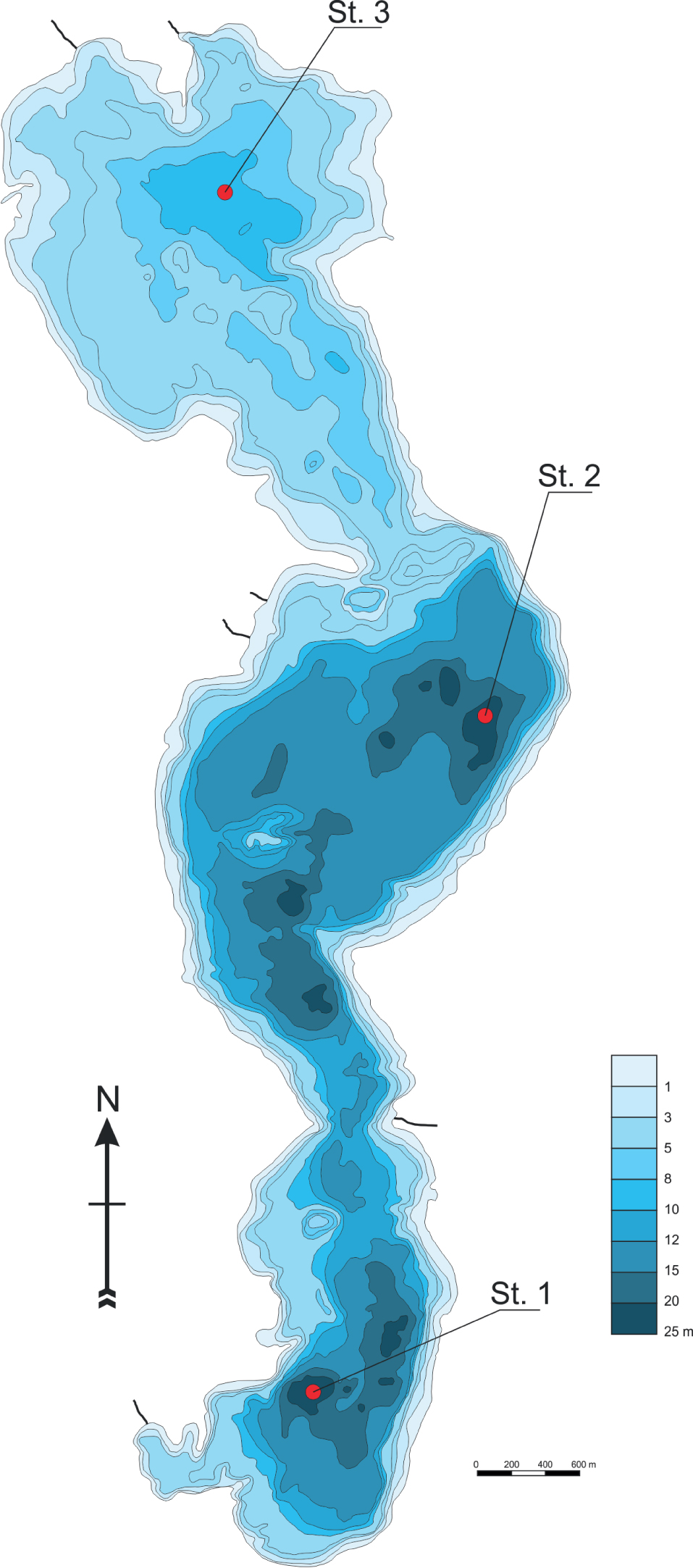
Figure 1
Lake Charzykowskie – the map and the numbers of sampling sites
Materials and Methods
The research was conducted in 2014-2015 and samples were collected once a month from May to September. Phytoplankton samples were collected from the pelagic zone, from the deepest places of the three subbasins. The detailed location and the names of the sites are presented on the map (Fig. 1). Each time the concentration of chlorophyll a, the total count and the total biomass of phytoplankton as well as the structure of their taxonomic groups were determined. At pelagic sites (1, 2 and 3), water was collected from three thermal layers as integrated samples from each thermal layer. The water was collected using a 2 l Limnos sampler, from which 200 ml subsamples were collected and preserved with Lugol’s solution (J in KJ) for microscopic analysis and determination of the phytoplankton count and biomass. Thermal and oxygen profiles were determined at three sites every month of the study, as well as water was collected for physicochemical analysis: transparency (SD visibility), pH, electrolytic conductivity (EC), oxygen (DO), chlorophyll a (Chl a), mineral forms of nitrogen (N-NH4, N-NO2, N-NO3), total nitrogen (TN), orthophosphates (P-PO4), total phosphorus (TP), magnesium (Mg+2), calcium (Ca+2), chlorides (Cl-) and total hardness.
Phytoplankton species were identified using a light microscope at 400× magnification. To identify the diatoms, samples were treated with HCl and ca. 30% H2O2. The count of algae was determined under an inverted microscope using the Utermöhl method (1958), and the biomass – using the volumetric method (Hillenbrand et al. 1999; Sun & Liu 2003) and assuming that 1 mm3 of algae is equal to 1 mg. The biomass was expressed as mg l-1 fresh mass. Only species with at least 5% contribution to the total biomass were considered dominant (Padisák et al. 2003). The dominant species described in this paper were classified into functional groups based on the studies by Reynolds et al. (2002), Reynolds (2006), Mieleitner et al. (2008) and Padisák et al. (2009) and life strategies after Wilk-Woźniak (2009).
The results were statistically analyzed – Pearson’s simple correlation (Past 3) was applied to analyze the relationships between the total biomass and environmental factors. To assess the relationships between the dominant species and environmental variables (CCA), the multivariate statistical package MVSP 3.2 was used (www.kovcomp.com/mvsp/).
The ecological status was based on the Phytoplankton Metric for Polish Lakes – PMPL (Hutorowicz & Pasztaleniec 2014). The PMPL index is an algorithm of the total phytoplankton biomass, cyanobacterial biomass, and chlorophyll a concentration. The method of calculating the index depends on the presence or absence of thermal stratification and on Schindler’s ratio (the ratio of catchment area and lake volume).
Results
Physicochemical analysis of water
Chemical parameters of water in Lake Charzykowskie in 2014 and 2015 showed good trophic conditions for the growth of phytoplankton and very bad oxygen conditions. High values of the concentration of biophilic elements, mainly phosphorus (on average above 0.1 mg TP l-1), place the lake in the eutrophic group. In early summer, however, total oxygen depletion was observed already at a depth of 6-7 m at stratified, deep sites 1 and 2. Hypoxic conditions occurred in the lake till late autumn. Other parameters of water were as follows: magnesium (from 6.8 to 17.5 mg l-1), calcium (from 41.1 to 57.16 mg l-1), chlorides (from 12.25 to 19 mg l-1), total hardness (from 3.07 to 10.2 mg l-1). The results of physicochemical analysis of water in Lake Charzykowskie are presented in Table 1.
Table 1
Selected physicochemical parameters of water in Lake Charzykowskie in 2014-2015
| parameter | 2014 | 2015 | ||||
|---|---|---|---|---|---|---|
| mean | range | ±SD | mean | range | ±SD | |
| Secchi depth (m) | 2.8 | 1.9-5.5 | 1.2 | 2.4 | 1.7-4.1 | 0.7 |
| Dissolved oxygen (mg l-1) | 8.3 | 4.8-10.6 | 2.1 | 9.3 | 7.5-11.4 | 1.2 |
| Water temperature (°C) | 20.0 | 15.4-25.0 | 3.6 | 18.4 | 15.0-21.3 | 2.7 |
| pH | 8.0 | 6.7-8.5 | 0.6 | 7.9 | 6.8-8.5 | 0.6 |
| Electrolytic conductivity (µS cm-1) | 329 | 317-348 | 9.3 | 332 | 302-357 | 14.9 |
| Chlorophyll a (µg l-1) | 25.41 | 2.27-78.32 | 21.80 | 12.44 | 2.9-21.31 | 5.26 |
| TP (mg l-1) | 0.101 | 0.015-0.300 | 0.10 | 0.149 | 0.045-0.496 | 0.12 |
| TN (mg l-1) | 3.45 | 1.65-5.25 | 1.2 | 3.49 | 0.33-8.73 | 2.07 |
Phytoplankton
A total of 81 taxa of plankton algae were identified in all water samples collected at 3 sites in 2014-2015. Green algae (Chlorophyta) and cyanobacteria (Cyanobacteria) were represented by the largest number of taxa – 30 and 26 taxa, respectively, followed by diatoms (Bacillariophyceace) – 15 taxa. Other taxonomic groups were represented by only a few species (from 1 to 4 taxa).
The biomass of phytoplankton in Lake Charzykowskie in 2014-2015 was varied and ranged from 0.32-18.42 mg l-1. The exception was a sample collected at site 3 in August 2014, where Ceratium hirundinella (O.F. Müller) Dujardin accounted for the maximum biomass, i.e. 36.6 mg l-1 (Fig. 2 ).
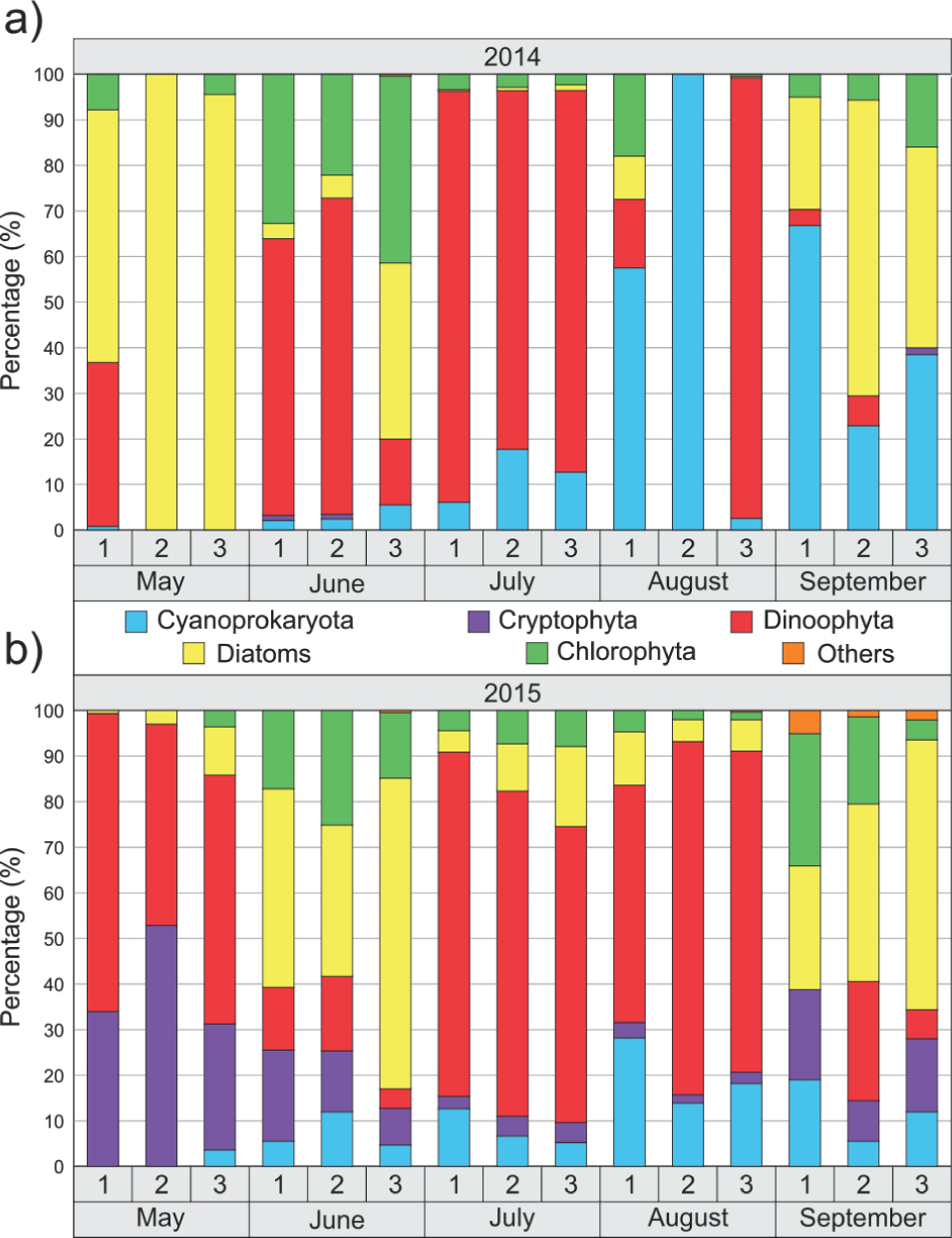
Figure 2
Percentage contribution of taxonomic groups to the total biomass of phytoplankton in Lake Charzykowskie in 2014 (a) and 2015 (b)
In spring 2014, the structure of phytoplankton biomass was dominated by large diatoms, i.e. Stephanodiscus neoastraea Håkansson & Hickel and Stephanodiscus alpinus Hustedt, which occurred with a high biomass of 8.2 mg l-1 at site 3 (Fig. 2a). A different situation was observed in May 2015 when taxa from Cryptophyta contributed the most to the biomass: Plagioselmis nannoplanctica (Skuja) Novar, Lucas et Morri and Cryptomonas sp. (Fig. 2b). In late June 2014, large numbers of Ceratium hirundinella occurred at sites 1 and 2 (> 65% of the total biomass). At the same time, a different structure of phytoplankton was observed at site 3 where diatoms Fragilaria crotonensis Kitton and Asterionella formosa Hassali dominated. As in the previous years, green algae (including mainly Volvox aureus Ehrenberg, Eudorina elegans Ehrenberg and Planktonema lauterbornii Schmidle) significantly contributed to the biomass of June phytoplankton. Samples collected in early summer 2015 at three sites were dominated by diatoms, including the most abundant species: Fragilaria crotonensis, Asterionella formosa and Aulacoseira granulata (Ehrenberg) Simonsen. Plagioselmis nannoplanctica still significantly contributed to the total biomass of phytoplankton.
The structure of summer phytoplankton (starting from July) proved to be invariable for years. The main part of the biomass was contributed by Ceratium hirundinella and C. furcoides (Levander) Langhans (at site 1 in 2014, > 83%) as well as by accompanying numerous cyanobacteria, mainly from the genus Microcystis (Fig. 2a). Fragilaria crotonensis occurred as a subdominant (Fig. 2b) only at site 3 in 2015. In August 2014, in addition to abundant dinoflagellates, the main part of the biomass was contributed by cyanobacteria. Those were mostly Microcystis aeruginosa Kützing and M. wesenbergii (Komárek) Komárek in Kondratieva, and Aphanizomenon flos-aquae Brébisson at site 1 in late summer. Whereas at site 2, the presence and dominance of the cyanobacterium Gloeotrichia echinulata P. G. Richter (> 80% of the total biomass) was observed for the first time. At the same time, Ceratium hirundinella still dominated at site 3 and accounted for the maximum biomass in the whole study period, i.e. 36.62 mg l-1. In August 2015, the phytoplankton structure was different compared to the previous year. In 2014, sites 1 and 2 were mostly dominated by Ceratium hirundinella, accompanied by numerous cyanobacteria, including mainly Aphanizomenon flos-aquae (average biomass at three sites was ca. 1.8 mg l-1). In 2015, phytoplankton was definitely dominated by cyanobacteria. The structure of phytoplankton was significantly reconstructed in late summer (September). Phytoplankton at that time was dominated by diatoms. Aulacoseira granulata and A. granulata var. angustissima (O. Müller) Simonsen dominated in 2014, while Asterionella formosa in 2015. The average September biomass in both years was similar and amounted to little more than 4 mg l-1.
The concentration of chlorophyll a in Lake Charzykowskie varied to a large extent and ranged on average from 25.41 µg l-1 in 2014 to 12.44 µg l-1 in 2015 (Fig. 3a, 3b).
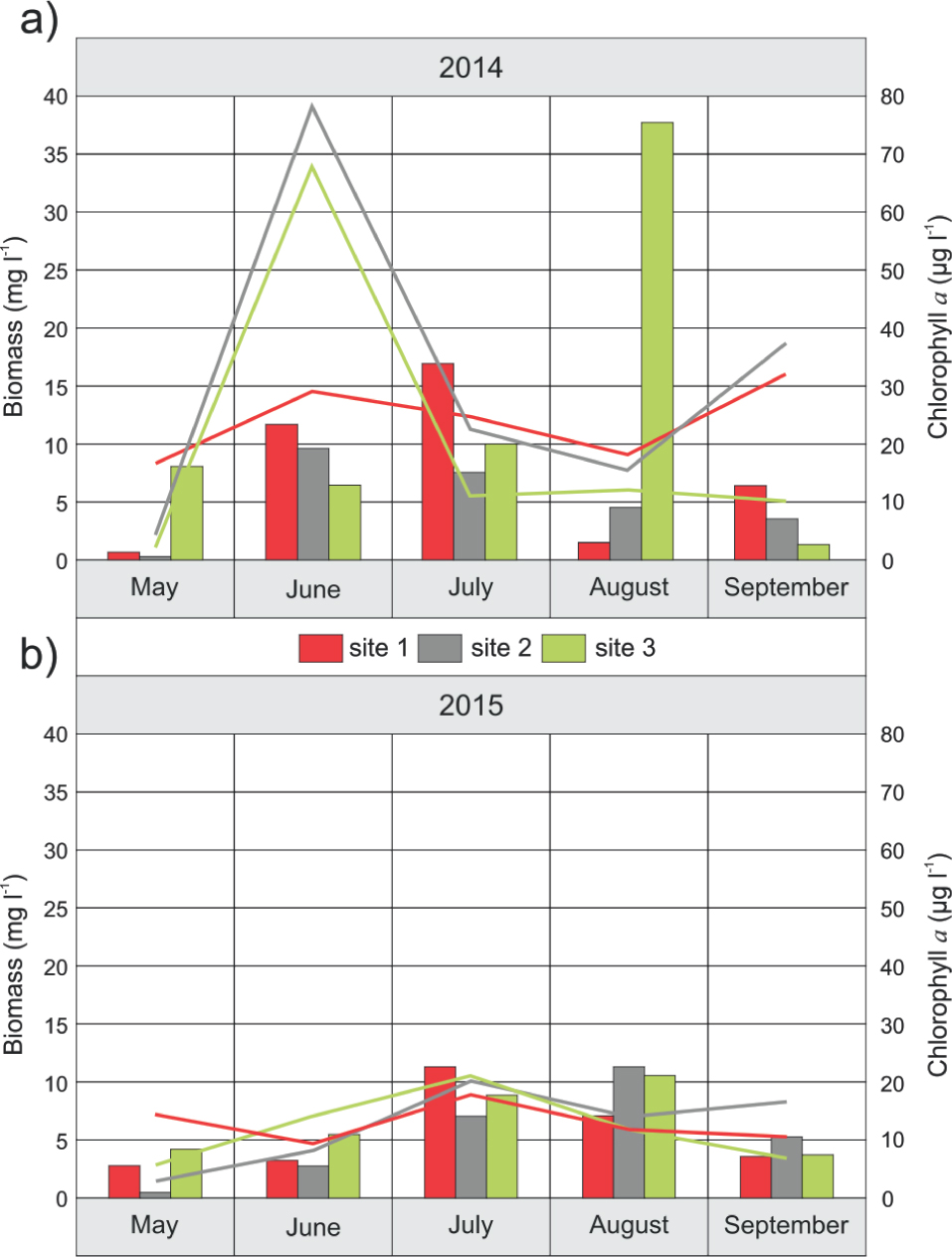
Figure 3
Changes in the biomass (mg l-1) and chlorophyll a concentration (µg l-1) in the phytoplankton of Lake Charzykowskie in 2014 (a) and 2015 (b); biomass – bar, chlorophyll a – line
Chlorophyll a concentration showed spatial heterogeneity. Values of this parameter ranged from 9.47 µg l-1 to 31.85 µg l-1 at site 1 in the southern subbasin, and from 2.9 µg l-1 to 78.32 µg l-1 at site 2 in the central subbasin. Values of chlorophyll a at site 3 in the northern subbasin ranged from 2.27 µg l-1 to 68 µg l-1.
Based on the total biomass of phytoplankton, the biomass of cyanobacteria and the concentration of chlorophyll a, the ecological status index was calculated for the lake (PMPL). In 2014, the ecological status of Lake Charzykowskie was moderate (PMPL value 2.97). In 2015, the status improved (good) and the value of PMPL was 1.85.
Discussion
The increasing eutrophication and the threat posed by cyanobacterial toxins, dangerous for living organisms, contribute to the growing interest in massive development of cyanobacteria in lakes. Therefore, the mechanisms of algal blooms, both in deep and stratified as well as in shallow and mixed lakes, have been addressed in numerous hydrobiological studies. Prediction and possible prevention of algal blooms is still an important issue in ecological and biotechnological studies (Dokulil & Teubner 2000; Kangro et al. 2005; Hajnal & Padisák 2007; Nõges et al. 2008; Nõges et al. 2010, Dembowska et al. 2015; Grabowska & Mazur-Marzec 2016). Lake Charzykowskie is one of the largest lakes in Poland, and at the same time one of the most extensively exploited for tourism. The lake can be a model water body for monitoring of short- and long-term changes associated with positive activities in the drainage basin.
The research conducted in Lake Charzykowskie during the last ten years indicates changes in the structure of phytoplankton, even though the trophic conditions in the lake are conducive to the development of phytoplankton, while oxygen conditions are very bad. Based on the high concentrations of biophilic elements, mainly phosphorus (on average 0.1 mg TP l-1), the lake can be classified as eutrophic (Vollenveider 1968; Carlson 1977). Changes in the structure of phytoplankton observed in Lake Charzykowskie during ca. 70 years are presented in Table 2.
Table 2
Structural changes in phytoplankton of Lake Charzykowskie in 1947-2015
| Date of studies Authors | Chl a (µg l-1) | Biomass (µg l-1) | Dominants and subdominants | Strategy | FGs | Traits of phytoplankton | Trophic status |
|---|---|---|---|---|---|---|---|
| 1947 (Cabejszek 1950) | 0.72 | Aulacoseira granulata Aphanizomenon Hosaquae Microcystis aeruginosa | R S S | P H1 LM | diatomaceous and cyanobacterial | β-mesotrophy | |
| 1954-1955 (Solski 1962) | 4.5-73.5 | ?eutrophy | |||||
| 1968 (Szulkowska-Wojaczek 1978) | 2.44 | Fragilaria crotonensis Microcystis aeruginosa | R | P | cyanobacterial and diatomaceous | eutrophy | |
| 1976 (Szulkowska-Wojaczek 1978) | 1.26 | Microcystis aeruginosa Oscillatoria n.det. | S | LM | cyanobacterial bloom | eutrophy | |
| 1987-1990 (Wiśniewska 1994) | 1.33-90.8 | 0.5-43.4 | Aulacoseira granulata Cyclotella sp. div. Microcystis aeruginosa Aphanizomenon flos-aquae | R CR S S | P - LM H1 | diatomaceous and cyanobacterial bloom | hypertrophy |
| 1999 (Wiśniewska 2000) | 4.2-28.3 | 0.06-10.4 | Fragilaria crotonensis Ceratium hirundinella Aphanizomenon flos-aquae Microcystis aeruginosa | R S S S | P LM H1 LM | diatoms, dinoflagellates, cyanobacteria | eutrophy |
| 2004 (Wiśniewska 2005) | 8.3-49.4 | 1.8-107.4 | Asterionella formosa Fragilaria crotonensis Ceratium hirundinella Aulacoseira granulata Microcystis aeruginosa | R R S R S | C P LM HP LM | diatoms, dinoflagellates, cyanobacteria | hypertrophy |
| 2008 (Luścińska & Wiśniewska 2012) | 1.1-11.0 | Stephanodiscus neoastrea, S. alpinus Aulacoseira islandica Ceratium hirundinella Aphanothece minutissima | C C S CS | C P LM L | diatoms and dinoflagellates | meso-eutrophy | |
| 2009 (Luścińska & Wiśniewska 2012) | 3.3-7.6 | Plagioselmis sp. Microcystis wesenbergii Ceratium hirundinella | C S S | X2 LM LM | cryptophytes, cryptophytes, dinoflagellates | meso-eutrophy | |
| 2014 (Wiśniewska & Dembowska this article) | 2.27-78.32 | 0.3-37.82 | Stephanodiscus neoastrea, S. alpinus Aulacoseira islandica Ceratium hirundinella | C S S | C P LM | diatoms and dinoflagellates | meso-eutrophy |
| 2015 (Wiśniewska & Dembowska this article) | 2.9-21.31 | 0.5-11.3 | Plagioselmis sp. Microcystis wesenbergii Ceratium hirundinella Fragilaria crotonensis | C S S R | X2 LM LM P | cryptophytes, cyanobacteria, dinoflagellates | meso-eutrophy |
The current research has shown that the phytoplankton community structure does not significantly change in the limnological cycle. Diatoms from the functional groups P and C, including diatoms constantly occurring in Lake Charzykowskie, i.e. Aulacoseira granulata (P), Asterionella formosa (C) and Fragilaria crotonenis (P) dominated in spring. The current research confirmed the dominance of the C-strategist Plagioselmis nannoplanctica from functional group X2 in the spring phytoplankton (observed also in 2008 and 2009; Wilk-Woźniak 2009). In late spring, waters of Lake Charzykowskie provide good conditions for the development of green algae Volvox and Eudorina from the functional group G, which prefer waters rich in nutrients and sunlight.
In summer 2014 and 2015, species from the functional group LM: Microcystis aeruginosa and Ceratium hirundinella co-dominated in the plankton. The group is characteristic of summer epilimnion in eutrophic lakes, while species are tolerant to low content of carbon and sensitive to water mixing. Gloeotrichia echinulata (H2) dominated in summer at site 2 (central subbasin). The species is characteristic of large mesotrophic lakes, tolerant of low content of nitrogen, sensitive to water mixing and low availability of light (Reynolds et al. 2002; Padisák et al. 2009). Aphanizomenon flos-aquae from group H1 still significantly contributed to the late autumn phytoplankton. The species is tolerant of low content of nitrogen and carbon, sensitive to the lack of phosphorus. Each autumn, the phytoplankton community is restructured toward the dominance of diatoms and cryptophytes.
The latest studies conducted in 2008-2009 and 2014-2015 showed that cyanobacterial blooms in Lake Charzykowskie caused in the 1980s by Microcystis sp. div. and Aphanizomenon flos-aquae are now short-lived and sporadic. In recent years, however, cyanobacteria were mainly represented by species from the functional group L, such as Aphanothece minutissima (W.West) Komárková-Legnerová. According to Padisák et al. (2009), those species may occur in summer even in oligotrophic waters, and Plagioselmis nannoplanctica (X2) is characteristic of well mixed meso-eutrophic lakes. The main functional groups and their representative species occurring in Lake Charzykowskie are presented in Table 3.
Table 3
Main functional groups in Lake Charzykowskie and representative species in each group (after Reynolds et al. 2002; Padisák et al. 2009) FG Representative species
| FG | Representative species | Physiological characteristics |
|---|---|---|
| B | Aulacoseira islandica Stephanodiscus neoastraea | Mixed, mesotrophic small- and medium-sized lakes, sensitive to the onset of stratification, adapted to low light, sensitive to pH increase, Si depletion, stratification |
| C | Asterionella formosa | Mixed, eutrophic small- and medium-sized lakes with species sensitive to the onset of stratification, sensitive to Si depletion |
| o | Fragilaria crotonensis Aulacoseira granulata A. granulata var. angustissima Staurastrum gracile S. chaetoceras Staurastrum sp. | Eutrophic epilimnia, tolerant of carbon dioxide depletion, more eutrophic waters, sensitive to Si depletion, stratification |
| LM | Microcystis sp. Ceratium hirundinella C. furcoides | Summer epilimnia in eutrophic lakes, low light and very low C tolerant, sensitive to mixing and poor stratification |
| H2 | Gloeotrichia echinulata Anabaena lemmermanii | Oligo-mesotrophic, deep, stratified lakes, with good light conditions, tolerant to low nitrogen, sensitive to mixing, poor light |
| HI | Aphanizomenon spp. Dolichospermum spiroides | Eutrophic, both stratified and shallow lakes with low nitrogen and low carbon, sensitive to mixing, poor light and low phosphorus |
| X2 | Plagioselmis | Shallow, clear, mixed layers in meso-eutrophic lakes, tolerance to stratification, sensitive to mixing and filter-feeding grazers, reduced grazing leads to high relative biomass |
| G | Eudorina Volvox | Nutrient-rich conditions in stagnant water columns, small eutrophic lakes and very stable phases in larger river-fed basins and storage reservoirs |
| K (L)? | Aphanothece Aphanocapsa | Aphanothece and Aphanocapsa colonies are often found late summer in epilimnion of oligotrophic, deep lakes |
It has been found in the present study that the biomass of phytoplankton in spring was at a low level of 0.32 mg l-1, while the maximum value of the biomass was recorded in summer – 37.82 mg l-1. It should be noted that the maximum value of the biomass was contributed by large dinoflagellates Ceratium hirundinella, and the correlation coefficient between the total biomass of phytoplankton and the biomass of dinoflagellates was high – r = 0.8959, p ≤ 0.001. Ceratium hirundinella was recorded in many lakes all over the world. The extensive development of this species is associated not only with the trophic conditions, but mostly with a high water temperature (Padisák 1985; Mac Donagh et al. 2005; Hart & Wragg 2009; Kozak et al. 2013). The correlation between the biomass values of dinoflagellates and water temperature in Lake Charzykowskie (Table 4) was high and amounted to r = 0.7098 (p ≤0.001).
The concentration of chlorophyll a in 2014-2015 ranged from 2.27 µg l-1 to a maximum of 78.32 µg l-1, which indicates eutrophic conditions (Carlson 1977). Statistically significant correlations were determined only between the concentration of chlorophyll a and the biomass of Chlorophyta (Table 4). The content of chlorophyll a in the cells of algae from other taxonomic groups (Cyanobacteria, Dinophyta) is usually lower, hence the lack of statistically significant correlations (Kasprzak et al. 2008; Dembowska et al. 2015).
Table 4
Statistically significant values of Pearson correlation between environmental parameters and phytoplankton biomass (p≤0.05, bold p≤ 0.001)
| WT | SD | EC | pH | DO | N-NH4 | N-NO2 | N-NO3 | TN | P-PO4 | Chl a | Dino | Eugl | |
|---|---|---|---|---|---|---|---|---|---|---|---|---|---|
| SD | -0.5113 | ||||||||||||
| EC | 0.4992 | ||||||||||||
| pH | 0.6326 | -0.5742 | |||||||||||
| DO | 0.5258 | ||||||||||||
| N-NH4 | 0.6409 | -0.4101 | 0.5970 | ||||||||||
| N-NO2 | 0.5213 | 0.6334 | |||||||||||
| N-NO3 | -0.4384 | -0.5323 | |||||||||||
| TN | -0.4358 | ||||||||||||
| P-PO, | 0.3837 | ||||||||||||
| Chl a | 0.4079 | 0.5159 | |||||||||||
| Cyano | -0.5017 | 0.3930 | -0.5295 | -0.5646 | 0.3757 | ||||||||
| Crypto | 1-0.4153 | ||||||||||||
| Dino | 0.7098 | -0.4801 | 0.4615 | ||||||||||
| Eugl | 0.4925 | ||||||||||||
| Chryso | 0.5305 | 0.7463 | |||||||||||
| Bacill | -0.3932 | ||||||||||||
| Chloro | 0.5316 | 0.6312 | |||||||||||
| B phyto | 0.6959 | -0.6359 | -0.3842 | 0.4268 | 0.4338 | 0.8959 |
Cyanobacteria and dinoflagellates dominated in the taxonomic structure of planktonic algae in the water, which is a characteristic phenomenon in lakes with large resources of available phosphorus and increased amounts of dissolved organic matter in the water (Górniak et al. 2002). Canonical correspondence analysis (CCA) demonstrated a clear correlation between the biomass of cyanobacteria and the total content of phosphorus in the water of Lake Charzykowskie (Fig. 4). Cyanobacteria were represented by a large number of potentially toxic species, e.g. Microcystis aeruginosa, Gloeotrichia echinulata, Aphanizomenon flos-aquae and Dolichospermum spiroides (Klébahn) Wacklin, Hoffmann et Komárek. (Błaszczyk et al. 2010; Kobos et al. 2013). However, the biomass of these species is significantly lower compared to that recorded in the 1980s and the 1990s (Wiśniewska 1994; 1996).
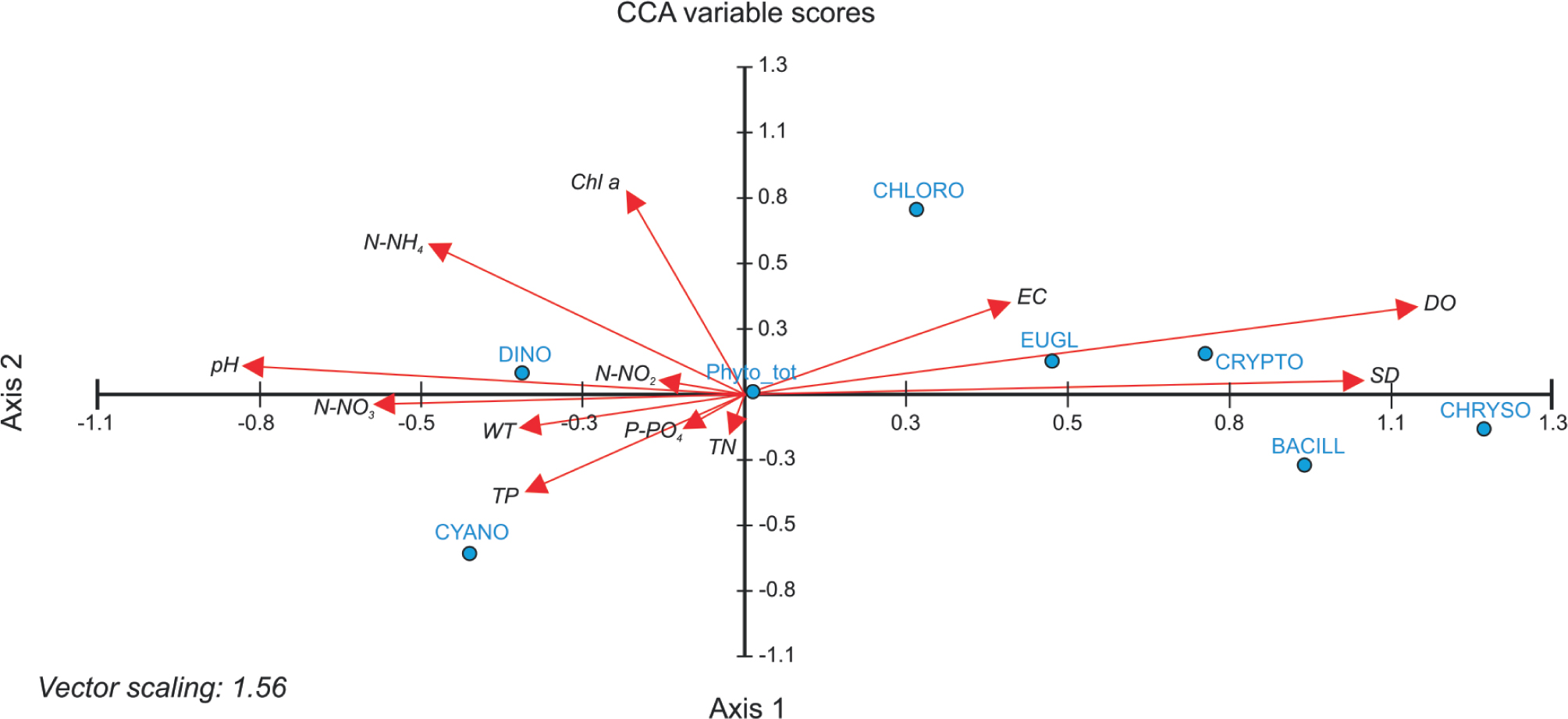
Figure 4
Ordination plot of canonical correspondence analysis (CCA) for the biomass of phytoplankton groups and environmental parameters in Lake Charzykowskie in 2014-2015. The first axis accounts for 31.221% of the total data variance, the second axis – for 14.130%.
The current quantitative and qualitative parameters of phytoplankton determined in the course of the research carried out in 2014 and 2015, and the long-term research indicate the ongoing process of ecosystem regeneration after the period of disturbance. If the main adverse factor was an excessive supply of nutrients from the lake catchment, the reduction in the load of fertilizing compounds does not result in the immediate change of phytoplankton structure (Dunalska et al. 2014; Dunalska & Wiśniewski 2016). Responses of lake ecosystems are usually delayed in time due to the large resources of phosphorus accumulated in the bottom sediments, which represent internal sources of supply for phytoplankton communities. Another factor affecting the processes of regeneration are currently frequent climate changes (Jeppesen et al. 2005). Global warming was recorded in Europe and Poland already at the beginning of the 21st century (IPCC 2012). According to Olrik et al. (2013), an increase in temperature may result in faster settling of phytoplankton and removal of phytoplankton-bound P from epilimnion. The stratification period in lakes will be extended, while the content of inorganic nitrogen in epilimnion will be reduced (due to denitrification and transformation into atmospheric N2). On the other hand, oxygen deficits in hypolimnion will contribute to the release of phosphates from sediments into the water. In the end, obligate autotrophs will be eliminated from phytoplankton in favor of mixotrophs (Ceratium) and N2-fixing cyanobacteria.
Conclusions
The research on phytoplankton in Lake Charzykowskie has been carried out from the mid-20th century. The trophic conditions in the lake have been monitored for almost 70 years. In the 1940s, the lake was classified as β-mesotrophic (Cabejszek 1950), while from the 1960s to 1990s as eutrophic (Szulkowska-Wojaczek 1978) or even hypertrophic (Wiśniewska 1994). The observations conducted in the last ten years have revealed a small but continuous improvement in the water quality of the studied lake. In 2014-2015, the biomass reduction and significant changes in the structure of phytoplankton were observed. In 2015, the ecological status of the lake was assessed as good. Cyanobacterial blooms are sporadic and less abundant and their duration is shorter. Despite the positive changes observed in the phytoplankton, the high content of nutrients in water is disturbing. Unfortunately, the morphometric conditions, i.e. the great depth of the lake, contribute to the oxygen deficit and release of nutrients from the sediments. Therefore, the sustainability of changes observed may be questionable, which is why the monitoring of Lake Charzykowskie should be continued.