
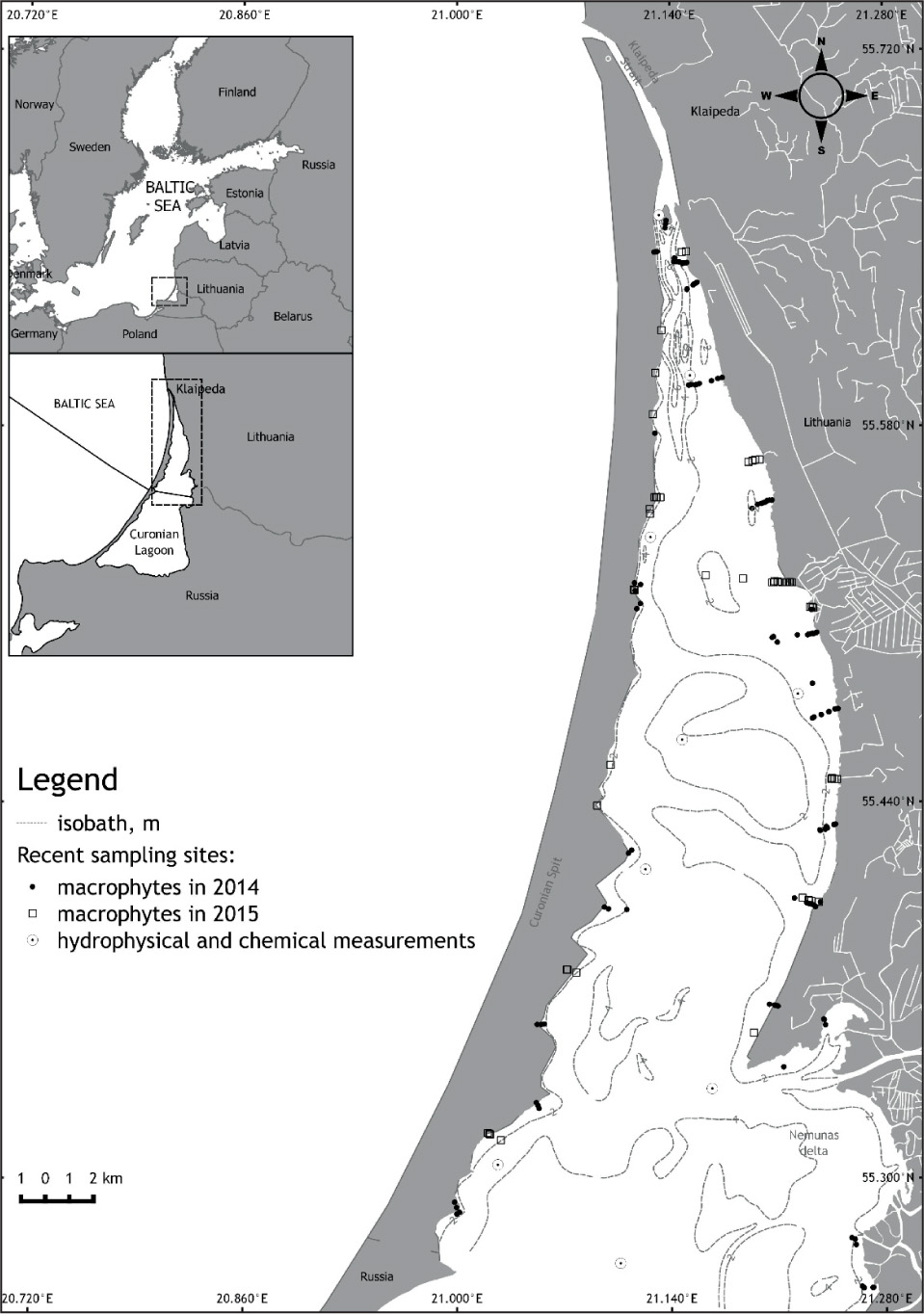
Figure 1
Geographical location of the study area and the distribution of recent (2014-2015) macrophyte sampling transects (samples were collected every ca. 0.25 m along the depth gradient from the coastline or reed stands down to the maximum colonization depth of macrophytes), sites locations (e.g. between the transects or within reed stands) and sampling locations of hydrophysical and chemical parameters in the estuarine part of the Curonian Lagoon
Table 1
Characteristics of the recent and historical macrophyte surveys in the Curonian Lagoon used for comparison analysis
| Study period | Sampling method | Number of transects and sites | Depth range (m) | Geographic extent | Reference |
|---|---|---|---|---|---|
| 1949-1959 | six-toothed hook, inspection of fishing nets | 35 sites (26 – littoral part, 4 – middle part, 5 –relevés); 15 littoral sites in the recent study area | 0-4 | Entire lagoon (except the south-eastern part) | Minkevičius, Pipinys 1959 |
| 1960-1980 | no data | no data | no data | Eastern Lithuanian part along the Nemunas River Delta and the south-eastern Russian part | Trainauskaitė 1978 |
| 1997-2007 | six-toothed hook | 22 transects and 13 sites (littoral part) | 0-2 | Lithuanian part | Plokštienė 2002; Sinkevičienė 2004 |
| 2014-2015 | double-headed rake, snorkeling | 27 transects and 12 sites (littoral part) | 0-3 | Lithuanian part | this study |
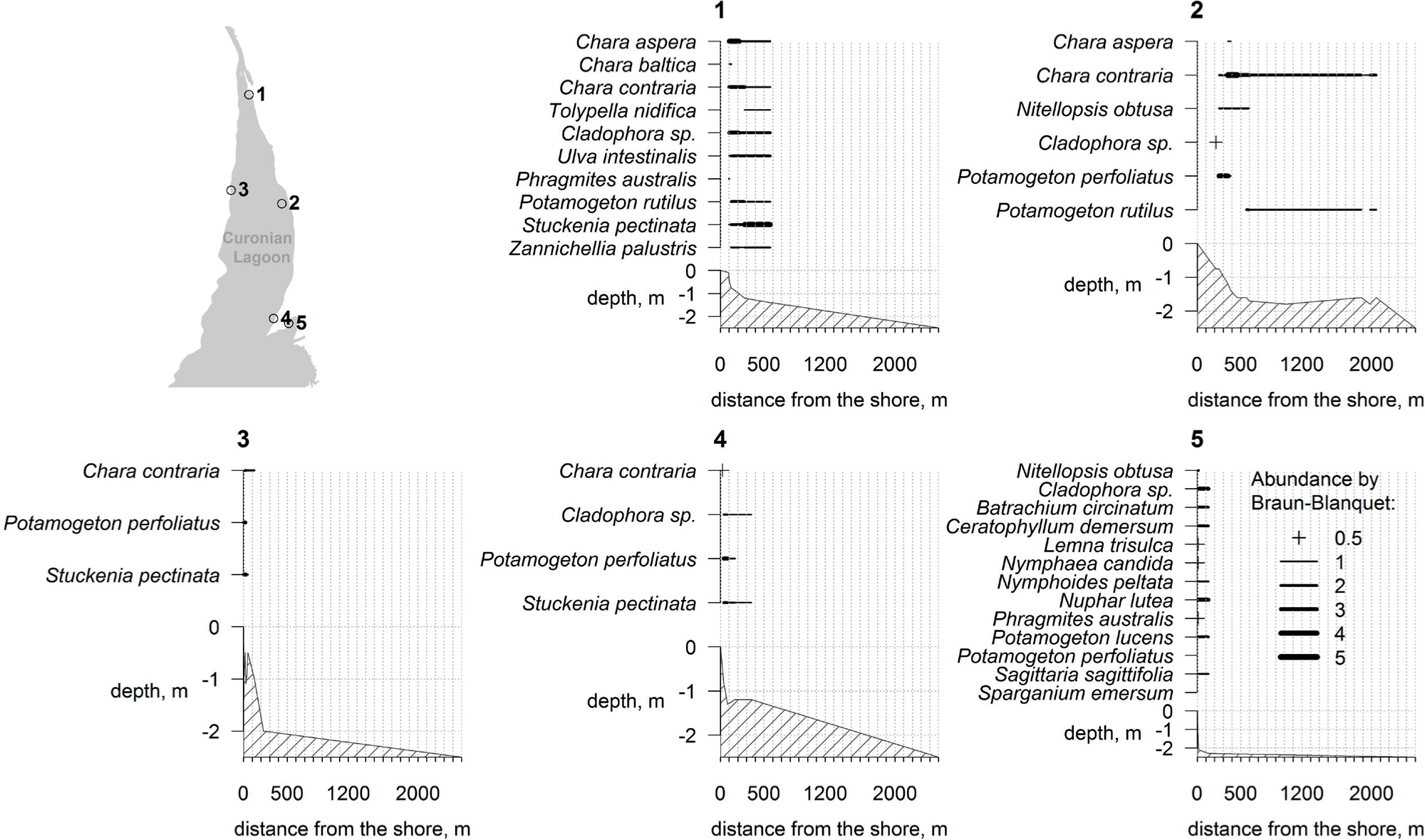
Figure 2
Examples of recent (2014-2015) abundance and depth distribution of macrophytes in the study transects (1-5) with charophytes in the northern part of the Curonian Lagoon
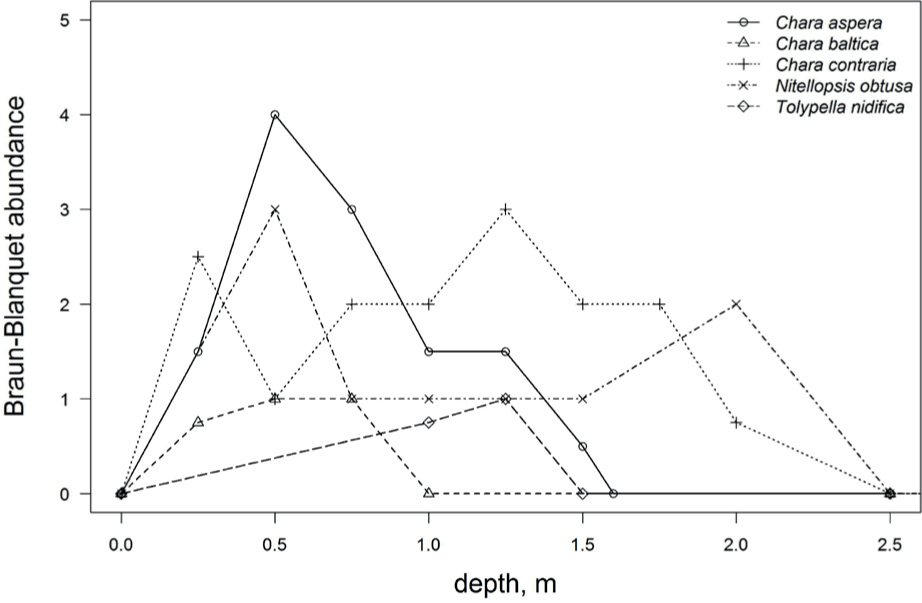
Figure 3
Recent (2014-2015) median ranges of depth distribution and abundance (Braun-Blanquet scale) of 5 charophyte species along the transects (locations are given in Fig. 2) in the Curonian Lagoon; empirical relationships obtained by linear interpolation
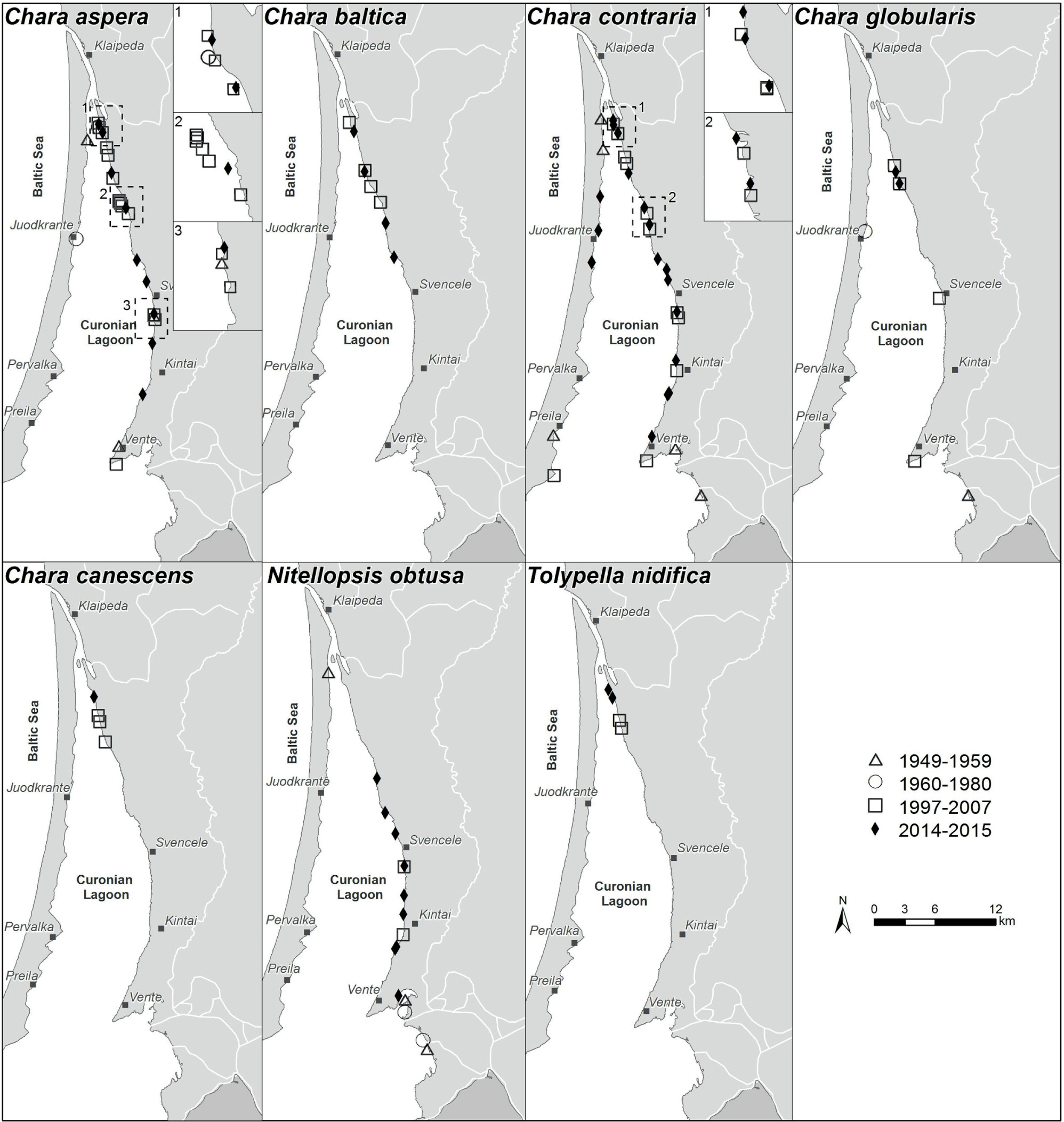
Figure 4
Recent (2014-2015) and previous (1949-1959, 1960-1980 and 1997-2007) distribution of charophyte species recorded in the Curonian Lagoon
Table 2
The maximum colonization depth (m) and occurrence of charophyte species recorded in different study periods
| Species | 1949-1959 | 1960-1980 | 1997-2007 | 2014-2015 |
|---|---|---|---|---|
| Chara aspera Willd. | 0.8H, R | +R | 0.6H, R | 1.7 |
| Chara contraria A. Braun ex Kütz. | 0.9H, R | +R | 0.5H, R | 2.0 |
| Nitellopsis obtusa (Desv.) J. Groves | 0.9H, R | +R | 0.7H, R | 2.0 |
| Chara globularis Thuill. | 0.9H, R | +H, R | 0.4H, R | 0.1 |
| Nitella mucronata (A. Braun) Miq. | +H | +H | – | – |
| Chara vulgaris L. | – | +R | +H | – |
| Chara virgata Kütz. | – | +H, R | – | – |
| Chara baltica (Hartman) Bruzelius | – | – | 0.6H, R | 0.9 |
| Chara canescens Loisel. | – | – | 0.2H, R | 0.1 |
| Tolypella nidifica (O. F. Müll.) A. Braun | – | – | 0.1H, R | 1.2 |
H – herbarium data; R – reference data; + – record of a charophyte without maximum colonization depth; – absence of a charophyte; bolded species – abundant species
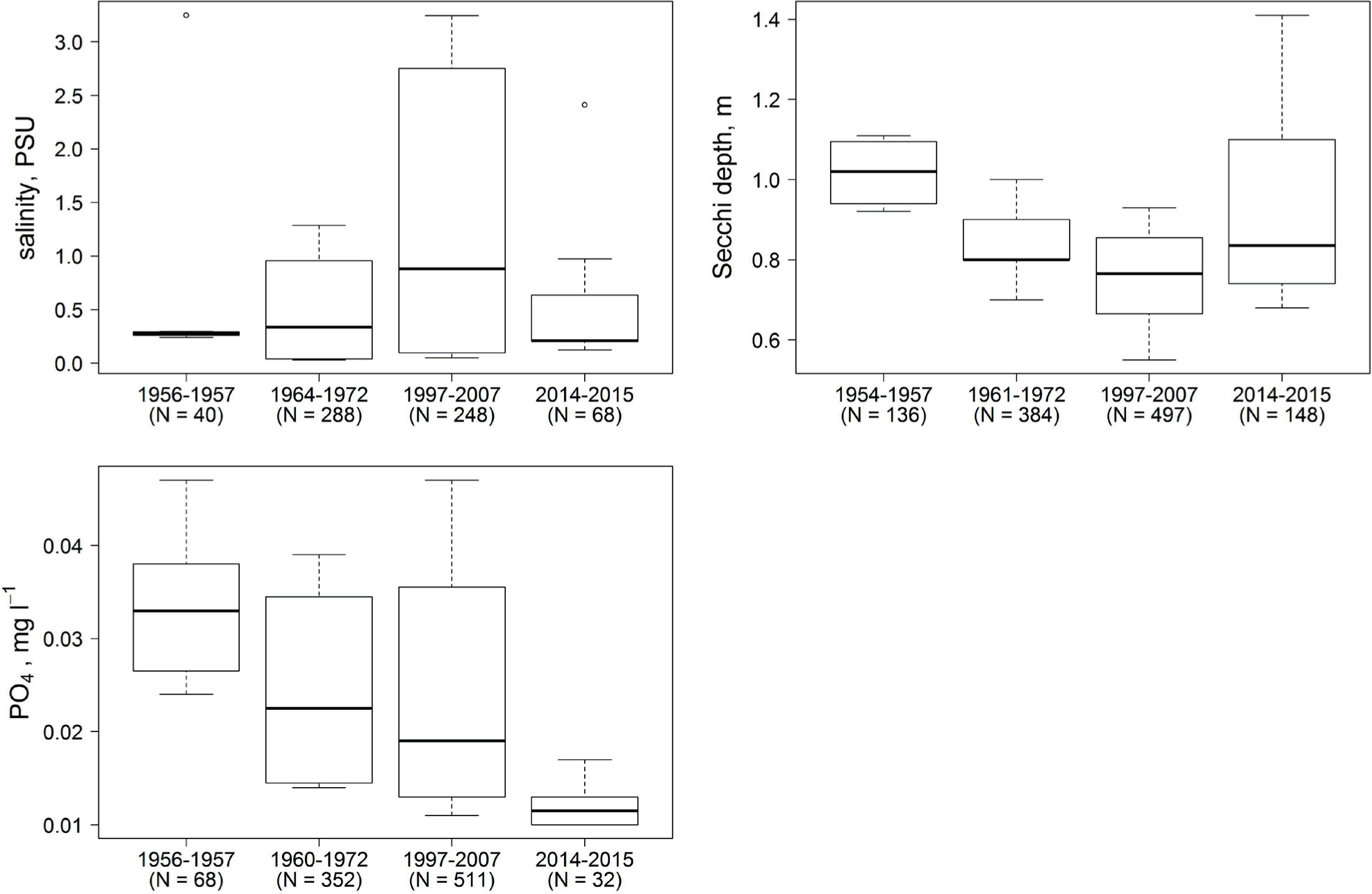
Figure 5
Statistics of mean salinity, Secchi depth and concentration of phosphates (PO4) in the northern part of the Curonian Lagoon in May-September in different periods: 1954-1957 (Jurevičius 1959), 1960-1972 (Vaitkevičienė, Vaitkevičius 1978), 1997-2007 (DMREPA) and 2014-2015 (this study and DMREPA). The midpoint of a boxplot is the median, the hinges are 25% and 75% quartiles, the whiskers show minimum and maximum values. N – the number of measurements in the period