
Introduction
Water bugs are an important component of the aquatic fauna. They are widely distributed and inhabit aquatic and semi-aquatic habitats, including both lentic and lotic bodies of water (Souza et al. 2006). In general, water bugs have a high dispersion capacity (Savage 1994; Usseglio-Polatera et al. 2000; Wachmann et al. 2006). For this reason, it is difficult to define the types of water bug assemblages (Carbonell et al. 2011). Although found in all types of aquatic habitats, they do not prefer high water velocity and prevail in stagnant or slow-flowing waters (Karaouazas, Gritzalis 2006; Nosek et al. 2007; Skern et al. 2010). Generally, the dimensions of water bodies, land use, aquatic and riparian vegetation, and water chemistry were considered as the most important factors affecting the assemblages of water bugs (Hufnagel et al. 1999; Karaouazas, Gritzalis 2006). Little is known about the ecology of water bugs in springs and there are no research on ecological factors that determine species distribution in these habitats.
In general, the fauna of water bugs in Montenegro is insufficiently studied (Schumacher 1914; Horváth 1918; Novak, Wagner 1955; Filippi 1957; Grupče 1961; Wagner 1962; Štusák 1980; Protić et al. 1990; Protić 1998; Kment et al. 2005; Kovács et al. 2011; Aukema et al. 2013). So far 18 species of water bugs are recorded for Montenegro. This is a relatively small number as compared to the neighboring countries (Serbia, Macedonia and Croatia) where more than 50 species are reported in each of them (Aukema, Rieger 1995; Protić 1998; 2011; Kment, Beran 2011; Aukema et al. 2013; Boda et al. 2015).
The objective of the present study was to determine which assemblages of water bugs (Heteroptera: Nepomorpha and Gerromorpha) occur in spring habitats in Montenegro, to evaluate the impact of environmental factors on the spatial pattern of these assemblages and to check the congruence of water bug assemblages based on biotic and environmental classification of karstic spring habitats.
Study area
Montenegro is the Western Balkan State and covers a total area of 14,026 km². It is a large karstic region and most of the country is covered by the Dinaric Alps. The highest point in the country is Bobotov Kuk (2522 m). The lower areas of Montenegro include the valley of the Zeta River, the Skadar Lake depression and a narrow coastal plain. Biogeographically, Montenegro belongs to the Alpine and Mediterranean regions which divide the country into two almost equal halves (EEA 2016). The lower areas of Montenegro have a warm Mediterranean climate, with hot and dry summers and cool, rainy winters.
The study was conducted in the area located in the Skadar Lake drainage basin. Lake Skadar is the largest lake in the Balkan Peninsula with a surface area that seasonally fluctuates between 370 to 600 km2. There are a number of temporary and permanent karstic springs, some of which are sublacustrine in cryptodepressians (so called ‘oko’) (Pešić, Glöer, 2013). The majority of springs are vauclusian springs and they are mostly cave springs.
Materials and methods
Water bugs were sampled with a small Surber sampler (10 × 10 cm = 0.01 m2, 350 μm mesh width). The sampling was done in summer 2014. All samples were immediately preserved in 96% ethanol, and subsequently sorted and determined in the laboratory.
In total, 230 adult and larvae specimens of water bugs were collected. The material was identified mostly based on Tamanini (1979) and Macan (1976).
Samples were collected from 32 springs located in the central part of Montenegro (Table 1). At the each site, water temperature and pH were measured with a pH-meter (HI 98127, 0.1 accuracy). Springs were divided into four classes based on their size: 1: <1 m2, 2: 1-5 m2, 3: 5-20 m2, 4: >20 m2. Water discharge was determined visually and grouped in classes (Table 2): 1 (<1 l min-1), 2: (>1 and <5 l min-1), 3: (>5 and <25 l min-1), 4: (<25 l min-1) according to Von Fumetti et al. (2006). The substrate types were categorized into five classes of frequency (Table 2) based on the percentage cover (Von Fumetti et al. 2006): 0: 0%; 1: 1-25%; 2: 26-50%; 3: 51-75%; 4: 76-100%.
Table 1
General characteristics of the studied springs
| Code | Spring | Longitude (E) | Latitude (N) | Altitude (m) | Spring type | Land use |
|---|---|---|---|---|---|---|
| S1 | Skadar Lake area, spring “Karuč" | 19° 6'20.8" | 42°21'29.8" | 12 | sublacustrine | Lake, village |
| S2 | Skadar Lake area, spring “Sinjac" | 19°09'11.8" | 42°22'01.6" | 9 | rheocrene | edge of forest |
| S3 | Podgorica area, spring “Kaluđerovo oko" | 19°8'58.6" | 42°22'28.31" | 17 | sublacustrine | meadows, edge of forest |
| S4 | Podgorica area, Bandići, spring “Crno oko" | 19°9'14.95" | 42°29'3.76" | 38 | limnocrene | village |
| S5 | Podgorica area, Bandići, spring “Vriješko vrelo" | 19°10'25.2" | 42°29'09.6" | 39 | limnocrene | village |
| S6 | Podgorica, village Daljam, spring “Kraljičino oko" | 19°08'44.2" | 42°28'52.3" | 44 | rheocrene | meadow |
| S7 | Podgorica, spring “Vrela ribnička" | 19°17'57.1" | 42°26'10.7" | 55 | rheocrene | urban |
| S8 | Podgorica, Piperi, spring"Studenci" | 19°14'35.5" | 42°28'59.4" | 48 | rheocrene | meadow |
| S9 | Podgorica, Piperi, spring"Taban" | 19°13'08.5" | 42°31'39.3" | 89 | rheocrene | edge of forest |
| S10 | Danilovgrad, spring "Glava Zete" | 18°59'48.7" | 42°40'29.5" | 78 | rheocrene | edge of forest |
| S11 | Danilovgrad, spring “Milojevića vrela” | 19°00'40.3" | 42°37'56.1" | 50 | rheocrene | edge of forest |
| S12 | Danilovgrad, spring "Oraška jama" | 19°05'33.1" | 42°31'52.5" | 56 | rheocrene | meadow |
| S13 | Podgorica, Mareza I spring on road to Daljam village | 19°10'55.6" | 42°28'48.2" | 38 | limnocrene | rocky ground |
| S14 | Podgorica, Mareza II spring on road to Daljam village | 19°10'52.5" | 42°28'50.8" | 40 | rheocrene | meadow |
| S15 | Podgorica, Morača river , spring Zlatica | 19°17'18.4" | 42°28'07.2" | 41 | rheocrene | riverside |
| S16 | Podgorica region, Kuči, spring"Mosor" | 19°18'32.1" | 42°27'46.7" | 115 | rheocrene (piped) | village |
| S17 | Danilovgrad, village Gornji Martinići, spring “Pištet" | 19°11'35.5" | 42°33'19.7" | 194 | rheocrene | village |
| S18 | Danilovgrad, village Gornji Martinići, Glizica, spring | 19°10'43.9" | 42°33'44.8" | 204 | rheocrene (piped) | village |
| S19 | Podgorica region, Piperi, spring"Studenac" | 19°13'40.7" | 42°32'25.2" | 443 | rheocrene (piped) | village |
| S20 | Podgorica, Piperi, spring “Mrtvak" | 19°13'21.2" | 42°32'39.7" | 406 | rheocrene (piped) | village |
| S21 | Podgorica, Piperi, spring “Gospođina voda" | 19°13'16.0" | 42°32'47.1" | 405 | rheocrene (piped) | village |
| S22 | Podgorica, Piperi, spring “Bitorod" | 19°13'59.9" | 42°32'02.3" | 404 | rheocrene (piped) | village |
| S23 | Podgorica, Piperi, spring “Močila" | 19°15'46.6" | 42°30'23.9" | 106 | rheocrene (piped) | edge of forest |
| S24 | Danilovgrad, spring Kupinovo | 19° 2'47.1" | 42°38'35.3" | 516 | rheocrene (piped) | village |
| S25 | Podgorica region, Kuči, spring"Fundina" | 19°21'52.7" | 42°26'42.8" | 651 | rheocrene (piped) | village |
| S26 | Danilovgrad, Podostrog, spring Šobajići | 19° 2'47.1" | 42°38'35.3" | 516 | rheocrene (piped) | village |
| S27 | Nikšić, village Vidrovan, spring “Vukovo Vrelo" | 18°56'31.5" | 42°51'26.7" | 663 | rheocrene | village |
| S28 | Podgorica, spring “Manastir Morača" | 19°23'26.1" | 42°46'00.4" | 308 | rheocrene | village |
| S29 | Ponikvica Mt., Martinićka Ponikvica, spring I | 19°16'01.3" | 42°40'28.5" | 1419 | rheocrene | edge of forest |
| S30 | Lukavica Mt., spring “Babino sicelo" | 19°12'54.9" | 42°48'15.9" | 1607 | limnocrene | meadow |
| S31 | Lukavica Mt., spring near Kapetanovo Lake | 19°13'40.5" | 42°48'46.5" | 1706 | rheocrene | meadows |
| S32 | Lukavica Mt., spring near Manito Lake | 19°14'42.84" | 42°48'22.96" | 1786 | limnocrene | meadow |
Table 2
Physical characteristics (spring size – SU and discharge – DI), temperature (TW), substrate composition and aquatic vegetation of 32 investigated springs (S1-S32)
| Spring code | Physical characteristics | TW | Substrate | Aquatic vegetation | |||||||
|---|---|---|---|---|---|---|---|---|---|---|---|
| SU | DI | Anoxic mud | clay | sand | gravel | stones | Moss | Macrophyte | Algae | ||
| S1 | 4 | 4 | 17.4 | 2 | 1 | 0 | 0 | 1 | 0 | 1 | 1 |
| S2 | 4 | 3 | 18.4 | 1 | 1 | 1 | 0 | 1 | 0 | 1 | 1 |
| S3 | 4 | 3 | 18.6 | 2 | 1 | 0 | 0 | 1 | 0 | 1 | 1 |
| S4 | 3 | 2 | 15.6 | 2 | 1 | 0 | 0 | 1 | 1 | 3 | 1 |
| S5 | 4 | 4 | 14.2 | 1 | 1 | 1 | 1 | 1 | 2 | 2 | 2 |
| S6 | 1 | 2 | 13.4 | 0 | 0 | 0 | 1 | 2 | 1 | 1 | 1 |
| S7 | 2 | 2 | 12.1 | 0 | 1 | 1 | 1 | 2 | 2 | 1 | 1 |
| S8 | 2 | 2 | 14.1 | 1 | 1 | 0 | 1 | 2 | 1 | 2 | 1 |
| S9 | 1 | 1 | 16.7 | 0 | 1 | 1 | 1 | 1 | 1 | 0 | 1 |
| S10 | 4 | 4 | 11 | 1 | 0 | 0 | 1 | 2 | 3 | 1 | 1 |
| S11 | 3 | 4 | 12.3 | 0 | 1 | 1 | 1 | 2 | 2 | 2 | 1 |
| S12 | 4 | 2 | 10.1 | 1 | 0 | 1 | 1 | 2 | 1 | 1 | 1 |
| S13 | 3 | 2 | 13.1 | 1 | 1 | 1 | 1 | 1 | 1 | 3 | 1 |
| S14 | 2 | 1 | 12.4 | 0 | 1 | 1 | 1 | 2 | 1 | 1 | 1 |
| S15 | 2 | 1 | 13.1 | 1 | 0 | 2 | 0 | 1 | 2 | 0 | 1 |
| S16 | 2 | 1 | 16.1 | 0 | 1 | 0 | 1 | 3 | 1 | 0 | 1 |
| S17 | 1 | 1 | 17.2 | 1 | 0 | 0 | 1 | 2 | 1 | 0 | 1 |
| S18 | 1 | 1 | 14.3 | 1 | 1 | 0 | 0 | 2 | 1 | 0 | 1 |
| S19 | 1 | 1 | 12.3 | 2 | 2 | 0 | 0 | 2 | 1 | 1 | 1 |
| S20 | 2 | 1 | 15.2 | 3 | 1 | 0 | 0 | 1 | 0 | 0 | 1 |
| S21 | 2 | 2 | 13.5 | 1 | 1 | 1 | 1 | 1 | 1 | 1 | 1 |
| S22 | 1 | 1 | 16.4 | 0 | 0 | 1 | 1 | 2 | 1 | 0 | 1 |
| S23 | 1 | 1 | 16.1 | 2 | 0 | 0 | 0 | 2 | 1 | 1 | 1 |
| S24 | 1 | 1 | 14.1 | 1 | 1 | 0 | 0 | 1 | 1 | 0 | 1 |
| S25 | 1 | 1 | 13 | 1 | 1 | 1 | 1 | 2 | 1 | 0 | 1 |
| S26 | 1 | 1 | 15.1 | 2 | 1 | 0 | 0 | 1 | 1 | 0 | 1 |
| S27 | 4 | 4 | 8.4 | 1 | 1 | 1 | 1 | 1 | 2 | 2 | 1 |
| S28 | 3 | 4 | 10.1 | 1 | 0 | 1 | 1 | 2 | 1 | 1 | 1 |
| S29 | 1 | 1 | 9.2 | 2 | 3 | 0 | 0 | 1 | 1 | 0 | 1 |
| S30 | 4 | 1 | 10.1 | 3 | 1 | 0 | 0 | 1 | 1 | 2 | 2 |
| S32 | 1 | 1 | 8.3 | 3 | 1 | 0 | 0 | 1 | 0 | 1 | 1 |
| S32 | 2 | 1 | 11.3 | 3 | 1 | 0 | 0 | 1 | 2 | 2 | 2 |
Data analyses
Statistical analyses were performed using PRIMER 7.0 (Clarke, Gorley 2015) and MVSP v3.21 (Kovach 1998-2012). For cluster analysis based on environmental data, centered and standardized environmental data were classified by the Euclidean distance similarity index. For classification of biotic samples, the Bray-Curtis similarity index on square root transformed data was used. PCA was performed on centered and standardized environmental data of the site groups used in the previous cluster analysis. SIMPER analysis was performed to test differences within faunal composition of groups A, B and C, and I, II, III and IV. Using the SIMPER procedure, dissimilarities between and similarities within the above-mentioned groups can be explained with individual species and the composition of Heteroptera assemblages. CCA (ter Braak 1986) was applied to test the influence of environmental variables on the investigated assemblages.
Results
A total of 25 species were found during this study (Table 3). They represented 9 families. The family Gerridae accounted for 32% (8 taxa) of the total number of taxa, followed by Corixidae (six taxa or 24%), and Notonectidae (four taxa or 16%).
Table 3
The occurrence of species in the studied springs
A – abbreviations of the species names. Species new to Montenegro are marked by one asterisk.
| Taxa | A | Spring number |
|---|---|---|
| Nepomorpha | ||
| Nepidae | ||
| Nepa cinerea Linnaeus, 1758 | Nci | 1,2,3,4,8,11,12 |
| *Ranatra linearis (Linnaeus, 1758) | Rli | 2,3,4,8,27,28 |
| Naucoridae | ||
| Ilyocoris cimicoides (Linnaeus, 1758) | Ici | 2,4 |
| Corixidae | ||
| *Corixa punctata (Illiger, 1807) | Cpu | 12,18,20,26 |
| Hesperocorixa linnaei (Fieber, 1848) | Hli | 1,2,3,27,28 |
| *Hesperocorixa parallela (Fieber, 1860) | Hpa | 29,31,32 |
| *Sigara nigrolineata (Fieber, 1848) | Sni | 1,3,4,11,17,25 |
| *Sigara lateralis (Leach, 1817) | Sla | 1,5,7,10,12,15,21,24,27,28,31,32 |
| Sigara falleni (Fieber, 1848) | Sfa | 3,4,12,13,16,19,23,25,30 |
| Notonectidae | ||
| Notonecta glauca Linnaeus, 1758 | Ngl | 1,5,7,9,11,13,15,18,22,25,31,32 |
| *Notonecta maculata Fabricius, 1794 | Nma | 3,5,14,16,20,23,25,28,32 |
| *Notonecta meridionalis Poisson, 1926 | Nme | 1,2,7,14 |
| *Anisops sardeus Herrich-Schaeff er, 1849 | Asa | 2 |
| Pleidae | ||
| Plea minutissima Leach, 1817 | Pmi | 1,2,3 |
| Belostomatiidae | ||
| Lethocerus patruelis (Stal, 1854) | Lpa | 1,3,6,7 |
| Gerromorpha | ||
| Hydrometridae | ||
| Hydrometra stagnorum (Linnaeus, 1758) | Hsa | 1,2,4,8,10,13,14,15,17,22,26,27,29,31,32 |
| Veliidae | ||
| Velia sp. | Vaf | 9,15,16,18,19,20,21,23,24,25,26,28,30 |
| Gerridae | ||
| *Aquarius najas (De Geer, 1773) | Ana | 1, 3,5,11,13,15,17,19,24,25 |
| *Aquarius paludum (Fabricius, 1794) | Apa | 11,18,19,22,27,29,30,31 |
| Gerris lacustris (Linnaeus, 1758) | Gla | 21,27,28,31,32 |
| *Gerris argentatus Schummel, 1832 | Gar | 13,14,15,24,27 |
| Gerris thoracicus Schummel, 1832 | Gth | 9,19 |
| Gerris costae (Herich-Schaeff er, 1850) | Gco | 2,3 |
| Gerris odontogaster (Zetterstadt, 1828) | God | 15,16,17,20,22,24 |
| *Gerris asper (Fieber, 1860) | Gas | 4,7,10 |
During this study, we found thirteen species new to Montenegro: Ranatra linearis (Linnaeus, 1758), Corixa punctata (Illiger, 1807), Hesperocorixa parallela (Fieber, 1860), Sigara nigrolineata (Fieber, 1848), S. lateralis (Leach, 1817), S. falleni (Fieber, 1848), Notonecta maculata Fabricius, 1794, N. meridionalis Poisson, 1926, Anisops sardeus Herrich-Schaeffer, 1849, Aquarius najas (De Geer, 1773), A. paludum (Fabricius, 1794), Gerris argentatus Schummel, 1832, and G. asper (Fieber, 1860).
From two to ten taxa were found per spring. The maximum α-diversity (10 species) is found in S2 and S3 – two sublacustrine karst springs in our study. On the other hand, the lowest α-diversity (2 species) was found in S6. The highest frequency was noted for Hydrometra stagnorum (present in 15 springs), followed by Velia sp. and Sigara lateralis. The most abundant species in the material was Notonecta glauca.
According to environmental characteristics, 32 investigated springs can be divided into three groups (Fig. 1A). The results of PCA (Fig. 2A) conducted to determine the environmental patterns most clearly separate the springs from group A. These springs are characterized by a high content of anoxic mud, clay and algae, a higher altitude and the lowest concentration of gravel and sand.
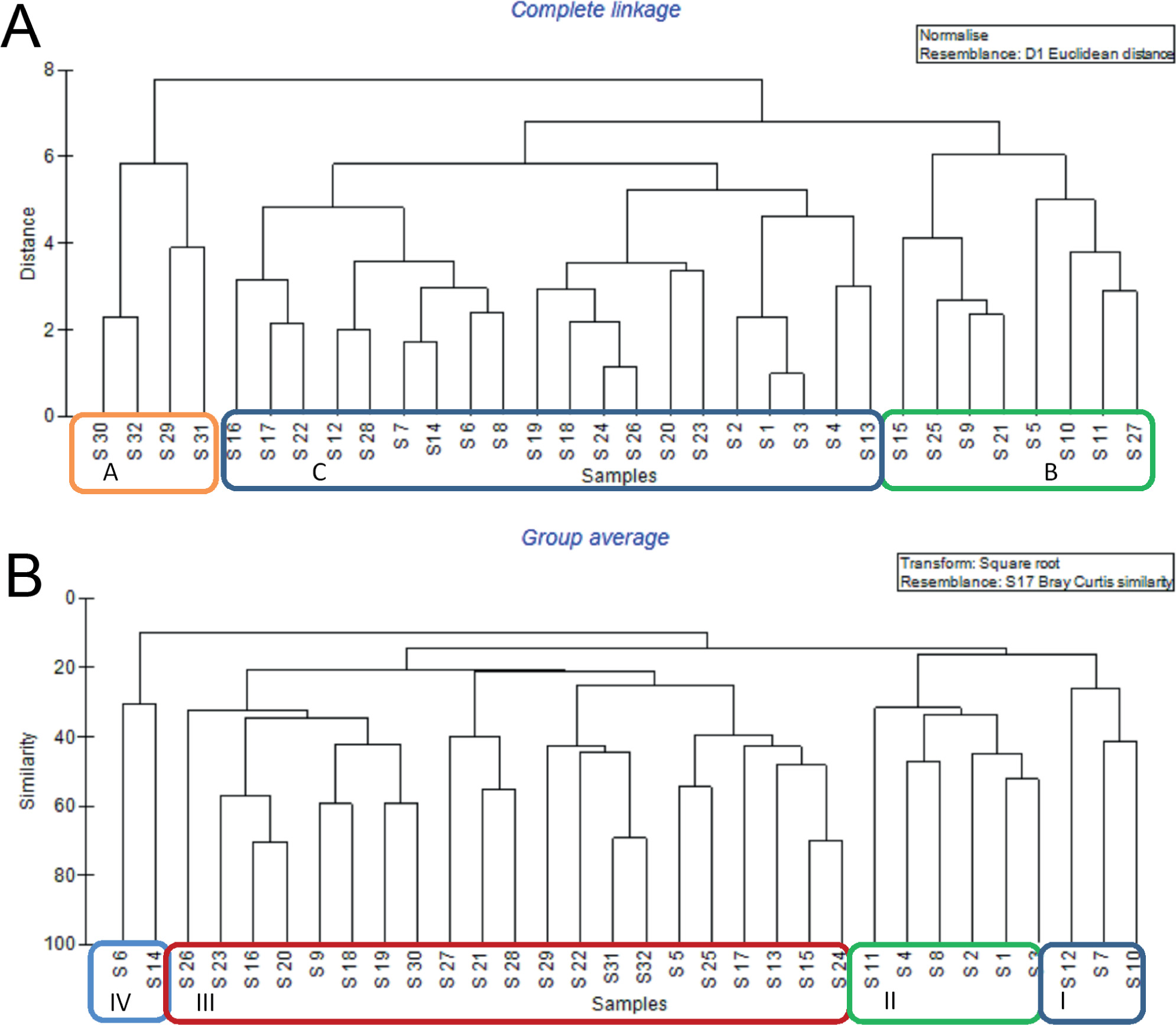
Figure 1
(A) Similarity distance between the sites in groups A, B, and C reflecting environmental characteristics of the investigated springs. (B) Bray-Curtis similarity of water bug assemblages within the investigated springs
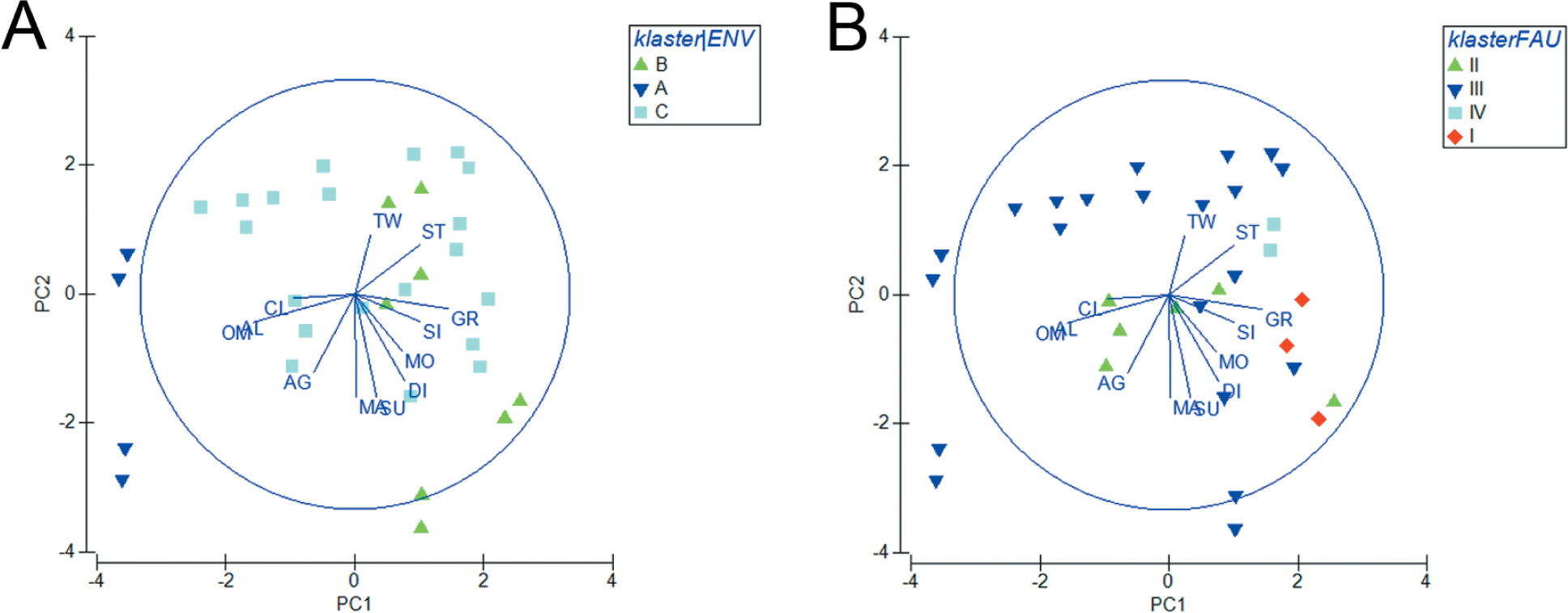
Figure 2
(A) Results of PCA showing environmental characteristics of 32 investigated springs in relation to environmental classification into groups A, B and C. (B) Results of PCA showing environmental characteristics of 32 investigated springs in relation to faunistic classification into groups I, II, II and IV. Abbreviations: TW – water temperature, DI – discharge, SU – spring size, AL – altitude, ST – stones, GR – gravel, SI – sand, CL – clay, OM – organic mud, AG – algae, MO – moss, MA – macrophytes
The assemblages of water bugs from the investigated springs may be divided into four groups (Fig. 1B). The results of PCA (Fig. 2B) showed that species in group I prefer springs with gravel and sandy substrate, enriched with mosses and characterized by a higher discharge. The communities from group IV generally prefer sites with stony bottom.
Table 4 presents taxa mostly associated with each of the site groups and dissimilarity in the taxonomic composition between each of the groups. Sigara lateralis is a characteristic representative of assemblages type I, while Nepa cinerea is characteristic of assemblages type II. Velia sp. and Gerris argentatus are characteristic of springs from group III and IV, respectively. Community groups specified in the biotic site classification (I, II, III, IV) are much better defined, have higher internal similarity and are more dissimilar to each other than assemblages of A, B and C groups distinguished in the environmental site classification (Table 4).
Table 4
Results of SIMPER analysis for aquatic bug assemblages of site groups A, B and C, and site groups I, II, III and IV
| Group A average similarity: 28.98 Group B average similarity: 20.41 Group C average similarity: 15.43 | Groups A and B average dissimilarity = 78.02 Groups A and C average dissimilarity = 85.97 Groups B and C average dissimilarity = 81.84 | Group I average similarity: 29.07 Group II average similarity: 32.48 Group III average similarity: 23.25 Group IV average similarity: 26.67 | Group I and II average dissimilarity = 88.21 Group I and III average dissimilarity = 86.72 Groups I and IV average dissimilarity = 91.10 Groups II and III average dissimilarity = 88.70 Groups II and IV average dissimilarity = 93.80 | ||||||||
|---|---|---|---|---|---|---|---|---|---|---|---|
| Species | Av. Abund. | Av. Sim | Groups III and IV average dissimilarity =92.33 | Contrib. % | Cum % | Species | Av. Abund. | Av. Sim | Sim/SD | Contrib. % | Cum % |
| Group A | Group I | ||||||||||
| Apa | 1.75 | 11.32 | 0.90 | 39.07 | 39.07 | Sla | 3.67 | 21.66 | 1.22 | 74.52 | 74.52 |
| Hpa | 2.25 | 6.15 | 0.80 | 21.22 | 60.29 | Gas | 1.33 | 7.41 | 0.58 | 25.48 | 100 |
| Hst | 1.25 | 4.56 | 0.91 | 15.75 | 76.04 | Group II | |||||
| Ngl | 1.75 | 4.17 | 0.41 | 14.38 | 90.42 | Nci | 3.67 | 16.55 | 2.02 | 50.96 | 50.96 |
| Group B | Sni | 1.33 | 3.22 | 0.70 | 9.93 | 60.89 | |||||
| Ngl | 2.00 | 6.69 | 0.60 | 32.80 | 32.80 | Rli | 1.17 | 2.39 | 0.75 | 7.35 | 68.24 |
| Sla | 1.63 | 5.05 | 0.63 | 24.75 | 57.55 | Hst | 1.17 | 2.21 | 0.75 | 6.80 | 75.04 |
| Vaf | 1.13 | 2.72 | 0.41 | 13.35 | 70.90 | Hli | 1.67 | 1.72 | 0.48 | 5.28 | 80.32 |
| Ana | 0.88 | 2.26 | 0.49 | 11.10 | 82.00 | Ana | 1.17 | 1.65 | 0.45 | 5.07 | 85.40 |
| Hst | 0.75 | 1.46 | 0.34 | 7.17 | 89.17 | Pmi | 1.00 | 0.99 | 0.45 | 3.06 | 88.46 |
| Nma | 0.63 | 0.68 | 0.19 | 3.33 | 92.50 | Ici | 1.50 | 0.99 | 0.26 | 3.04 | 91.50 |
| Group C | Group III | ||||||||||
| Vaf | 1.00 | 2.86 | 0.38 | 18.52 | 18.52 | Vaf | 1.48 | 6.79 | 0.65 | 29.20 | 29.20 |
| Hst | 0.95 | 1.93 | 0.41 | 12.52 | 31.03 | Hgl | 1.43 | 4.00 | 0.43 | 17.21 | 46.41 |
| Ana | 0.80 | 1.39 | 0.28 | 9.03 | 40.07 | Hst | 0.95 | 2.24 | 0.40 | 9.65 | 56.06 |
| Sfa | 0.85 | 1.38 | 0.32 | 8.93 | 48.99 | Ana | 0.76 | 1.78 | 0.30 | 7.66 | 63.73 |
| Nma | 0.80 | 1.14 | 0.27 | 7.40 | 56.39 | Sla | 0.76 | 1.73 | 0.35 | 7.46 | 71.19 |
| Nci | 1.00 | 0.95 | 0.26 | 6.18 | 62.56 | Apa | 0.76 | 1.60 | 0.31 | 6.88 | 78.06 |
| Ngl | 0.70 | 0.93 | 0.22 | 6.01 | 68.58 | Nma | 0.67 | 1.44 | 0.31 | 6.18 | 84.25 |
| God | 0.70 | 0.91 | 0.22 | 5.87 | 74.45 | God | 0.81 | 1.24 | 0.26 | 5.32 | 89.60 |
| Sla | 0.70 | 0.82 | 0.20 | 5.34 | 79.79 | Sfa | 0.48 | 0.89 | 0.26 | 3.83 | 93.43 |
| Cpu | 0.50 | 0.58 | 0.16 | 3.79 | 83.58 | Group IV | |||||
| Gar | 0.35 | 0.54 | 0.17 | 3.48 | 87.06 | Gar | 2 | 26.67 | / | 100 | 100 |
| Rli | 0.45 | 0.38 | 0.22 | 2.44 | 89.50 | ||||||
| Hli | 0.70 | 0.36 | 0.17 | 2.35 | 91.84 | ||||||
ANOVA showed significant differences (F=5.442 p=0.004) for species richness between assemblages of water bugs from site groups I, II, III and IV. Assemblages of type II (mean 7.3, SD 1.0) were characterized by the highest diversity and were followed by assemblages of type III (mean 4.5, SD 1.35), type I (mean 4.0, SD 1.0 and type IV (mean 3.0, SD 1.41).
One-way ANOVA was used to confirm significant differences in species richness (F=11.031 p=0.000) between the spring types (sublacustrine, limnocrene and rheocrene springs). The LSD analysis revealed that sublacustrine springs significantly differ (p=0.000 and p=0.001, respectively) from the two other types of springs, while no significant differences were found between rheocrene and limnocrene springs (p=0.512).
The results of CCA analysis (Fig. 3) summarize the main relationship between aquatic bugs and the environment. Axis 1 and axis 2 explained 25.5% and 18.8% of the total variance, respectively. The environmental factors which significantly influence the communities are spring size (explaining 53.88% and 2.16% of the variation on Axis 1 and 2, respectively), discharge (41.73% and 8.76%, respectively) and water temperature (26.73% and 35.52%, respectively).
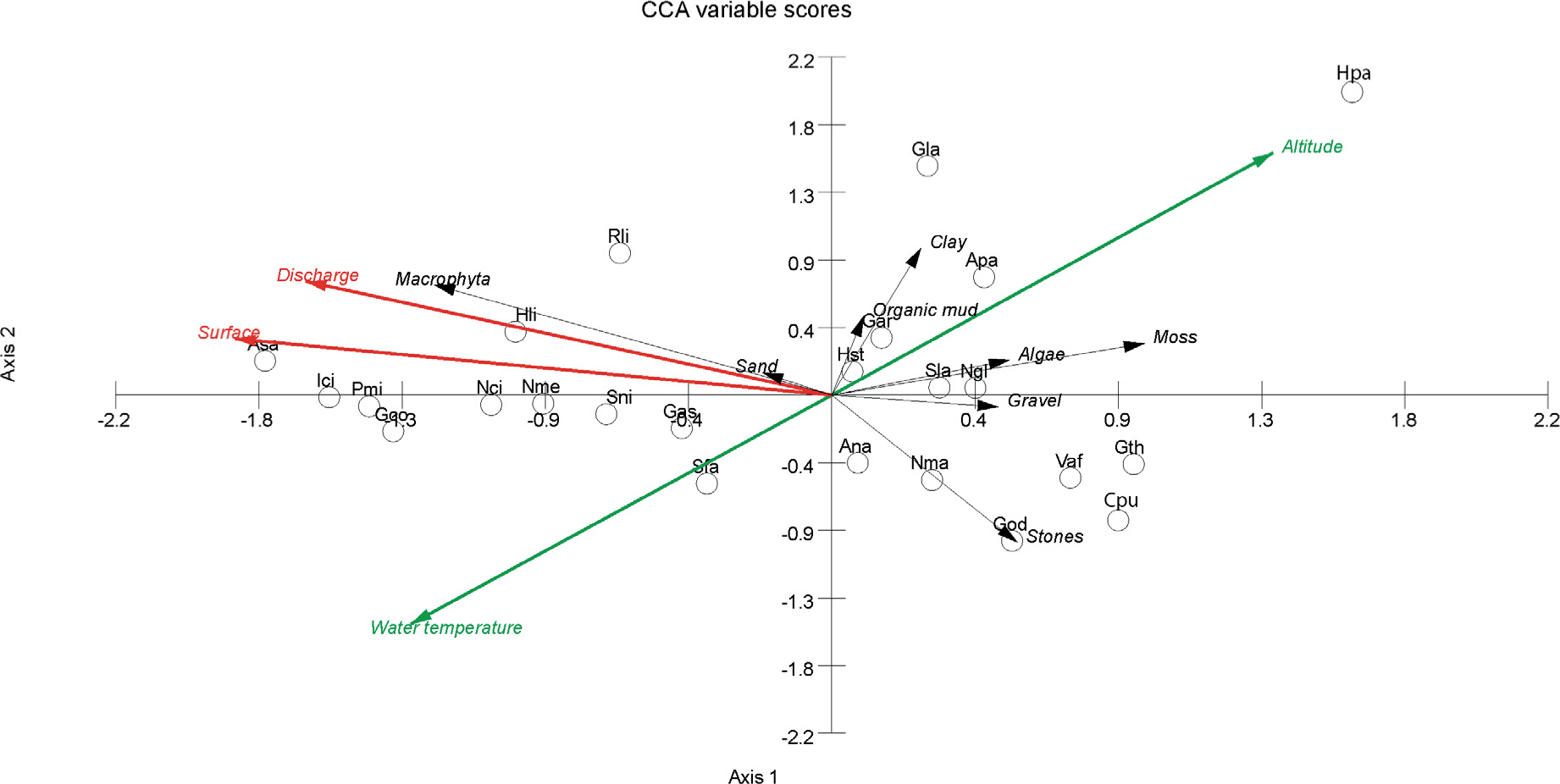
Figure 3
CCA biplot of species and environmental variables based on 32 investigated springs
Axis 1 was positively correlated with the percentage of mosses and algae and negatively correlated with the spring size, discharge and the percentage of macrophytes. Axis 2 was positively correlated with the altitude, and negatively correlated with the water temperature (Fig. 3).
Discussion
Aquatic and semiaquatic Heteroptera are an important component of the spring biocenosis. With some exceptions (e.g. Grandova 2014), however, species composition and spatial patterns of water bugs in the springs have not been previously researched. A total of 25 taxa were recorded in 32 springs situated in the central part of Montenegro. This level of diversity is comparable to that reported by Grandova (2014) in springs of the Ukrainian steppe zone (20 species).
The result of our study showed that the fauna of water bugs in the investigated springs is relatively diverse but the widespread polytopic species (H. stagnorum, N. glauca and S. lateralis) dominated. However, we could observe some differences in the distribution maxima in different types of spring habitats, even with those common species. Sigara lateralis dominated in the assemblages of type I, where 74.52% of the individuals of this species were observed. Our study in the central part of Montenegro revealed that environmental and faunistic classification of springs based on water bug communities may not correspond with each other. According to environmental characteristics, springs were divided into three groups, while communities of aquatic bug species divide the sites into four groups. The environmental classification indicates anthropogenic impact on the spring habitats. Group C includes springs which are under a strong anthropogenic influence, especially springs S18-S20 and S22-S24 which are piped (spring water emerging from an artificial pipe) and situated in a village. Springs of group A are located at a higher altitude on the muddy bottom, and their water is not used intensively. Olosutean & Ilie (2010b) proved that the lack of anthropogenic activities favors a heterogeneous community of aquatic bug species.
Our study showed that community groups of water bugs specified in the biotic classification of spring habitats are much better defined than the assemblages distinguished in the environmental site classification. It is worth mentioning that our study focused on the factors directly affecting the water bugs in the aquatic environment. However, the formation of water bug assemblages is also affected by other factors (e.g. the type and structure of landscape, geographical location and proximity of nearby sources of immigrants) acting in the terrestrial environment and this can cause a discrepancy in the grouping of sites based on the environmental and faunistic data.
Assemblage I dominated by corixid Sigara lateralis seems to be characteristic of large karstic lowland springs (S 12, S7, S10) with stony substrate, enriched with moss. According to Hufnagel et al. (1999), the corixids Sigara falleni and S. lateralis are characteristic of deeper water bodies. On other hand, communities of type II, characterized by the highest species richness, show preference for limnocrene and sublacustrine springs enriched with muddy substrate and with moderately dense vegetation. Such water bodies were also characterized by relatively higher water temperature.
The preference by most water bugs for sites enriched with muddy substrate and/or dense shoreline vegetation may be explained by the greater possibility of finding hiding places (Skern et al. 2010). Nepa cinerea favors shaded habitats with moderately dense vegetation and submerged branches (Peták et al. 2014). According to Hufnagel et al. (1999), the latter species with Hydrometra stagnorum and Geris lacustris forms an eco-group characteristic of small shallow sites, which is confirmed by CCA results of our study. Skern et al. (2010) indicate that H. stagnorum and G. lacustris have a preference for low macrophyte cover and higher cover of shoreline plants. The stony substrate also favors Gerris lacustris (see: Olosutean, Ilie 2010a).
The results of CCA showed that the first axis is most significantly determined by the spring size, indicating that this factor is the main driver of biotic diversity of water bugs in springs. The importance of dimensions of water bodies in the determination of the spatial pattern of water bug communities was mentioned by several authors (e.g. Macan 1954; Hufnagel et al. 1999; Skern et al. 2010). In our study, spring size reveals a strong gradient along the first axis for the species (Anisops sardeus, Ilyocoris cimicoides, Plea minutissima) that prefer larger water bodies. This is consistent with the studies on water bug communities in lotic and lentic waters, which showed that some species (e.g. Ranatra linearis, Ilyocoris cimicoides, Plea minutissima group) favor large and deep water bodies (Hufnagel et al. 1999).
The variability of assemblages along the second axis is mainly determined by the altitude and temperature. Species richness of water bugs tends to increase from uplands to mountain elevations (Tully et al. 1991). In our study, we did not find a significant correlation between the altitude and species richness of water bugs in the investigated springs. CCA indicates that Hesperocorixa parallela is associated with springs at higher elevation situated on the shore of mountain lakes.
PCA showed that water temperature varies within assemblage types. Temperature is often associated with other factors such as spring size and shading by aquatic and/or riparian vegetation and might have indirect impact on water bug communities. Shallow water has a relatively higher temperature, while shading can reduce water temperature (Moosmann et al. 2005).
Our study showed that the species-richest springs were sublacustrine springs, followed by limnocrenes and rheocrenes. In the study by Grandova (2014), limnocrenes were the richest in species, fewer species were found in rheocrenes, while helocrenes were sparsely populated. The results of our study revealed that sublacustrine springs exhibited significantly higher diversity in terms of species richness. However, we did not observed significant statistical differences between limnocrenes and rheocrenes. This may suggest that the type of springs is not an important factor determining the species richness of water bugs in springs or its influence is masked by other factors, including the human impact.