
Table 1
Environmental conditions and food resources during experiments carried out in highly eutrophic Lake Gardno. Mean values for the incubation of whole water and 20% dilution were calculated for bacterial and flagellate abundances (see Materials and Methods). In the case of chlorophyll a concentration, values for whole water and 10-μm filtrates are provided, because only such small algae (up to 10 μm) represented the available food resource for the ciliates studied.
| Experiment | Temp.(°C) | Salinity(PSU) | Ciliates(cells ml1) | Chlorophyll a (μg l-1) | Bacteria (106 cells ml1) | Nanoflagellates (103 cells ml1) | ||||
|---|---|---|---|---|---|---|---|---|---|---|
| whole water | 10-μm filtrate | whole water | 20% dilution | whole water | 20% dilution | |||||
| 21–22/09/2011 | midnight | 15.6 | 0.59 | 67.3 | 60.9 | 7.03 | 7.04 | 5.22 | 18.7 | 11.2 |
| 22/09/2011 | noon | 15.4 | 0.67 | 42.2 | 61.9 | 6.28 | 5.89 | 3.26 | 19.3 | 16.9 |
| 13/06/2012 | noon | 20.0 | 0.92 | 118 | 50.3 | 9.17 | 8.76 | 7.87 | 20.3 | 14.6 |
| 13–14/06/2012 | midnight | 21.1 | 0.84 | 119 | 33.8 | 6.89 | 9.76 | 9.14 | 16.0 | 12.8 |
| 28–29/06/2013 | midnight | 18.4 | 0.17 | 307 | 45.3 | 7.58 | 16.4 | 14.9 | 18.1 | 15.5 |
| 29/06/2013 | noon | 18.2 | 0.18 | 423 | 46.8 | 8.69 | 12.7 | 10.7 | 16.6 | 15.4 |
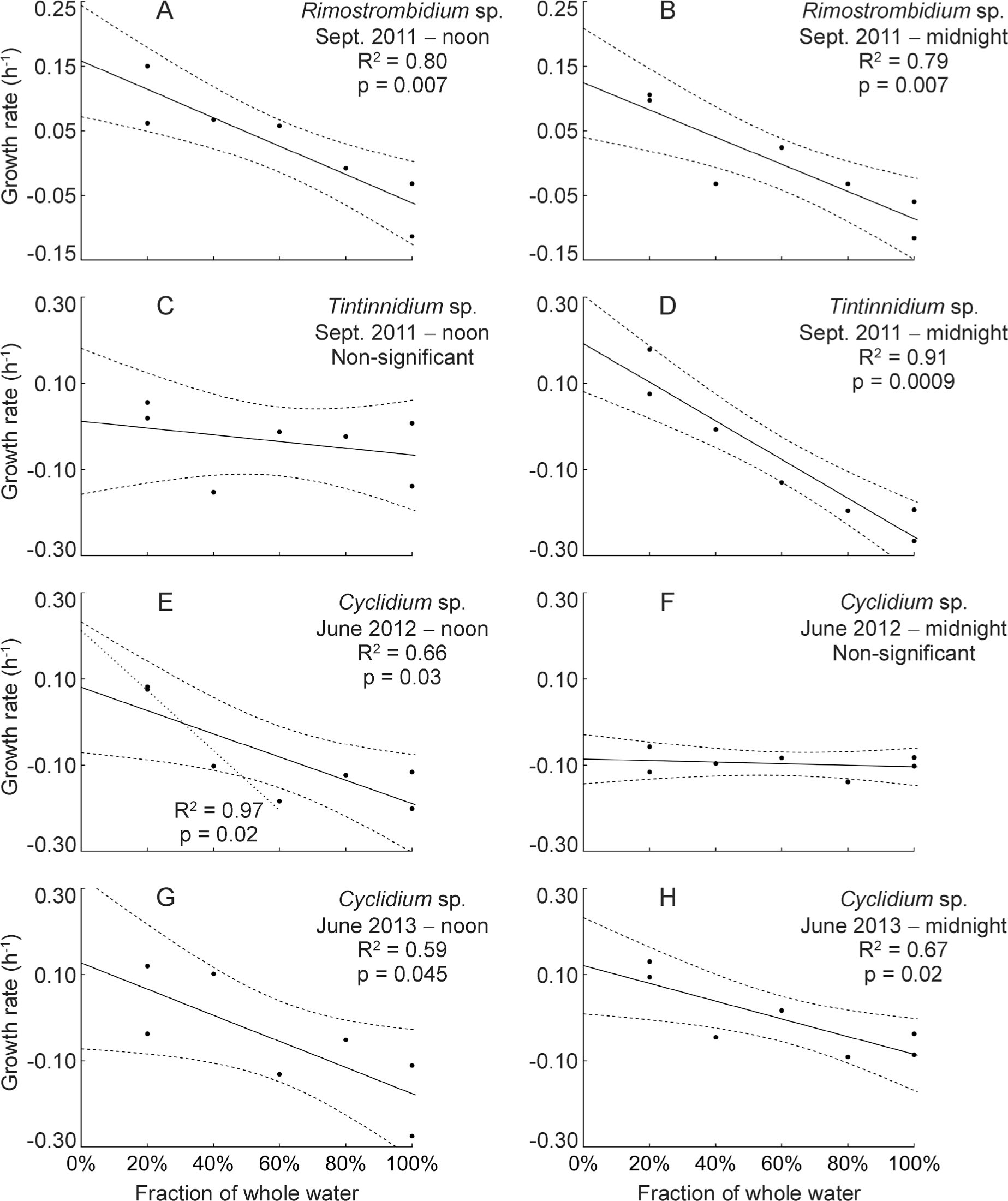
Figure 1
Growth responses of ciliates to gradual dilution observed during approx. 4 hours of incubation performed around noon and midnight on three occasions in Lake Gardno. Through dilution, grazing pressure decreased toward zero and the apparent growth rate approximates the specific growth rate (y-intercept). The date of the experiments and statistical significances are depicted on the graphs. The dashed line represents the 95% confidence interval. In the experiment with Cyclidium sp. performed around noon in June 2012 (E), the grazing pressure was relaxed only in more diluted treatments, thus the additional grazing curve was plotted for 20–60% dilutions (dotted line) that demonstrated higher statistical significance.
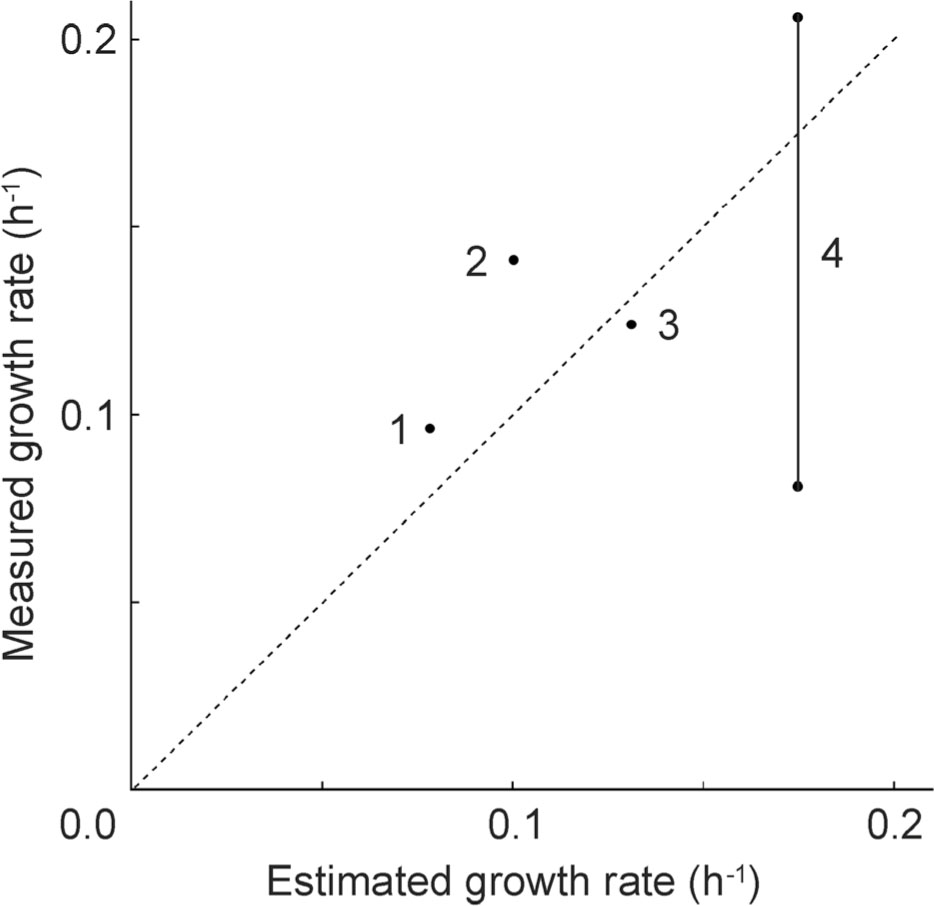
Figure 2
Mean diel growth rates versus growth rates estimated with the allometric equation according to Müller & Geller (1993): (1) Tintinnidium sp., (2) Rimostrombidium sp., (3) Cyclidium sp. in June 2013, (4) Cyclidium sp. in June 2012 (noon only, range of growth rates estimated with two methods of analysis (Fig. 1E). The dashed diagonal represents a 1:1 relationship.