
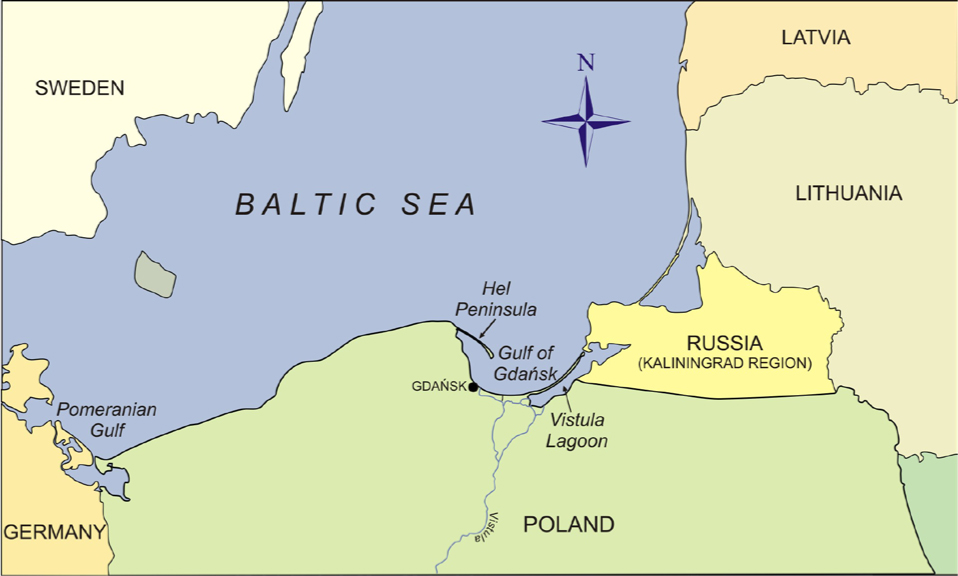
Figure 1
Location of the Hel Peninsula in the Baltic Sea
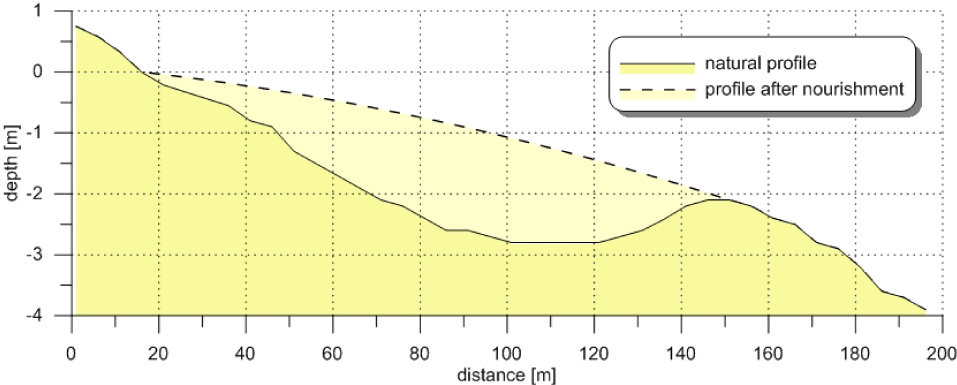
Figure 2
The nearshore part of the cross-shore profile at the Hel Peninsula
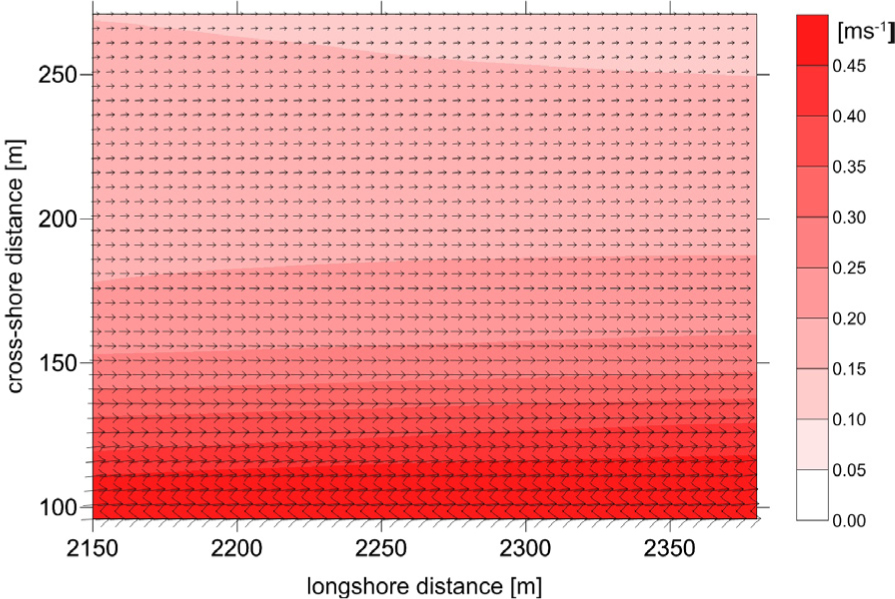
Figure 3
Calculated depth-averaged flow velocities for the natural nearshore zone (without groins) in moderate storm conditions (Hs=1 m, Tp=4 s, α=45°)
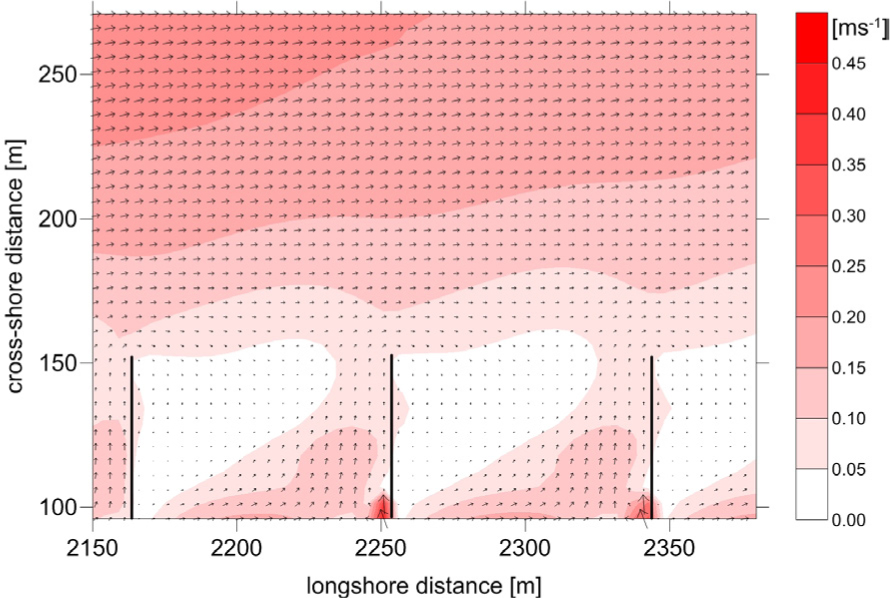
Figure 4
Calculated depth-averaged flow velocities for full length groins in moderate storm conditions (Hs=1 m, Tp=4 s, α=45°)
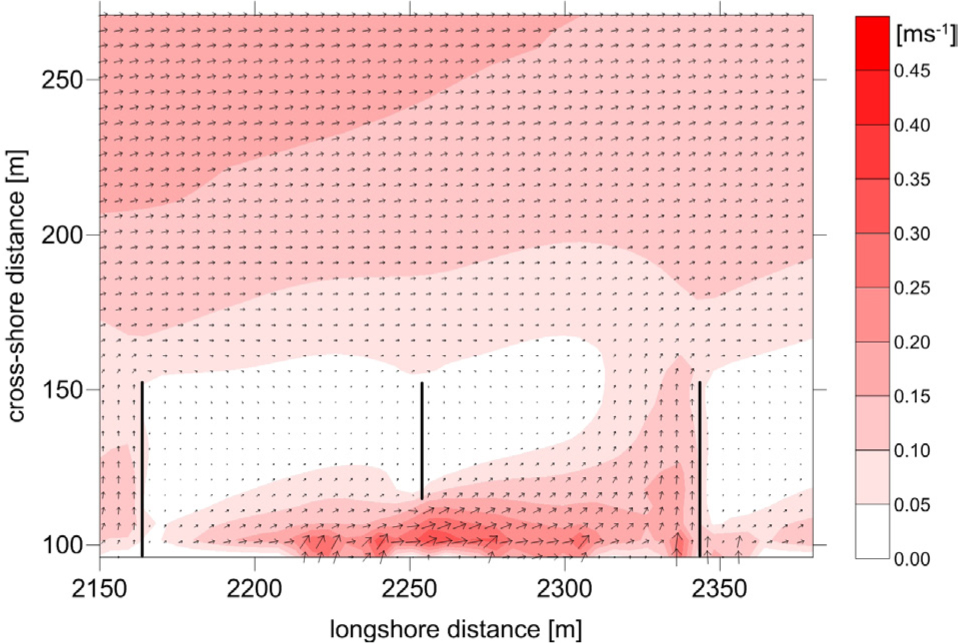
Figure 5
Calculated depth-averaged flow velocities for a groin separated from the shoreline in moderate storm conditions (Hs=1 m, Tp=4 s, α=45°)
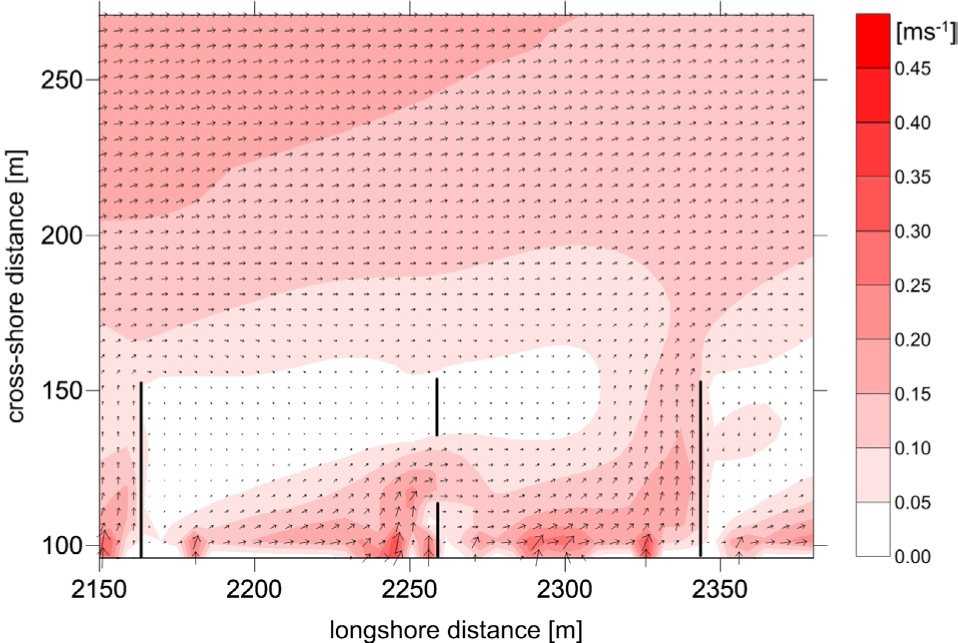
Figure 6
Calculated depth-averaged flow velocities for a groin with a breach about its central part in moderate storm conditions (Hs=1 m, Tp=4 s, α=45°)
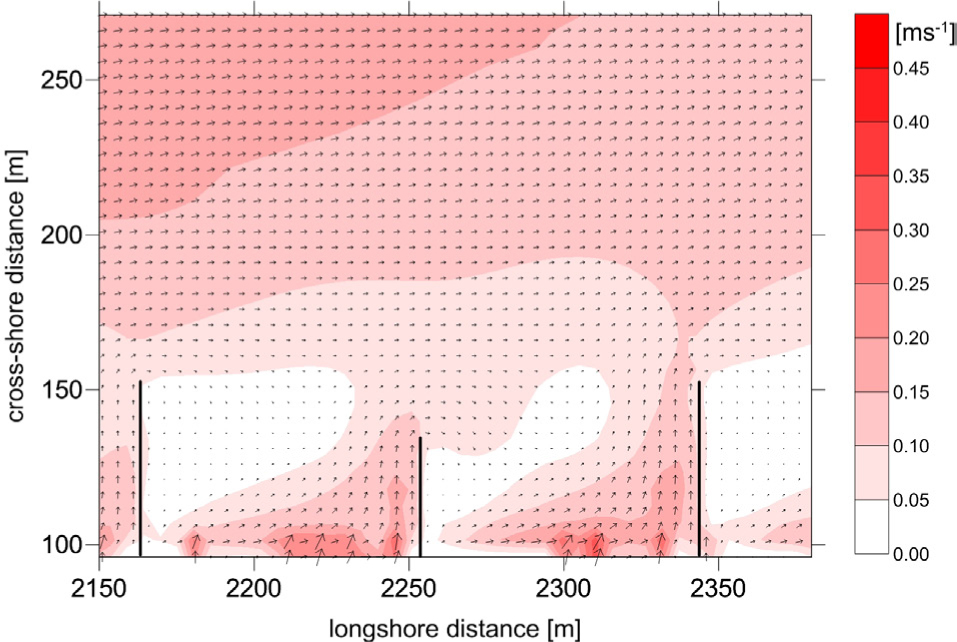
Figure 7
Calculated depth-averaged flow velocities for a groin with missing piles at its end in moderate storm conditions (Hs=1 m, Tp=4 s, α=45°)
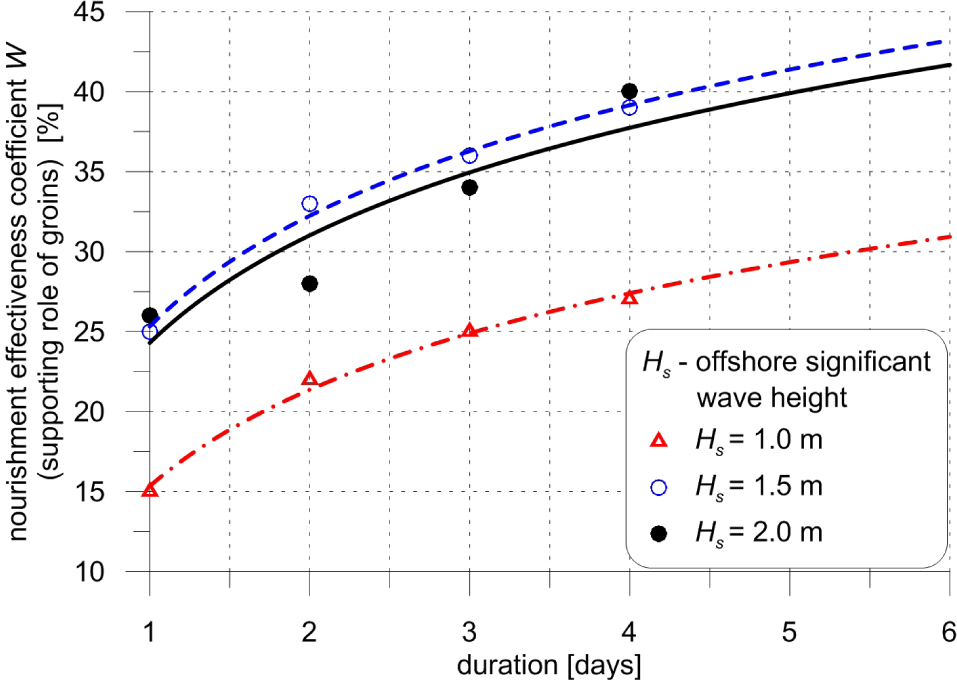
Figure 8
Coefficient W, representing the supporting role of groins in artificial shore nourishment, as a function of time for various offshore wave heights
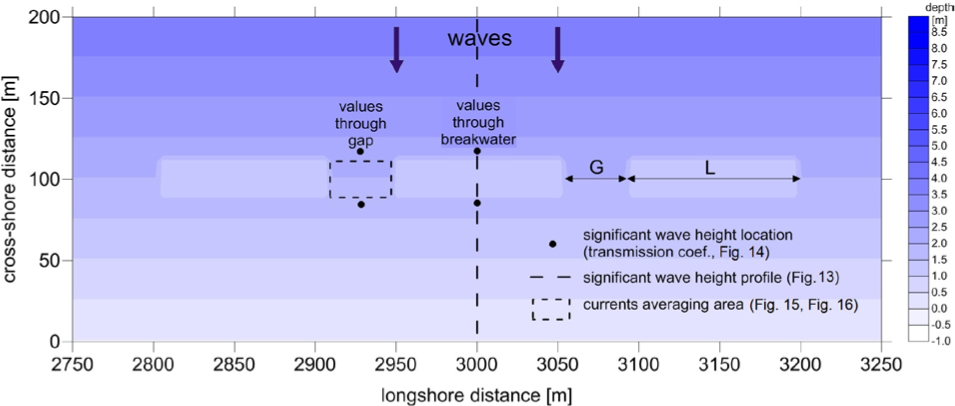
Figure 9
Layout of submerged breakwaters in the nearshore zone (L – breakwater segment length, G – gap length)
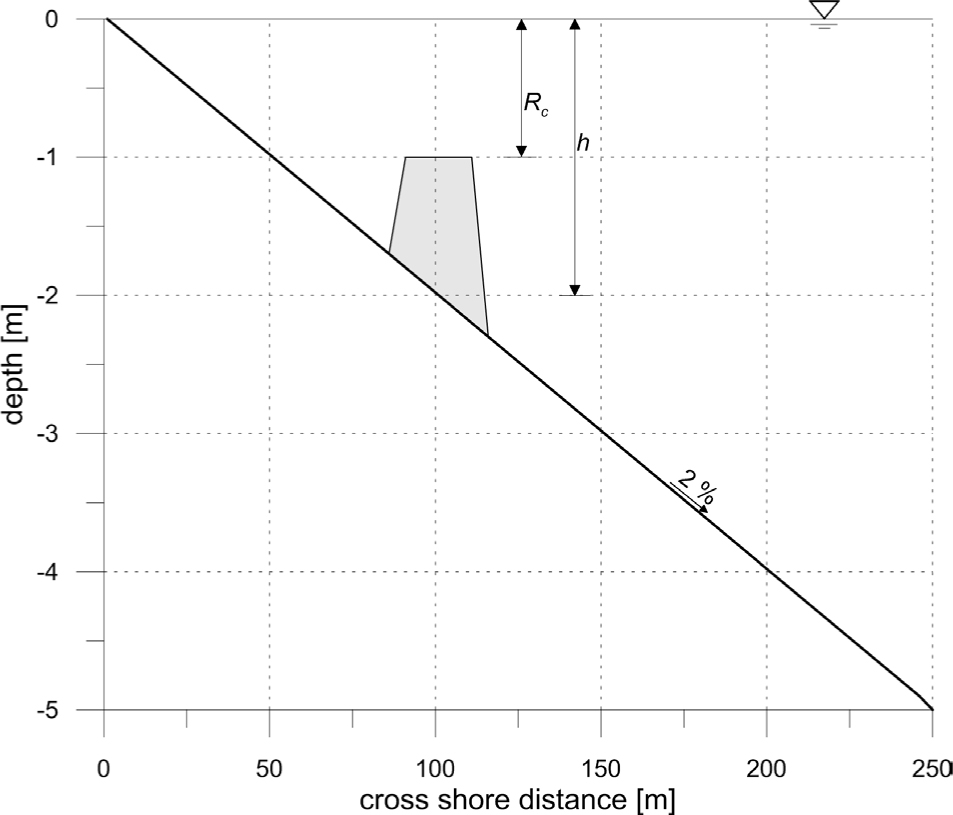
Figure 10
Cross-section of nearshore sea bottom with a submerged breakwater (Rc – water depth at a breakwater crest).
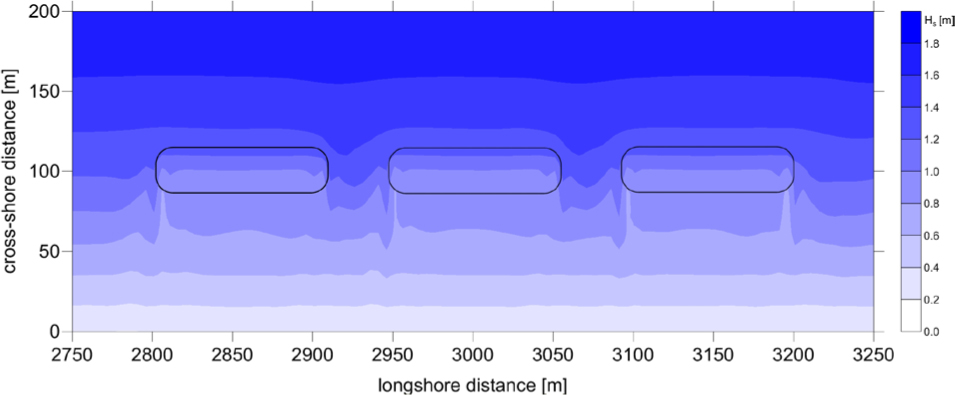
Figure 11
Calculated significant wave heights near submerged breakwaters for Rc/h=0.2 and L/G=2.63 (Hs=2 m, Tp=5.5 s, α=90°)
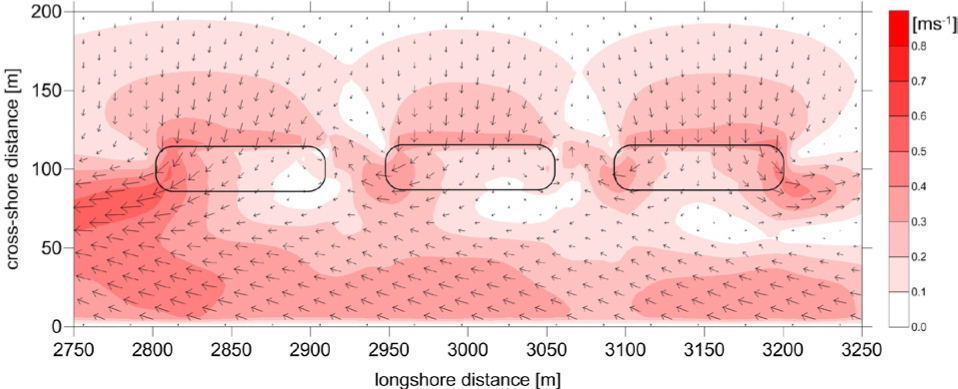
Figure 12
Calculated flow velocities near submerged breakwaters for Rc/h=0.2 and L/G=2.63 (Hs=2 m, Tp=5.5 s, α=90°)
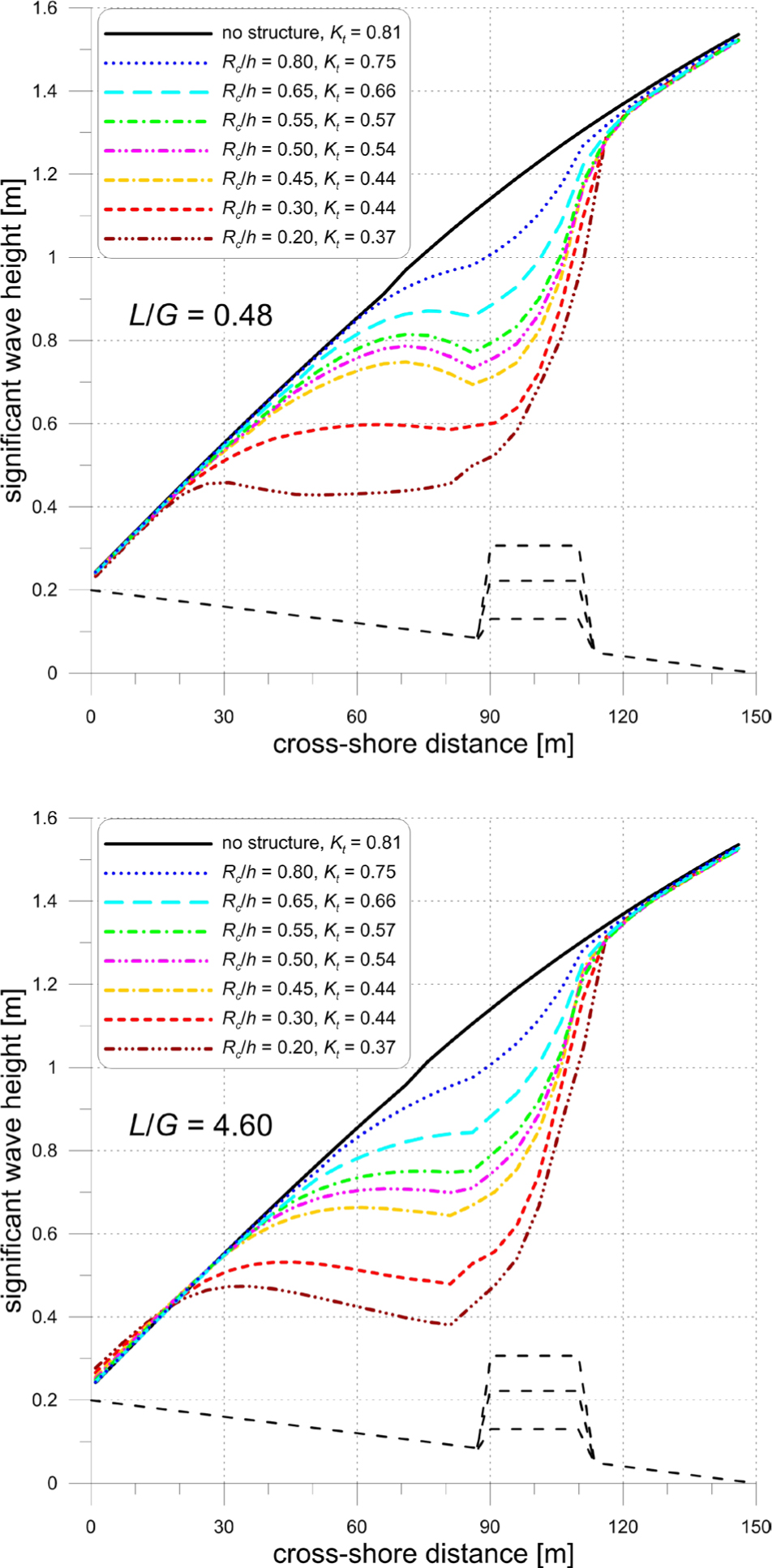
Figure 13
Calculated wave heights at different distances from the shoreline for L/G=0.48 (up) and L/G=4.6 (down) as curves corresponding to various ratios Rc/h resulting in various transmission coefficients Kt (bottom dashed lines indicate location of a breakwater and symbolize variability of its height); Hs=2 m, Tp=5.5 s, α=90°
Table 1
Coefficients (a and b) and goodness (R2) of linear approximation of the transmission coefficient Kt using the Rc/h ratio for various L/G values and for general approximation
| L/G | 0.48 | 0.70 | 1.00 | 1.50 | 2.00 | 2.63 | 3.14 | 3.67 | 3.83 | 4.60 | 4.80 | General |
|---|---|---|---|---|---|---|---|---|---|---|---|---|
| A | 0.627 | 0.616 | 0.644 | 0.675 | 0.717 | 0.712 | 0.717 | 0.715 | 0.704 | 0.706 | 0.702 | 0.686 |
| B | 0.253 | 0.248 | 0.227 | 0.205 | 0.178 | 0.180 | 0.171 | 0.178 | 0.180 | 0.183 | 0.180 | 0.198 |
| R2 | 0.997 | 1.000 | 0.997 | 0.995 | 0.994 | 0.995 | 0.996 | 0.995 | 0.997 | 0.996 | 0.998 | 0.987 |
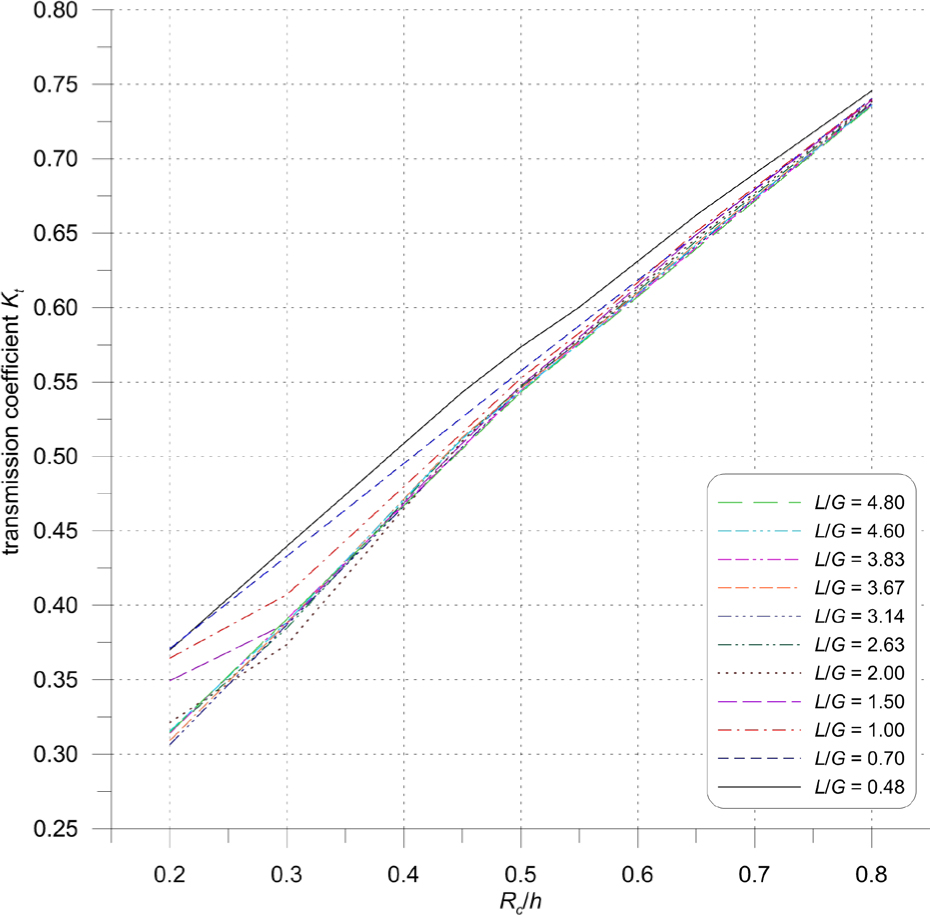
Figure 14
Calculated transmission coefficients Kt as functions of Rc/h for various L/G ratios (Hs=2 m, Tp=5.5 s, α=90°)
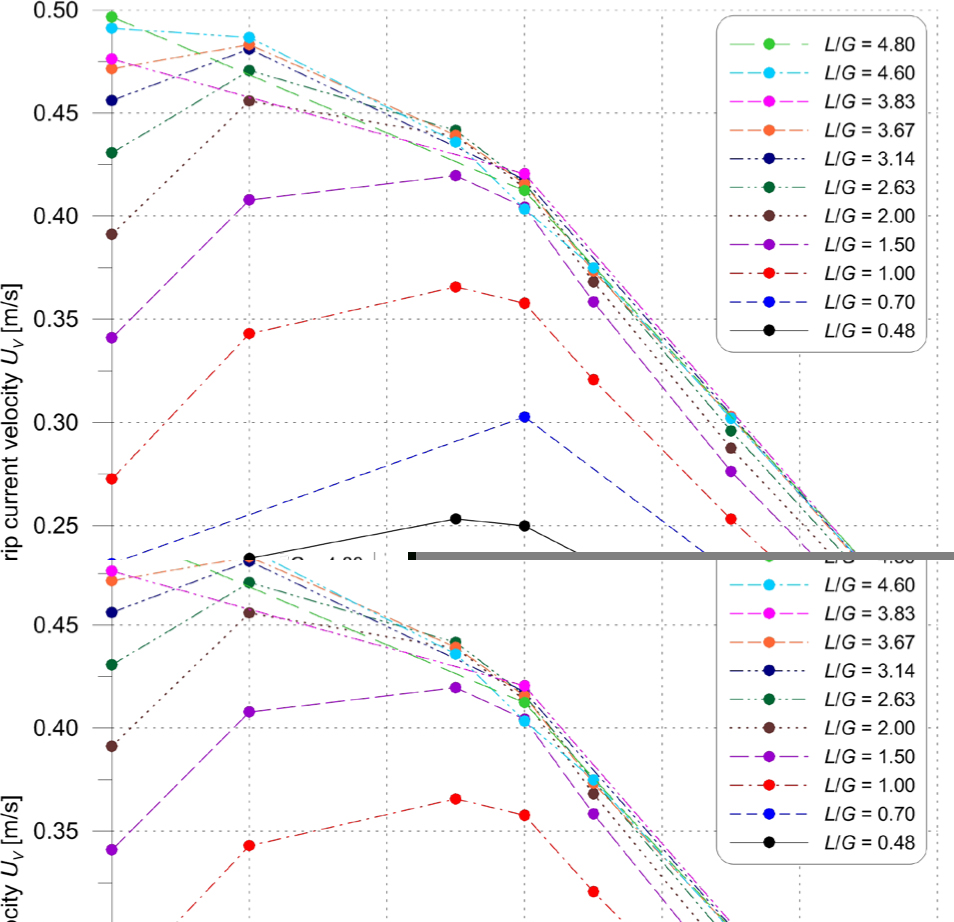
Figure 15
Calculated rip current velocities as functions of Rc/h for various L/G ratios (Hs=2 m, Tp=5.5s, α=90°)
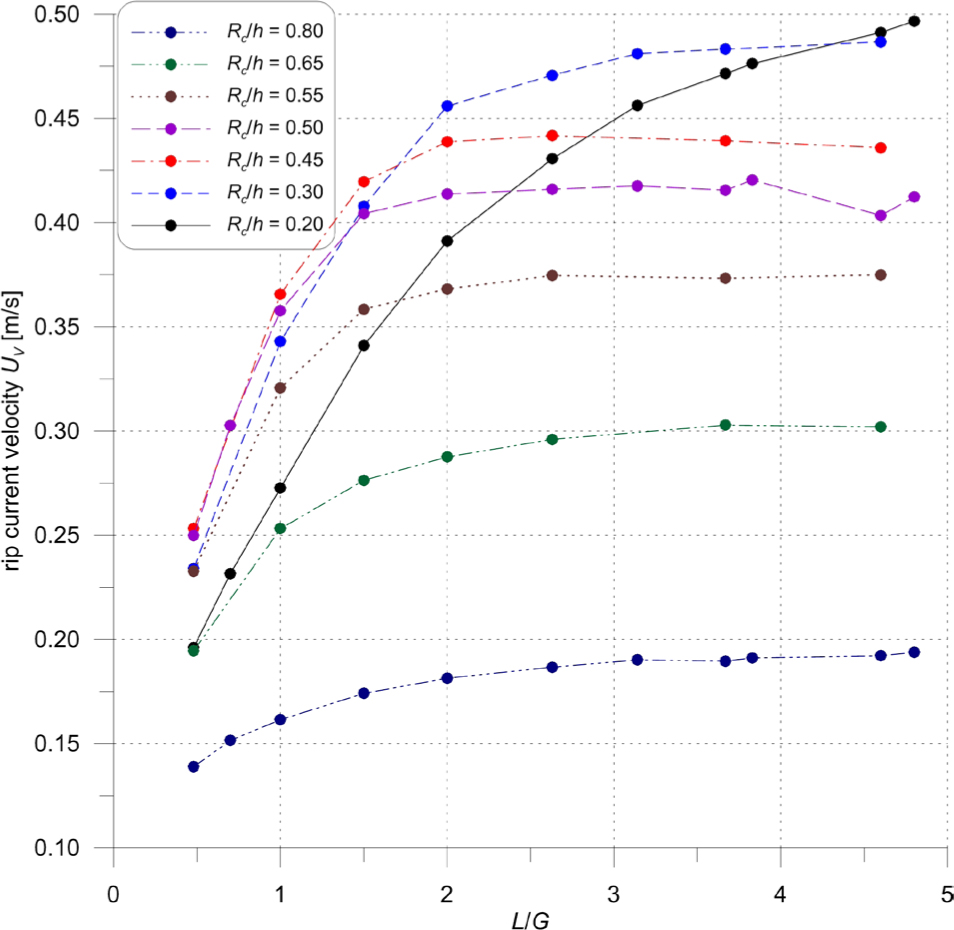
Figure 16
Calculated rip current velocities as functions of L/G for various Rc/h ratios (Hs=2m, Tp=5.5s, α=90°)
Table 2
Coefficients (A, B and C) and goodness (R2) of approximation (Eq. 3) of rip current velocity UV using the L/G ratio for various Rc/h quantities
| Rc/h | 0.20 | 0.30 | 0.45 | 0.50 | 0.55 | 0.65 | 0.80 |
|---|---|---|---|---|---|---|---|
| A | 0.388 | 0.384 | 0.370 | 0.356 | 0.281 | 0.175 | 0.074 |
| B | 0.117 | 0.104 | 0.071 | 0.059 | 0.094 | 0.126 | 0.118 |
| C | 0.432 | 0.732 | 1.118 | 1.228 | 1.131 | 0.881 | 0.660 |
| R2 | 1.000 | 0.999 | 0.997 | 0.992 | 0.999 | 0.996 | 0.996 |
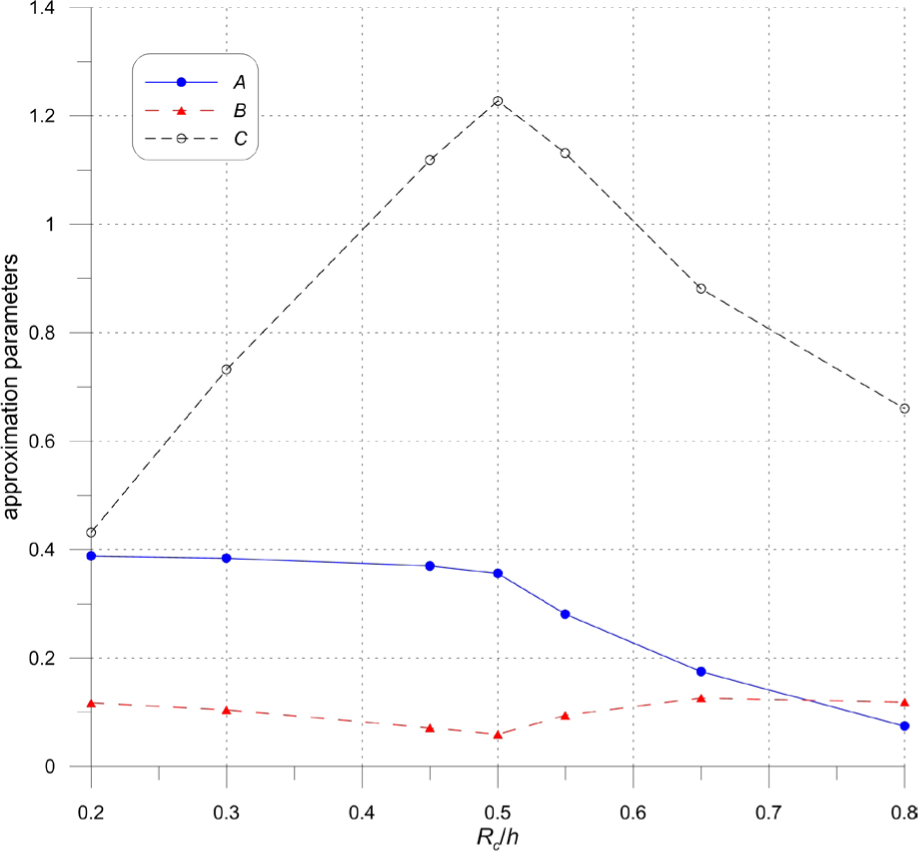
Figure 17
Calculated coefficients A, B and C as functions of Rc/h