
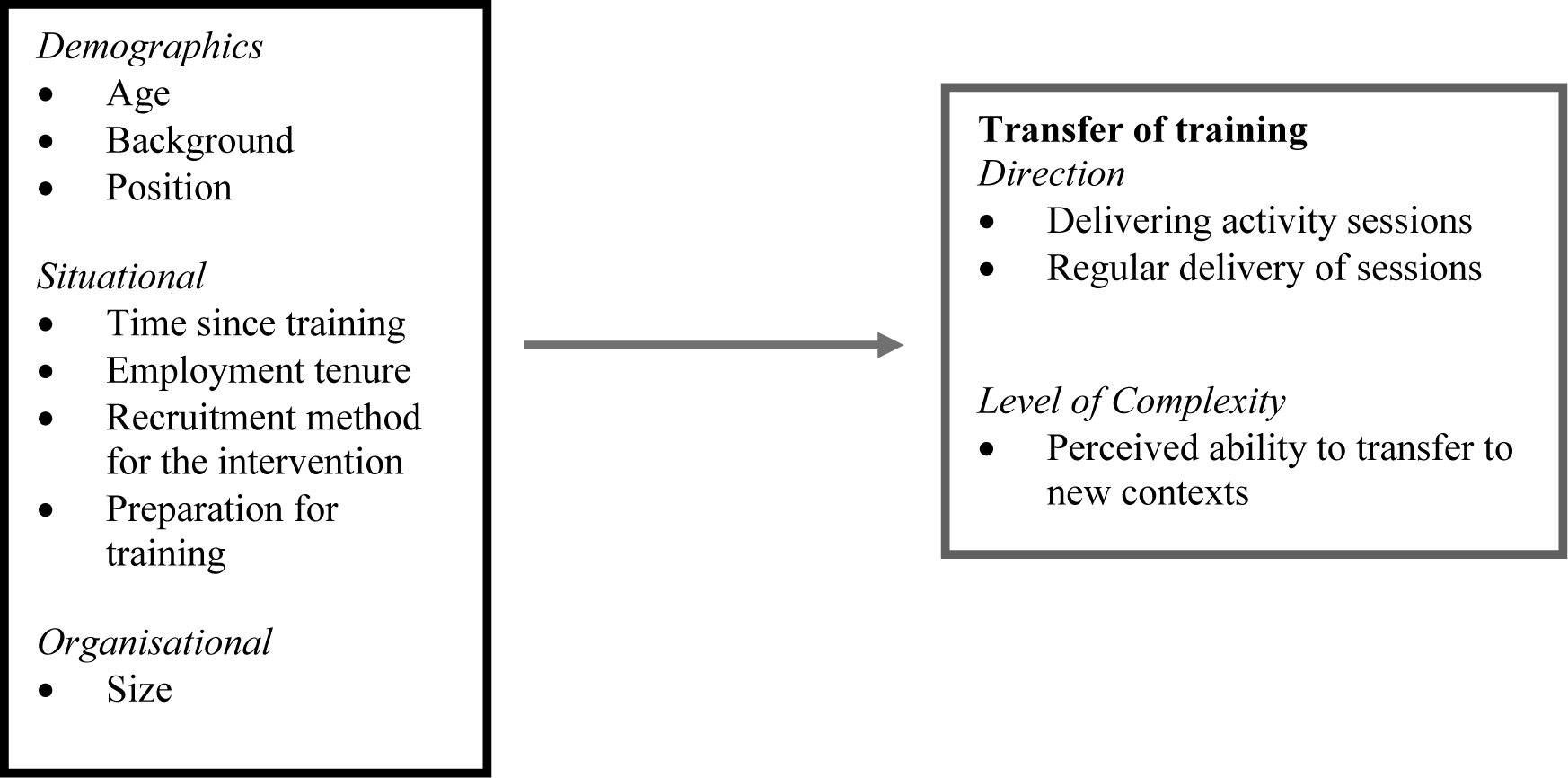
Figure 1
Model depicting the independent and dependent variables explored
Table 1
Ranges and mean scores for age, employment tenure and organisation size
| Variable | N. | Minimum | Maximum | Mean | Standard Deviation (S. D) |
|---|---|---|---|---|---|
| Age | 109 | 27 | 69 | 49.1 | 7.9 |
| Employment Tenure | 120 | 3 | 37 | 13.1 | 7.6 |
| Organisation Size | 96 | 8 | 420 | 57.9 | 64.6 |
Table 2
Sub groups for the independent variables: age, employment tenure, time since training, position, recruitment method and organisation size
| Variable | Groups | Description | N. | Frequency % |
|---|---|---|---|---|
| Age | Gr. 1 | 20-39 Years | 13 | 11.9 |
| Gr. 2 | 40-49 years | 45 | 41.3 | |
| Gr. 3 | 50+ years | 51 | 46.8 | |
| Employment tenure | Gr.1 | Up to 10 years | 61 | 50.8 |
| Gr. 2 | 11 – 20 years | 39 | 32.5 | |
| Gr. 3 | 21+ years | 20 | 16.7 | |
| Time since training | Gr. 1 | Up to 2 years | 21 | 16.9 |
| Gr. 2 | 2-3 years | 25 | 20.2 | |
| Gr. 3 | 3-4 years | 20 | 16.1 | |
| Gr. 4 | 4-5 years | 36 | 29 | |
| Gr. 5 | 5+ years | 22 | 17.7 | |
| Time since training – Re-coded for regression analysis | Gr. 1 | 6 -36 months | 46 | 37.1 |
| Gr. 2 | 37 -60 months | 88 | 62.9 | |
| Position | Gr. 1 | Activity co-ordinators and physiotherapy assistants | 35 | 30.5 |
| Gr. 2 | HCAs, nurses and others | 80 | 69.5 | |
| Recruitment method | Volunteered | 27 | 23.7 | |
| Approached by management | 87 | 76.3 | ||
| Organisation size | < 50 residents | 58 | 60.4 | |
| 50+ residents | 38 | 39.6 | ||
Table 3
Significant associations between independent variables and training transfer – direction
Table 4
Logistical regression analysis predicting likelihood of reporting delivery and regular delivery of activity sessions – summary of top indicators
| Logistical regression predicting employee delivery of activity sessions (yes or no) | ||||||||
|---|---|---|---|---|---|---|---|---|
| Independent variables | B | SE | Wald | df | p | 0R | 95% of CI for OR | |
| Lower | Higher | |||||||
| Age | −.038 | .045 | .737 | 1 | .390 | .962 | .881 | 1.051 |
| Background | −.293 | .646 | .206 | 1 | .650 | .764 | .210 | 2.648 |
| Employment position | 2.872 | 1.102 | 6.779 | 1 | .009** | 17.670 | 2.034 | 153.497 |
| Years employed | −.051 | .037 | 1.096 | 1 | .167 | .950 | .883 | 1.022 |
| Logistical regression predicting employee delivery of activity sessions regularly | ||||||||
| Independent variables | B | SE | Wald | df | p | 0R | 95% of CI for OR | |
| Lower | Higher | |||||||
| Background | .959 | .723 | 1.758 | 1 | .185 | 2.609 | .632 | 10.772 |
| Employment position | 1.567 | .848 | 3.415 | 1 | .065 | 4.791 | .909 | 25.239 |
| Preparation | .988 | 1.066 | .859 | 1 | .354 | 2.685 | .333 | 21.683 |
| Time since training | .902 | .663 | 1.854 | 1 | .173 | 2.465 | .673 | 9.029 |
Note: * = p < .05;