

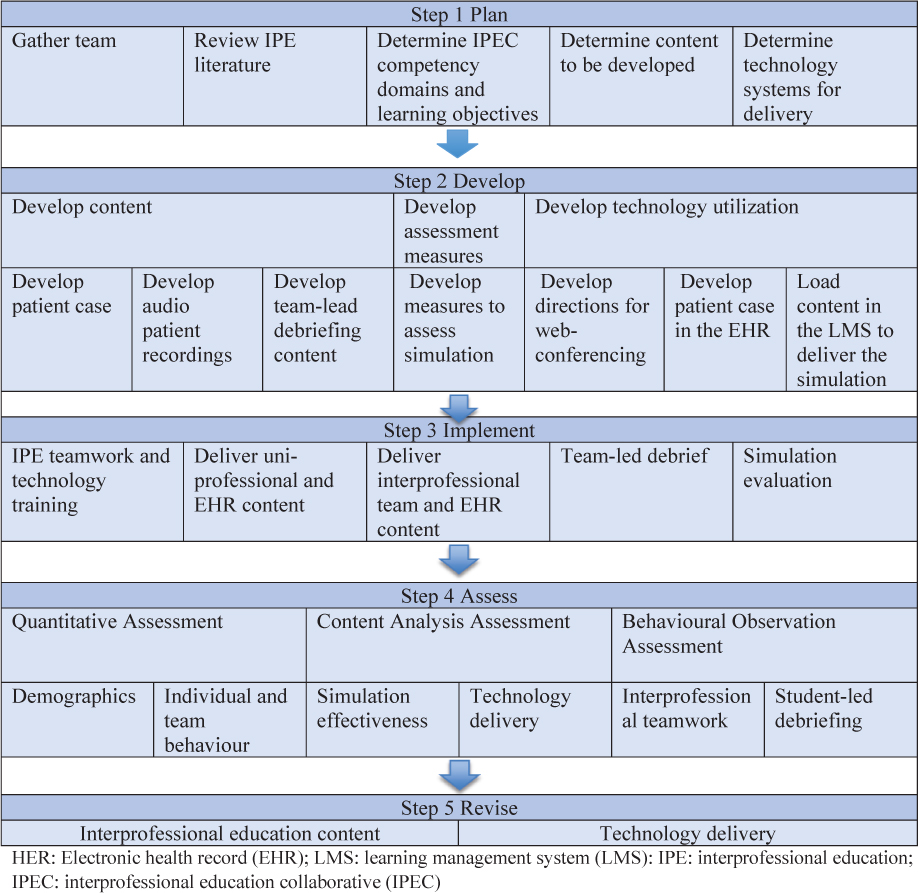
Figure 1
IPOC-SEEDS Simulati on Process Steps
Table 1
IPOC-SEEDS Simulation Development
| Develop Content | Tasks | Review |
|---|---|---|
| Patient case |
|
|
| Audio patient encounters |
|
|
| Team-led debriefing |
|
|
| Assessment measures |
|
|
| Develop Technology | ||
| Electronic health record (EHR) |
|
|
| Learning Management System (LMS) |
|
|
| Synchronous webconferencing system |
|
|
ROL: Review of Literature
*Boese T. Advancing Care Excellence for Seniors unfolding case on Red Yoder. New York: National League for Nursing. 2011. Accessed 2013. http://www.nln.org/professional-development-programs/teaching-resources/aging/ace-s/unfolding-cases/red-yoder
**Brett-Fleegler M, Rudolph J, Eppich W, et al. Debriefing assessment for simulation in healthcare: development and psychometric properties. Simul Healthc. 2012; 7(5): 288-94. 10.1097/SIH.0b013e3182620228.
***University of Washington. Performance Assessment of Communication and Teamwork Novice Observer Form. http://collaborate.uw.edu/sites/default/files/files/PACT_RealTime_ShortForm_Generic_110611_copyright.pdf, Published 2011. Accessed January 14, 2013.
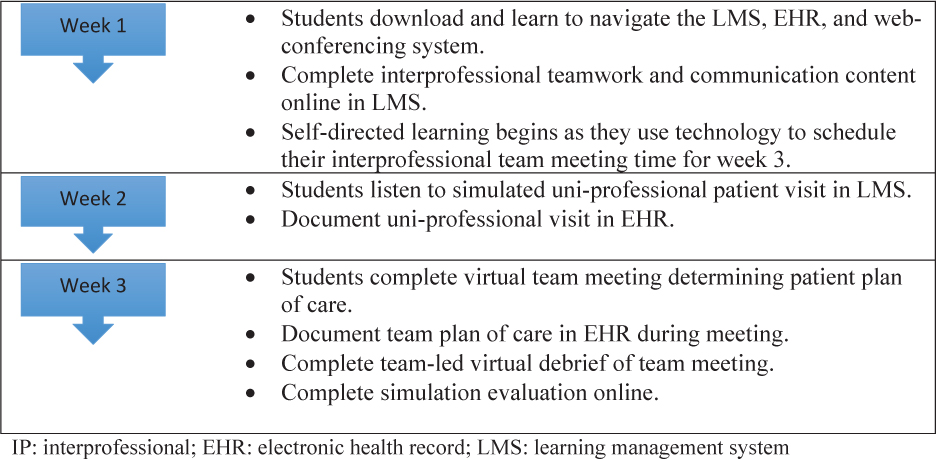
Figure 2
IPOC-SEEDS Online Simulation Methods
Table 2
IPOC-SEEDS Simulation Objectives with Respective Assessment
| Domain | Objective | Assessment |
|---|---|---|
| IPEC: Roles and Responsibilities | 1 (RR4) Identify the roles and responsibilities for yourself and other care providers and how the team works together to provide care. | IPOC-SEEDS evaluation:
|
| IPEC: Teams and teamwork | 2 (TT4) Integrate the knowledge and experience of other professions – appropriate to the specific care situation – to inform care decisions, whilst respecting patient and community values and priorities/ preferences for care. | Assess during IP team meeting
|
| IPEC: Teams and teamwork | 3 (TT5) Apply teamwork principles that support collaborative practice and team effectiveness. | Assess during IP team meeting
|
| IPEC: Teams and teamwork | 4 (TT8) Reflect on individual and team performance for individual, as well as team, performance improvement. | PACT measure
DASH measure
IPOC-SEEDS evaluation
|
| Informatics | Navigate the electronic health record | IPOC-SEEDS evaluation
|
| Simulation effectiveness | Was the IPOC-SEEDS simulation effective? | IPOC-SEEDS evaluation
|
| Simulation value | What was the value of the simulation? | IPOC-SEEDS evaluation
|
| Technology utilization | Did technology utilisation and delivery work? | IPOC-SEEDS evaluation
|
* Interprofessional Education Collaborative Expert Panel. Core competencies for interprofessional collaborative practice: Report of an expert panel. Washington, D.C.: Interprofessional Education Collaborative. http://www.aacn.nche.edu/education-resources/ipecreport.pdf. Published 2011.
**Quality and Safety Education for Nurses. QSEN competencies. QSEN.org (n.d.). Accessed January 14, 2013.
Table 3
Demographics
| Demographics | Fall 2013 Pilot | N = 100 | Spring 2014 | N=106 |
|---|---|---|---|---|
| Nutrition | 16 | Nutrition | 0 | |
| MSN | 29 | MSN | 30 | |
| Profession | DNP | 6 | DNP | 7 |
| Occupational Therapy | 34 | Occupational Therapy | 29 | |
| Pharmacy | 15 | Pharmacy | 40 | |
| African American | 2 | African American | 2 | |
| Asian | 6 | Asian | 9 | |
| Ethnicity | Caucasian | 83 | Caucasian | 86 |
| Hispanic | 6 | Hispanic | 2 | |
| Native American | 0 | Native American | 1 | |
| Other or not specified | 3 | Other or not specified | 7 | |
| 20–29 | 72 | 20–29 | 75 | |
| 30–39 | 18 | 30–39 | 20 | |
| Age | 40–49 | 8 | 40–49 | 7 |
| 50–59 | 2 | 50–59 | 2 | |
| Male | 13 | Male | 23 | |
| Gender | Female | 87 | Female | 80 |
| Unspecified | 0 | Unspecified | 3 | |
| Student Location | < 3 h from KUMC | 86 | < 3 h from KUMC | 77 |
| > 3 h from KUMC | 14 | > 3 h from KUMC | 29 | |
| Novice | 3 | Novice | 10 | |
| Advance beginner | 21 | Advance beginner | 19 | |
| Technology experience self-rating | Competent (2–3yr) | 30 | Competent (2–3yr) | 23 |
| Proficient (3–5 yr) | 29 | Proficient (3–5 yr) | 31 | |
| Expert (5–10 yr) | 17 | Expert (5–10 yr) | 23 | |
| First EHR Experience | 55 | First EHR Experience | 34 | |
| EHR Experience | Using EHR 6 months or more | 16 | Using EHR 6 months or more | 37 |
| Using EHR 1 yr. or more | 29 | Using EHR 1 yr. or more | 34 | |
Table 4
Student Evaluation Results
| Evaluation Results | Fall 2013 Pilot N = 100 | Spring 2014 N = 106 | ||||||||
|---|---|---|---|---|---|---|---|---|---|---|
| How often did you: | Not at all 0% - 5% | Sometimes 25% | Often 50% | Most of the time 75% | Always 95% -100% | Not at all 0–% - 5% | Sometimes 25% | Often 50% | Most of the time 75% | Always 95% -100% |
| Speak up/advocate for profession? | 1% | 12% | 7% | 28% | 52% | 1% | 9% | 14% | 36% | 40% |
| Feel empowered to speak freely? | 0% | 3% | 8% | 21% | 68% | 0% | 2% | 13% | 24% | 62% |
| Feel your opinion was valued? | 0% | 0% | 3% | 11% | 86% | 0% | 1% | 5% | 15% | 80% |
| Contribute to the plan of care? | 0% | 5% | 7% | 24% | 64% | 0% | 4% | 15% | 35% | 47% |
| Fulfil your professional role? | 0% | 0% | 3% | 19% | 78% | 0% | 2% | 4% | 27% | 67% |
| Fulfil your team role? | 1% | 5% | 6% | 21% | 67% | 1% | 3% | 10% | 26% | 60% |
| Fall 2013 Pilot N = 100 | Spring 2014 N = 106 | |||||||||
| How often did your team: | Not at all 0% - 5% | Sometimes 25% | Often 50% | Most of the time 75% | Always 95% -100% | Not at all 0% - 5% | Sometimes 25% | Often 50% | Most of the time 75% | Always 95% -100% |
| Introduce selves/ describe profession? | 0% | 3% | 5% | 5% | 87% | 0% | 2% | 9% | 14% | 75% |
| Keep patient’s perspective considered throughout meeting? | 0% | 3% | 4% | 22% | 71% | 0% | 2% | 2% | 22% | 74% |
| Percent of time all opinions were valued? | 0% | 0% | 1% | 9% | 90% | 0% | 0% | 1% | 8% | 92% |
Table 5
Assessment of Interprofessional Team Work Using the Performance, Assessment of Communication and Teamwork (PACT) Tool during an Online Simulation
| PACT Domain | Team Structure | Leadership | Situational Monitoring | Mutual Support | Communication |
|---|---|---|---|---|---|
| Nine Team Overall | Range: 3-4 | Range: 2-5 | Range: 2-5 | Range: 3-5 | Range: 3-5 |
| Scores | Mean: 3.4 | Mean: 3.6 | Mean: 3.4 | Mean: 4.6 | Mean: 3.9 |
PACT Scoring: 5 Excellent; 4 Average to excellent; 3 Average; 2 Poor to average; and 1 Poor
Table 6
Evaluation of Student Team-led Debriefing with Debriefing Assessment for Simulation in Healthcare (DASH) tool
| DASH | Element 2 Maintains an engaging learning environment | Element 3 Structures the debriefing in an organized way | Element 4 Provokes engaging discussion | Element 6 Helps trainees achieve or sustain good future performance |
|---|---|---|---|---|
| Nine Team Overall | Range: 5-7 | Range: 6-7 | Range: 4-7 | Range: 5-6 |
| Scores | Mean: 5.9 | Mean: 6.3 | Mean: 5.7 | Mean: 5.8 |
DASH Scoring: 7 Extremely effective/outstanding; 6 Consistently effective/very good; 5 Mostly effective/good; 4 Somewhat effective/average; 3 Mostly ineffective/very poor; 2 Consistently ineffective/very poor; and 1 Extremely ineffective/detrimental.