Table 1
Checklist of helminths isolated in Neotropical raptors of the genus Milvagol; M. chimango and M. chimachima
| Host and helminths | Anatomical location | Country | References |
|---|---|---|---|
| Milvago chimango | |||
| TREMATODA | |||
| Ophiosoma microcephalum | I | Argentina | Boero & Led (1971) |
| NEMATODA | |||
| Procyrnea spinosa | Pr; Gi | Chile | San Martín et al. (2006) |
| Capillaria tenuissima | I | Chile | San Martín et al. (2006) |
| Porrocaecum depressum | I | Chile | San Martín et al. (2006) |
| Synhimantus milvagoi | St | Argentina | Boero & Led (1971) |
| Milvago chimachima | |||
| TREMATODA | |||
| Strigea falconis brasiliana | SmI | Argentina | Drago et al. (2014) |
| Athesmia heterolecithodes | BiDu | Argentina; Brazil | Lunaschi & Drago (2009); Travassos et al. (1969) |
| Lubens lubens | GaBl | Brazil | Travassos et al. (1969) |
| NEMATODA | |||
| Pelecitus sp. | TarTend | Brazil | Vicente et al. (1995); Pinto & Noronha (2003) |
| Skrjabinura spiralis | St; I | Brazil | Magalhães et al. (1994); Vicente et al. (1995) |
| Contracaecum caballeroi | I | Brazil | Magalhães et al. (1994); Vicente et al. (1995) |
| Synhimantus (Synhimantus) rectus | St; Gi | Brazil | Magalhães et al. (1994); Vicente et al. (1995) |
| Procyrnea leptoptera | Gi | Brazil | Magalhães et al. (1994); Vicente et al. (1995) |
| Thelazia sp. | Ey | Brazil | Vicente et al. (1995) |
| Thelazia aquilina | Ey | Brazil | Magalhães et al. (1994); Vicente et al. (1995);Rodrigues (1996) |
Abbreviations: E – esophagus; Cr – crop; St – stomach; Pr – proventriculus; Gi – gizzard; I – intestine; SmI – small intestine; GaBl – gall bladder; BiDu – bile ducts; TarTend – tarsus’s tendons; Ey – eyes
Table 2
Helminths isolated in the digestive tract of chimango caracara Milvago chimango temucoensis (n=14) from Los Ríos Region, Chile
| Helminth species | Anatomical location | Total | P (%) | IM | ||
|---|---|---|---|---|---|---|
| NEMATODA | ||||||
| Capillaridae | ||||||
| Capillaria sp. | E; Cr; I | 17 | 35.70 | 3.40 | ||
| Capillaria tenuissima | I | 1197 | 71.40 | 119.70 | ||
| Pterothominx sp. | I | 104 | 35.70 | 20.80 | ||
| Baruscapillaria falconis | I | 482 | 42.90 | 80.33 | ||
| Habronematidae | ||||||
| Procyrnea spinosa | Glu; SbG; Gi; I | 8 | 28.60 | 2.00 | ||
| Acuariidae | ||||||
| Cosmocephalus obvelatus | Cr | 2 | 7.10 | 2.00 | ||
| Synhimantus (Dispharynx) sp. | Cr | 5 | 7.10 | 5.00 | ||
| Synhimantus (Dispharynx) nasuta | Glu | 5 | 7.10 | 5.00 | ||
| Synhimantus (Synhimantus) sp. | Glu | 4 | 14.30 | 2.00 | ||
| Skrjabinoclava sp. | Glu | 2 | 7.10 | 2.00 | ||
| Paracuaria adunca | Glu | 2 | 7.10 | 2.00 | ||
| Ascarididae | ||||||
| Porrocaecum depressum | Glu; I | 20 | 35.70 | 4.00 | ||
| Anisakidae | ||||||
| Contracaecum rudolphii sensu lato | Glu | 24 | 14.30 | 12.00 | ||
| Undetermined Nematoda | Glu; SbG | 11 | 28.60 | 2.75 | ||
| PLATYHELMINTHES | ||||||
| Echinostomatidae | ||||||
| Stephanoprora sp. | I | 2 | 7.10 | 2.00 | ||
| ACANTHOCEPHALA | ||||||
| Polymorphidae | ||||||
| Polymorphus mutabilis | I | 4 | 7.10 | 4.00 | ||
Abbreviations: E – esophagus; Cr – crop; Glu – gastric lumen; Gi – gizzard; SbG – under linning of the gizzard; I – intestine; P – prevalence; IM – mean intensity
Figs. 1 – 6
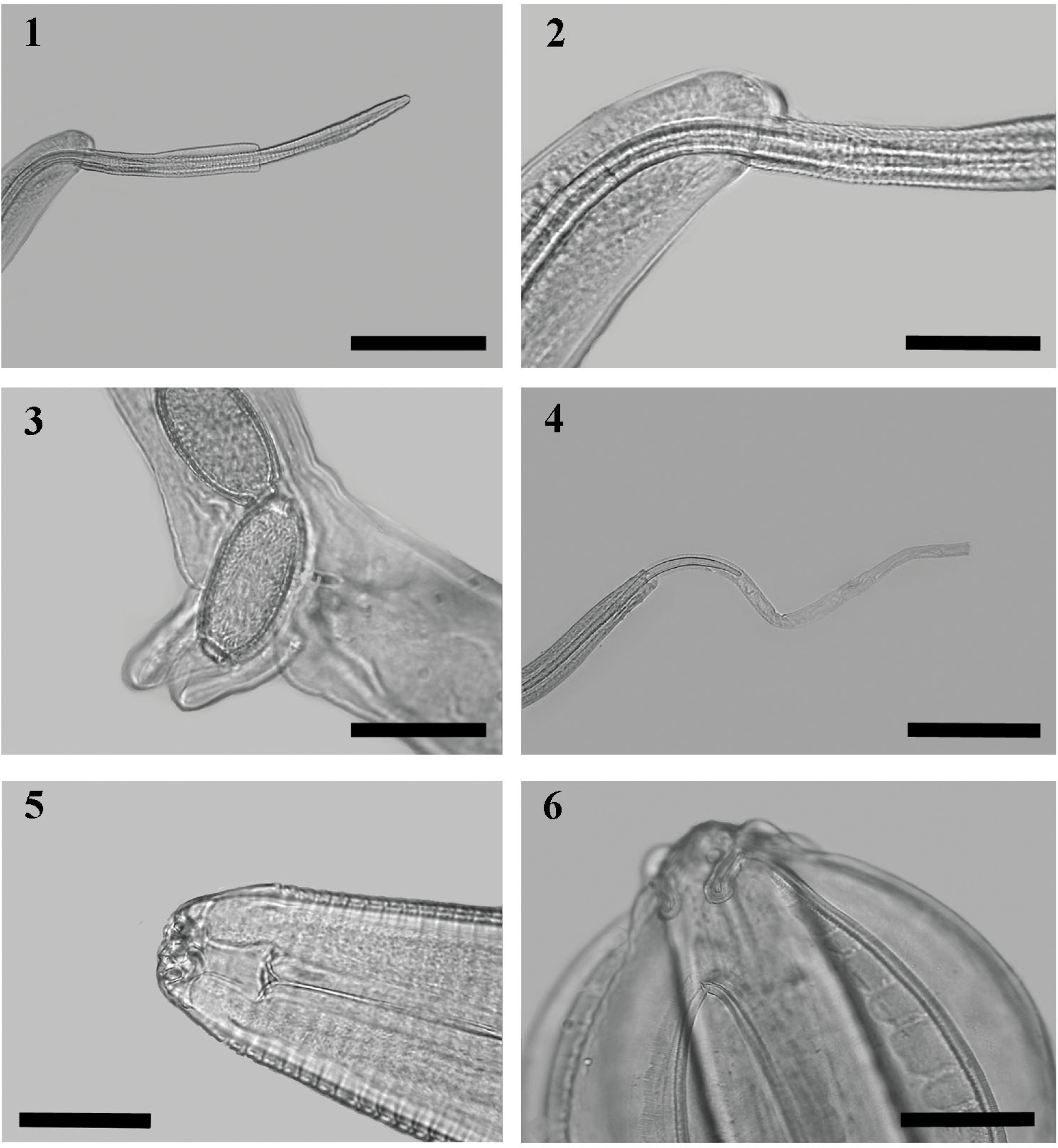
Helminths isolated from chimango caracara Milvago chimango temucoensis.
Figs. 1 – 2. Capillaria tenuissima. 2. Posterior end of a male, it can be noted how the spicule is going out through the spicule sheath. Scale bar = 80 μm. 3. Little spines on the surface of the spicule sheath. Scale bar = 40 μm. Fig. 3. Vulvar appendix of Pterothominx sp.. Scale bar = 40 μm. Fig. 4. Posterior end of a male of Baruscapillaria falconis, note the length of the spicule sheath. Scale bar = 80 μm. Fig. 5. Anterior end of Procyrnea spinosa. Scale bar = 100 μm. Fig. 6. Anterior end of a female of Cosmocephalus obvelatus with its cephalic cordons covered with rectangular plates. Scale bar = 80 μm.
Table 3
Measurements of the nematodes of the family Capillariidae isolated from the chimango caracara in the present study
| Capillaria tenuissima | Pterothominx sp. | Baruscapillaria falconis | |||
|---|---|---|---|---|---|
| ♀ (n=10) | ♂ (n=24) | ♀ (n=11) | ♀ (n=6) | ♂ (n=6) | |
| BL | 8.35 – 14.06 mm | 6.19 – 11.87 mm | 11.25 – 14.67 mm | 8.47 – 12.41 mm | 9.14 – 12.61 mm |
| ETL | 3.09 – 5.47 mm | 3.06 – 5.54 mm | 3.99 – 5.67 mm | 3.57 – 4.95 mm | 3.76 – 5.18 mm |
| EW | 12.0 | 9.0 – 12.0 | 12.0 – 15.0 | 9.0 – 12.0 | 9.0 – 12.0 |
| DAN | 186.0 – 336.0 | 240.0 – 414.0 | 252.0 – 444.0 | 307.5 – 510.0 | 267.0 – 390.0 |
| DAV | 3.32 – 5.79 mm | – | 4.42 – 6.07 mm | 3.96 – 5.34 mm | – |
| DEV | 6.0 – 30.0 | – | 12.0 – 54.0 | 45.0 – 90.0 | – |
| DPCL | 3.0 – 18.0 | 12.0 – 33.0 | 12.0 – 27.0 | 12.0 – 18.0 | 24.0 – 27.0 |
| BWNR | 18.0 – 24.0 | 18.0 – 30.0 | 12.0 – 39.0 | 15.0 – 22.5 | 18.0 – 21.0 |
| BWEI | 45.0 – 67.0 | 37.5 – 67.5 | 60.0 – 82.5 | 37.5 – 52.5 | 39.0 – 48.0 |
| BWV | 45.0 – 67.1 | – | 60.0 – 82.5 | 37.5 – 52.5 | – |
| BWCL | 30.0 – 36.0 | 24.0 – 54.0 | 36.0 – 45.0 | 30.0 – 33.0 | 24.0 – 27.0 |
| EL | 57.0 – 69.0 | – | 66.0 – 72.0 | 51.0 – 60.0 | – |
| EW | 30.0 – 33.0 | – | 33.0 – 39.0 | 27.0 – 30.0 | – |
| SL | – | 0.84 – 1.30 mm | – | – | 0.33 – 1.13 mm |
| SW | – | 6.0 – 18.0 | – | – | 6.0 – 9.0 |
| SSL | – | 69.0 – 258.0 | – | – | 1.35 – 4.59 mm |
| SSW | – | 12.0 – 27.0 | – | – | 12.0 – 15.0 |
| LW | – | 6.0 – 18.0 | – | – | 9.0 |
| RSSL/BL | – | 0.011 – 0.021 | – | – | 0.142 – 0.357 |
Abbreviations: BL – Body length; ETL – Esophagus total length; EW – Stichocyte width; DAN – Distance between anterior end-nerve ring; DAV – Distance between anterior end-vulva; DEV – Distance between distal end esophagus-vulva; DPCL – Distance between posterior end-cloacal aperture; BWNR – Body width at nerve ring; BWEI – Body width at esophagus-intestinal union; BWV – Body width at vulva; BWCL – Body width at cloacal aperture; EL – Eggs length; EW – Eggs width; SL – Spicule length; SW – Spicule width; SSL – Spicule sheath length; SSW – Spicule sheath width; LW – Lobe width; RSSL/BL – Ratio spicule sheath length/body length
Table 4
Measurements of the nematodes of the families Habronematidae, Ascarididae and Anisakidae isolated from the chimango caracara in the present study
| Procyrnea spinosa | Porrocaecum depressum | Contracaecum rudolphii s. lato | |||
|---|---|---|---|---|---|
| ♀ (n=5) | ♂ (n=3) | ♀ (n=2) | ♂ (n=1) | ♂ (n=2) | |
| BL | 10.01 – 15.26 mm | 8.76 – 10.33 mm | 95.00 – 106.00 mm | 73.00 mm | 12.58 – 14.94 mm |
| ETL | 3.81 – 4.94 mm | 3.55 – 3.90 mm | 3.66 – 4.90 mm | 3.63 mm | 1.86 – 2.27 mm |
| ICL | – | – | 2.19 – 3.67 mm | 3.05 mm | 1.25 – 1.47 mm |
| IL | – | – | 127.5 – 180.0 | 113.7 | 38.6 – 51.4 |
| VEL | – | – | 0.76 – 1.05 mm | 570.0 | 634.5 – 759.9 |
| VL | 37.5 – 45.0 | 30.0 | – | – | – |
| VW | 12.0 | 6.0 – 9.0 | – | – | – |
| GEL | 3.36 – 4.41 mm | 3.06 – 3.45 mm | – | – | – |
| GEW | 127.5 – 180.0 | 150.0 – 180.0 | – | – | – |
| MEL | 0.45 – 0.60 mm | 0.45 – 0.49 mm | – | – | – |
| MEW | 30.0 – 48.0 | 27.0 – 36.0 | – | – | – |
| DAN | 315.0 – 354.0 | 276.0 – 315.0 | – | – | – |
| DAD | 162.0 – 180.0 | 147.0 – 204.0 | – | 255.0 | – |
| DAE | 414.0 – 471.0 | 360.0 – 408.0 | – | – | 172.5 |
| DAV | 8.23 – 8.48 mm | – | 26.00 – 31.00 mm | – | – |
| DPCL | 127.5 – 157.5 | 172.5 – 210.0 | 645.0 – 720.0 | 282.0 | 180.0 – 195.0 |
| DPPH | 24.0 – 27.0 | – | 75.0 – 82.5 | – | – |
| BWNR | 150.0 – 157.0 | 127.5 – 157.5 | – | – | – |
| BWD | 105.0 – 135.0 | 112.5 – 135.0 | – | – | – |
| BWEI | 382.5 – 405.0 | 270.0 – 360.0 | – | – | – |
| BWEVE | – | – | 1.29 – 1.51 mm | 1.17 mm | 337.5 – 450.0 |
| BWV | 435.0 – 465.0 | – | 1.88 – 1.94 mm | – | – |
| BWCL | 165.0 – 180.0 | 122.3 – 127.2 | 592.5 – 780.0 | 322.5 | 165.0 |
| EL | 36.0 – 42.0 | – | 99.8 – 107.9 | – | – |
| EW | 18.0 – 24.0 | – | 67.0 – 84.7 | – | – |
| LSL | – | 1.54 – 1.59 mm | – | 1.24 mm | 5.82 – 7.09 mm |
| RSL | – | 0.36 – 0.39 mm | – | 1.15 mm | 5.58 – 6.33 mm |
| ML | – | – | 15.0 | 15.0 | – |
| RMEL/GEL | 0.133 – 0.136 | 0.142 – 0.147 | – | – | – |
| RRSL/LSL | – | 0.233 – 0.245 | – | 0.927 | 0.892 – 0.958 |
Abbreviations: BL – Body length; ETL – Esophagus total length; ICL – Intestinal cecum length; IL – Interlabia length; VEL – Ventriculus length; VL – Vestibule length; VW – Vestibule width; GEL – Glandular esophagus length; GEW – Glandular esophagus width; MEL – Muscular esophagus length; MEW – Muscular esophagus width; DAN – Distance between anterior end-nerve ring; DAD – Distance between anterio end-deirid; DAE – Distance between anterior end-excretory pore; DAV – Distance between anterior end-vulva; DPCL – Distance between posterior end-cloacal aperture; DPPH – Distance between posterior end-phasmid; BWNR – Body width at nerve ring; BWD – Body width at deirid; BWEI – Body width at esophagus-intestinal union; BWEVE – Body width at esophagus-ventriculus union; BWV – Body width at vulva; BWCL – Body width at cloacal aperture; EL – Eggs length; EW – Eggs width; LSL – Left spicule length; RSL – Right spicule length; ML – Mucron length; RMEL/GEL – Ratio muscular esophagus length/glandular esophagus length; RRSL/LSL – Ratio right spicule length/left spicule length
Table 5
Measurements of the nematodes of the family Acuariidae isolated from the chimango caracara in the present study
| Cosmocephalusobvelatus | Paracuaria adunca | Synhimantus (D.)nasuta | Synhimantus (D.) sp. | Synhimantus (Synhimantus) sp. | Skrjabinoclava sp. | ||
|---|---|---|---|---|---|---|---|
| ♀ (n=1) | ♂ (n=2) | ♂ (n=5) | ♀ (n=3) | ♂ (n=2) | ♀ (n=4) | ♀ (n=2) | |
| BL | 13.23 mm | 9.07 – 9.35 mm | 4.26 – 9.12 mm | 22.99 – 23.58 mm | 10.32 – 19.80 mm | 9.22 – 11.11 mm | 4.14 – 4.44 mm |
| ETL | 4.60 mm | 2.59 – 2.99 mm | 2.34 – 3.10 mm | 5.02 – 6.30 mm | 3.54 – 4.71 mm | 3.57 – 4.05 mm | 1.37 – 1.44 mm |
| VL | 453.0 | 151.9 – 175.4 | 112.5 – 180.0 | 360.0 – 522.0 | 309.0 – 375.0 | 157.5 – 198.0 | 120.0 – 150.0 |
| VW | 15.0 | 8.4 – 9.7 | 7.5 – 9.0 | 30.0 – 39.0 | 18.0 – 22.5 | 15.0 – 18.0 | 6.0 |
| GEL | 3.60 mm | 1.60 – 1.98 mm | 1.80 – 2.49 mm | 3.60 – 4.99 mm | 2.91 – 3.75 mm | 2.83 – 3.34 mm | 1.13 – 1.17 mm |
| GEW | 135.0 | 28.6 – 34.1 | 90.0 – 97.5 | 217.5 – 234.0 | 105.0 – 150.0 | 142.5 – 165.0 | 48.0 – 54.0 |
| MEL | 1.00 mm | 0.98 – 1.00 mm | 0.41 – 0.60 mm | 0.97 – 1.42 mm | 0.62 – 0.96 mm | 0.69 – 0.73 mm | 0.24 – 0.27 mm |
| MEW | 60.0 | 22.7 – 23.8 | 37.5 – 60.0 | 142.5 – 162.0 | 75.0 – 105.0 | 60.0 – 82.50 | 30.0 |
| DCL | 495.0 | – | 202.5 – 345.0 | 2.39 – 3.11 mm | 0.87 – 1.47 mm | 457.5 – 517.5 | 45.0 |
| RCL | 414.0 | – | 90.0 – 225.0 | 1.08 – 1.54 mm | 262.5 – 600.0 | 330.0 – 397.5 | – |
| DAN | 450.0 | 168.8 – 198.2 | 105.0 – 180.0 | 427.5 – 525.0 | 315.0 – 435.0 | 172.5 – 210.0 | 120.0 – 157.5 |
| DAD | 502.5 | 221.3 – 228.4 | 165.0 – 330.0 | 0.74 – 1.41 mm | 570.0 – 862.5 | 352.5 – 480.0 | 52.5 – 60.0 |
| DAE | 585.0 | 189.4 – 280.4 | 180.0 – 330.0 | 1.10 – 1.26 mm | 0.67 – 1.01 mm | 405.0 – 480.0 | 172.5 – 202.5 |
| DAV | 6.30 mm | – | – | 12.39 – 12.93 mm | – | 5.34 – 6.69 mm | 3.87 – 4.16 mm |
| DPCL | 216.0 | 161.1 – 175.1 | 126.0 – 240.0 | 180.0 – 240.0 | 288.00 – 372.0 | 90.0 – 105.0 | 75.0 – 82.5 |
| DPPH | 34.6 | – | – | 21.0 – 24.0 | – | 15.0 – 27.0 | – |
| BWNR | 204.0 | 68.2 – 69.9 | 97.5 – 135.0 | 345.0 – 510.0 | 165.0 – 225.0 | 135.0 – 157.5 | 82.5 |
| BWD | 204.0 | 73.8 – 76.2 | 112.5 – 150.0 | 495.0 – 517.5 | 165.0 – 255.0 | 172.5 – 195.0 | 60.0 |
| BWEI | 273.0 | 103.5 – 123.5 | 157.5 – 210.0 | 472.5 – 630.0 | 210.0 – 330.0 | 292.5 – 367.5 | 112.5 – 127.5 |
| BWV | 285.0 | – | – | 607.5 – 720.0 | – | 300.0 – 345.0 | 112.5 – 120.0 |
| BWCL | 126.0 | 74.9 – 82.2 | 105.0 – 150.0 | 150.0 – 255.0 | 127.5 – 202.5 | 75.0 – 150.0 | 45.0 – 52.5 |
| EL | 18.0 – 21.0 | – | – | 42.0 – 48.0 | – | 33.0 – 36.0 | 27.0 – 33.0 |
| EW | 12.0 – 15.0 | – | – | 21.0 – 24.0 | – | 24.0 | 18.0 – 21.0 |
| LSL | – | 388.2 – 397.5 | 510.0 – 622.5 | – | 615.0 – 622.5 | – | – |
| RSL | – | 119.6 – 127.1 | 157.5 – 172.5 | – | 202.5 – 225.0 | – | – |
| RMEL/GEL | 0.277 | 0.505 – 0.612 | 0.227 – 0.240 | 0.269 – 0.284 | 0.213 – 0.256 | 0.218 – 0.243 | 0.212 – 0.230 |
| RRSL/LSL | – | 0.308 – 0.319 | 0.277 – 0.308 | – | 0.329 – 0.361 | – | – |
Abbreviations: BL – Body length; ETL – Esophagus total length; VL – Vestibule length; VW – Vestibule width; GEL – Glandular esophagus length; GEW – Glandular esophagus width; MEL – Muscular esophagus length; MEW – Muscular esophagus width; DCL – Descending cordons length; RCL – Recurrente cordons length; DAN – Distance between anterior end-nerve ring; DAD – Distance between anterio end-deirid; DAE – Distance between anterior end-excretory pore; DAV – Distance between anterior end-vulva; DPCL – Distance between posterior end-cloacal aperture; DPPH – Distance between posterior end-phasmid; BWNR – Body width at nerve ring; BWD – Body width at deirid; BWEI – Body width at esophagus-intestinal union; BWV – Body width at vulva; BWCL – Body width at cloacal aperture; EL – Eggs length; EW – Eggs width; LSL – Left spicule length; RSL – Right spicule length; RMEL/GEL – Ratio muscular esophagus length/glandular esophagus length; RRSL/LSL – Ratio right spicule length/left spicule length
Figs. 7 – 12
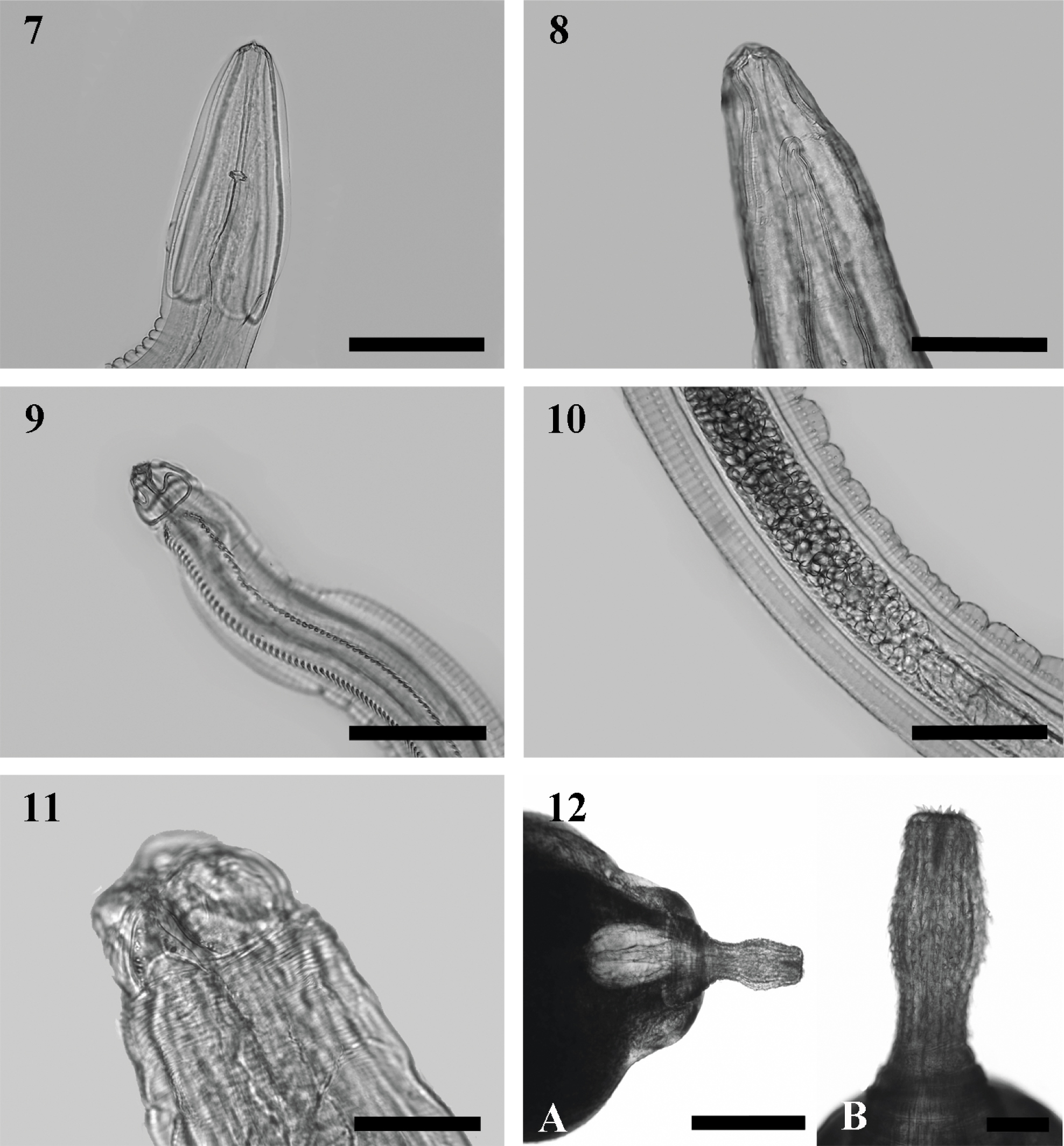
Figure 7. Anterior end of Synhimantus (Dispharynx) nasuta. Scale bar = 80 μm.
Fig. 8. Anterior end of Synhimantus (Synhimantus) sp., with anastomosed cephalic cordons and cuticular plates on the surface of the cordons. Scale bar = 80 μm. Figs. 9–10. Skrjabinoclava sp. 9. Anterior end and the presence of a double row of spines in each side of the body. Scale bar = 80 μm. 10. Presence of eggs. Scale bar = 80 μm. Fig. 11. Anterior end of Contracaecum rudolphii sensu lato. Scale bar = 70 μm. Fig. 12. Polymorphus mutabilis. A. Broad trunk with proboscis receptable caudal to the small proboscis. Scale bar= 800 μm. B. Proboscis covered with rows of small hooks. Scale bar = 200 μm.