
Table 1
Demographic characteristics of the participants (n=429)
| Characteristics | n (%) |
|---|---|
| Gender | |
| Male | 50 (11.7) |
| Female | 379 (88.3) |
| Grade | |
| 1 | 105 (24.5) |
| 2 | 105 (24.5) |
| 3 | 132 (30.8) |
| 4 | 87 (20.3) |
| Living location | |
| City | 103 (24) |
| Town | 118 (27.5) |
| Village | 208 (48.5) |
| Satisfaction with major | |
| Very much | 19 (4.4) |
| Prefer | 202 (47.0) |
| No feeling | 185 (43.1) |
| Hate | 23 (5.4) |
| Satisfaction with teaching methods | |
| Satisfied | 17 (3.9) |
| Relatively satisfied | 265 (61.8) |
| Uncertain | 80 (18.6) |
| Less satisfied | 59 (13.8) |
| Very dissatisfied | 8 (1.9) |
| Learning difficulties | |
| No difficulties | 288 (67.1) |
| Have little | 130 (30.3) |
| Have more | 11 (2.6) |
[i]
Table 2
Pearson correlation coefficients of the variables (N = 429)
| Order | Item | 1 | 2 | 3 | 4 | 5 | 6 | 7 | 8 | 9 | 10 | 11 | 12 | 13 |
|---|---|---|---|---|---|---|---|---|---|---|---|---|---|---|
| 1 | SM | 1 | ||||||||||||
| 2 | DL | 0.537* | 1 | |||||||||||
| 3 | SC | 0.616* | 0.673* | 1 | ||||||||||
| 4 | Total SDLR | 0.849* | 0.838* | 0.890* | 1 | |||||||||
| 5 | NPO | 0.210* | 0.163* | 0.219* | 0.232* | 1 | ||||||||
| 6 | RPS | 0.285* | 0.393* | 0.413* | 0.420* | –0.37 | 1 | |||||||
| 7 | PPO | 0.365* | 0.502* | 0.528* | 0.537* | 0.118* | –0.58* | 1 | ||||||
| 8 | AS | 0.294* | 0.313* | –0.28* | 0.346* | 0.53* | 0.125* | 0.266* | 1 | |||||
| 9 | ICS | 0.00 | 0.063 | –0.024 | 0.012 | 0.270* | 0.004 | 0.01 | 0.379* | 1 | ||||
| 10 | Total PSA | 0.376* | 0.452* | 0.451* | 0.493* | 0.660* | 0.481* | 0.592* | 0.808* | 0.520* | 1 | |||
| 11 | ASE | 0.507* | 0.431* | 0.540* | 0.576* | 0.201* | 0.353* | 0.422* | 0.173* | –0.067 | 0.339* | 1 | ||
| 12 | BSE | 0.557* | 0.490* | 0.509* | 0.606* | 0.291* | 0.308* | 0.432* | 0.379* | 0.134* | 0.499* | 0.621* | 1 | |
| 13 | Total academic self–efficacy | 0.591* | 0.512* | 0.582* | 0.657* | 0.274* | 0.366* | 0.474* | 0.308* | 0.039 | 0.467* | 0.898* | 0.903* | 1 |
Notes: SM: self-management; DL: the desire to learn; SC: self-control; SDLR: self-directed learning readiness; NPO: negative problem orientation; RPS: rational problem-solving; PPO: positive problem orientation; AS: avoidance style; ICS: impulsivity/carelessness style; PSA: problem-solving ability; ASE: ability self-efficacy; BSE: behavioral self-efficacy.
Table 3
Mediating effect of academic self-efficacy on the relationship between self-directed learning readiness and problem-solving ability (N = 429)
| Dependent variable | Independent variable | t | B | R2 | Adjusted R2 |
|---|---|---|---|---|---|
| Academic self-efficacy | Self-directed learning readiness | 17.99*** | 0.657 | 0.431 | 0.430 |
| Problem-solving ability | Academic self-efficacy | 10.90*** | 0.467 | 0.218 | 0.216 |
| Problem-solving ability | Self-directed learning readiness | 11.72*** | 0.493 | 0.243 | 0.242 |
| Problem-solving ability | Self-directed learning readiness | 6.027*** | 0.329 | 0.279 | 0.276 |
| Academic self-efficacy | 4.598*** | 0.251 |
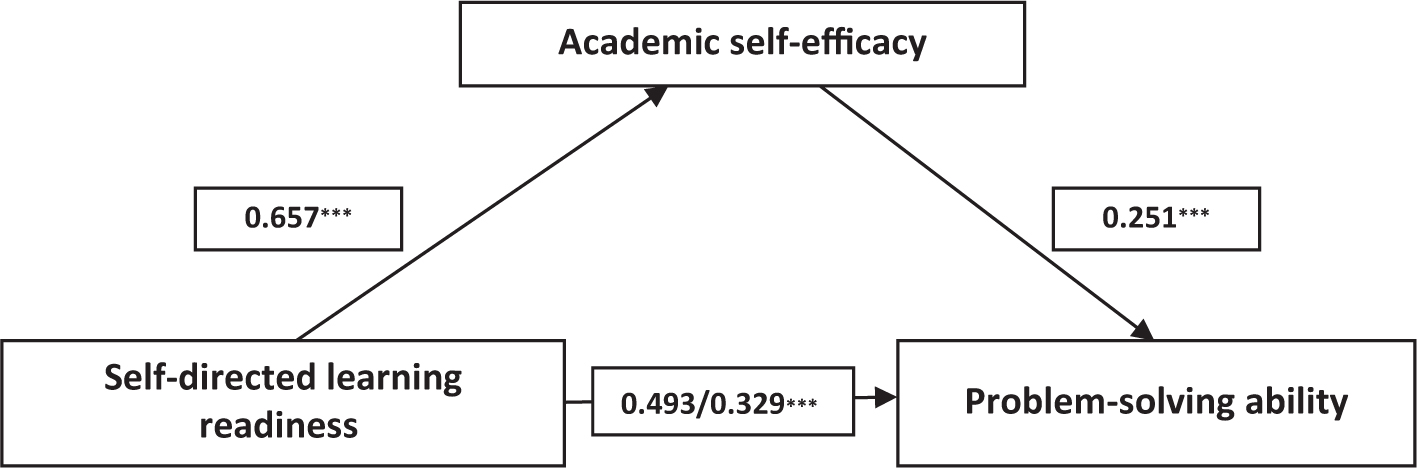
Figure 1
Mediating effect of academic self-efficacy on the relationship between self-directed learning readiness and problem-solving ability. Note: ***P <0.01.