
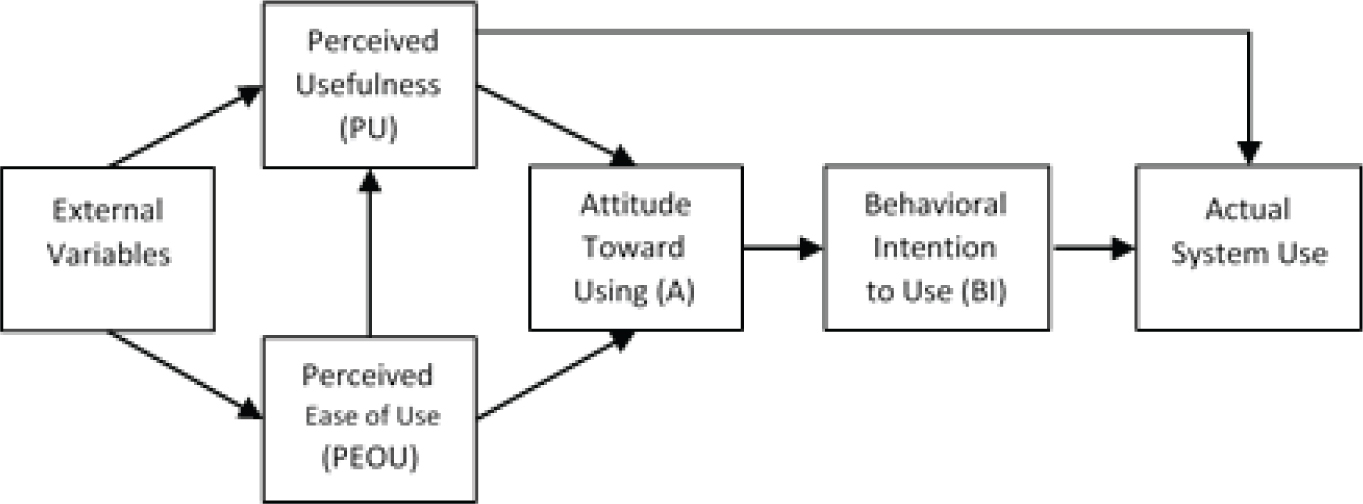
Figure 1
Technology Acceptance Model (TAM); Source: Davis (1989)
Abbildung 1. Technologieakzeptanzmodell (TAM); Quelle: Davis (1989)
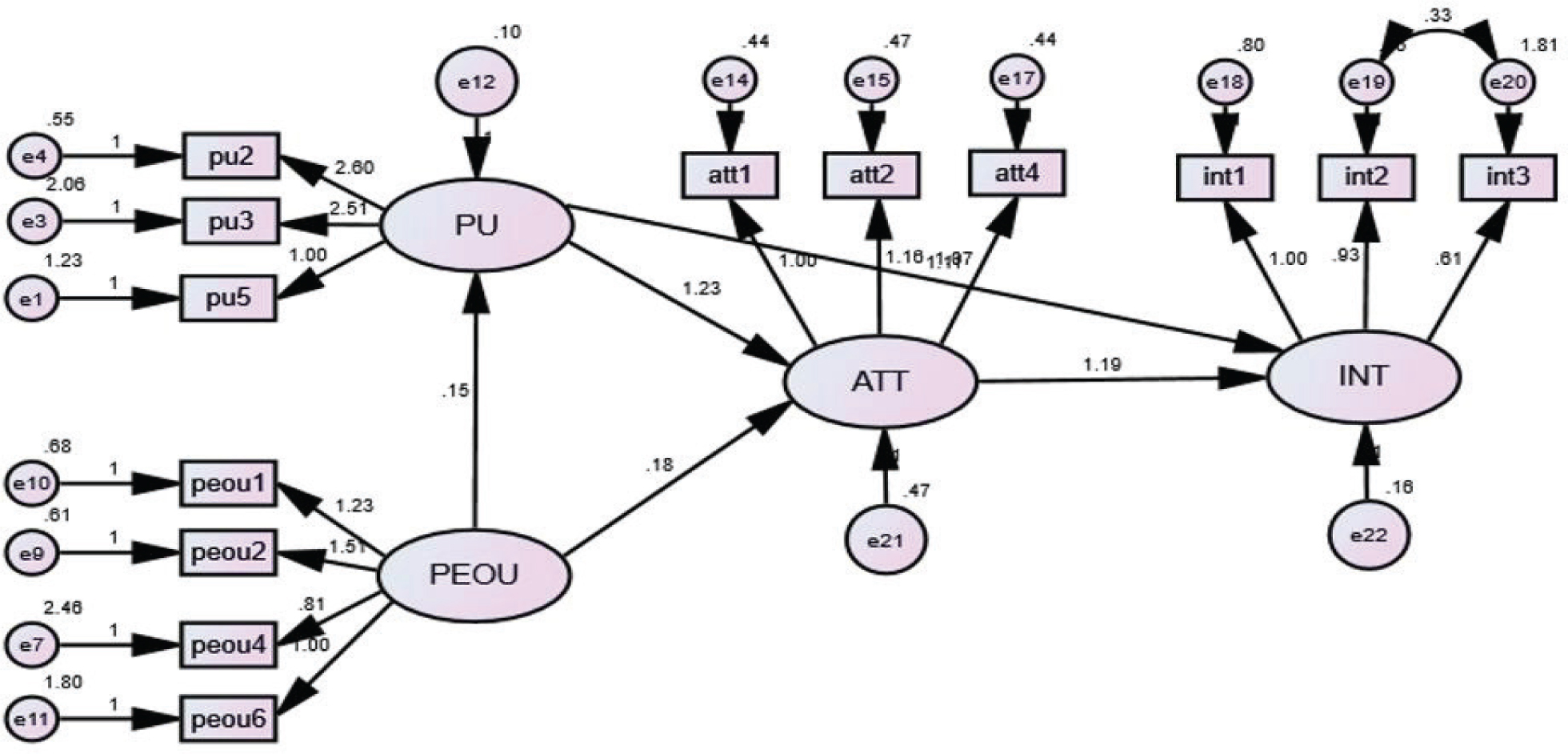
Figure 2
Path diagram
Abbildung 2. Pfaddiagramm
Table 1
Items of the TAM model
Tabelle 1 Begriffe des TAM Modells
| Latent variables | Measurement variables (items) | 7 points scale | |
|---|---|---|---|
| By using IP in my farm, the agronomic effectiveness would improve. | (1) Extremely unlikely→ Extremely likely (7) | ||
| PU | By using IP in my farm, the costs of inputs would decrease. | (1) Extremely unlikely→ Extremely likely (7) | |
| I believe IP can bring more benefits to the environment than conventional systems. | (1) Extremely unlikely→ Extremely likely (7) | ||
| It will be easy for me to learn and apply most of the IP practices. | (1) Extremely unlikely→ Extremely likely (7) | ||
| It will be easy for me to understand and apply the IP standards for common beans’ production. | (1) Extremely unlikely→ Extremely likely (7) | ||
| PEOU | It will be easy for me understand and apply the IP standards for common beans’ production. | (1) Extremely unlikely→ Extremely likely (7) | |
| It will be easy for me to use IP with the present biological control agents and other IPM supplies available in my region. | (1) Extremely unlikely→ Extremely likely (7) | ||
| I would find IP easy to use for producing common beans. | (1) Extremely unlikely→ Extremely likely (7) | ||
| ATT | I would say that my overall opinion of IP system is (…) | (1) Extremely unfavorable→ Extremely favorable (7) | |
| I (…) the idea of using IP in my farm. | (1) Extremely dislike→ Extremely like (7) | ||
| Using IP system in my farm is an (…) decision. | (1) Extremely negative→ Extremely positive (7) | ||
| INT | I intend to use IP as my farming system. | (1) Extremely unlikely→ Extremely likely (7) | |
| I would recommend the IP system adoption for other farmers in my region. | (1) Extremely unlikely→ Extremely likely (7) | ||
| I would also adopt IP if the neighboring farmers adopt. | (1) Extremely unlikely→ Extremely likely (7) |
Table 2
Model fit summary
Tabelle. Zusammenfassung der Modellgüte
| Measures | Estimated Model | Acceptable values |
|---|---|---|
| Chi-square | 59.694 | the lower the better |
| DoF | 59 | - |
| p-value | 0.45 | the higher (non-significant) the better |
| GFI | 0.912 | ≥ 0.90 |
| CFI | 0.998 | ≥ 0.90 |
| RMSEA | 0.011 | < 0.080 |
| CMIN/DoF | 1.012 | 1 – 5 |
Table 3
Standardized Residual Covariances Matrix
Tabelle 3. Standardisierte Residuen-Kovarianzmatrix
| PEOU6 | PU3 | BI3 | BI2 | BI1 | A4 | A2 | A1 | PEOU1 | PEOU2 | PEOU4 | PU2 | PU5 | |
|---|---|---|---|---|---|---|---|---|---|---|---|---|---|
| PEOU6 | .000 | ||||||||||||
| PU 3 | 1.546 | .000 | |||||||||||
| BI3 | .524 | .458 | .000 | ||||||||||
| BI2 | 1.719 | -.355 | .000 | .000 | |||||||||
| BI1 | 1.844 | .066 | -.439 | .027 | .000 | ||||||||
| A4 | 1.284 | -.401 | -.070 | -.237 | -.039 | .000 | |||||||
| A2 | 1.968 | .809 | .197 | -.033 | .167 | .067 | .000 | ||||||
| A1 | 1.480 | -.635 | .535 | .194 | -.102 | .157 | -.214 | .000 | |||||
| PEOU1 | -.309 | .167 | -1.294 | -.329 | .106 | -.930 | .029 | -.659 | .000 | ||||
| PEOU2 | -.153 | .510 | -.961 | -.323 | .179 | -.531 | .195 | -.014 | .112 | .000 | |||
| PEOU4 | .603 | 1.407 | .957 | -.019 | -1.147 | .187 | -.010 | -.225 | .184 | -.223 | .000 | ||
| PU2 | .562 | .044 | .364 | .159 | -.152 | .060 | -.531 | -.087 | -.643 | .012 | -.935 | .000 | |
| PU 5 | -.082 | -.347 | .578 | .311 | -.103 | 1.497 | .244 | 2.382 | -.475 | -.503 | 1.201 | .063 | .00 |
Table 4
Structural Model and Hypothesis testing
Tabelle 4. Strukturiertes Model und Hypothesentest
Table 5
Standardized Regression Weights
Tabelle 5. Standardisierte Regressionsgewichte
| Sth. Regression Weights | Estimate | Sth. Regression Weights | Estimate |
|---|---|---|---|
| INT←PU | 0.287 | peou2←PEOU | 0.834 |
| INT←ATT | 0.762 | peou4←PEOU | 0.377 |
| A←PEOU | 0.171 | peou6←PEOU | 0.504 |
| PU←PEOU | 0.351 | al←ATT | 0.785 |
| ATT←PU | 0.498 | a2← ATT | 0.818 |
| pu2←PU | 0.767 | a4← ATT | 0.807 |
| pu3←PU | 0.512 | intl←INT | 0.827 |
| pu5←PU | 0.294 | int2←INT | 0.833 |
| peou1←PEOU | 0.761 | int3←INT | 0.514 |
| Latent variables | Descriptive Statistics Measurement variables (items) | Mean | Std. Deviation |
|---|---|---|---|
| (PU) Perceived Usefulness (0.722)* | Benefits to environment | 6.0 | 1.1 |
| Improve agronomic efficiency | 5.7 | 1.1 | |
| Reduce costs with inputs | 5.2 | 1.6 | |
| (PEOU) Perceived Ease of Use (0.730)* | Easy to learn and apply IP practices | 5.7 | 1.2 |
| Easy to comprehend and apply the norms | 5.3 | 1.4 | |
| Easy to apply with support services | 4.5 | 1.6 | |
| Can apply without a full-time agronomist | 3.6 | 2.1 | |
| (ATT) Attitude (0.896)* | Overall opinion of IP | 5.7 | 1.0 |
| The decision of using IP | 5.7 | 1.1 | |
| The choice of using IP | 5.6 | 1.2 | |
| The idea of using IP on the farm | 5.5 | 1.2 | |
| (INT) Behavioral Intention (0.783)* | Would recommend IP for other growers | 5.4 | 1.4 |
| Would adopt if the neighbors adopt | 5.2 | 1.5 | |
| Have the intention to use IP in the next 5 years | 5.0 | 1.6 | |