
Table 1
Magnetic resonance imaging parameters
| Parameters | 3D T1-weighted SPACE | 3D T1-weighted VIBE |
|---|---|---|
| TR (ms) | 500 | 20 |
| TE (ms) | 20 | 3.69 |
| Flip angles (degree) | Variable | 12 |
| Reconstructed slice thickness (mm) | 0.98 | 1 |
| Voxel size (mm) | 0.98 × 0.98 × 0.98 | 0.65 × 0.62 × 1.25 |
| Echo-train length | 35 | Not applicable |
| Matrix size | 256 × 256 × 176 | 320 × 272 (85% of read) × 128 mm (80% of slice per slab) |
| Field of view | 250 × 250 | 210 × 171 |
| Partition direction | N/A | Zero-filled with 160 points |
| Bandwidth (hertz per pixel) | 621 | 130 |
| Number of acquisition (NEX) | 1 | 1 |
| Acquisition plane | Sagittal | Axial |
| Acceleration factor | 2 | 2 |
| Fat suppression | No | Yes |
| Acquisition time (min:s) | 4:47 | 4:51 |
[i] 3D, Three-dimensional; SPACE, Sampling Perfection with Application optimized Contrasts using different flip angle Evolutions; VIBE, Volumetric Interpolated Brain Examination.
Table 2
Results of detection of parenchymal enhancing lesions on 3D T1-weighted SPACE and 3D T1-weighted VIBE
| Parameters | Imaging sequence | ||
|---|---|---|---|
| 3D T1-weighted SPACE | 3D T1-weighted VIBE | P | |
| Separate reading | |||
| Total number of enhancing lesions | 424 | 378 | |
| Median number of enhancing lesions | 6 | 5 | 0.008* |
| Range | 1–122 | 1–117 | |
| Interquartile range | 18 | 14 | |
| Head-to-head comparison | |||
| Number of truly missed lesions | 1 | 7 | |
| Number of false-positive lesions | 3 | 3 | |
| Interobserver reliability | |||
| Intraclass correlation coefficient | 0.999 | 0.998 | |
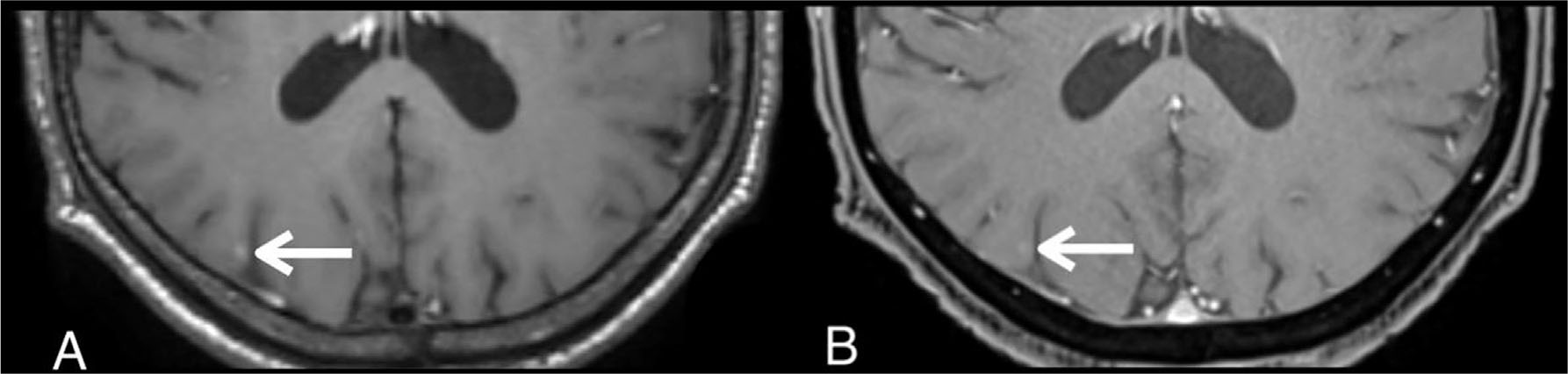
Figure 1
A 58-year-old lung cancer patient with a brain metastasis in the right occipital lobe (white arrow) that was missed by readers on contrast-enhanced 3D T1-weighted VIBE on a separate reading. Axial contrast-enhanced 3D T1-weighted SPACE (A) shows higher contrast enhancement compared with axial contrast-enhanced 3D T1-weighted VIBE (B).
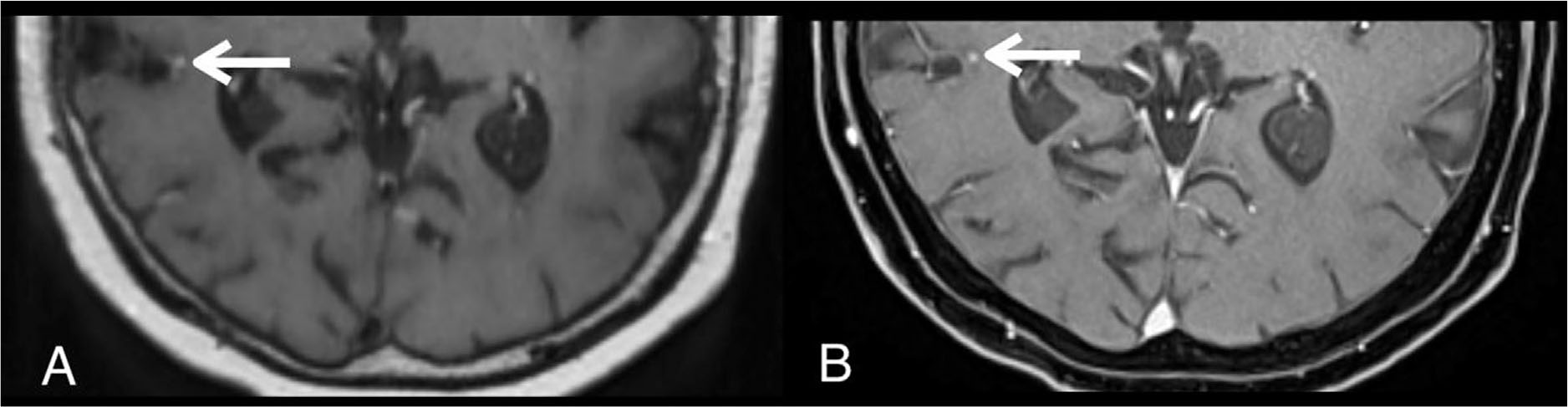
Figure 2
A 76-year-old lung cancer patient with a brain metastasis in the right temporal lobe (white arrow) that was missed by readers on contrast-enhanced 3D T1-weighted SPACE. Axial contrast-enhanced 3D T1-weighted SPACE (A) and contrast-enhanced 3D T1-weighted VIBE (B). The degree of enhancement is similar on both sequences. However, this lesion was missed because it located close to a vessel and was mistaken for an incompletely suppressed vascular signal on contrast-enhanced 3D T1-weighted SPACE (A). Axial contrast-enhanced 3D T1-weighted VIBE (B) clearly distinguishes parenchymal enhancing lesion and adjacent vascular structure.
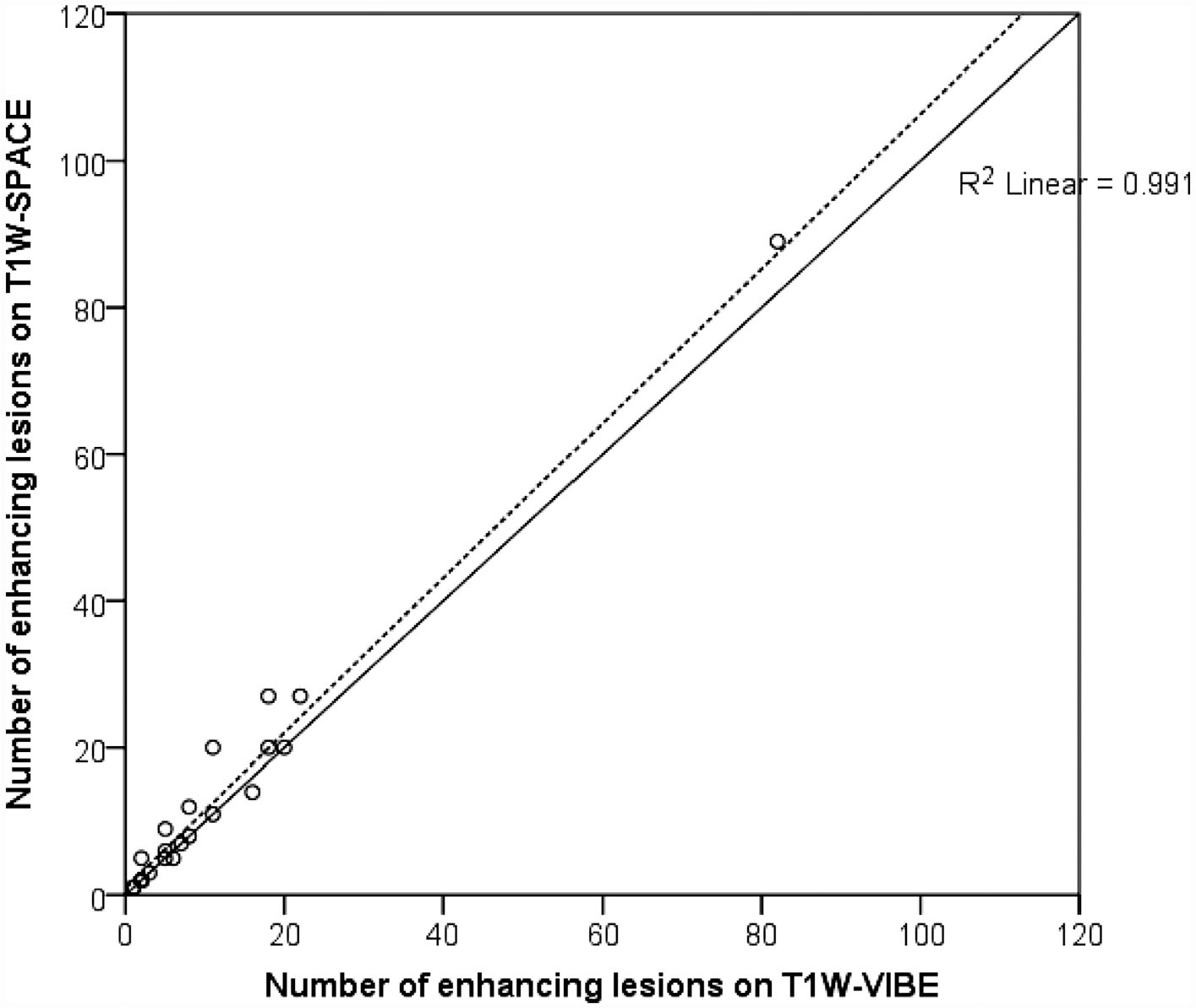
Figure 3
A scatter plot demonstrates correlation between the number of enhancing lesions on 3D T1-weighted SPACE and 3D T1-weighted VIBE. The black line represents the line of identity when y = x. The dotted line represents a trend line which was linearly fitted from the raw data. Note that the trend line lies above the line of identity which reflects a systematic difference between the two sequences.
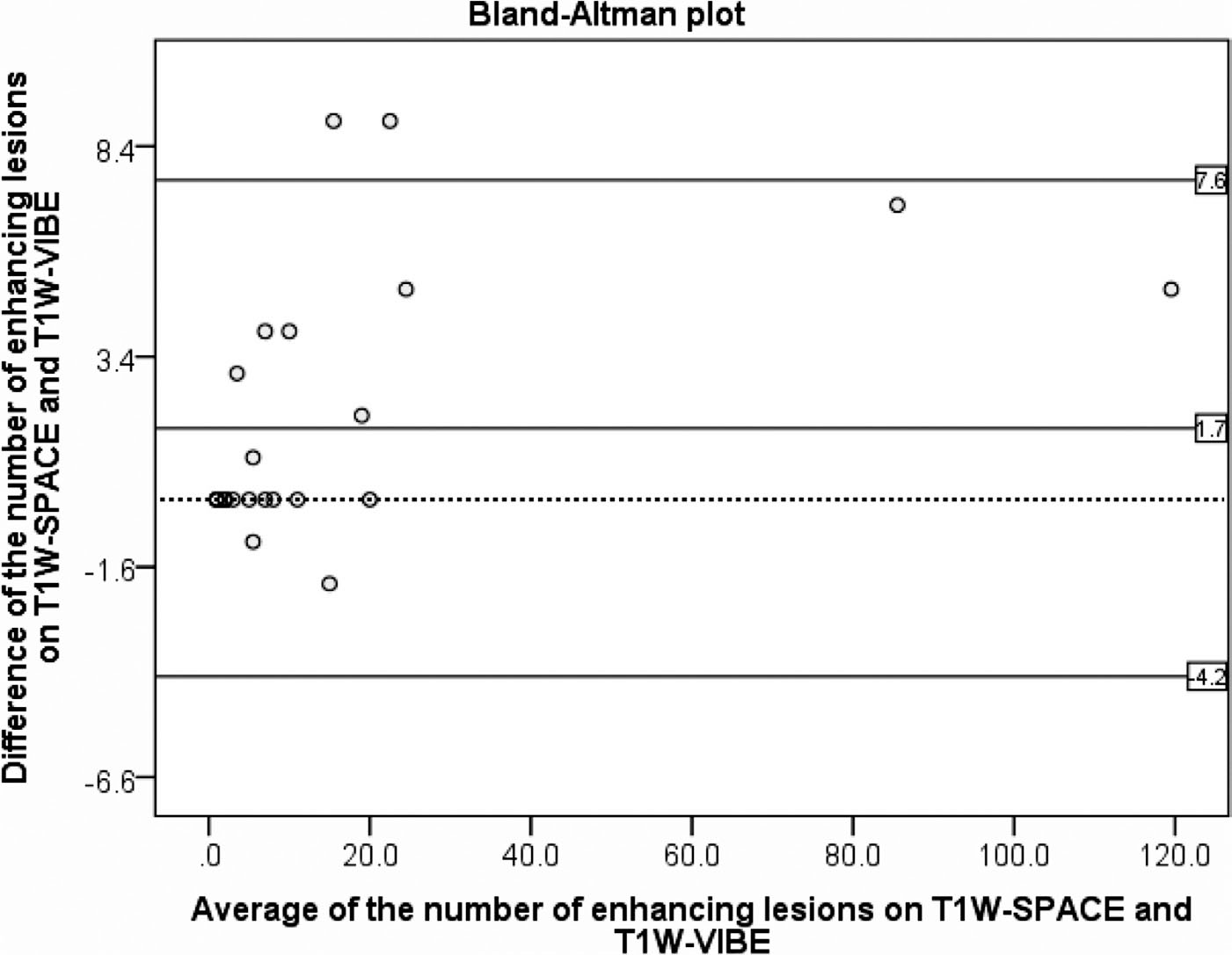
Figure 4
The Bland–Altman plot demonstrates higher variability when the number of the enhancing lesions is large. The dotted line shows value of zero.
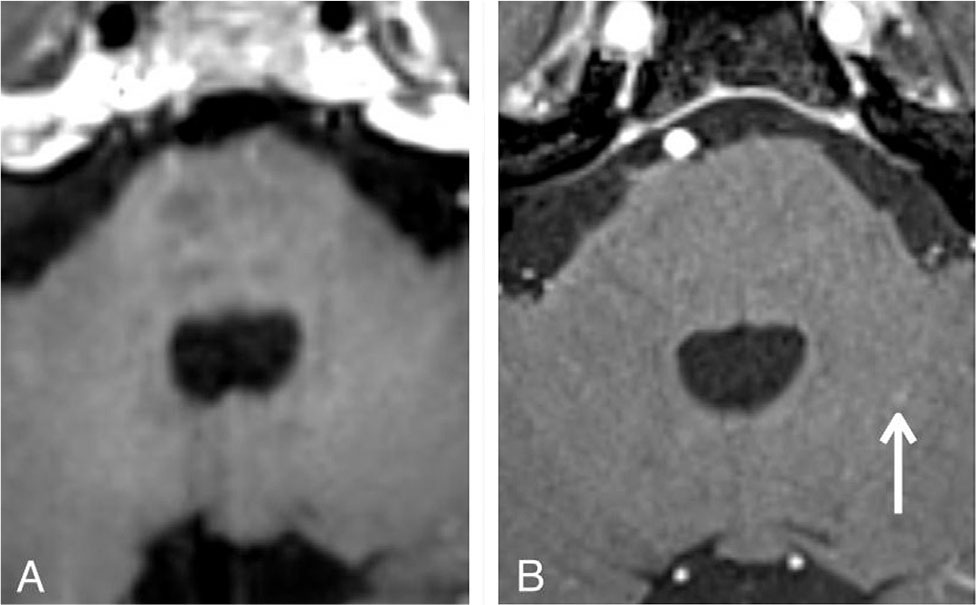
Figure 5
A 60-year-old lung cancer patient with a tiny enhancing lesion in the left cerebellar hemisphere (white arrow) that was not visible on contrast-enhanced 3D T1-weighted SPACE in head-to-head analysis. Axial contrast-enhanced 3D T1-weighted VIBE (B) shows a tiny enhancing lesion while contrast-enhanced 3D T1-weighted SPACE (A) shows no visible lesion.
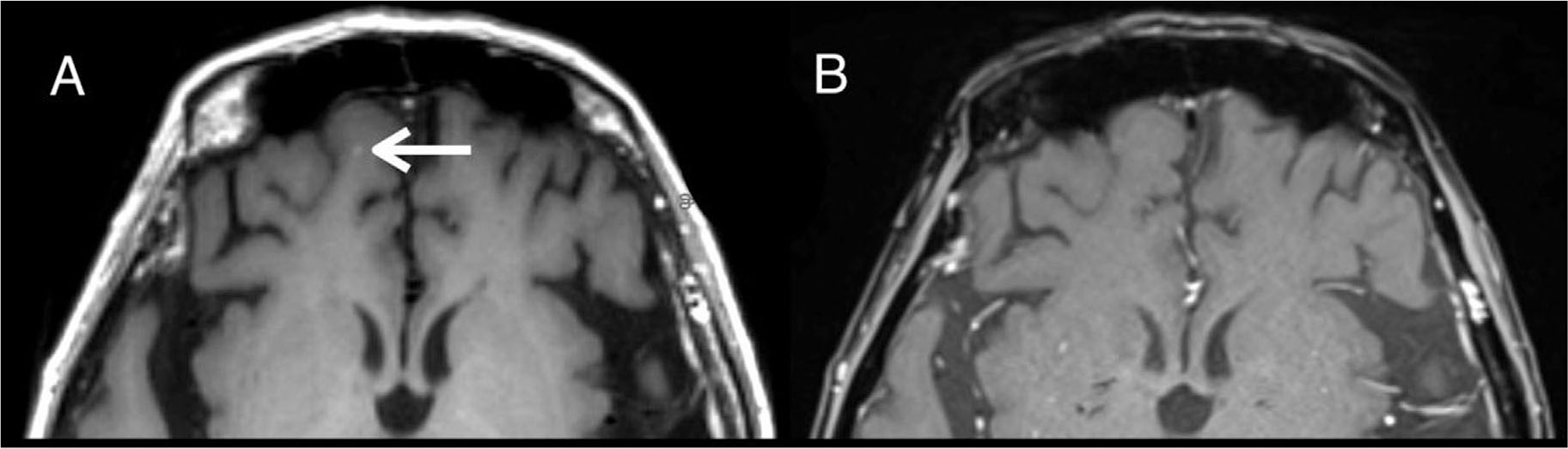
Figure 6
A 53-year-old breast cancer patient with a tiny metastasis in the right frontal lobe (white arrow) that was not visible on contrast-enhanced 3D T1-weighted VIBE in head-to-head analysis. Axial contrast-enhanced 3D T1-weighted SPACE (A) shows a tiny enhancing lesion while contrast-enhanced 3D T1-weighted VIBE (B) shows no visible lesion.
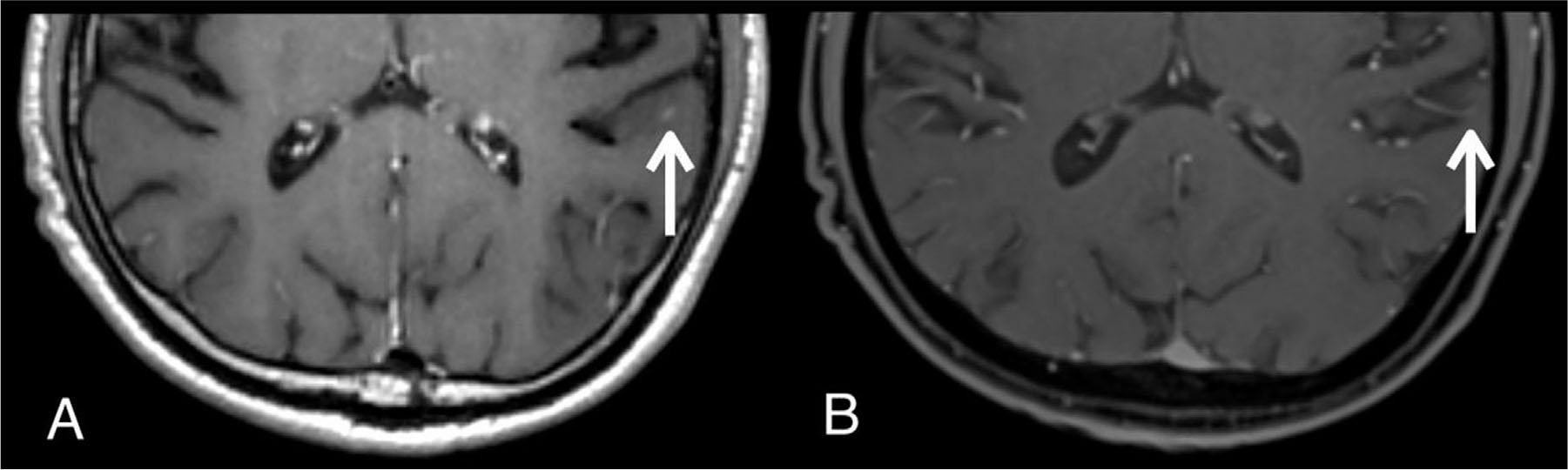
Figure 7
A 62-year-old lung cancer patient with a false-positive lesion in the left temporal lobe (white arrow). Axial contrast-enhanced 3D T1-weighted SPACE (A) and contrast-enhanced 3D T1-weighted VIBE (B). A false-positive lesion is a partial hyperintensity of a blood vessel which mimics enhancing brain metastasis on contrast-enhanced 3D T1-weighted SPACE (A). The linear hyperintensity continues as a vascular structure on contrast-enhanced 3D T1-weighted VIBE (B).