
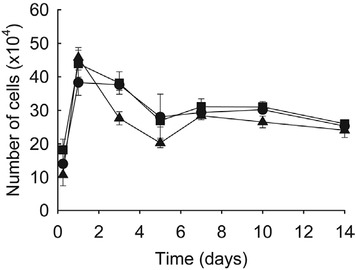
Figure 1
Growth kinetics of rat mesenchymal stem cells cultured in hydrogels. Squares indicate hydrogels made of 4% silk fibroin (SF) solution only (SF hydrogel), circles indicate hydrogels made of 4% SF solution + 0.05% collagen solution (SF/0.05C hydrogel), and triangles indicate hydrogels made of 4% SF solution + 0.1% collagen solution (SF/0.1C hydrogel). Error bars are standard deviations of triplicate experiments.
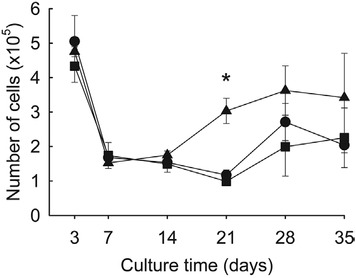
Figure 2
DNA assay of rat mesenchymal stem cells cultured in hydrogels in osteogenic induction medium. Squares indicate hydrogels made of 4% silk fibroin (SF) solution only (SF hydrogel), circles indicate hydrogels made of 4% SF solution + 0.05% collagen solution (SF/0.05C hydrogel), and triangles indicate hydrogels made of 4% SF solution + 0.1% collagen solution (SF/0.1C hydrogel). *P < 0.05 (one-way analysis of variance with a post hoc least significant difference test). Error bars are standard deviations of triplicate experiments.
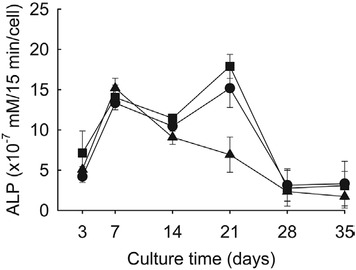
Figure 3
Alkaline phosphatase (ALP) activity of rat mesenchymal stem cells cultured on hydrogels in osteogenic induction medium. Units indicate mM p-nitrophenol produced per min per cell. Squares indicate hydrogels made of 4% silk fibroin (SF) solution only (SF hydrogel), circles indicate hydrogels made of 4% SF solution + 0.05% collagen solution (SF/0.05C hydrogel), and triangles indicate hydrogels made of 4% SF solution + 0.1% collagen solution (SF/0.1C hydrogel). Error bars are standard deviations of triplicate experiments.
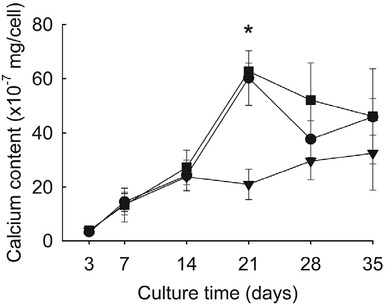
Figure 4
Calcium content of rat mesenchymal stem cells cultured on hydrogels in osteogenic induction medium. Squares indicate hydrogels made of 4% silk fibroin (SF) solution only (SF hydrogel), circles indicate hydrogels made of 4% SF solution + 0.05% collagen solution (SF/0.05C hydrogel), and triangles indicate hydrogels made of 4% SF solution + 0.1% collagen solution (SF/0.1C hydrogel). *P < 0.05 (one-way analysis of variance with a post hoc least significant difference test). Error bars are standard deviations of triplicate experiments.
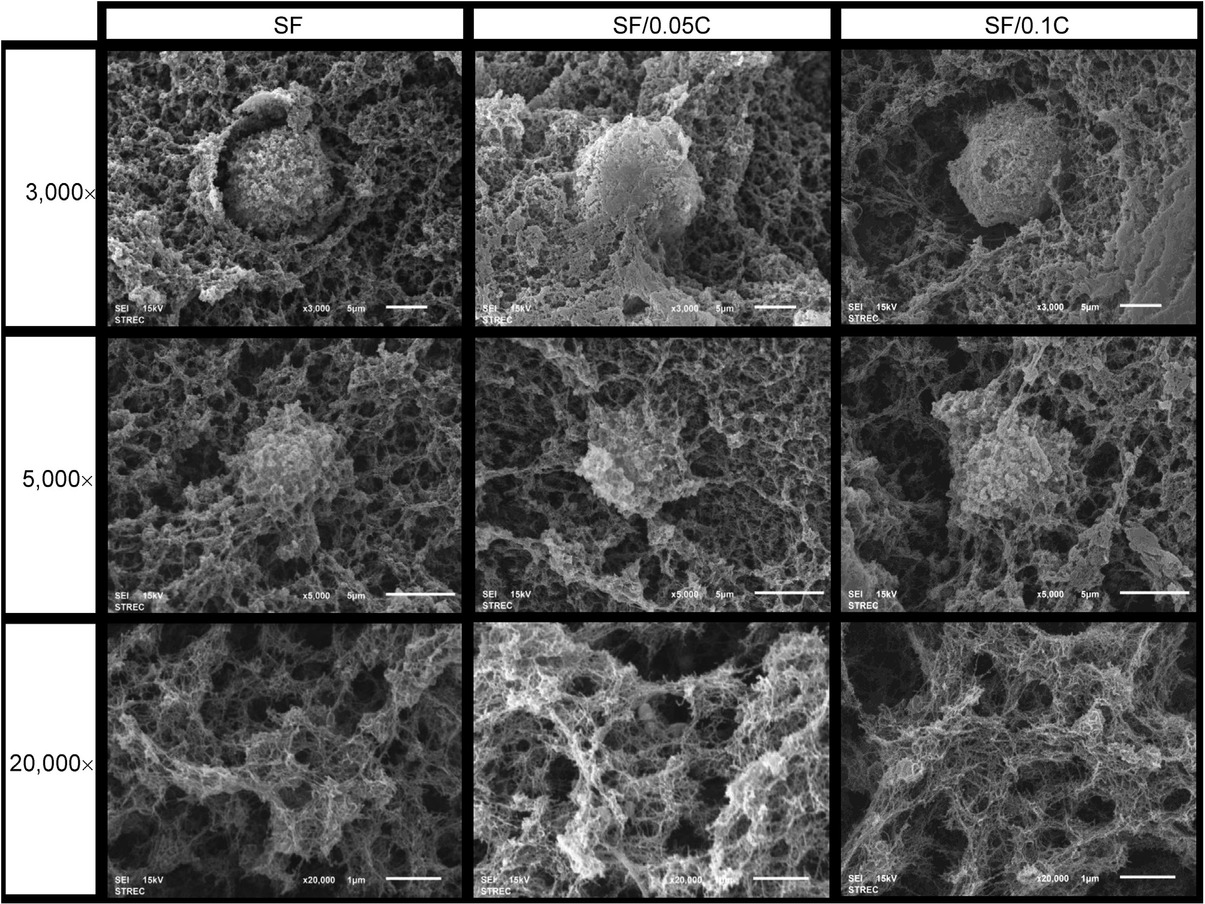
Figure 5
SEM images of rat MSCs cultured in hydrogels under different magnifications. SF (hydrogel made of 4% silk fibroin (SF) solution only, SF/0.05C (hydrogel made of 4% SF solution + 0.05% collagen solution), and SF/0.1C (hydrogel made of 4% SF solution + 0.1% collagen solution).