
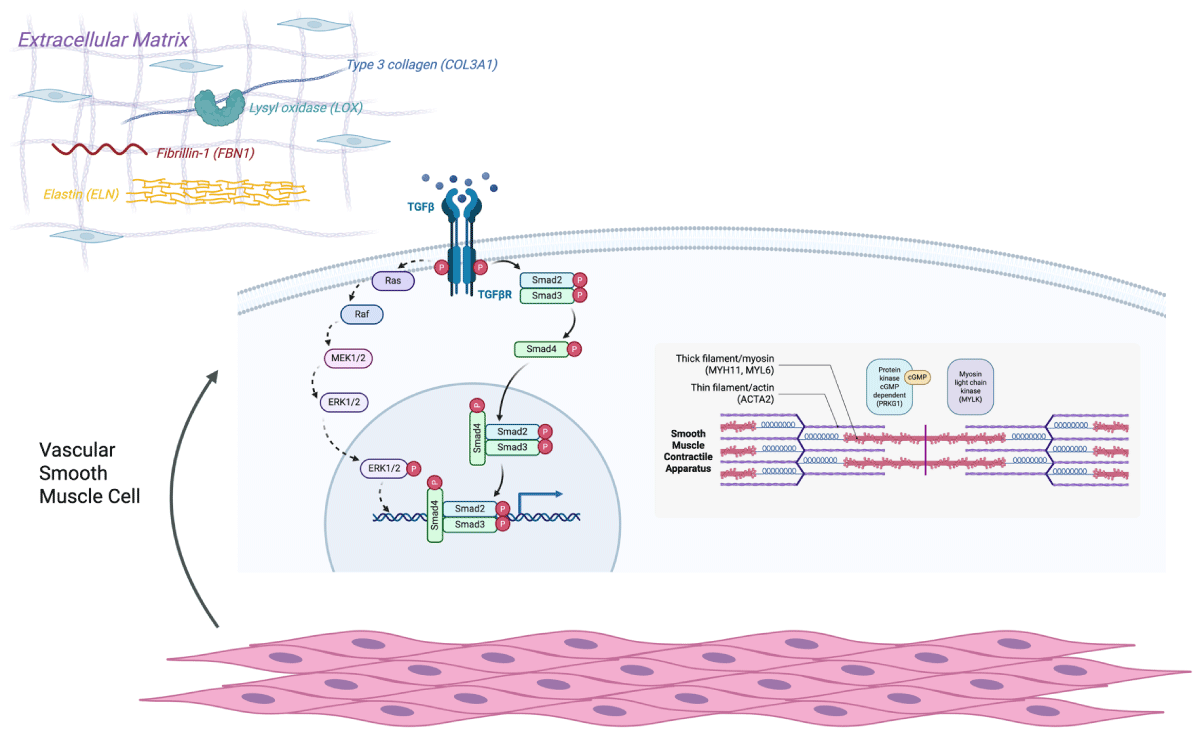
Figure 1
Pathogenic variants in the extracellular matrix, TGFβ signaling pathway, and smooth muscle contractile apparatus. Schematic of genetic variants associated with thoracic aortopathy. Genetic variants associated with thoracic aortopathy include those involved in the extracellular matrix, TGFβ signaling pathway, and smooth muscle contractile apparatus, all of which are essential to maintain connective tissue homeostasis and vascular wall integrity. During smooth muscle signaling, fibrillin proteins coordinate the co-localization of inactive TGFβ with ligands. Activation of the TGFβ receptor leads to the phosphorylation and activation of SMAD and other transcription factors, which leads to downstream signaling and activation of the smooth muscle contractile apparatus. In the extracellular matrix, variants affect elastin (ELN), fibrillin-1 (FBN), lysyl oxidase (LOX), and type 3 collagen (COL3A1). In the TGFβ signaling pathway, variants affect TGFβ isoforms, the TGFβ receptor, SMAD transcription factors (SMAD2, SMAD3, and SMAD4), and additional factors (ERK, JNK, and p38). In the smooth muscle contractile apparatus, variants affect the actin thin filaments (ACTA2), myosin heavy chain (MYH11), myosin light chains (MYL6), and additional regulatory proteins such as myosin light chain kinase (MYLK) and cGMP-dependent protein kinase (PRKG1). Created in BioRender. Wittenberg R. (2026) https://BioRender.com/mgpwapl.
Table 1
Syndromic heritable thoracic aortic disease.
| SYNDROME | GENE | AFFECTED PROTEIN | PREVALENCE | PRIMARY INHERITANCE PATTERN | OTHER PHENOTYPIC FINDINGS | THRESHOLD FOR PROPHYLACTIC AORTIC SURGERY3,* |
|---|---|---|---|---|---|---|
| Marfan Syndrome13,14,47,61 | FBN1 | Fibrillin-1 | 1:5,000 | Autosomal dominant | Long bone overgrowth and joint laxity, dolichostenomelia, pectus excavatum/carinatum, scoliosis, myopia, ectopia lentis, retinal detachment, glaucoma, early cataracts, mitral or tricuspid valve prolapse, pulmonary artery enlargement | 4.5–5.0 cm |
| Loeys-Dietz Syndrome16,17,19 | TGFB2 TGFB3 TGFBR1 TGFBR2 SMAD2 SMAD3 | TGFβ signaling proteins | 1:50,000 | Autosomal dominant | Pectus excavatum/carinatum, scoliosis, joint laxity, arachnodactyly, talipes equinovarus, cervical spine instability, hypertelorism, strabismus, bifid uvula/cleft palate, craniosynostosis, velvety/translucent skin, easy bruising, dystrophic scars, uterine rupture, extra-aortic aneurysms | 4.0–5.0 cm |
| Vascular Ehlers-Danlos Syndrome (Ehlers-Danlos Syndrome Type IV)20,21,62 | COL3A1 | Collagen type III alpha 1 chain | 1:50,000 | Autosomal dominant | Spontaneous pneumothorax, congenital hip dislocation, hypermobility, keratoconus, tendon and muscle rupture, talipes equinovarus, bowel and uterine rupture, sunken eyes, narrow nose, gingival recession, lobeless ears, acrogeria, easy bruising, translucent skin, varicose veins, extra-aortic aneurysms | 4.0–5.0 cm |
| Multisystem Smooth Muscle Dysfunction Syndrome24 | ACTA2 (Arginine 179 Variant) | Smooth muscle alpha actin | 1:1,000,000 | Autosomal dominant (majority de novo) | Congenital mydriasis, patent ductus arteriosus or aorto-pulmonary window, pulmonary artery hypertension, moyamoya-like cerebrovascular disease, intestinal hypoperistalsis and malrotation, hypotonic bladder | 4.2–4.5 cm |
| Shprintzen-Goldberg Syndrome25,26,63 | SKI | TGFβ signaling protein | Very rare | Autosomal dominant (majority de novo) | Developmental delay (motor and cognitive), craniosynostosis, dolichostenomelia, arachnodactyly, camptodactyly, pectus excavatum/carinatum, scoliosis, joint hypermobility or contractures, pes planus, foot malposition, cervical spine malformations, abdominal wall defects, myopia, mitral valve prolapse, atrial septal defects | Individualized recommendations |
| Arterial Tortuosity Syndrome27,28 | SLC2A10 | Glucose transporter in TGFβ signaling | Very rare | Autosomal Recessive | Pulmonary artery stenosis, soft or hyperextensible skin, joint hypermobility, inguinal or diaphragmatic hernias, pectus excavatum/carinatum, arachnodactyly, scoliosis, joint contractures, camptodactyly, cerebrovascular and abdominal infarction | Individualized recommendations |
| Ehlers-Danlos Syndrome with Periventricular Nodular Heterotopia29,30 | FLNA | Filamin A | Very rare | X-Linked | Seizures, subependymal gray matter peri-ventricular nodules, hyperextensible skin, joint hypermobility, tissue fragility, patent ductus arteriosus, bicuspid aortic valve, congenital lung disease | Individualized recommendations |
| Meester-Loeys Syndrome31,32,64 | BGN | Biglycan | Very rare | X-Linked | Hypertelorism, bifid uvula, cervical spine instability, pectus excavatum/carinatum, joint hypermobility or contractures, striae, extra-aortic aneurysms | Individualized recommendations |
| LOX-Related Thoracic Aortic Aneurysm33,34 | LOX | Lysyl oxidase | Very rare | Autosomal dominant | High-arched palate, pectus excavatum/carinatum, dolichostenomelia, scoliosis, joint hypermobility, skin striae, dural ectasia, bicuspid aortic valve | Individualized recommendations |
[i] *All surgical recommendations are individualized based on genotype- and phenotype-specific features, family history, and shared decision making.
Table 2
Genes associated with heritable thoracic aortic disease.8
| GENE | PROTEIN | OMIM NUMBER | HUMAN SYNDROME | CLINICAL PATHWAY |
|---|---|---|---|---|
| Category A: Definite or Strong Gene-Disease Association | ||||
| ACTA2 | Alpha smooth muscle actin | 102620 | Multisystemic smooth muscle dysfunction syndrome (R179) | Cytoskeletal/smooth muscle contraction |
| COL3A1 | Collagen 3 alpha-1 | 120180 | Ehlers-Danlos syndrome, type IV | Collagen |
| FBN1 | Fibrillin-1 | 134797 | Marfan syndrome | TGFβ signaling |
| MYH11 | Smooth muscle myosin | 160745 | Cytoskeletal/Smooth Muscle Contraction | |
| MYLK | Myosin light chain kinase | 600922 | Cytoskeletal/smooth muscle contraction | |
| SMAD3 | SMAD family member 3 | 603109 | Loeys-Dietz syndrome, type 3/aneurysms-osteoarthritis syndrome | TGFβ signaling |
| TGFB2 | Transforming growth factor beta 2 | 190220 | Loeys-Dietz syndrome, type 4 | TGFβ signaling |
| TGFBR1 | Transforming growth factor beta receptor 1 | 190181 | Loeys-Dietz syndrome, type 1 | TGFβ signaling |
| TGFBR2 | Transforming growth factor beta receptor 2 | 190182 | Loeys-Dietz syndrome, type 2 | TGFβ signaling |
| Category B: Moderate or Limited Gene-Disease Association (Primarily Associated with Other Features; Do Not Carry Significant Risk of Progression to Aortic Dissection) | ||||
| ELN | Elastin | 130160 | Cutis laxa | Extracellular matrix |
| FBN2 | Fibrillin-2 | 612570 | Congenital contractures | Extracellular matrix |
| FLNA | Filamin A | 300017 | Periventricular nodular heterotopia | Cytoskeletal/smooth muscle contraction |
| NOTCH1 | Notch 1 | 190198 | Associated with bicuspid aortic valve | Developmental |
| SKI | v-SKI sarcoma oncogene homolog | 164780 | Shprintzen-Goldberg syndrome | TGFβ signaling |
| SLC2A10 | Glucose transporter type 10 | 606145 | Arterial tortuosity syndrome | TGFβ signaling |
| SMAD4 | SMAD family member 4 | 600993 | Juvenile polyposis syndrome/hereditary hemorrhagic telangiectasia syndrome | TGFβ signaling |
| EFEMP2 | Fibulin 4 | 604633 | Cutis laxa type 1B | Extracellular matrix |
| Category C: Limited Gene-Disease Association (Diagnosis Primarily Based on Non-Vascular Features) | ||||
| CBS | Cystathionine beta-synthase | 613381 | Homocystinuria | Miscellaneous/Unknown |
| COL4A5 | Collagen 4-alpha5 | 303630 | X-linked Alport syndrome | Collagen |
| PKD1 | Polycystin 1 | 601313 | Polycystic kidney disease with intracranial aneurysms | Miscellaneous/Unknown |
| PKD2 | Polycystin 2 | 173910 | Polycystic kidney disease with intracranial aneurysms | Miscellaneous/Unknown |
| Category D: No Clinical Evidence for Gene-Disease Association | ||||
| ACVRL1 | Activin receptor-like kinase 1 | 601284 | Hereditary hemorrhagic telangiectasia syndrome, type 2 | TGFβ signaling |
| ADAMTS10 | A disintegrin and metalloproteinase with thrombospondin motifs 10 | 608990 | Weill-Marchesani syndrome | Miscellaneous/Unknown |
| B3GAT3 | Galactosylgalactosylxylosylprotein 3-beta-glucuronosyltransferase 3 | 606374 | Larsen-like syndrome | Extracellular matrix |
| COL11A1 | Collagen 11 alpha-1 | 120280 | Stickler syndrome, type 2/Marshall syndrome | Collagen |
| COL18A1 | Collagen 18 alpha-1 | 120328 | Knobloch syndrome | Collagen |
| COL1A1 | Collagen 1 alpha-1 | 120150 | Ehlers-Danlos syndrome, type 7A, osteogenesis imperfecta | Collagen |
| COL1A2 | Collagen 1 alpha-2 | 120160 | Ehlers-Danlos syndrome, type 7B, osteogenesis imperfecta | Collagen |
| COL4A1 | Collagen 4 alpha-1 | 120130 | HANAC | Collagen |
| COL5A1 | Collagen 5 alpha-1 | 120215 | Ehlers-Danlos syndrome, type 1–2 | Collagen |
| COL5A2 | Collagen 5 alpha-2 | 120190 | Ehlers-Danlos syndrome, type 1–2 | Collagen |
| COL9A1 | Collagen 9 alpha-1 | 120210 | Multiple epiphyseal dysplasia | Collagen |
| COL9A2 | Collagen 9 alpha-2 | 120260 | Multiple epiphyseal dysplasia | Collagen |
| EMILIN1 | Elastin microfibril interfacer 1 | 130660 | Miscellaneous/Unknown | |
| ENG | Endoglin | 131195 | Hereditary hemorrhagic telangiectasia syndrome | TGFβ signaling |
| GATA5 | GATA binding protein 5 | 611496 | Associated with bicuspid aortic valve | Miscellaneous/Unknown |
| GJA1 | Connexin-43 | 121014 | Associated with hypoplastic left heart syndrome | Miscellaneous/Unknown |
| JAG1 | Jaggard-1 | 601920 | Alagille syndrome | Developmental |
| MED12 | Mediator of RNA polymerase II transcription, subunit 12 homolog | 300188 | Lujan-Fryns syndrome | Miscellaneous/Unknown |
| PLOD1 | Lysyl hydroxylase 1 | 153454 | Ehlers-Danlos syndrome, type VI | Extracellular matrix |
| PLOD3 | Lysyl hydroxylase 3 | 603066 | Bone fragility, contractures, arterial rupture, deafness | Extracellular matrix |
| SMAD6 | SMAD family member 6 | 602931 | TGFβ signaling | |
| UPF3B | Regulator of nonsense transcripts 3b | 300298 | Miscellaneous/Unknown | |
| VCAN | Versican | 118661 | Miscellaneous/Unknown | |
| LOX* | Lysyl oxidase | 153455 | Extracellular matrix | |
| PRKG1* | Protein kinase, cGMP-dependent, type 1 | 176894 | Cytoskeletal/smooth muscle contraction | |
| Recent Genes | ||||
| BGN | Biglycan | 301870 | Meester-Loeys syndrome | Extracellular matrix |
| FOXE3 | Forkhead box 3 | 601094 | Miscellaneous/Unknown | |
| HCN4 | Hyperpolarization activated cyclic nucleotide gated potassium channel 4 | 605206 | Miscellaneous/Unknown | |
| MAT2A | Methionine adenosyltransferase II, alpha | 601468 | Extracellular matrix | |
| MFAP5 | Microfibril-associated glycoprotein 2 | 601103 | Extracellular matrix | |
| SMAD2 | SMAD family member 2 | 601366 | TGFβ signaling | |
| TGFB3 | Transforming growth factor beta 3 | 190230 | Loeys-Dietz syndrome, type 5 | TGFβ signaling |
[i] *Subsequent accumulated genetic evidence since 2018 has strongly causally implicated LOX and PRKG1 in thoracic aortic disease.
Table 3
Comparison of loci identified in three or more genome-wide association studies (GWAS) studies.
| NEAREST GENE | TCHEANDJIEU ET AL., 202240 | NEKOUI ET AL., 202241 | KLARIN ET AL., 202339 | PIRRUCCELLO ET AL., 202142 | FRANCIS ET AL., 202243,* |
|---|---|---|---|---|---|
| ELN | ✓ | ✓ | ✓ | ✓ | ✓ |
| FBN1 | ✓ | ✓ | ✓ | ✓ | ✓ |
| PRDM6 | ✓ | ✓ | ✓ | ✓ | ✓ |
| SMG6 | ✓ | ✓ | ✓ | ✓ | ✓ |
| TBX20 | ✓ | ✓ | ✓ | ✓ | ✓ |
| THSD4 | ✓ | ✓ | ✓ | ✓ | ✓ |
| ULK4 | ✓ | ✓ | ✓ | ✓ | ✓ |
| ADAMTS8 | × | ✓ | ✓ | ✓ | ✓ |
| AIG1 | ✓ | ✓ | × | ✓ | ✓ |
| ANGPT1 | ✓ | ✓ | × | ✓ | ✓ |
| CBFA2T3 | ✓ | ✓ | × | ✓ | ✓ |
| CDH13 | × | ✓ | ✓ | ✓ | ✓ |
| EDN1 | ✓ | ✓ | × | ✓ | ✓ |
| FGD5 | ✓ | ✓ | × | ✓ | ✓ |
| FLNB | ✓ | ✓ | × | ✓ | ✓ |
| GATA2 | ✓ | ✓ | × | ✓ | ✓ |
| HAS2 | ✓ | ✓ | × | ✓ | ✓ |
| TNRC6B | ✓ | ✓ | × | ✓ | ✓ |
| USP15 | ✓ | ✓ | × | ✓ | ✓ |
| WWP2 | ✓ | ✓ | × | ✓ | ✓ |
| ANO1 | ✓ | ✓ | × | ✓ | × |
| COL6A3 | × | ✓ | ✓ | ✓ | × |
| DCDC1 | × | ✓ | × | ✓ | ✓ |
| DLEU1 | × | ✓ | ✓ | ✓ | × |
| ESR1 | × | ✓ | × | ✓ | ✓ |
| FGGY | × | ✓ | × | ✓ | ✓ |
| GNAO1 | × | ✓ | × | ✓ | ✓ |
| MASP1 | ✓ | × | × | ✓ | ✓ |
| NOC3 L | ✓ | × | × | ✓ | ✓ |
| OSR1 | × | ✓ | ✓ | ✓ | × |
| SLX4IP | × | ✓ | × | ✓ | ✓ |
| SPSB1 | × | × | ✓ | ✓ | ✓ |
| ZNF827 | × | ✓ | ✓ | × | ✓ |
[i] *For Francis et al., 2022, multiple GWAS were conducted. Genes relating to loci identified in the GWAS for maximum ascending aortic diameter are considered in this table.
Table 4
Select thoracic aortic aneurysm polygenic risk factor studies. GWAS: genome wide association studies; MRI: magnetic resonance imaging; PRS: polygenic risk score
| STUDY | PRIMARY BIOBANK/DATASET | OUTCOME OF INTEREST | FINDINGS |
|---|---|---|---|
| High Heritability of Ascending Aortic Diameter and Trans-Ancestry Prediction of Thoracic Aortic Disease (Tcheandjieu et al., 2022)40 | UK Biobank | Ascending aortic diameter, TAA, surgical intervention for TAA |
|
| Spatially Distinct Genetic Determinants of Aortic Dimensions Influence Risks of Aneurysm and Stenosis (Nekoui et al., 2022)41 | UK Biobank | Left ventricular outflow tract, aortic root, and ascending aorta diameter |
|
| Genome-Wide Association Study of Thoracic Aortic Aneurysm and Dissection in the Million Veteran Program (Klarin et al., 2023)39 | Million Veteran Program | TAA/thoracic aortic dissection |
|
| The AORTA Gene Score for Detection and Risk Stratification of Ascending Aortic Dilation (Pirruccello et al., 2024)44 | UK Biobank | Ascending aortic diameter |
|
| Development and Validation of a Clinical Polygenic Risk Report in U.S.-Based Health Systems for 8 Cardiovascular Conditions (Misra et al., 2026)45 | Mass General Brigham Biobank | TAA |
|