
Introduction
This report on Maya Medicine draws on coauthor Juan Olivero’s upbringing in Guatemala and his firsthand experiences with Maya shamans successfully treating external injuries there. It examines this traditional practice against the backdrop of advanced scientific studies that have expanded our knowledge of Maya civilization as well as recent scientific breakthroughs, including the decipherment of Maya hieroglyphics and advancements in archaeology, climate science, and genetic analysis.1
The Maya
The Maya were one of many civilizations that developed and flourished in pre-Colombian Mesoamerica. They spoke 28 distinct but related dialogues and numbered more than 16 million at the peak of their evolution. While they shared cultural and linguistic traits with local civilizations, they were distinguished by their hieroglyphics, architectural feats, cultivation of maize, creation of water irrigation and purification, a detailed recording of the history and deeds of their elite rulers related to their ritual-based calendar, and the first road network in the new world.2,3 In addition, they are credited for developing the mathematical concept of zero, cacao chocolate, hallucinogenic plants, and rubber. They were keen celestial observers who predicted astronomical events with remarkable accuracy, although much of their observations served astrological rather than astronomical purposes.4,5,6,7,8
Their origin is traced to diverse groups of Olmec people who moved from the lowlands of southeastern Mexico to Mesoamerica between 1000 BCE and 700 BCE, building tribal villages that gradually evolved into large city states early in their Classic period (Figure 1). A defining hallmark of Maya architecture was their stone cities with a large central ball court surrounded by stepped pyramids topped by temples, and elevated flat-roofed structures topped by palaces that housed their elite rulers and priests. Over time, stellae and altars were erected in the plazas to glorify their leaders and deities. The populace lived in isolated clusters of one-room houses scattered in the surrounding area and linked to the center by paved roadways. Basic highlights of their lives included rubber ball games in the central courts and elaborate rituals performed by their rulers and priests atop the pyramids.5,6,7 While the Egyptians and Mesopotamians built pyramids for a 2,000-year period ending around 500 BCE, Maya pyramid construction began around 900 BCE and continued for another 1,500 years, into the post-classic period (Figure 1). Unlike the Egyptian pyramids, which served primarily as tombs, Maya pyramids were temples used to perform rituals. Furthermore, compared to Mesopotamian ziggurats, they featured much more ornate decorations, such as intricate carvings, murals, and sculptures.
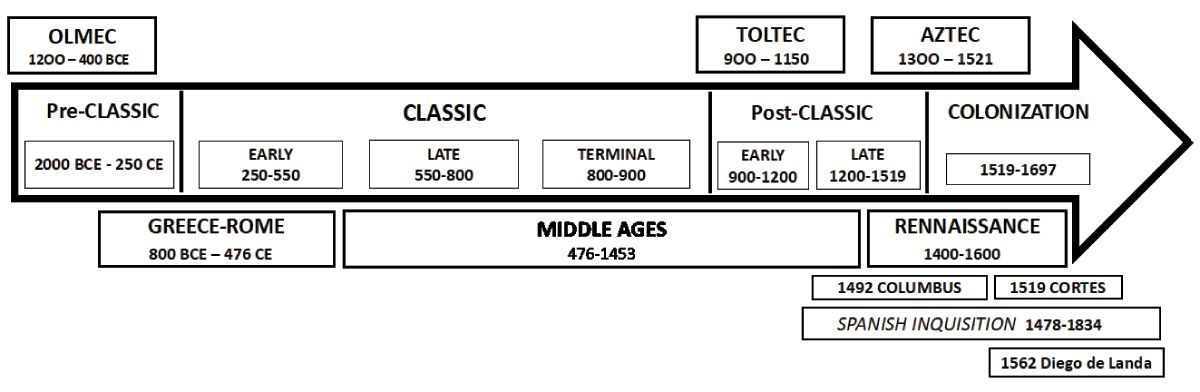
Figure 1
Timeline of the evolution of the Maya civilization. The boxes above the arrow show regional Mesoamerican cultures. The boxes below the arrow show the progress of Western civilization in the Old World.
The Maya never formed a unified nation, existing instead as a network of 60 independent city-states that frequently allied and warred with one another. Around 900 CE, these cities were mysteriously abandoned and fell into ruin. Like the collapses of other ancient civilizations, the Maya’s downfall remains a subject of ongoing debate, with experts attributing it to a complex combination of warfare, severe drought, climate change, epidemics, and soil degradation.9
Spanish conquistadors arrived in 1519, but the fragmented, distant Maya city-states resisted until 1697. Early in the conquest, Franciscan and Dominican friars forcibly converted the Maya to Christianity and destroyed virtually all indigenous historical records. Today, only four Maya codices survive. Ultimately, the cities were abandoned, only to be rediscovered in the 19th century—a process of archaeological exploration that continues to uncover new sites.2,3,5
As confirmed by genetic analysis, the Maya never disappeared (unlike other civilizations). Their culture survived and their language and rituals were preserved, particularly in the Guatemalan highlands where some six million Mayans still depend on traditional healers who practice the medicine of their predecessors.10,11
Maya Medicine
The Maya believed that humans were created by their prime god Hunab from his own flesh and maize, while his son Itzamná was the lord of heaven and sun, and his wife Ixchel was the goddess of the moon and medical matters. Their four sons, the Bacabs, were assigned to holding the four corners of heaven to prevent it from falling. Although all six are invoked in medical incantations, Ixchel is specifically identified as the Maya goddess of medicine and midwifery.7,12
Maya medicine was practiced by shamans, known as ah-men (literally translated as “one who knows”), who were part of their priesthood but of a lower social standing than that of the ruling elite priests. Maya medicine was passed from one generation to the next, although entry to the profession could be made following an extensive tutorial training with an established shaman.8,13 Whether there once were extant medical texts that were destroyed during the purging of Maya codices in 1652 by the Christian missionaries will never be known.
Maya medicine was essentially spiritual, combining religious, magic, psychic, supernatural, and enchantment elements with a rather limited spatter of science accrued over the ages. Disease was attributed to the body’s invasion by evil spirits that disturbed its balance and had to be extricated by prayer and supplication designed to appease and expel the invading evil spirits. Being a holistic medicine, the body’s life forces were considered to be interconnected with nature and the cosmos, which provided the general framework for their overall healing practices. Sickness was considered divine punishment for wrong doing or neglect of religious duties.14,15,16
Each therapeutic session was a religious ceremony that began with a patient confession of potential sins that may have contributed to or caused the illness, followed by incantations by the shaman invoking divine guidance and the help of benevolent spirits to placate and banish the evil spirits. Disease was considered a semipersonalized being and addressed by the shamans as a person in their incantations and invocations, such as “I curse you little seizure.”18,19 It involved some massaging of the abdomen, concluding with a diagnosis for which an appropriate treatment was prescribed. While the abdominal massaging may have served some diagnostic purpose, it was used as a therapeutic procedure to realign the internal abdominal organs and used primarily in digestive diseases and feminine disorders. Treatment consisted mostly of plant-based remedies that could be ingested, smoked, or given as a poultice or enema.20
Sweat houses were sacred spaces for hydrotherapy and spiritual purification. Through sacred rituals, they aimed to heal and restore balance to both body and spirit. Other cleansing treatments included self-induced vomiting and self-administered enemas.21 Bleeding was also used in therapy, where a sharp viper tooth was pressed into specific points of the body to draw blood that was meant to release bad fluids and spirits from the body.22
Surgical intervention was limited to minor procedures, and human hair was used for suturing. They were reasonably adept at setting bones and healing fractures. They also excelled in dentistry, scraping tartar, filling cavities, inserting dental inlays of jade, turquoise, or precious metals, and administering herbal poultices for pain.14,15,23 They were highly skilled at treating mental disorders suited for their spiritual-based therapies.16
Maya Medical Science
Maya medicine was essentially one of caring rather than curing, with treatments directed at symptoms rather than specific organ-based diseases. It consisted of long lists of symptoms, incantations, rituals, and an equally extensive list of therapeutic recipes without any explanation of their effectiveness or how they were conceived. Ancient Maya medicine was deeply divinatory, lacking the rational, science-based approach developed by Old World contemporaries like the Greeks, Romans, Arabs, and Byzantine (Figure 1). The more intellectually advanced Western medicine introduced in New Spain (the 16th-18th centuries) still shared a heavy reliance on herbal remedies. Interestingly, despite dramatic population declines, life expectancy in both Old and New Spain remained largely unchanged until the late 19th century.24
The Maya had scant knowledge of anatomy and physiology, although their limited knowledge in anatomy expanded following the intrusion of Mexican civilizations. As a result, Mayan human sacrifice and extraction of the heart, dating back to the first millennium, became increasingly more prevalent over time, particularly after the invasion of the Aztecs (Figure 1). Human sacrifice and the ritual extraction of the heart in turn helped formulate their concept of the cardiovascular circulation.25,26
The heart was pulled from the incised diaphragm or sternum and separated from anchoring vessels outside the rib cage using jade knives or an ax—essentially ripped out of the chest.27 Sacrificial victims were smeared in blue, the color of the sky, the sea, and of their rain god that was considered to represent tranquility. Victims also were sacrificed by decapitation or abdominal evisceration. The entrails were then burned, offering the rising smoke in sacrifice to the gods.26,27 Unlike the Egyptians’ meticulous embalming of dead bodies, the Maya’s immediate removal and disposition of entrails from sacrificed bodies did not allow for their anatomical evaluation. In extant scenes of sacrificial ceremonies or those wounded in battle, the depicted organs lack detail or even actual semblance to their natural structure. For example, the intestines were shown as “a bubbly almost shapeless mass with an irregular outline.”25
Another source of anatomical information on internal organs derived by other ancient civilizations (Egyptians, Sumerian) was from that of animals butchered for food. The Mayan diet, however, was largely vegetarian and consisted of maize, beans, and squash. Mayans had limited domesticated animals, and meat from hunted animals was rare.2,3,4,5 Thus, although Mayans may have acquired a superficial notion of body organs, it never developed into the sophistication achieved by the Egyptians or the Babylonians. The 16th century Florentine Codex compiled by the Franciscan friar Bernardino de Sahagun dedicates Chapter 27 to the listing of the external and internal organs. Of the 14 paragraphs in the chapter, one is dedicated to the internal organs. The heart is classified as “round, hot, it lives, it beats, it jumps, it beats repeatedly, I know in my heart, heart disease.”27,28,29,30,31
Their concept of physiology consisted of a vague homeostasis between cold and hot.32 Essentially the body’s balance was one of an equilibrium between complementary opposites of cold and heat, the nature of whose disturbance was made by the diagnosis and accordingly restored by the appropriate treatment following the principle of opposites. Diseases considered hot were treated with cold and vice versa.31 Taking the pulse was used to evaluate imbalances.33
The Maya never attributed diseases to organs, although they did classify illnesses by locality—such as imbalance in the abdomen, chest, or head. They also used a systemic alternative functional classification, such as alimentary, respiratory, psychic, and excretory-reproductive.13,14,15,16,17,18
Mayan Concept of the Cardiovascular System
The Mayans were aware of blood circulation. Self-induced mutilation was an important component of their religious ritual ceremonies when rulers induced bleeding from their extremities, ear, nose, tongue and penis using plant thorns, Stingray spines, or jade knives. The blood of these ceremonial events or that of ritualized human sacrifices was intended as food to the gods and connected them directly to their gods.25 The extraction of the still-beating heart while the rest of the body paled, lost its balance of heat versus cold, and dropped motionless probably accounts for why the heart came to be considered the site of vital power, where blood was deemed to be vitalized. Rather than just an organ, the Maya viewed the heart as the site of moods, where emotions generated and resided. Maya words for the heart reflect its spiritual and emotional meanings such as Ruk’u’x (vital heart/spirit), Óol (vital force/emotion), and K’uxaj (physical/emotional heart). In extant figures, the heart is rendered as a two-chamber organ with three connecting vessels from the superior chamber, which bears a close resemblance to the glyph the Maya used for the heart (Figure 2).34
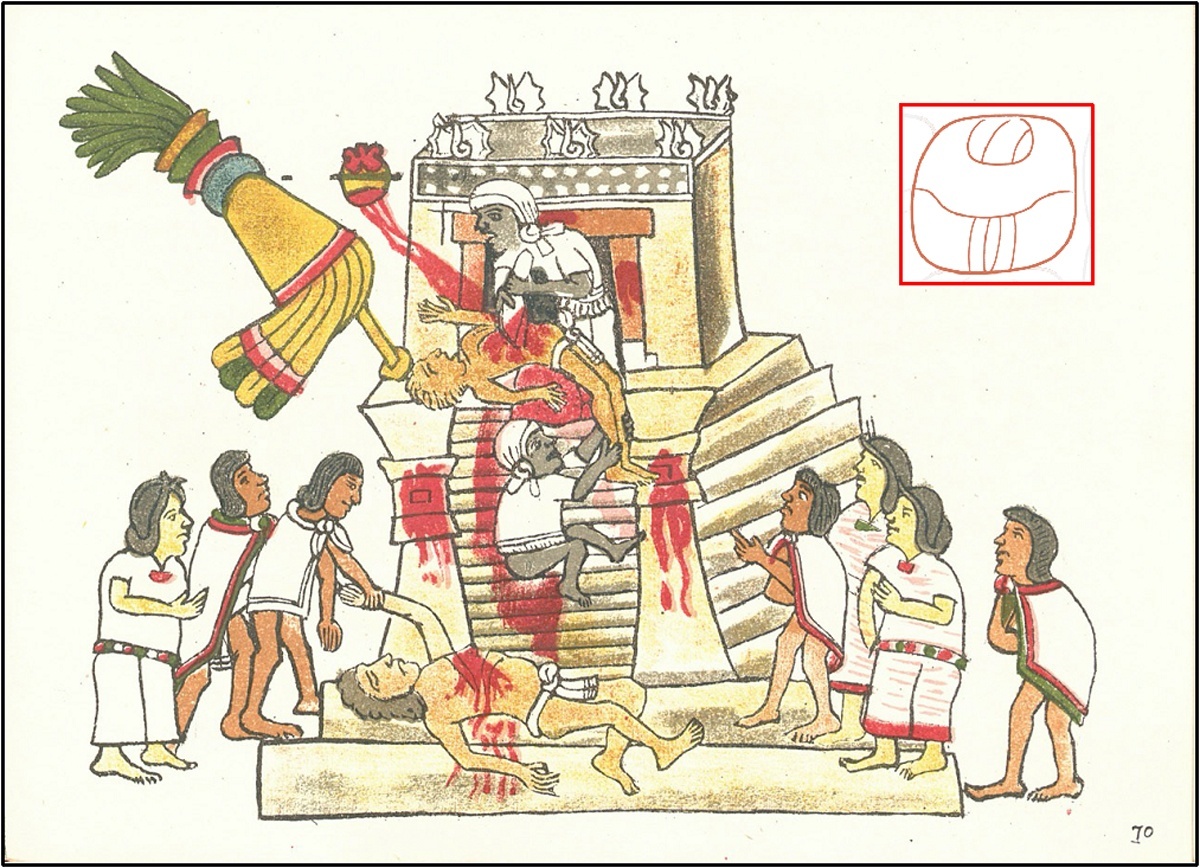
Figure 2
Sacrificial heart extraction from Codex Magliabechiano, folio 70. Inset, outlined in red, the Maya glyph for the heart.34
Feeling the wrist pulse was considered a direct feel of a person’s blood circulation, the essence of their well-being and being in balance.33 Feeling the pulse just below the belly button was their way of feeling blood flow to a person’s stomach and intra-abdominal organs. This is why abdominal massaging was considered to restore balance by improving the delivery of the blood’s healing vital powers.28,29,30,31
Although several of the therapeutic plants they used had diuretic properties, there is no evidence that they conceived the mechanism of diuresis or that they attributed homeostasis to the kidney.35,36 While the shamans treated a host of symptoms related to renal disorders and seemingly identified and named the kidney, they had no glyph for it or attributable maladies. And while they had a word for urine, they considered the kidney part of the reproductive system.28,29
The Present
The Maya who survived the enslavement, brutality, and infectious diseases of the Conquistadores migrated to the southern highlands of Mesoamerica, where they regrouped, settled in small groups, and where today some six million Mayans survive.2,3,5 Many of them have little or no access to official health care and depend on the traditional medicine of their ah-men, who sometime during the 16th century began to be known as curanderos (healers).13 One of the earliest cultural changes impacted by colonization was that invocations and solicitations were directed to Mary, Jesus, and God rather than to the old pantheon of Maya deities and spirits, and the use of the cross in their therapeutic ceremonies. Another is the increase in specialists such as bonesetters and midwives, selected by divine election, who operate in a complementary relationship with generalist shamans and practiced their specialty with a spatter of magic rituals.37,38 Colonization also introduced antibiotics and some other pharmaceuticals, which are now used in addition to their traditional region-specific herbal treatments.13,20,21
Certain aspects of traditional Maya medicine have found a niche in the global alternative wellness market, most notably through abdominal massage and ceremonial sweat baths.13,19 Additionally, several Maya herbal remedies have been shown to be effective in treating cardiovascular, gastrointestinal, and renal conditions. Today, these remedies are often sold in specialty stores as supplements of Mayan origin. A prominent example is a high-flavanol cacao drink marketed as Maia, which is promoted for its cardiovascular benefits.