
Table 1
Formal factors supporting RVOT intervention in repaired tetralogy of Fallot. RVOTO: right ventricular outflow tract obstruction; PVR: pulmonary valve replacement; RVEDVi: right ventricular end-diastolic volume index; RVESVi: right ventricular end-systolic volume index; RVEF: right ventricular ejection fraction; LVEF: left ventricular ejection fraction; LVEDVi: left ventricular end-diastolic volume index; RVSP: right ventricular systolic pressure; TR: tricuspid regurgitation
| FORMAL FACTORS SUPPORTING RVOT INTERVENTION IN RTOF | 2020 ESC ACHD GUIDELINES3 | 2025 ACC/AHA ACHD GUIDELINES1 |
|---|---|---|
| Symptoms | PVR is recommended in symptomatic patients with severe PR and/or moderate RVOTO (Class l-C) | PVR is recommended in symptomatic patients with at least moderate PR (Class 1) |
| Right ventricle | Asymptomatic patients should be considered for PVR if PR/RVOTO and (Class II-C):
| Asymptomatic patients should be considered for PVR if at least moderate PR and at least two among (Class 2a):
|
| Left ventricle | None | Asymptomatic patients should be considered for PVR if at least moderate PR and LVEF < 50% along with at least one additional factor (Class 2a) |
| Arrhythmias | None | Asymptomatic patients should be considered for PVR if at least moderate PR and ventricular arrhythmia (Class 2b) |
| Functional capacity | Asymptomatic patients should be considered for PVR if PR/RVOTO and decrease in objective exercise capacity (Class II-C) | Asymptomatic patients should be considered for PVR if at least moderate PR and decrease in objective exercise capacity with at least one additional factor (Class 2a) |
| Additional factors | Asymptomatic patients should be considered for PVR if PR/RVOTO and progressive TR to at least moderate (Class ll-C) | Asymptomatic patients should be considered for PVR if PR/RVOTO and progressive functional TR to at least moderate (Class 2b) |
| Type of intervention | In patients with no native outflow tract, catheter intervention should be preferred if anatomically feasible (Class l-C) | No preference between surgical or transcatheter approach is provided |
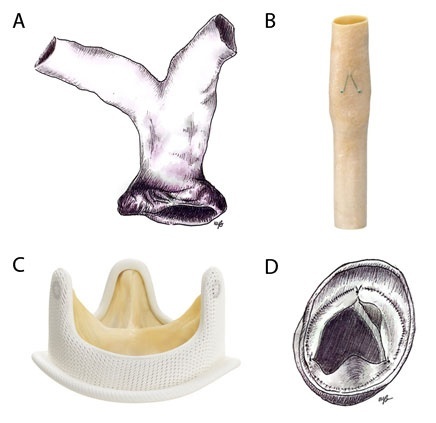
Figure 1
Surgical RV-PA conduits and prosthetic valves for PVR in ACHD: (A) Pulmonary homograft, (B) Contegra™ pulmonary valved conduit, (C) Hancock™ II bioprosthesis, (D) ePTFE valved conduit. Contegra pulmonary valved conduit and Hancock II bioprosthesis images reprinted with permission from Medtronic.
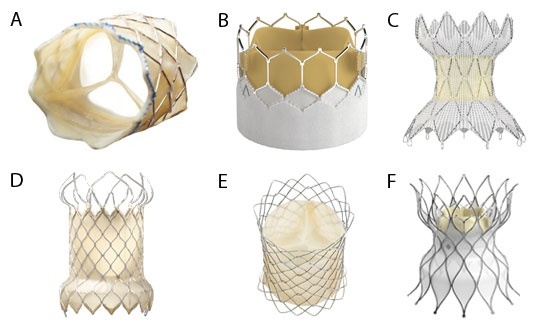
Figure 2
Transcatheter pulmonary valves for right ventricular outflow tract (RVOT) dysfunction in adult congenital heart disease: (A) Melody™ transcatheter pulmonary valve, (B) Sapien™ 3 Ultra-Resilia valve, (C) Harmony™ transcatheter pulmonary valve, (D) Venus P-Valve™ System, (E) Pulsta™ valve, (F) Alterra™ Adaptive Prestent. Reprinted with permission from Medtronic (Melody, Harmony valves), Edwards Lifesciences (Sapien 3 Ultra Resilia, Alterra Adaptive Prestent), Venus MedTech (VenusP-valve) and Taewoong Medical (Pulsta valve).