
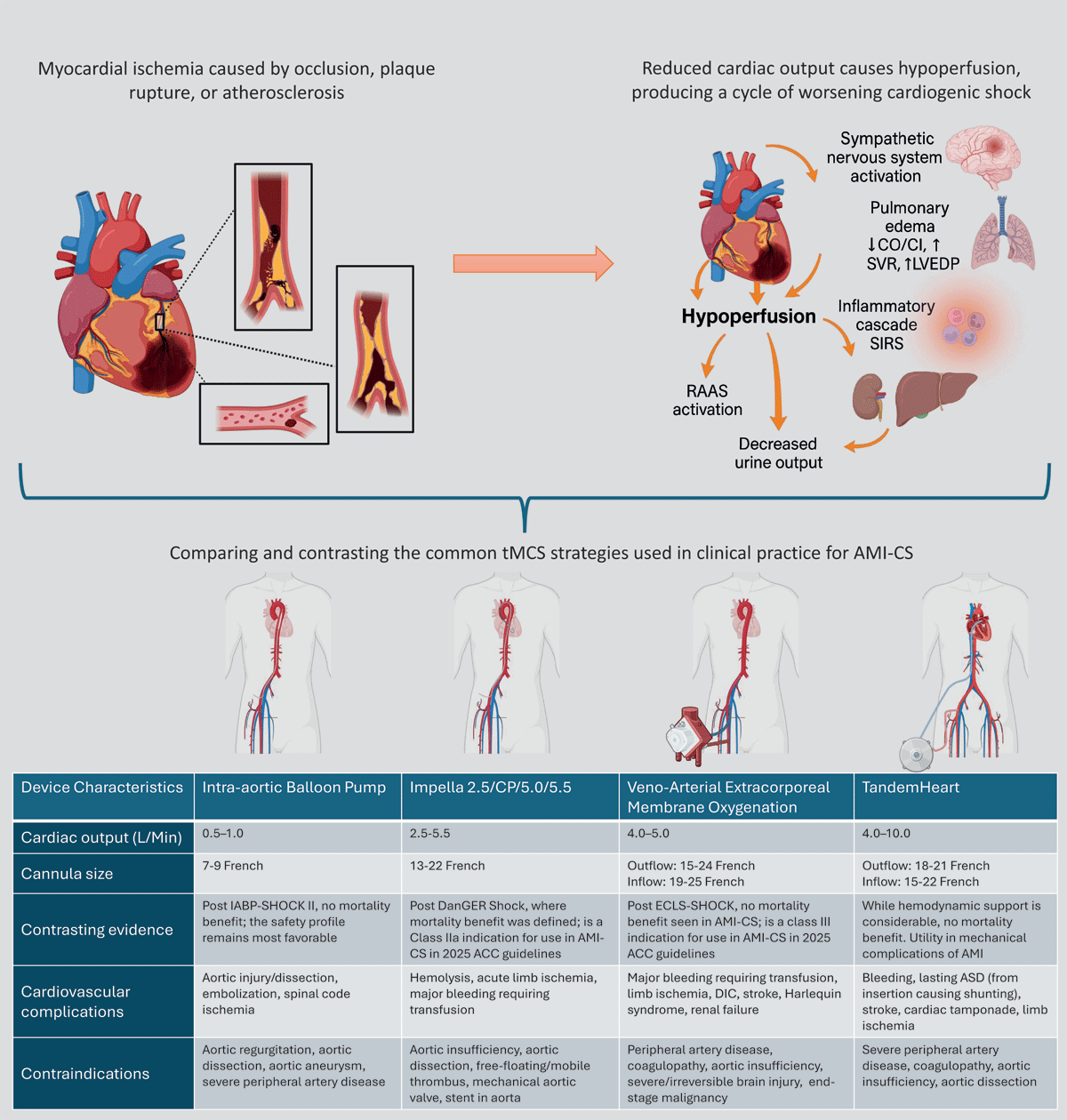
Figure 1
Cardiogenic shock in acute myocardial infarction causes and temporary mechanical circulatory support (tMCS) tools. CO: cardiac output; CI: cardiac index; SVR: systemic vascular resistance; LVEDP: left ventricular end diastolic pressure; SIRS: systemic inflammatory response syndrome; RAAS: renin-angiotensin-aldosterone system; tMCS: temporary mechanical circulatory support; AMI-CS: acute myocardiol infarction-cardiogenic shock; DanGer Shock: Danish-German Cardiogenic Shock; ECLS-SHOCK: Extracorporeal Life Support in Infarct-Related Cardiogenic Shock; ACC: American College of Cardiology
Table 1
Summary of clinical trials: IABP in acute myocardial infarction cardiogenic shock. IABP: intraaortic balloon pump; RCT: randomized controlled trial; PCI: percutaneous coronary intervention; CI: cardiac index; ICU: intensive care unit
| STUDY (YEAR) | STUDY TYPE | COMPARISON | KEY FINDINGS | MORTALITY | COMPLICATIONS |
|---|---|---|---|---|---|
| IABP-SHOCK (2010) (N = 45) | RCT | IABP vs standard therapy in patients undergoing PCI | No significant difference in CI, APACHE II score (predictor of mortality in the ICU) | Similar mortality rate mentioned, but study not powered for it, thereby proportion not reported | No complications reported were attributed to the IABP per authors |
| IABP-SHOCK II (2012)(N = 300) | RCT | IABP vs standard therapy | No significant reduction in 30-day mortality | 39.7% vs 41.3% (P = .69) | No difference between major bleeding, sepsis, stroke, peripheral ischemia related complications |
Table 2
Summary of clinical trials and observational studies with Impella. NCSI: National Cardiogenic Shock Initiative; RCT: randomized controlled trial; AMI-CS: Acute myocardial infarction cardiogenic shock; OMM: optimal medical management; tMCS: temporary mechanical circulatory support; IABP: intraaortic balloon pump
| STUDY (YEAR) | STUDY TYPE | COMPARISON | KEY FINDINGS | OUTCOMES | COMPLICATIONS |
|---|---|---|---|---|---|
| Trials of Impella vs Standard of Care | |||||
| NSCI(N = 406) | Prospective | Feasibility of shock protocol for early recognition of AMI-CS with Impella insertion | Standardized shock protocol provided to identify early window for Impella insertion | CI increased from 2.0 + 0.7 L/min/m2 to 2.6 + 0.8 L/min/m2 (P < .001). Lactate from 4.8 + 3.9 mmol/L to 2.7 + 2.8 mmol/L (P < .0001) | No significant trends identified |
| DanGer Shock (2024)(N = 334) | RCT | Impella CP vs OMM | All-cause mortality was significantly improved in Impella group | 45.8% vs 58.5% (HR 0.74; 95% CI, 0.55–0.99, P = .04) | Among a composite safety end point of severe bleeding, limb ischemia, device failure, hemolysis, or aortic regurgitation, 24% of Impella recipients compared with 6.2% of standard care recipients |
| Impella Compared to Other tMCS* | |||||
| ISAR-SHOCK (2023)(N = 26) | RCT | Impella 2.5 vs IABP | Impella 2.5 recipients had a significantly increased CI compared with IABP and clinical markers of perfusion while having similar mortality rates | Mortality was identical in both groups (46%). Increase in CI (ΔCI = 0.49 ± 0.46 L/min/m2) vs ΔCI = 0.11 ± 0.31 L/min/m2; P = .02) and MAP (9.0 ± 14.0 mm Hg vs 1.2 ± 16.2 mm Hg in the IABP group (P = .09) among Impella vs IABP | In investigating hemolysis incidence, 2.6 ± 2.7 U vs IABP 1.2 ± 1.9 U, P = .18 of hemoglobin product was given to Impella compared with IABP recipients |
| IMPRESS (2017)(N = 48) | RCT | Impella CP vs IABP | No significant difference in 30-day and 6-month all-cause mortality | 30-day mortality: 46% in Impella CP vs 50% in IABP (HR 0.96; 95% CI, 0.42–2.18, P = .92). 6-month mortality: 50% for Impella CP vs 50% for IABP (HR =\ 1.04; 95% CI, 0.47–2.32, P = .923) | 33% of Impella vs 8% of IABP had major bleeding episodes, with 13% of Impella being device related bleeding vs 4% in IABP recipients |
Table 3
Summary of clinical trials and observational studies: TandemHeart. RCT: randomized controlled trial; IABP: intra-aortic balloon pump; MI-VSD: myocardial infarction ventricular septal defect
| STUDY (YEAR) | STUDY TYPE | COMPARISON | KEY FINDINGS | MORTALITY | COMPLICATIONS |
|---|---|---|---|---|---|
| Thiele et al. (2005)(N = 41) | RCT | TandemHeart vs IABP | Improved cardiac performance; increased risks | 43% vs 45% (P = .86) | ↑ severe bleeding and limb ischemia in TandemHeart |
| Burkhoff et al. (2006)(N = 42) | RCT | TandemHeart vs IABP | Improved hemodynamics; no survival benefit | 53% vs 64% (no significant difference) | Similar to IABP |
| Kar et al. (2006)(N = 18) | Retrospective | High risk PTCA vs CS | Improved cardiac index | 30-day: 61% vs 45% post-TandemHeart | Not clearly specified |
| Kar et al. (2011)(N = 117) | Retrospective | No comparison; worsening CS despite IABP and pressor support | Improved hemodynamics, renal function | 30-day: 40.2%, 6-month: 45.3% | Not clearly specified |
| Gregoric et al. (2014)(N = 11) | Retrospective | Pre-vs post-op TandemHeart for post MI VSD | Improved survival in pre-VSD repair | 6-month: 0% vs 75% | Not clearly specified |
Table 4
Summary of clinical trials and observational studies: venoarterial extracorporeal membrane oxygenation (VA-ECMO). RCT: randomized controlled trial; LVEF: left ventricular ejection fraction; PCI: percutaneous coronary intervention; CS: cardiogenic shock.
| STUDY (YEAR) | STUDY TYPE | COMPARISON | KEY FINDINGS | MORTALITY | COMPLICATIONS |
|---|---|---|---|---|---|
| Brunner et al. (2019)(N = 42) | RCT | VA-ECMO vs standard therapy | No benefit in LVEF or survival at 30 days | 19% vs 33% (P = .37) | No significant difference |
| Sheu et al. (2010)(N = 334) | Observational | ECMO-assisted PCI vs standard PCI in STEMI-CS | Improved 30-day survival | 41.7% vs 76.0% (P < .001) | Not clearly specified |
| ECMO-CS (2023)(N = 122) | RCT | Early ECMO vs conservative ECMO | No benefit in composite outcomes or survival | 50% vs 50% (P = .97) | Major bleeding (42% vs 23%), limb ischemia (11% vs 4%) |
| EUROSHOCK (2023)(N = 35) | RCT | Early ECMO vs standard therapy | No survival benefit | 47% vs 50% (P = .86) | Major bleeding, vascular complications |
| ECLS-SHOCK (2023)(N = 417) | RCT | Early ECMO vs standard therapy | No survival benefit | 47.8% vs 49% (P = .81) | Severe bleeding (23.4% vs 9.6%), vascular complications (11.2% vs 3.8%) |
| Zeymer et al. (2023)(N = 567) | Meta-analysis | VA-ECMO vs standard therapy | No survival advantage; more complications | 46% vs 48% (no significant difference) | Major bleeding, vascular complications |