
Acute Myocardial Infarction-Induced Cardiogenic Shock: Understanding Etiology and the Need for Further Support
In-hospital mortality from acute myocardial infarction cardiogenic shock (AMI-CS) is estimated to be between 40% and 80%, with 5-year morbidity in survivors remaining significant at 58%.1,2,3,4,5
This state of shock primarily arises from extensive myocardial injury resulting from prolonged ischemia.6,7,8,9,10 The loss of epicardial coronary artery perfusion in otherwise perfusion-dependent cardiac tissue progresses to tissue necrosis, with continuous infarction worsening myocardial stunning and progressively depressing cardiac function.6,11,12,13 The significant reduction in cardiac output triggers compensatory mechanisms aimed at maintaining adequate systemic perfusion. These include activation of the sympathetic nervous system and the renin-angiotensin-aldosterone system. While initially adaptive, these mechanisms increase systemic vascular resistance, leading to increased myocardial workload, oxygen consumption, and further myocardial stress. This heightened afterload works against the depressed cardiac function, significantly reducing coronary preload to cardiac tissue and establishing a detrimental feedback loop.14 Therefore, early restoration of adequate systemic and coronary perfusion is critical to interrupt this devastating cascade and improve patient survival.12
Temporary mechanical circulatory support devices (tMCS) have emerged as an increasingly relevant tool to interrupt this deleterious cycle early in its course by improving myocardial perfusion, reducing ventricular workload, stabilizing hemodynamics, and ultimately mitigating multiorgan dysfunction to improve patient outcomes.15,16,17 Early recognition of the shock state and timely device implantation have been shown to significantly improve hemodynamics and markers of end-organ perfusion within hours to days of initiation. This has led to increasing adoption of these devices in the clinical setting. Data from both nationally representative samples and larger nationwide analyses estimate that tMCS has been implemented in 42.7% to 71.6% of AMI-CS patients, with recent trends indicating a continued rise in adoption.8,9,10,11 In the 2025 American College of Cardiology (ACC)/American Heart Association (AHA) /American College of Emergency Physicians/National Association of EMS Physicians/Society for Cardiovascular Angiography & Interventions guidelines for the management of acute cardiogenic shock (ACS), left ventricle (LV) unloading strategies with tMCS among patients experiencing AMI-CS received a Class IIa recommendation.12 However, evidence guiding their optimal use remains heterogeneous, complicated by variability in patient selection, timing of device implantation, and differences in device mechanisms and risk profiles.15
This review aims to provide an evidence-based analysis of available tMCS devices, including intra-aortic balloon pump, Impella (Abiomed/J&J MedTech), TandemHeart™ (LivaNova, Inc.), and venoarterial extracorporeal membrane oxygenation (VA-ECMO). It summarizes key clinical trials, device-specific indications, associated complications, and current guidelines to assist clinicians in making informed decisions tailored to patient-specific clinical scenarios (Figure 1).
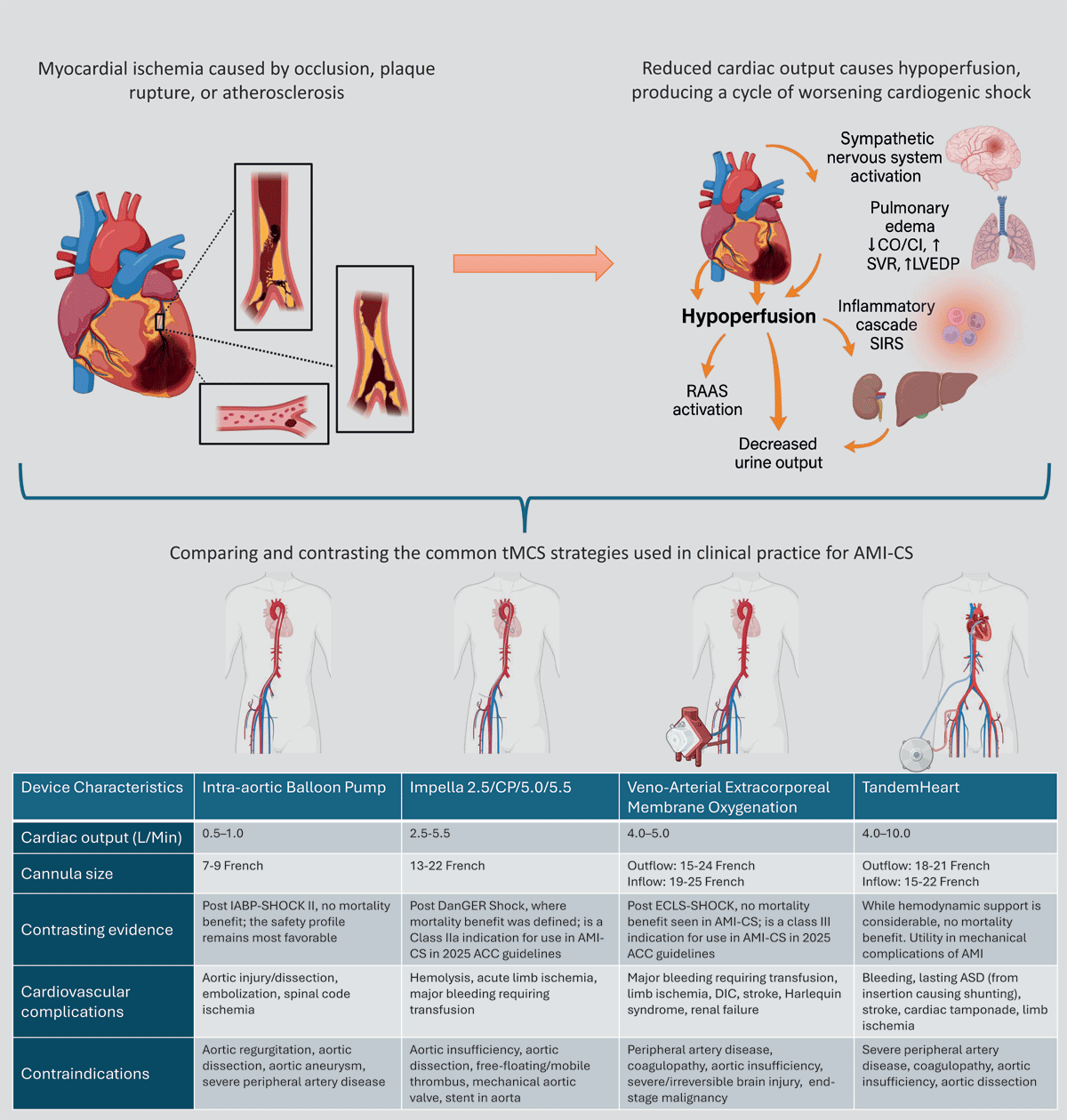
Figure 1
Cardiogenic shock in acute myocardial infarction causes and temporary mechanical circulatory support (tMCS) tools. CO: cardiac output; CI: cardiac index; SVR: systemic vascular resistance; LVEDP: left ventricular end diastolic pressure; SIRS: systemic inflammatory response syndrome; RAAS: renin-angiotensin-aldosterone system; tMCS: temporary mechanical circulatory support; AMI-CS: acute myocardiol infarction-cardiogenic shock; DanGer Shock: Danish-German Cardiogenic Shock; ECLS-SHOCK: Extracorporeal Life Support in Infarct-Related Cardiogenic Shock; ACC: American College of Cardiology
Intra-Aortic Balloon Pump in Acute Myocardial Infarction Cardiogenic Shock
The role of the intra-aortic balloon pump (IABP) for CS management has remained contentious. IABP functions with counterpulsation, where the device inflates during diastole, augmenting aortic pressure increasing coronary perfusion, and deflating during systole, decreasing afterload. The IABP mildly augments mean arterial pressure and cardiac index while reducing LV end-diastolic pressure and systemic vascular resistance, providing a limited magnitude of support of approximately 0.5 to 1.0 L/min.18
Historically, IABP use in AMI-CS was broadly supported by guidelines. The 1999 ACC/AHA guidelines gave IABP a Class I recommendation, suggesting that it should be used in conjunction with early revascularization. These conclusions were based on the SHOCK (Should We Emergently Revascularize Occluded Coronaries for Cardiogenic Shock) trial, which established the importance of early revascularization in AMI-CS, where 86% of patients were placed on IABP counterpulsation. Yet the adjuvant benefits of IABP in AMI-CS within this cohort were not independently evaluated.19,20 More recent guidelines, however, have downgraded its recommendation to Class III due to a lack of survival benefits.12 Despite its limitations, IABP remains favored in more resource-constrained settings due to its ease of use.21
In the early 2000s, IABP was the default MCS device for AMI-CS, often employed in tandem with revascularization. However, adoption significantly declined after the reporting of the IABP-SHOCK II trial (Table 1). This randomized, multicenter study enrolled 600 patients with AMI-CS undergoing early revascularization and randomly assigned them to IABP or no mechanical support. The trial found no significant difference in 30-day mortality between groups (39% vs 41%; P = .69). There were also no significant differences in secondary outcomes, including hemodynamic parameters, organ perfusion, or intensive care unit length of stay. However, it was still found to be safe, with no increase in bleeding, stroke, or limb ischemia compared to the standard of care, suggesting that the introduction of a device in this scenario was not necessary.5
Table 1
Summary of clinical trials: IABP in acute myocardial infarction cardiogenic shock. IABP: intraaortic balloon pump; RCT: randomized controlled trial; PCI: percutaneous coronary intervention; CI: cardiac index; ICU: intensive care unit
| STUDY (YEAR) | STUDY TYPE | COMPARISON | KEY FINDINGS | MORTALITY | COMPLICATIONS |
|---|---|---|---|---|---|
| IABP-SHOCK (2010) (N = 45) | RCT | IABP vs standard therapy in patients undergoing PCI | No significant difference in CI, APACHE II score (predictor of mortality in the ICU) | Similar mortality rate mentioned, but study not powered for it, thereby proportion not reported | No complications reported were attributed to the IABP per authors |
| IABP-SHOCK II (2012)(N = 300) | RCT | IABP vs standard therapy | No significant reduction in 30-day mortality | 39.7% vs 41.3% (P = .69) | No difference between major bleeding, sepsis, stroke, peripheral ischemia related complications |
With the publication of this trial, registry data from both Europe and the United States confirmed a steep reduction in IABP use. Yet the device continues to be used in refractory shock unresponsive to pharmacologic therapy as well as a bridge-to-decision or bridge-to-definitive therapy, including heart transplantation, where it retains an important role.22 Long-term follow-up reinforced these findings. At 12 months, mortality remained equivalent between groups, and at 6 years, nearly two-thirds of patients in both arms had died.23 Among survivors, there was no difference in quality of life. These results prompted changes in international guidelines and reinforced a more conservative approach for IABP use. It is worth noting that these findings have only been studied in AMI-CS settings and in a single significant trial. However, in resource-constrained settings, IABP remains an acceptable alternative with minimal complication risk.24
Impella in Acute Myocardial Infarction Cardiogenic Shock
The Impella family of devices consists of invasive catheter-mounted left ventricular assist devices (LVADs) that temporarily reduce myocardial workload and oxygen consumption while increasing cardiac output and end-organ perfusion. A microaxial flow pump generates forward flow by channeling left ventricular preload into the ascending aortic pathway, improving both coronary perfusion and systemic cardiac output.25 With this volume offloading, LV work and myocardial oxygen demand are decreased, left ventricular end-diastolic wall stress and pulmonary pressures are reduced, thereby secondarily offloading the right ventricle, and both mean arterial pressure and cardiac output are preserved.26,27 This is particularly important in AMI-CS, where myocardial stunning and dysfunction are prevalent pathologies, allowing cardiac tissue to either rest or have its function supplemented as a bridge to further therapeutics.12
This family of devices includes the Impella 2.5, Impella CP, Impella 5.0, Impella 5.0/LD, and Impella 5.5, with the first two being inserted through femoral access while the latter require placement of an arteriotomy (typically in the subclavian artery) with conduit placement to access the proximal aorta directly.28 All devices are introduced across the aortic valve and positioned within the LV with a distal pigtail catheter. The 2.5, 5.0, and 5.5 models provide 2.5 L/min, 5.0 L/min, and 5.5 L/min of output from the LV, respectively, while the CP model provides up to 4.0 L/min of output.29 The use of Impella devices in AMI-CS continues to evolve. Due to the need for urgent initiation in emergency settings, challenges in patient selection persist, and data on in-hospital events, short- and long-term outcomes, and complications remain limited. These factors have contributed to a relative paucity of high-quality literature on Impella use in AMI-CS, although recently published trials have aimed to achieve larger sample sizes (Table 2). Encouraging findings—particularly from the recent DanGer Shock (Danish-German Cardiogenic Shock) trial—have led to a Class IIa recommendation for Impella use among patients with STEMI-related AMI-CS.12 Device implantation remains largely operator-dependent, with Impella adoption continuing to increase nationally over the past decade.30,31
Table 2
Summary of clinical trials and observational studies with Impella. NCSI: National Cardiogenic Shock Initiative; RCT: randomized controlled trial; AMI-CS: Acute myocardial infarction cardiogenic shock; OMM: optimal medical management; tMCS: temporary mechanical circulatory support; IABP: intraaortic balloon pump
| STUDY (YEAR) | STUDY TYPE | COMPARISON | KEY FINDINGS | OUTCOMES | COMPLICATIONS |
|---|---|---|---|---|---|
| Trials of Impella vs Standard of Care | |||||
| NSCI(N = 406) | Prospective | Feasibility of shock protocol for early recognition of AMI-CS with Impella insertion | Standardized shock protocol provided to identify early window for Impella insertion | CI increased from 2.0 + 0.7 L/min/m2 to 2.6 + 0.8 L/min/m2 (P < .001). Lactate from 4.8 + 3.9 mmol/L to 2.7 + 2.8 mmol/L (P < .0001) | No significant trends identified |
| DanGer Shock (2024)(N = 334) | RCT | Impella CP vs OMM | All-cause mortality was significantly improved in Impella group | 45.8% vs 58.5% (HR 0.74; 95% CI, 0.55–0.99, P = .04) | Among a composite safety end point of severe bleeding, limb ischemia, device failure, hemolysis, or aortic regurgitation, 24% of Impella recipients compared with 6.2% of standard care recipients |
| Impella Compared to Other tMCS* | |||||
| ISAR-SHOCK (2023)(N = 26) | RCT | Impella 2.5 vs IABP | Impella 2.5 recipients had a significantly increased CI compared with IABP and clinical markers of perfusion while having similar mortality rates | Mortality was identical in both groups (46%). Increase in CI (ΔCI = 0.49 ± 0.46 L/min/m2) vs ΔCI = 0.11 ± 0.31 L/min/m2; P = .02) and MAP (9.0 ± 14.0 mm Hg vs 1.2 ± 16.2 mm Hg in the IABP group (P = .09) among Impella vs IABP | In investigating hemolysis incidence, 2.6 ± 2.7 U vs IABP 1.2 ± 1.9 U, P = .18 of hemoglobin product was given to Impella compared with IABP recipients |
| IMPRESS (2017)(N = 48) | RCT | Impella CP vs IABP | No significant difference in 30-day and 6-month all-cause mortality | 30-day mortality: 46% in Impella CP vs 50% in IABP (HR 0.96; 95% CI, 0.42–2.18, P = .92). 6-month mortality: 50% for Impella CP vs 50% for IABP (HR =\ 1.04; 95% CI, 0.47–2.32, P = .923) | 33% of Impella vs 8% of IABP had major bleeding episodes, with 13% of Impella being device related bleeding vs 4% in IABP recipients |
Most evidence supporting Impella use in AMI-CS has been comparative, often evaluating its performance relative to other MCS devices, particularly IABP. Initial studies focused on improvements in hemodynamic parameters, such as cardiac index, a key marker of systemic perfusion, medication titration, and device selection.32 The ISAR-SHOCK (Impella LP2.5 vs IABP in Cardiogenic SHOCK) trial reported significant improvements in cardiac index following Impella initiation compared to IABP, sustained over 1- to 3-day periods (Impella Δ0.49 ± 0.46 L/min/m2 vs IABP Δ0.11 ± 0.31 L/min/m2; P = .02), alongside improved markers of perfusion including lactic acid levels and mean arterial pressure.33
The National Cardiogenic Shock Initiative corroborated these favorable hemodynamic and perfusion benefits and also evaluated methodologies for earlier identification of patients who might benefit from Impella support in AMI-CS.34 In terms of mortality, the IMPRESS (Impella versus IABP reduces mortality in STEMI patients treated with primary PCI in severe cardiogenic shock) trial compared Impella 2.5 or Impella CP with IABP in AMI-CS patients and found no significant difference in 30-day mortality (46% Impella vs 50% IABP; HR = 0.96; CI 0.42–2.18; P = .92) or 6-month mortality (50% Impella vs 50% IABP; HR = 1.04; CI 0.47–2.32; P = .92), although major bleeding and hemolysis were more frequent in the Impella group.35
The recently reported DanGer Shock trial, which studied Impella CP versus standard care in AMI-CS, represents the largest cohort to date for long-term mortality outcomes. In this trial, Impella use significantly reduced 180-day mortality (45.8% Impella vs 58.5% standard care; HR = 0.74; CI 0.55–0.99; P = .04).36 However, adverse events such as bleeding and critical limb ischemia remained prevalent, similar to the IMPRESS trial. Subanalyses have also shown that Impella use increases the risk of acute kidney injury and the need for renal replacement therapy. While survival outcomes appear favorable with Impella, morbidity risks remain under-characterized and should be carefully considered by operators.37
TandemHeart in Acute Myocardial Infarction Cardiogenic Shock
The TandemHeart is a percutaneous left atrium (LA)-to-femoral artery LVAD. Unlike other percutaneous devices such as Impella, TandemHeart requires a transseptal puncture to withdraw oxygenated blood directly from the LA and return it through an arterial cannula, typically placed in the femoral artery. This configuration reduces pulmonary capillary wedge pressure (PCWP) and left ventricular end-diastolic pressure (LVEDP). Although it causes a mild increase in afterload by returning blood to the arterial system through the femoral arteries, TandemHeart improves tissue perfusion and can increase cardiac output to approximately 4.0 to 5.0 L/min at a maximum speed of 7500 rpm.38,39 The device is typically used for a few hours to several days, with reported use extending up to 14 days.38 A key limitation of TandemHeart is the complexity of insertion, which requires specialized expertise due to the transseptal puncture. This can increase time from patient presentation to left ventricular unloading. Despite these challenges, percutaneous LVADs (pLVADs), including TandemHeart, can be used temporarily as a bridge to recovery or definitive treatment.
Evidence on TandemHeart in AMI-CS is limited and largely derived from underpowered studies (Table 3). Early randomized trials demonstrated its hemodynamic superiority over IABP. A 2005 randomized trial by Thiele et al. involving 41 AMI-CS patients undergoing revascularization demonstrated significant improvements in cardiac power index and systemic perfusion with TandemHeart, although 30-day mortality remained similar between groups (IABP 45% vs pVAD 43%; P = .86). TandemHeart was associated with higher rates of severe bleeding and limb ischemia.5
Table 3
Summary of clinical trials and observational studies: TandemHeart. RCT: randomized controlled trial; IABP: intra-aortic balloon pump; MI-VSD: myocardial infarction ventricular septal defect
| STUDY (YEAR) | STUDY TYPE | COMPARISON | KEY FINDINGS | MORTALITY | COMPLICATIONS |
|---|---|---|---|---|---|
| Thiele et al. (2005)(N = 41) | RCT | TandemHeart vs IABP | Improved cardiac performance; increased risks | 43% vs 45% (P = .86) | ↑ severe bleeding and limb ischemia in TandemHeart |
| Burkhoff et al. (2006)(N = 42) | RCT | TandemHeart vs IABP | Improved hemodynamics; no survival benefit | 53% vs 64% (no significant difference) | Similar to IABP |
| Kar et al. (2006)(N = 18) | Retrospective | High risk PTCA vs CS | Improved cardiac index | 30-day: 61% vs 45% post-TandemHeart | Not clearly specified |
| Kar et al. (2011)(N = 117) | Retrospective | No comparison; worsening CS despite IABP and pressor support | Improved hemodynamics, renal function | 30-day: 40.2%, 6-month: 45.3% | Not clearly specified |
| Gregoric et al. (2014)(N = 11) | Retrospective | Pre-vs post-op TandemHeart for post MI VSD | Improved survival in pre-VSD repair | 6-month: 0% vs 75% | Not clearly specified |
Burkhoff et al. further randomized 42 patients with CS (70% AMI-induced) to either TandemHeart or IABP.40 At enrollment, 71% of participants were already receiving IABP for persistent CS. TandemHeart resulted in a 20% higher cardiac index and an 18.5% lower PCWP versus IABP, but 30-day survival was similar (53% vs 64%, respectively), with no significant difference in adverse event rates. TandemHeart may provide benefit in specific high-risk clinical scenarios, such as refractory CS unresponsive to initial IABP or in mechanical AMI complications (eg, ventricular septal defect, or VSD).40
A single-center retrospective study by Kar et al. evaluated 117 patients with severe refractory CS unresponsive to IABP and vasopressors. Of 80 patients with ischemic cardiomyopathy, only five had STEMI at implantation, including patients with post-MI complications (eg, VSD, incessant ventricular tachycardia, and pump failure). TandemHeart implantation led to significant hemodynamic improvements (increased cardiac index and decreased PCWP), with a 30-day mortality of 40.2% and 6-month survival of 45.3%.41
Kar et al. (2006) also analyzed TandemHeart use in 11 CS patients unresponsive to IABP/inotropes and seven high-risk patients who had undergone percutaneous transluminal coronary angioplasty (PTCA). In the CS group, cardiac index improved from 1.57 ± 0.31 to 2.60 ± 0.34 L/min/m2, with a 45% survival rate. In the PTCA group, device support averaged 5.5 ± 8.3 hours, with a mean flow of 2.42 ± 0.55 L/min. Overall 30-day survival across both groups was 61%.42 However, CS etiology was not fully specified, limiting conclusions regarding optimal patient selection.
To address the limited power of individual studies, Cheng et al. performed a meta-analysis involving two TandemHeart trials (N = 100). pLVADs improved hemodynamic parameters relative to IABP but showed no significant difference in 30-day mortality. Bleeding and limb ischemia were more common in the pLVAD group.43 Current ACC/AHA guidelines do not recommend pLVADs as first-line therapy for AMI-CS due to lack of proven survival benefit over IABP. MCS is, however, given a Class IIa recommendation in AMI-CS refractory to initial pharmacotherapy.12
TandemHeart may have a role in mechanical AMI complications. Gregoric et al. retrospectively analyzed 11 patients with post-MI VSD complicated by CS. All three patients died after receiving immediate surgical repair with postoperative TandemHeart, while eight patients receiving preoperative TandemHeart (mean 7 ± 3 days) all survived beyond 30 days, with 6-month survival of 75%.44 These findings suggest early mechanical support with TandemHeart may benefit high-risk postinfarction VSD patients for whom immediate surgery carries prohibitive mortality risk.
In summary, TandemHeart improves hemodynamics in AMI-CS more effectively than IABP, but this has not translated into improved survival in randomized trials. Current evidence supports its use in select scenarios, such as postinfarction VSD or refractory shock following IABP failure.
VA-ECMO in Acute Myocardial Infarction Cardiogenic Shock
VA-ECMO is a tMCS system used in patients with severe CS. It consists of a venous inflow cannula, a pump, an oxygenator, and an arterial outflow cannula. It can be cannulated centrally or peripherally depending on the clinical scenario and patient condition. Central VA-ECMO is generally inserted in the operating room for patients requiring post-cardiotomy support, particularly for those who cannot be weaned off cardiopulmonary bypass.45 Peripheral cannulation, on the other hand, is typically performed percutaneously or through surgical cutdown in patients with refractory CS or cardiac arrest.
The most common access sites for peripheral cannulation are the femoral artery and the femoral vein or internal jugular vein. Another configuration involves venous access through the femoral or internal jugular vein, with arterial return to a graft placed on the subclavian artery.46 This latter approach ensures perfusion of the cerebral circulation with oxygenated blood and allows for patient ambulation while on ECMO. The primary advantage of peripheral VA-ECMO is its ease and rapid deployment outside of the operating room. It can be initiated in response to hemodynamic instability at the bedside, in the catheterization laboratory, or even in prehospital settings.
VA-ECMO typically delivers flow rates of approximately 3 to 4 L/min. By draining blood from the systemic venous system, VA-ECMO reduces right ventricular preload and relieves peripheral venous congestion. However, the retrograde arterial flow increases LV afterload, which can exacerbate pulmonary edema, increase LV diastolic pressure, and impair coronary perfusion. This can result in LV distention and worsening myocardial ischemia. In cases of LV distension, an unloading strategy such as Impella device placement or balloon atrial septostomy may be necessary to unload the LV and improve coronary perfusion.47 VA-ECMO is associated with several complications, including bleeding, limb ischemia, Harlequin syndrome, stroke, and renal failure.
The use of VA-ECMO in patients with AMI-CS has increased, particularly as percutaneous systems have become more widely available and IABP has failed to demonstrate a survival benefit in randomized trials. Although early observational studies suggested that VA-ECMO could stabilize hemodynamics and improve survival rates in AMI-related CS,48,49 more recent randomized controlled trials have produced mixed or neutral results, prompting a reassessment of its routine use in this setting (Table 4).
Table 4
Summary of clinical trials and observational studies: venoarterial extracorporeal membrane oxygenation (VA-ECMO). RCT: randomized controlled trial; LVEF: left ventricular ejection fraction; PCI: percutaneous coronary intervention; CS: cardiogenic shock.
| STUDY (YEAR) | STUDY TYPE | COMPARISON | KEY FINDINGS | MORTALITY | COMPLICATIONS |
|---|---|---|---|---|---|
| Brunner et al. (2019)(N = 42) | RCT | VA-ECMO vs standard therapy | No benefit in LVEF or survival at 30 days | 19% vs 33% (P = .37) | No significant difference |
| Sheu et al. (2010)(N = 334) | Observational | ECMO-assisted PCI vs standard PCI in STEMI-CS | Improved 30-day survival | 41.7% vs 76.0% (P < .001) | Not clearly specified |
| ECMO-CS (2023)(N = 122) | RCT | Early ECMO vs conservative ECMO | No benefit in composite outcomes or survival | 50% vs 50% (P = .97) | Major bleeding (42% vs 23%), limb ischemia (11% vs 4%) |
| EUROSHOCK (2023)(N = 35) | RCT | Early ECMO vs standard therapy | No survival benefit | 47% vs 50% (P = .86) | Major bleeding, vascular complications |
| ECLS-SHOCK (2023)(N = 417) | RCT | Early ECMO vs standard therapy | No survival benefit | 47.8% vs 49% (P = .81) | Severe bleeding (23.4% vs 9.6%), vascular complications (11.2% vs 3.8%) |
| Zeymer et al. (2023)(N = 567) | Meta-analysis | VA-ECMO vs standard therapy | No survival advantage; more complications | 46% vs 48% (no significant difference) | Major bleeding, vascular complications |
Although there is no clear guideline regarding patient selection for VA-ECMO, in the setting of ACS-CS, achieving hemodynamic stabilization in patients with severe or rapidly deteriorating AMI-CS remains the most common indication for initiation of extracorporeal life support (ECLS) therapy. It can be used as a bridge to recovery or destination therapy, such as durable ventricular assist device implantation or cardiac transplantation.50
A small randomized clinical trial by Brunner et al. (N = 42) evaluated ECLS combined with standard medical therapy versus standard therapy alone and did not demonstrate significant differences in LVEF or 30-day mortality between the two groups (19% vs 33%; P = .37).51 Additionally, there was no significant difference in the rates of complications such as stroke, life-threatening bleeding, and peripheral vascular complications between the groups.
The recent ECMO-CS trial (N = 122), a multicenter randomized controlled trial, compared early VA-ECMO initiation to conservative therapy and found no significant difference in the 30-day composite end point (mortality, cardiac arrest, or additional support), and no significant difference in overall mortality (50% in both groups; P = .97). However, VA-ECMO use was associated with higher rates of major bleeding (42% vs 23%) and limb ischemia requiring intervention (11% vs 4%). Additionally, the trial did not exclusively include patients with CS secondary to AMI; only 74 of the 117 patients had AMI-CS.52
The EURO SHOCK (Testing the value of novel strategy and its cost efficacy in order to improve the poor outcomes in cardiogenic shock) trial (N = 35) similarly reported no survival benefit at 30 days with early VA-ECMO use compared to standard therapy (43.8 vs 61.1%; P = .22). The trial also reported higher rates of major bleeding and vascular complications in the VA-ECMO group.53 However, this was a small trial since recruitment was significantly affected by the COVID-19 pandemic.
The ECLS-SHOCK (Extracorporeal life support in infarct-related cardiogenic shock) trial further confirmed these findings in a larger cohort (N = 417), with no significant difference in 30-day mortality between the VA-ECMO and control groups (47.8% vs 49%; P = .81).20 However, VA-ECMO was associated with significantly higher rates of severe bleeding (23.4% vs 9.6%) and vascular complications (11.2% vs 3.8%).54
An individual patient-data meta-analysis by Zeymer et al. (N = 567) pooling data from recent randomized trials echoed these neutral survival results, demonstrating no significant difference in 30-day mortality between the VA-ECMO and control groups (46% vs 48%).55 A follow-up analysis of patients from the DanGer-SHOCK trial (N = 202) similarly found no difference in 180-day mortality (45% vs 51%; P = .53). Higher rates of bleeding and vascular complications were observed in the VA-ECMO group.56 Given these data, guidelines have shifted toward a more conservative stance. The 2025 ACC/AHA guidelines downgrade the routine use of VA-ECMO to a Class III recommendation due to the lack of demonstrated survival benefit,12 and the 2023 ESC guidelines recommend VA-ECMO in cases of refractory CS when other therapies, such as IABP or Impella, have failed (Class IIb, Level C).57
Although ECMO offers effective hemodynamic support in critically ill patients, it has not consistently shown a survival benefit in AMI-CS. One potential reason is the high incidence of complications, such as major bleeding, vascular injury, and renal failure, which may offset any hemodynamic advantages. Another possible explanation is the limited sample size of randomized clinical trials, which may have reduced the statistical power to detect a meaningful survival difference.
Conclusion
AMI-CS remains a clinical challenge with persistently high mortality despite therapeutic advances. Temporary mechanical circulatory support devices—IABP, Impella, TandemHeart, and VA-ECMO—offer critical hemodynamic stabilization but exhibit differing profiles of benefits and risks. Current evidence and guidelines emphasize an individualized approach considering each device’s hemodynamic support capabilities, complication rates, and procedural complexity. Tailored decision-making grounded in comprehensive patient evaluation and evidence-based guidance remains essential to improving outcomes in this complex patient population.
Key Points
Despite the increasing adoption of temporary mechanical circulatory support (tMCS) devices in acute myocardial infarction cardiogenic shock (AMI-CS), high in-hospital mortality rates persist, underscoring the need for optimized patient selection and timing of support initiation.
While the intra-aortic balloon pump offers a favorable safety profile and ease of use, especially in resource-limited settings, its survival benefit in AMI-CS remains limited but important to consider across wider indications.
The Impella class of devices has continued to show increased adoption and favorable hemodynamic support in AMI-CS with recent evidence supporting a mortality benefit. However, it remains associated with a higher risk of bleeding, hemolysis, and kidney injury.
TandemHeart has not demonstrated a consistent survival benefit in AMI-CS patients; however, it may have some utility in cases of refractory cardiogenic shock or to provide support in the setting of mechanical complications of AMI-CS.
Venoarterial extracorporeal membrane oxygenation provides robust circulatory support in severe AMI-CS but is associated with significant complications and has shown inconsistent survival benefits in randomized trials, leading to its downgrade in guideline recommendations.
Competing Interests
Dr. Patel is a consultant for SumHealth. The other authors have no competing interests to declare.