
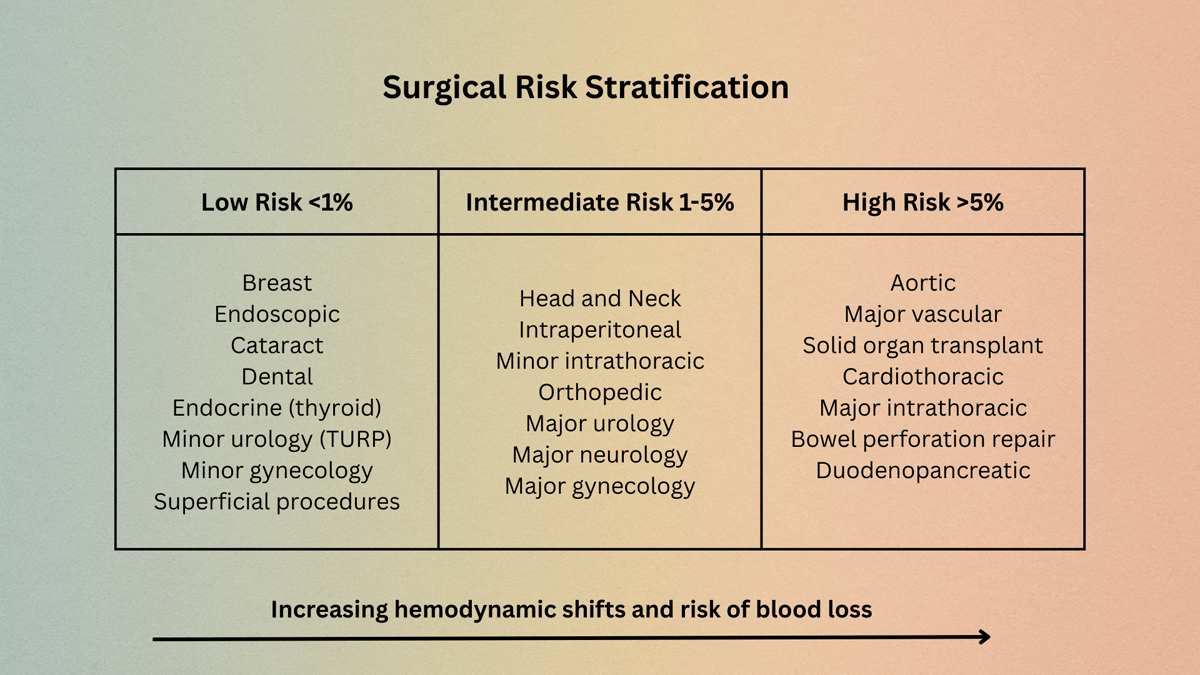
Figure 1
Surgical risk stratification and associated hemodynamic shifts. TURP: transurethral resection of the prostate
Table 1
Comparison of risk calculators indices used to assess perioperative risk in patients undergoing noncardiac surgery. ADLs: activities of daily living; CV: cardiovascular; METs: metabolic equivalents (a way to estimate how much energy your body uses during physical activity); ASA class: The American Society of Anesthesiologists physical status classification (a grading system to determine the health of a person before surgical procedure that requires anesthesia); AUB-HAS2: American University of Beirut-HAS2 Cardiovascular Risk Index; ACS NSQIP: American College of Surgeons National Surgical Quality Improvement Program
| RISK ASSESSMENT TOOL | PURPOSE | RISK FACTORS CONSIDERED | OUTPUT/SCORE INTERPRETATION | STRENGTHS | LIMITATIONS | PREDICTION VS OUTCOMES | REFERENCES | CRITERIA FOR USE | SCORE RANGE | THRESHOLD FOR ELEVATED RISK | OUTCOME PREDICTED |
|---|---|---|---|---|---|---|---|---|---|---|---|
| Goldman Index of Cardiac Risk (1977) | First major risk index for predicting perioperative cardiac complications | Age, history of MI, S3 gallop, jugular venous distention, significant aortic stenosis, arrhythmias, emergency surgery, type of surgery | Point-based scoring system; higher score = greater cardiac risk | Historical significance; first structured cardiac risk assessment tool | Outdated; has been largely replaced by more modern risk indices | Overestimates risk in modern surgical settings due to advancements in perioperative care | Goldman et al., New England Journal of Medicine, 1977 | General surgical patients with cardiac concerns | 0–53 points | ≥ 26 points (high risk) | Perioperative cardiac complications, mortality |
| Duke Activity Status Index (DASI) (1989) | Assesses functional capacity in relation to cardiac risk | Patient-reported functional capacity (ADLs) | Score correlates with estimated METs; lower score = higher risk | Easy to administer, provides functional capacity insight | Subjective, patient-reported data may be inaccurate | Correlates with METs but subjective; may not always predict perioperative events | Hlatky et al., Circulation, 1989 | Patients undergoing non-cardiac surgery; assesses functional capacity | 0–58 points | < 34 points (high risk) | Functional capacity estimation, perioperative cardiac risk |
| Revised Cardiac Risk Index (RCRI) (1999) | Predicts major cardiac complications after non-cardiac surgery | Ischemic heart disease, CHF, cerebrovascular disease, insulin use, creatinine > 2.0 | 0–6 point score, higher score = greater risk | Simple and widely used, well-validated | Limited number of variables, may not capture all risk factors | Widely used but has limitations in high-risk patients; often underestimates risk | Lee et al., Circulation, 1999 | Patients undergoing non-cardiac surgery | 0–12 METs equivalent | ≥ 2 points (higher cardiac risk) | Major cardiac complications post-surgery |
| Gupta Perioperative Risk (2011) | Estimates risk of myocardial infarction or cardiac arrest in non-cardiac surgery | Type of surgery, functional status, ASA class, creatinine level, age | Probability of MI or cardiac arrest (%) | Uses large dataset, validated in multiple populations | Limited to MI/cardiac arrest risk, does not assess overall surgical risk | Moderate accuracy; validated but may underpredict in high-risk patients | Gupta et al., Anesthesiology, 2011 | Patients undergoing non-cardiac surgery | Percentage risk | ≥ 1% (elevated risk) | Postoperative complications, including cardiac events |
| American College of Surgeons Surgical Risk Calculator (2013) | Provides individualized risk estimates for surgical complications | Demographics, comorbidities, functional status, type of surgery, frailty | Personalized risk percentage for complications including cardiac events | Highly personalized, considers multiple risk factors | Complex tool requiring online calculator, less validated in some populations | Personalized and data-driven; good prediction, but requires online access | Bilimoria et al., JAMA Surgery, 2013 | General surgical patients; requires ACS NSQIP data | Personalized risk percentage | ≥ 1% (elevated risk) | Personalized complication risk estimation |
| METS (Metabolic Equivalent Task Score) (2014) | Evaluates a patient’s functional status in terms of metabolic equivalents | Exercise tolerance, ability to perform daily activities | Higher METs = better functional capacity, lower risk | Noninvasive, can guide preoperative cardiac testing | Limited application for patients with limited mobility | Good correlation with functional status; less reliable in sedentary patients | Ainsworth et al., ACSM Guidelines, 2014 | General surgical patients | 0–100% mortality risk | < 4 METs (poor functional capacity) | Perioperative mortality |
| Surgical Outcome Risk Tool (SORT) (2014) | Estimates 30-day mortality risk in non-cardiac surgery | Age, ASA class, urgency of surgery, surgical severity, functional status, comorbidities | Probability (%) of 30-day mortality; higher score = greater risk | Simple and easy to use; validated in large surgical populations | Limited to mortality prediction; does not assess other complications | Good accuracy for predicting mortality but does not account for non-fatal complications | Protopapa et al., British Journal of Anaesthesia, 2014 | General surgical patients in Canada | 0–100% risk score | ≥ 5% (elevated risk) | Perioperative complications and mortality |
| NSQIP Geriatric-Sensitive Perioperative Cardiac Risk Index (2017) | Estimates perioperative cardiac risk with a focus on older surgical patients | Age, frailty, ASA class, functional dependence, cognitive impairment, comorbidities, emergency status, surgical risk level | Probability (%) of perioperative cardiac complications and mortality | Specifically tailored for older patients; considers frailty and functional dependence | Limited validation outside geriatric populations; requires NSQIP database access | More accurate than general cardiac risk scores for geriatric patients; integrates frailty as a key factor | Berian et al., Journal of the American College of Surgeons, 2017 | General surgical patients | 0–100% mortality risk | ≥ 5% (high risk) | 30-day postoperative mortality |
| AUB-HAS2 Cardiovascular Risk Index (2019) | Predicts major adverse cardiovascular events (MACE) in non-cardiac surgery | Age, urgency of surgery, history of heart failure, coronary artery disease, stroke, diabetes, functional status, renal function | Point-based scoring system; higher score = greater risk of MACE | Includes a broad range of cardiovascular risk factors; validated in surgical patients | Less widely used than other indices; requires further validation in diverse populations | Good predictive value for MACE; comparable to RCRI but includes more cardiovascular-specific factors | Abou-Zahr et al., Journal of the American College of Cardiology, 2019 | General surgical patients with potential cardiac risk | 1–4 points | ≥ 2 points (moderate risk), ≥ 3 points (high risk) | Perioperative cardiac risk |
| National Surgical Quality Improvement Program (NSQIP) (2020) | Estimates postoperative complications including cardiac risk | Patient demographics, comorbidities, type of surgery, functional status | Risk percentage of complications including cardiac events | Comprehensive and data-driven, dynamic risk assessment | Requires access to NSQIP database, complex calculations | Highly accurate; uses real-world data, but access limitations | American College of Surgeons NSQIP, 2020 | Patients undergoing non-cardiac surgery with cardiovascular risks | 0–10 points | ≥ 6 points (high cardiovascular risk) | Major adverse cardiovascular events (MACE) |
| CanRisk (2021) | Predicts perioperative risk in Canadian surgical patients based on population-specific data | Age, comorbidities, functional status, surgical urgency, frailty, socioeconomic factors | Risk percentage for perioperative complications and mortality | Designed specifically for Canadian populations, includes socioeconomic factors | Less known internationally, validation studies still ongoing | Good predictive accuracy but limited external validation outside Canada | Canadian Surgical Outcomes Risk Assessment (CanRisk), 2021 | Geriatric surgical patients | 0–100% probability | ≥ 5% (high risk in geriatric patients) | Perioperative cardiac complications and mortality |
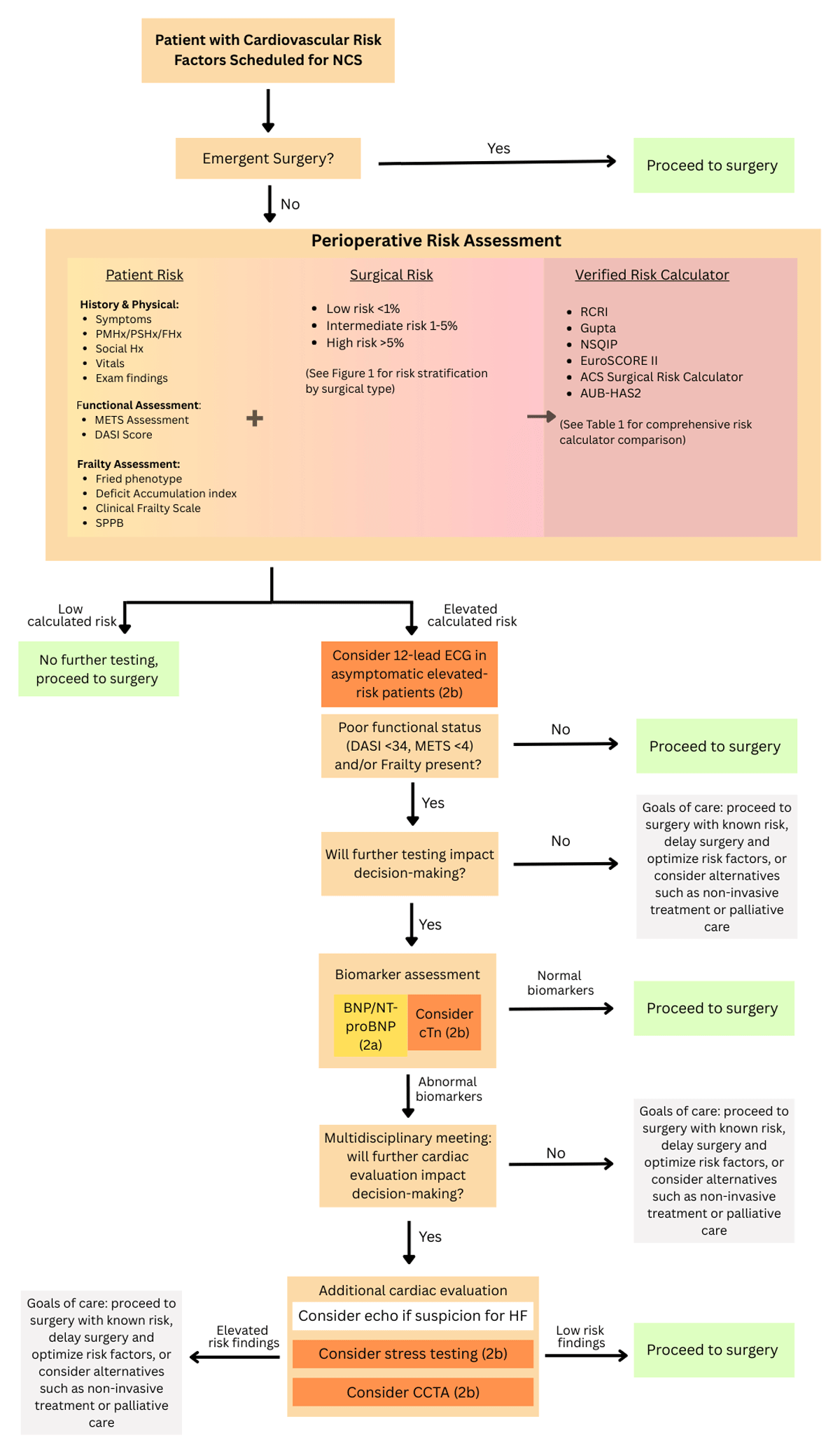
Figure 2
2024 Algorithm for Perioperative Cardiac Assessment. Adapted and revised from the 2024 AHA/ACC/ACS/ASNC/HRS/SCA/SCCT/SCMR/SVM Guideline for Perioperative Cardiovascular Management for Noncardiac Surgery. NCS: noncardiac surgery; Hx: history; PMHx: past medical history; PSHx: past surgical history; FHx: family history; METS: Metabolic Equivalents Task Score; DASI: Duke Activity Status Index; RCRI: Revised Cardiac Risk Index; NSQIP: National Surgical Quality Improvement Program; AUB-HAS2: American University of Beirut-HAS2 Cardiovascular Risk Index