
Introduction
Approximately 313 million surgeries are performed worldwide annually. Of those, 33.6 million are performed in the United States (US), where 42% of surgeries are inpatient and 57% are outpatient.1,2,3 Perioperative cardiovascular complications remain a significant cause of morbidity and mortality, affecting up to 3% of those undergoing noncardiac surgery (NCS).4,5 National US administrative data from 2008 to 2013 show that 45% of patients undergoing NCS had more than two cardiovascular risk factors—such as hypertension (HTN), dyslipidemia, diabetes mellitus (DM), obesity, and chronic kidney disease—and 24.3% had atherosclerotic cardiovascular disease, or ASCVD, defined as known coronary artery disease (CAD), peripheral artery disease, and prior stroke.6 Due to the high-risk burden and current preoperative strategies, it is estimated that US preoperative testing costs $18 billion annually.7
Perioperative major adverse cardiovascular events (MACE) occur in 3% of patients undergoing inpatient NCS, with rates declining from 3.1% to 2.6% over two decades. However, postoperative death remains significant, with about 1.5% of patients dying within 30 days of NCS.8,9 This article reviews the latest evidence-based recommendations for preoperative cardiovascular risk assessment in patients undergoing NCS.
Paradigm Shift in Approach to Preoperative Diagnostic Assessment
Prior to the 2024 American Heart Association (AHA)/American College of Cardiology (ACC) perioperative guidelines, the last formal perioperative guidelines for patients undergoing NCS were published in 2014. Over the past decade, evidence has revealed widespread overuse of diagnostic testing—about 65% deemed unnecessary and often in low-risk patients—with limited impact on outcomes.10,11
The 2014 ACC/AHA perioperative guidelines focused on functional capacity, risk stratification, and selective noninvasive testing with the goal of reducing perioperative events by detecting silent ischemia. However, subsequent studies challenged this philosophy, showing that detecting ischemia preoperatively did not significantly improve postoperative mortality or rates of myocardial infarction.11,12,13 Instead, increased testing often led to downstream procedures, increased costs, and surgical delays all without improving hard outcomes.14,15,16 While ischemia remained a predictor of adverse events, this emerging data cast doubt on evaluating ischemia as a modifiable perioperative target and led to a paradigm shift: that routine ischemia testing in all preoperative patients with cardiovascular risk factors is often unnecessary and, in most patients, unlikely to change outcomes.
Consequently, the focus has shifted towards risk predictors beyond ischemia. Biomarkers such as cardiac troponin, B-type natriuretic protein (BNP), and N-terminal pro-B-type natriuretic protein (NT-proBNP) have emerged as powerful predictors of perioperative and long-term mortality,17,18 reflecting myocardial stress or injury not always evident on imaging. As a result, current approaches reserve imaging for patients with elevated risk, where it may change management, while biomarkers are used to flag those who may benefit from perioperative diagnosis, optimization, and intensified surveillance.
In summary, while ischemia testing was previously focused on identifying targets for intervention, we now understand that treating significant coronary atherosclerosis by revascularization may not improve mortality in all the asymptomatic preoperative patients with cardiovascular risk factors.19 Instead, the emphasis has shifted from risk stratification to optimizing risk factors and promotes both primary and secondary prevention, treating atherosclerosis with optimal medical therapy.
Risk Stratification of Asymptomatic Patients with Cardiovascular Risk Factors
Type of Surgery
NCS carries an inherent risk of perioperative cardiovascular complication and mortality. The pathogenesis of ischemic cardiovascular complications during NCS stems from ischemic myocardial injury, either from acute plaque rupture leading to an acute coronary syndrome or from myocardial oxygen supply-demand mismatch.20 Beyond ischemic injury, the perioperative period involves a myriad of physiological changes—hemodynamic fluctuations, sympathetic activation and catecholamine release, anemia, cytokine production, and hypercoagulability—that can predispose patients to other cardiac complications including arrhythmia and heart failure.21 As such, surgeries that confer the highest risk (> 5% risk of MACE) such as transplant, abdominal, thoracic, and vascular surgeries, are those with significant hemodynamic shifts, high risk of bleeding, and prolonged anesthesia.22 Furthermore, those undergoing transplantation typically have greater CVD risk factors such as HTN, hyperlipidemia, and/or DM, compared to the general population.23 A meta-analysis involving 54,697 liver transplant recipients demonstrated that CVD-related death accounted for 40.2% of those who died within 30 days of transplantation24 On the other hand, Intermediate-risk NCS such as orthopedic, head and neck, and prostate surgeries carry a perioperative cardiac event risk of 1% to 5% while hemodynamic fluctuations during low-risk cataract, endocrine, endoscopic, and breast surgeries are minimal, and the risk of cardiac events is typically < 1%.25,26 Surgery types stratified by risk and hemodynamic shifts are illustrated in Figure 1.
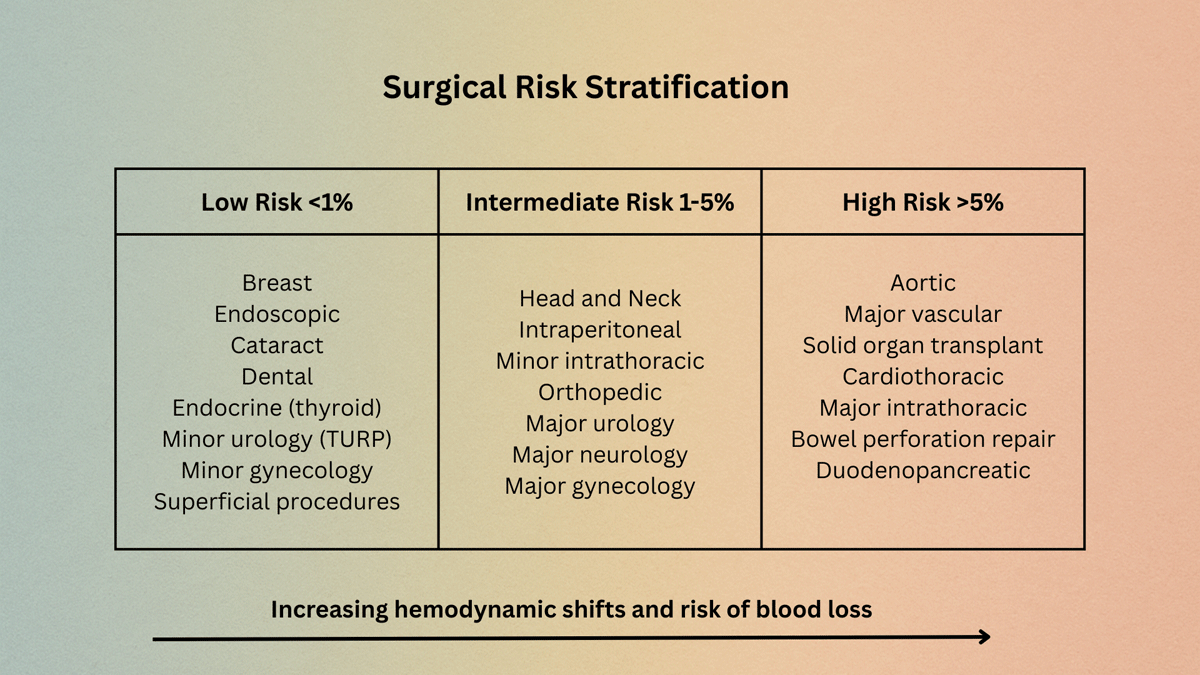
Figure 1
Surgical risk stratification and associated hemodynamic shifts. TURP: transurethral resection of the prostate
Clinical Factors
Assessing key clinical risk factors before surgery is essential for improving outcomes and guiding perioperative care. Risk evaluation begins during the clinic visit, where clinicians should conduct a detailed history focusing on symptoms suggestive of CVD, medical, surgical, family, social, and lifestyle history. Vitals and physical exam help further elucidate underlying CVD. In-person visits are preferred due to the importance of physical examinations; however, a study by Siegel et al. showed that in those without known CVD, telemedicine may be appropriate for preoperative evaluation.27 Major risk factors for cardiovascular complications and poor surgical outcomes include HTN, hyperlipidemia, DM, and frailty.28
Hypertension
Uncontrolled systemic HTN increases mortality, CVD, cerebrovascular events, and bleeding.29 Perioperative HTN raises myocardial demand and subendocardial ischemia, sympathetic overactivity, and end-organ damage.30,31 Patients with chronic HTN and an ASCVD risk of 10% or higher should continue antihypertensives perioperatively, targeting a systolic blood pressure < 130 mm Hg and diastolic blood pressure < 80 mm Hg as dictated by the AHA/ACC hypertension guidelines.32 However, perioperative HTN should be avoided as well due to its own association with mortality.33
Hyperlipidemia
Hyperlipidemia is a well-established risk factor for CVD, stroke, and renal failure in the perioperative period.34,35 Statins are widely utilized in the management of patients with hyperlipidemia, DM, and elevated ASCVD risk. Guidelines recommend continuing statins perioperatively in those who have already been initiated.31 While the LOAD (Effect of inspiratory muscle training with load compared with sham training on blood pressure in individuals with hypertension) trial demonstrated limited evidence to support reduction of MACE in those initiated on a statin in the perioperative period,36 NCS presents an opportunity to start long-term therapy in patients who meet criteria for their use.
Diabetes Mellitus
Those with DM undergoing NCS carry a greater risk of CV events, infections, and mortality during NCS.37 It is unclear based on the available literature whether elevated hemoglobin A1c (A1c) levels are directly correlated to poor surgical outcomes or whether the poor outcomes are primarily a consequence of inadequate shorter-term (perioperative) glucose control.38 As such, the 2025 perioperative guidelines support checking A1c levels within 3 months of NCS; while there is no validated risk threshold, those with A1c levels > 8% have poorer outcomes, and delaying nonemergent surgery to lower A1c levels is reasonable.39
Functional Capacity
Functional capacity is a strong independent predictor of adverse events after NCS and should be assessed in all patients.40,41 Traditionally, functional status has been evaluated using the Metabolic Equivalents of Task (METS) Assessment, which asks patients about their physical abilities and scores them from 0 to > 10 METs. Patients unable to achieve four METs or greater are considered to have poor functional status and are at increased perioperative risk. The 2024 AHA/ACC perioperative guidelines introduce a Class 2a recommendation to use the Duke Activity Status Index (DASI) score as a more robust tool for functional capacity than METS alone.41 The DASI score is a patient-reported questionnaire scored from 0 to 58 points, with a score of < 34 indicating increased risk of 30-day death or MI.42
Frailty
Also novel to the 2024 AHA/ACC perioperative guidelines is a Class 2a recommendation for assessment of frailty. A meta-analysis of 1.1 million adults showed that frailty significantly raises postoperative complications (RR, 2.39; 95% CI, 2.02–2.83) and mortality (RR, 3.71; 95% CI, 2.89–4.77).43 Tools for assessing frailty include the Fried Frailty phenotype, Deficit Accumulation Index, Edmonton Frail Scale, FRAIL scale, Clinical Frailty Scale (CFS), and Short Physical Performance Battery with some evidence favoring CFS for its predictive power.44 Furthermore, there is some data to suggest that exercise and nutritional prehabilitation may reduce rates of pulmonary and cardiac complications of NCS in frail patients.45
Use of Risk Calculator Indices to Assess Perioperative MACE
Risk calculators aid in stratifying surgical patients using demographic, clinical, and procedural factors. Commonly used preoperative risk indices include the Revised Cardiac Risk Index (RCRI), Gupta Perioperative Risk Calculator, American College of Surgeons National Surgical Quality Improvement Program (ACS-NSQIP) Risk Calculator, American College of Surgeons Surgical Risk Calculator, and CanRisk. Developed by Lee et al., the RCRI assesses risk based on six clinical factors46 and is endorsed by the Canadian Cardiovascular Society (CCS) and ACC/AHA. Gupta Perioperative Risk Calculator, also known as the Gupta Myocardial Infarction or Cardiac Arrest calculator, estimates cardiac risk in NCS using functional status, surgery type, and medical comorbidities.47 ACS-NSQIP, supported by the American College of Surgeons (ACS), uses a broad dataset to predict 30-day morbidity and mortality and has been shown to have excellent performance across various surgical settings.48,49 ACS-NSQIP has been adapted for limited use in Canada and Europe, although its dataset is primarily based on American cohorts. While RCRI remains a widely used tool, ACS-NSQIP provides enhanced predictive capabilities in its domain. See Table 1 for further detailed risk calculator comparison.
Table 1
Comparison of risk calculators indices used to assess perioperative risk in patients undergoing noncardiac surgery. ADLs: activities of daily living; CV: cardiovascular; METs: metabolic equivalents (a way to estimate how much energy your body uses during physical activity); ASA class: The American Society of Anesthesiologists physical status classification (a grading system to determine the health of a person before surgical procedure that requires anesthesia); AUB-HAS2: American University of Beirut-HAS2 Cardiovascular Risk Index; ACS NSQIP: American College of Surgeons National Surgical Quality Improvement Program
| RISK ASSESSMENT TOOL | PURPOSE | RISK FACTORS CONSIDERED | OUTPUT/SCORE INTERPRETATION | STRENGTHS | LIMITATIONS | PREDICTION VS OUTCOMES | REFERENCES | CRITERIA FOR USE | SCORE RANGE | THRESHOLD FOR ELEVATED RISK | OUTCOME PREDICTED |
|---|---|---|---|---|---|---|---|---|---|---|---|
| Goldman Index of Cardiac Risk (1977) | First major risk index for predicting perioperative cardiac complications | Age, history of MI, S3 gallop, jugular venous distention, significant aortic stenosis, arrhythmias, emergency surgery, type of surgery | Point-based scoring system; higher score = greater cardiac risk | Historical significance; first structured cardiac risk assessment tool | Outdated; has been largely replaced by more modern risk indices | Overestimates risk in modern surgical settings due to advancements in perioperative care | Goldman et al., New England Journal of Medicine, 1977 | General surgical patients with cardiac concerns | 0–53 points | ≥ 26 points (high risk) | Perioperative cardiac complications, mortality |
| Duke Activity Status Index (DASI) (1989) | Assesses functional capacity in relation to cardiac risk | Patient-reported functional capacity (ADLs) | Score correlates with estimated METs; lower score = higher risk | Easy to administer, provides functional capacity insight | Subjective, patient-reported data may be inaccurate | Correlates with METs but subjective; may not always predict perioperative events | Hlatky et al., Circulation, 1989 | Patients undergoing non-cardiac surgery; assesses functional capacity | 0–58 points | < 34 points (high risk) | Functional capacity estimation, perioperative cardiac risk |
| Revised Cardiac Risk Index (RCRI) (1999) | Predicts major cardiac complications after non-cardiac surgery | Ischemic heart disease, CHF, cerebrovascular disease, insulin use, creatinine > 2.0 | 0–6 point score, higher score = greater risk | Simple and widely used, well-validated | Limited number of variables, may not capture all risk factors | Widely used but has limitations in high-risk patients; often underestimates risk | Lee et al., Circulation, 1999 | Patients undergoing non-cardiac surgery | 0–12 METs equivalent | ≥ 2 points (higher cardiac risk) | Major cardiac complications post-surgery |
| Gupta Perioperative Risk (2011) | Estimates risk of myocardial infarction or cardiac arrest in non-cardiac surgery | Type of surgery, functional status, ASA class, creatinine level, age | Probability of MI or cardiac arrest (%) | Uses large dataset, validated in multiple populations | Limited to MI/cardiac arrest risk, does not assess overall surgical risk | Moderate accuracy; validated but may underpredict in high-risk patients | Gupta et al., Anesthesiology, 2011 | Patients undergoing non-cardiac surgery | Percentage risk | ≥ 1% (elevated risk) | Postoperative complications, including cardiac events |
| American College of Surgeons Surgical Risk Calculator (2013) | Provides individualized risk estimates for surgical complications | Demographics, comorbidities, functional status, type of surgery, frailty | Personalized risk percentage for complications including cardiac events | Highly personalized, considers multiple risk factors | Complex tool requiring online calculator, less validated in some populations | Personalized and data-driven; good prediction, but requires online access | Bilimoria et al., JAMA Surgery, 2013 | General surgical patients; requires ACS NSQIP data | Personalized risk percentage | ≥ 1% (elevated risk) | Personalized complication risk estimation |
| METS (Metabolic Equivalent Task Score) (2014) | Evaluates a patient’s functional status in terms of metabolic equivalents | Exercise tolerance, ability to perform daily activities | Higher METs = better functional capacity, lower risk | Noninvasive, can guide preoperative cardiac testing | Limited application for patients with limited mobility | Good correlation with functional status; less reliable in sedentary patients | Ainsworth et al., ACSM Guidelines, 2014 | General surgical patients | 0–100% mortality risk | < 4 METs (poor functional capacity) | Perioperative mortality |
| Surgical Outcome Risk Tool (SORT) (2014) | Estimates 30-day mortality risk in non-cardiac surgery | Age, ASA class, urgency of surgery, surgical severity, functional status, comorbidities | Probability (%) of 30-day mortality; higher score = greater risk | Simple and easy to use; validated in large surgical populations | Limited to mortality prediction; does not assess other complications | Good accuracy for predicting mortality but does not account for non-fatal complications | Protopapa et al., British Journal of Anaesthesia, 2014 | General surgical patients in Canada | 0–100% risk score | ≥ 5% (elevated risk) | Perioperative complications and mortality |
| NSQIP Geriatric-Sensitive Perioperative Cardiac Risk Index (2017) | Estimates perioperative cardiac risk with a focus on older surgical patients | Age, frailty, ASA class, functional dependence, cognitive impairment, comorbidities, emergency status, surgical risk level | Probability (%) of perioperative cardiac complications and mortality | Specifically tailored for older patients; considers frailty and functional dependence | Limited validation outside geriatric populations; requires NSQIP database access | More accurate than general cardiac risk scores for geriatric patients; integrates frailty as a key factor | Berian et al., Journal of the American College of Surgeons, 2017 | General surgical patients | 0–100% mortality risk | ≥ 5% (high risk) | 30-day postoperative mortality |
| AUB-HAS2 Cardiovascular Risk Index (2019) | Predicts major adverse cardiovascular events (MACE) in non-cardiac surgery | Age, urgency of surgery, history of heart failure, coronary artery disease, stroke, diabetes, functional status, renal function | Point-based scoring system; higher score = greater risk of MACE | Includes a broad range of cardiovascular risk factors; validated in surgical patients | Less widely used than other indices; requires further validation in diverse populations | Good predictive value for MACE; comparable to RCRI but includes more cardiovascular-specific factors | Abou-Zahr et al., Journal of the American College of Cardiology, 2019 | General surgical patients with potential cardiac risk | 1–4 points | ≥ 2 points (moderate risk), ≥ 3 points (high risk) | Perioperative cardiac risk |
| National Surgical Quality Improvement Program (NSQIP) (2020) | Estimates postoperative complications including cardiac risk | Patient demographics, comorbidities, type of surgery, functional status | Risk percentage of complications including cardiac events | Comprehensive and data-driven, dynamic risk assessment | Requires access to NSQIP database, complex calculations | Highly accurate; uses real-world data, but access limitations | American College of Surgeons NSQIP, 2020 | Patients undergoing non-cardiac surgery with cardiovascular risks | 0–10 points | ≥ 6 points (high cardiovascular risk) | Major adverse cardiovascular events (MACE) |
| CanRisk (2021) | Predicts perioperative risk in Canadian surgical patients based on population-specific data | Age, comorbidities, functional status, surgical urgency, frailty, socioeconomic factors | Risk percentage for perioperative complications and mortality | Designed specifically for Canadian populations, includes socioeconomic factors | Less known internationally, validation studies still ongoing | Good predictive accuracy but limited external validation outside Canada | Canadian Surgical Outcomes Risk Assessment (CanRisk), 2021 | Geriatric surgical patients | 0–100% probability | ≥ 5% (high risk in geriatric patients) | Perioperative cardiac complications and mortality |
Currently, no consensus exists on the most accurate tool for predicting MACE. A study comparing RCRI and American Society of Anesthesiologists in 184 non-cardiothoracic surgery patients found similar predictive performance for cardiac and pulmonary complications (AUC = 0.75 and 0.77, respectively).50 Alternatively, the 2019 American University of Beriut Cardiovascular Risk Index (AUB-HAS2) outperformed RCRI and the Andersson score in predicting postoperative complications including rehospitalization, decompensated heart failure, acute kidney injury, and infection (AUB-HAS2: AUCROC 0.646, P < .001; RCRI: AUCROC 0.560, P = .126; Andersson: AUCROC 0.487, P = .760).51 Due to these differences, further validation studies are warranted to determine the optimal prediction model.
Overall, risk assessment remains central to perioperative management and is best achieved through a combination of history, exam, functional and frailty assessment, and risk calculators.
Preoperative Testing
Billions of US dollars are spent annually on preoperative testing. A study looking at over 100,000 ASA Class 1 or 2 (healthy or mild systemic disease, respectively) patients who underwent low-risk elective outpatient surgery showed that $373 million was spent on preoperative testing, with no difference in outcomes between those who underwent testing and those who did not.52
Electrocardiogram
The latest data provides no evidence to support the routine use of a 12-lead electrocardiogram (ECG) in low-risk patients undergoing NCS.53,54,55 While the 2024 AHA/ACC perioperative guidelines discuss the utility of obtaining an ECG in patients in preexisting cardiac conditions, the guidelines give only a Class 2b recommendation for its use in asymptomatic patients without CVD undergoing high-risk surgeries. Rather, the value of clinical risk assessment tools with validated indices is far higher than that of a single 12-lead ECG.
Assessment of Left Ventricular Function
There is no evidence to date to support routine preoperative left ventricular (LV) assessment in clinically stable patients with cardiac risk factors.56,57 However, the 2024 ACC/AHA preoperative guidelines recommend assessment of LV function in patients with clinical signs of heart failure (HF) or suspected new/worsening LV dysfunction based on numerous studies linking HF to poor perioperative outcomes.58,59 Certain studies show that patients with reduced LV ejection fraction (LVEF) fare worse than those with preserved LVEF, especially during intermediate-high risk procedures.60 While LVEF is an independent predictor of mortality, a large Veterans-based study showed that symptomatic HF regardless of LVEF was associated with a higher 90-day postoperative mortality.61 Thus, those with highest risk include patients with decreased LVEF and symptomatic HF patients regardless of LVEF. The guidelines support preoperative LV function assessment in those with symptomatic signs of HF and can be considered for further evaluation in those with elevated BNP or NT-proBNP.
Stress Testing
Since 1996, clinical guidelines have advised against the use of preoperative stress testing in patients with low estimated perioperative risk.62 Still, a 2020 study found that nearly 50% of patients with zero RCRI risk factors undergoing intermediate-risk orthopedic surgery still underwent stress testing,11 highlighting a persistent pattern of guideline nonadherence in perioperative evaluation practices. In patients with elevated estimated perioperative risk, the role of stress testing has evolved. Although previously a Class 2a recommendation in the 2014 AHA/ACC perioperative guidelines, preoperative stress testing (either exercise or pharmacological) in elevated-risk patients with poor or unknown functional status received a Class 2b recommendation per the updated 2024 AHA/ACC perioperative guidelines. Additionally, while prior data from small observational studies linked inducible ischemia with perioperative MACE,63,64 recent data reveals that a positive stress test adds no incremental value beyond standard risk assessments (such as risk calculators and biomarkers).65,66 This likely reflects the lack of benefit in preoperative revascularization of asymptomatic patients with abnormal stress tests.19 Moreover, recent high-quality trials by Rubin et al., Cheng et al., and Columbo et al. have shown no improvement in perioperative outcomes among elevated-risk patients undergoing intermediate and high-risk surgeries when stress testing is performed.11,12,13 Overall, noninvasive stress testing should be avoided in low-risk patients and reserved for high-risk patients only in situations where revascularization will ultimately improve clinical outcomes, such as in those with left main disease and severe multivessel disease with reduced LVEF.
Coronary Computed Tomography Angiography
Given its increased utilization over the past decade, coronary computed tomography angiography (CCTA) has been incorporated as a new addition to the 2024 AHA/ACC perioperative guidelines. Like stress testing, routine CCTA is not recommended in patients with low estimated perioperative risk. For high-risk patients with poor or unknown functional status, CCTA received a Class 2b recommendation only for detection of high-risk coronary anatomy (left main disease or severe multivessel disease with reduced LVEF) where revascularization may improve outcomes. The 2015 Coronary CTA VISION Study involved 1,000 patients undergoing NCS and found that those with single vessel disease had a three-times higher risk of perioperative MACE and those with multivessel disease had a five-times higher risk. Although it identified atherosclerotic disease, the study also showed that CCTA was five times more likely than RCRI alone to overestimate risk in patients who otherwise would not experience cardiovascular death or MI within 30 days of surgery.67 A meta-analysis by Koshy et al. reported similar findings but highlighted the practicality of CCTA’s high negative predictive value over its weak positive predictive value.68 Some evidence suggests that patients with a coronary artery calcium score of 0 within 2 years may proceed to surgery without further testing due to low risk of perioperative MACE.69 However, in symptomatic patients with chest pain and no history of CAD or prior angiography, CCTA may serve as a noninvasive alternative for identifying high-risk coronary anatomy.70
Invasive Angiography and Revascularization
Invasive angiography is not recommended preoperatively, regardless of patient or surgical risk, and offers no survival benefit in the perioperative context. The CARP (coronary artery revascularization prophylaxis) trial evaluated 510 patients with significant CAD (> 70% stenosis of one or more major coronary arteries) and found no difference in postoperative MI or long-term mortality between those who underwent preoperative revascularization and those who did not.19 Notably, this study excluded patients with left main disease, LVEF < 20% due to ischemic heart disease, and patients with severe aortic stenosis. Following the CARP trial, the DECREASE-V (Clinical Randomized Trial to Evaluate the Safety of a Noninvasive Approach in High-Risk Patients Undergoing Major Vascular Surgery) study evaluated 1,880 high-risk patients undergoing vascular surgery. Among them, 49 received revascularization after identification of extensive ischemia on dobutamine stress echo. The study found no difference in 30-day or 1 year mortality between the revascularized and non-revascularized groups.71 Additionally, a retrospective analysis of 1,104 high-risk patients with ischemic heart disease (IHD) undergoing vascular surgery showed no difference in overall mortality between those who received revascularization before surgery and those who did not. Particularly, while the non-revascularized group exhibited higher ischemic cardiovascular mortality, the revascularized cohort had higher mortality from nonischemic causes.72 This further confirms the conclusion that revascularization before NCS does not improve overall mortality or outcomes.
Preoperative Biomarkers
Cardiac biomarkers such as cardiac troponin and BNP/NT-proBNP are ubiquitous and inexpensive laboratory tests that can assess for myocardial injury and cardiac wall stress. While these tests are widely available, understanding the appropriate application of biomarkers in the context of perioperative workup is crucial. Low-risk patients and those undergoing low-risk surgery do not require biomarker screening and should proceed directly to surgery. In patients with high risk as determined by risk indices and poor functional status or frailty, multiple trials have demonstrated that combining the RCRI score with cardiac biomarkers adds incremental value to risk assessment compared to risk assessment indices alone.17,18 Because of the excellent negative predictive value of cardiac troponin and BNP/NT-proBNP, elevated-risk asymptomatic patients with negative biomarkers can proceed to surgery without further testing. Despite multiple trials showing the strength of cardiac biomarkers as strong prognostic markers,73,74,75,76,77 no studies show mortality benefit from altering management based on abnormal biomarkers. Thus, in patients with elevated biomarkers, guidelines recommend risk reclassification and shared decision-making between patients and provider about proceeding with surgery.31
2024 Algorithm for Perioperative Cardiac Assessment
Figure 2, adapted from the AHA/ACC 2024 perioperative guidelines, presents a framework for evaluating a patient with cardiac risk factors undergoing NCS. The framework begins with determining surgical urgency, where emergent surgeries should proceed directly to the operating room, regardless of risk. In non-emergent cases, the next step is risk stratification, described in sections II and III. This step is key, as it incorporates lifelong clinical history rather than an estimation of risk from a single test or measurement in time. Those with low estimated risk should proceed directly to surgery without further testing, and those with elevated estimated risk but good functional capacity and no frailty may also proceed to surgery. In those with elevated risk and poor functional status and/or frailty, the next steps involve multidisciplinary discussions with the patient, family, and other providers to assess goals and determine whether further testing would influence management. If further testing is desired, cardiac biomarkers are obtained first. In those with negative biomarkers, surgery can proceed without additional testing. In those with elevated biomarkers, patient-centered multidisciplinary discussion is warranted to decide if further cardiac testing would change management. If further testing is warranted, consideration of echocardiography, stress testing, and/or CCTA can be considered based on the patient’s symptoms and risk factors. If the imaging has no elevated risk findings, surgery can proceed. If elevated-risk features are present on imaging, further evaluation or reassessment of surgical risk-benefit is warranted.
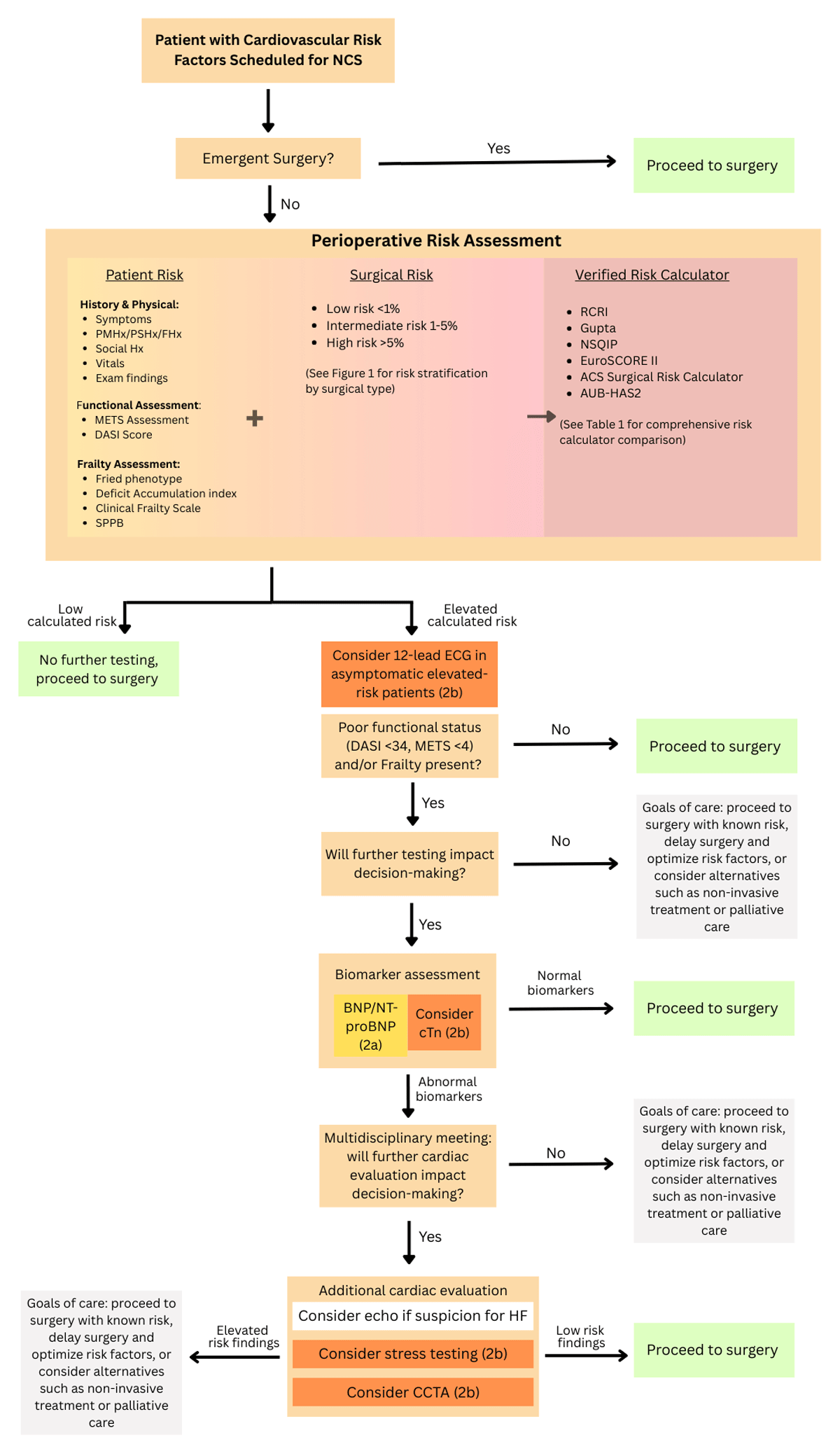
Figure 2
2024 Algorithm for Perioperative Cardiac Assessment. Adapted and revised from the 2024 AHA/ACC/ACS/ASNC/HRS/SCA/SCCT/SCMR/SVM Guideline for Perioperative Cardiovascular Management for Noncardiac Surgery. NCS: noncardiac surgery; Hx: history; PMHx: past medical history; PSHx: past surgical history; FHx: family history; METS: Metabolic Equivalents Task Score; DASI: Duke Activity Status Index; RCRI: Revised Cardiac Risk Index; NSQIP: National Surgical Quality Improvement Program; AUB-HAS2: American University of Beirut-HAS2 Cardiovascular Risk Index
Comparative Analysis of Guidelines
The Canadian Anesthesiologists’ Society and Canadian Cardiovascular Society emphasize a patient-centered approach combining risk calculators with frailty and functional assessments. They recommend using RCRI in NCS and supplementing it with biomarkers (eg, BNP, troponins),78 and they support risk-based preoperative testing to reduce unnecessary investigations.
The European Society of Cardiology and the European Society of Anesthesiology and Intensive Care focus on systematic preoperative evaluation, particularly for high-risk patients. They advise risk assessment incorporating stress testing or cardiac imaging for those with poor functional capacity or new cardiac symptoms.79 The guideline highlights the significance of shared decision-making and multidisciplinary risk stratification to ensure comprehensive patient care.
American Guidelines (ACC/AHA, ACS, ASA) rely on ACS-NSQIP and RCRI for surgical risk assessment and promote functional capacity measures (METS, DASI) alongside risk scores.80
In summary, Canadian guidelines favor personalization, European guidelines emphasize comprehensive cardiac risk assessment, and American guidelines utilize large-scale databases for dynamic risk modeling.
Future Perspectives
The future of perioperative care lies in refining risk stratification tools, care delivery models, and risk modification strategies. Currently, there is no one risk prediction tool that is recommended over the other, and more data is needed to determine which provides the most accurate perioperative risk classification. Most existing tools use electronic healthcare records, but utilizing imaging and physiologic data through artificial intelligence and machine learning may improve performance. Furthermore, the development of surgery-specific tools could further enhance accuracy. Penultimately, while current risk stratification tools have reasonable predictive performance, there are no recommendations on modifying treatment plans based on the models’ risk estimate. Furthermore, the landscape of preoperative testing continues to evolve, and certain areas lack definitive data to guide management. For instance, while biomarkers have demonstrated promise in improving risk stratification, their timing, integration, and impact on outcomes remains unclear. Similarly, more data is required to elucidate the role of perioperative ECG and focused LVEF assessment in stable patients undergoing NCS. Additional risk stratification will also be needed to predict events beyond ischemic complications, including heart failure and arrhythmias. Further data will also be needed in specific high-risk patient populations, including solid organ transplant recipients.
Conclusion
Noncardiac surgery poses significant risks, particularly in patients with preexisting risk factors. Preoperative assessment is crucial to identify those at high risk of cardiovascular complications and mortality. Updated guidelines from American, Canadian, and European societies emphasize reducing unnecessary testing and focusing on measures that correlate with mortality, such as risk factor identification, functional assessment, risk calculators, and biomarkers. Ongoing high-quality evidence and multidisciplinary care are essential for perioperative NCS management.
Key Points
A thorough risk assessment—including clinical risk factors, functional status, and surgical risk—using risk indices is the most powerful means to stratify risk.
Low-risk, asymptomatic patients should not receive additional laboratory or imaging testing and should proceed directly to surgery.
Cardiac biomarkers may be used to further stratify high-risk patients and identify those who may benefit from additional testing.
Stress testing is overutilized and its use should be limited to those in whom revascularization has supportive evidence of improved outcomes.
CME Credit Opportunity
Houston Methodist is accredited by the Accreditation Council for Continuing Medical Education (ACCME) to provide continuing medical education for physicians.
Houston Methodist designates this Journal-based CME activity for a maximum of 1 AMA PRA Category 1 Credit™. Physicians should claim only the credit commensurate with the extent of their participation in the activity.
Click to earn CME credit: learn.houstonmethodist.org/MDCVJ-21.4.
Competing Interests
The authors have no competing interests to declare.