
Introduction
Recent analysis shows that cardiovascular disease (CVD) has become the number one cause of mortality and morbidity not just in the Western world but globally, accounting for over 30% of all deaths worldwide.1 Cardiovascular disease accounted for over 20 million deaths in 2021 alone,2 and those residing in the United States (US) have a 50% chance of experiencing a cardiac event over their lifetime.3 Although these numbers were in decline for roughly three decades,3,4 the past decade has seen an increase, particularly for those in middle- and low-income brackets. Despite this increase, evidence from multiple randomized placebo-controlled clinical trials shows that coronary artery disease (CAD) is highly preventable,5 and secondary prevention—by modifying one or more of the known conventional risk factors—is highly effective. Medications targeting modifiable risk factors such as hypercholesterolemia or hypertension is readily available and relatively inexpensive. The key to conquering this disease, however, is to decrease the prevalence through early primary prevention.
Currently, primary prevention is limited because reliable biomarkers of CAD in young asymptomatic individuals are not available. Known conventional risk factors for CAD, such as hypertension or diabetes, occur in the sixth or seventh decade of life, which is late for primary prevention and especially late in males.6,7,8,9
The recent discovery of DNA variants predisposing to CAD offers a more appropriate approach to detect those who would benefit most from early primary prevention. Genetic risk, which accounts for 50% of risk for CAD,10 is inherited at birth and does not change in one’s lifetime; thus, it can be used to risk stratify for CAD at an early age to enable primary prevention. Figure 1 is a graphic depiction of CAD genetics, including the application of a genetic, or polygenic, risk score (PRS) as a biomarker to risk stratify and identify young asymptomatic individuals at high risk for CAD. It has been proposed that individuals at high genetic risk for CAD (as detected by a high PRS) could receive an annual injection of one of the small interfering RNA drugs targeting PCSK9, which would help sustain a significant reduction in low-density lipoprotein cholesterol (LDL) for a year. This approach, analogous to a flu vaccine if given at age 30 and annually thereafter, could delay the onset of clinical manifestations of CAD until age 100.
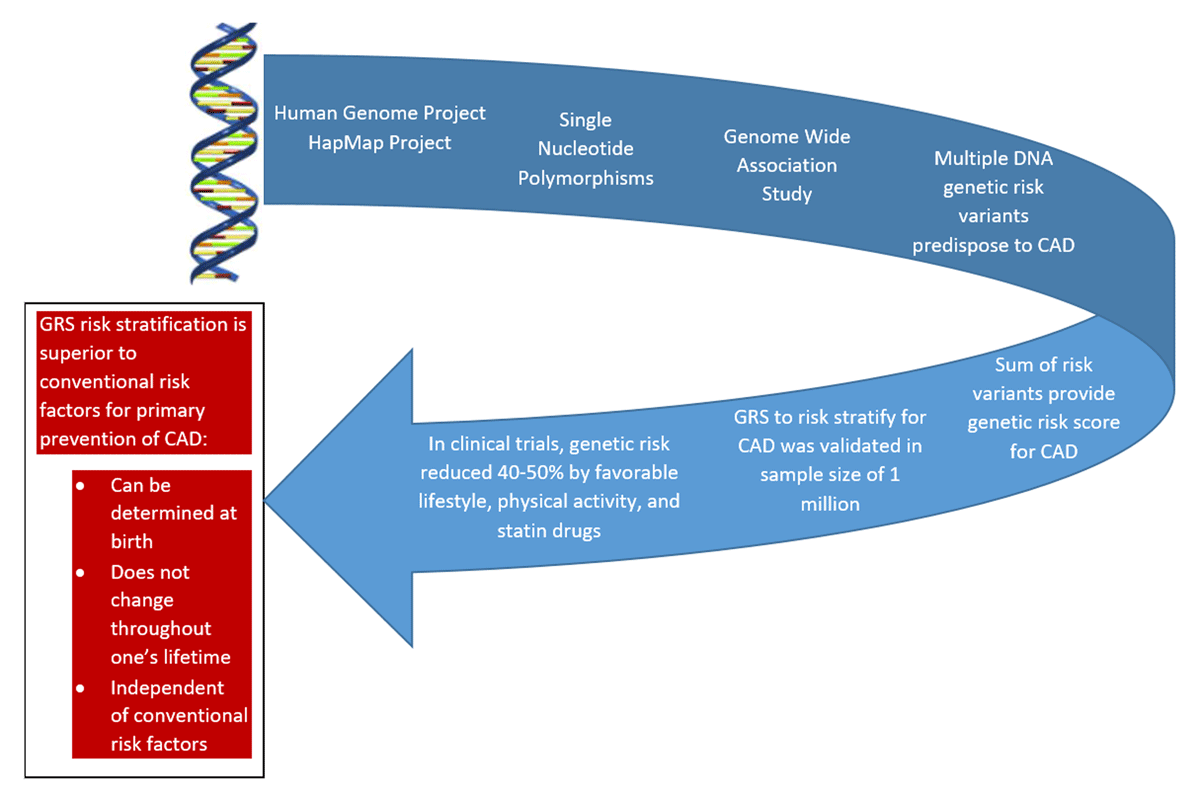
Figure 1
Graphic depiction of the genetics of coronary artery disease (CAD) using a genetic risk score as a biomarker to risk stratify for CAD and to identify young asymptomatic individuals at high risk for CAD. Genome-wide association studies enabled an unbiased search for genetic variants predisposing to CAD. The total risk burden is summarized in a single number referred to as a genetic risk score, which is now more commonly referred to as Polygenic Risk Score (PRS). The PRS was used to stratify for risk of CAD. Prospective clinical trials showed lifestyle changes and drug therapy decreased genetic risk by 40-50%. Modified from Roberts et al. JACC Basic Translational Science 2021;6(3);287-304.
Subclinical Atherosclerosis is Amenable to Primary Prevention
The inherent nature whereby atherosclerosis develops in the coronary vessels makes it most amenable and vulnerable to early prevention. Coronary atherosclerosis, the cause of CAD, develops in childhood and gradually progresses over decades. It has been observed as fatty streaks in the coronary arteries of males as early as their teenage years based on autopsies of soldiers who died during the Korean War.11 Similarly, individuals who die young from trauma often exhibit significant atherosclerosis in the coronary vessels.12 The gradual rate of progression of subclinical coronary atherosclerosis continues silently until it reaches a certain threshold, when it is clinically manifested. The clinical threshold usually occurs in the fifth or sixth decade for males and in the sixth or seventh decade for females.
The main contributing factor to atherosclerosis is plasma cholesterol that seeps into the coronary vessel wall. The retained cholesterol undergoes oxidation, which attracts a variety of inflammatory and immune cells that lead to plaque formation. The clinical threshold is usually reached when the plaque causes a 30% to 40% narrowing of the coronary lumen. This degree of narrowing does not interfere with coronary blood flow, but the plaque induces abnormalities in the vessel wall that predispose it to thrombosis. Plaque rupture or erosion can precipitate a thrombus, which occludes the lumen and triggers an event such as myocardial infarction (MI) or sudden death. The peak incidence of MI in the US averages 58 years for males and 68 years for females.1 Once the clinical threshold is reached, the incidence of MI doubles every 10 years, resulting in a 1% incidence at age 40 years, 2% at age 50 years, 4% at age 60, 8% at age 70, and 16% at age 80 years.13
Women tend to have a lower risk of CAD during the premenopausal years; however, once menopause is reached, the disease progresses rapidly such that the overall incidence of CAD by the seventh decade is similar to that of males.14 A recent observational study of 500 pre- and post-menopausal women without known CAD indicated that the absence of clinical features of CAD in women prior to menopause is due to delayed development of subclinical coronary atherosclerosis.15 Currently, coronary computerized tomography angiography (CCA) is the most sensitive technique to detect and quantify subclinical coronary atherosclerosis, and this was the first study to use CCA in premenopausal women without known heart disease. Results showed minimal or no subclinical coronary atherosclerosis in the majority of individuals. These results have implications for selecting the optimal age to initiate primary preventative therapy. For pre-menopausal women, prevention may be delayed until the third or fourth decade of life, whereas observations in young men suggest that primary prevention is preferably initiated in the second or third decade.
Early Primary Prevention of CAD Should be the Future Goal
Rare inherited disorders, such as familial hypercholesterolemia, have helped to significantly elucidate the role of cholesterol in the pathogenesis of CAD.16 Discovery of a family with familial hypercholesteremia in the 1970s was subsequently shown to be due to a mutation in the LDL receptor.17 Studies subsequently showed that families with this defect had increased plasma LDL and experienced premature heart disease as early as the second or third decade of life. Analogous to these observations was the more recent discovery18 of a gain of function mutation in the PCSK9 gene that caused increased levels of plasma LDL and was associated with premature CAD. Subsequently, it was determined that a loss of function mutation in the PCSK9 gene was associated with low plasma LDL levels and an 80% reduction in the risk for CAD.19
The exposure to lower plasma LDL from birth is associated with a greater reduction in the risk of CAD. Ference et al., using the method of Mendelian Randomization, selected nine genetic variants associated with decreased plasma LDL.20,21 These genetic variants were randomly assigned at conception, exposing the individual to genetic influence throughout their lifetime. The main age of the study population was 50 years, and they showed a 54.5% reduction in cardiac risk for each millimole decrease in plasma LDL. A millimole is equivalent to a plasma LDL of 38.7 mg/dL. This percent reduction is much greater than the 20% reduction in cardiac events per mm of LDL reduction observed in clinical trials. These clinical trials enroll individuals usually in their fifth or six decade of life, and the duration of prevention is usually only 3 to 5 years. Thus, there is a 3-fold greater reduction in cardiac events per mm reduction in LDL if the reduction of plasma LDL is initiated at birth. In a previous follow-up study of the Framingham Offspring Cohort,22 the investigators observed that cardiac risk was doubled for each additional decade of exposure to plasma LDL. These studies indicate that the risk from plasma LDL relates to not only the concentration but also the duration of exposure. All of these studies indicate that the earlier prevention is initiated, the greater the reduction in cardiac risk from plasma LDL.
Intravascular ultrasound studies show the rate of plaque growth is directly proportional to the absolute plasma LDL levels.23,24 To account for the cumulative risk from the duration of exposure and the plasma concentration of LDL, Ference et al.25 proposed the use of mg-years of LDL. Using this derived metric for cumulative risk for CAD, one can estimate the extent of plaque burden and the approximate age at which the clinical threshold for MI will occur. For example, someone at age 40 with an LDL of 125 mg/dL has a cumulative risk of 5,000 mg-years (40 × 125 = 5,000). The incidence of MI in an American at age 40 years is known to average 1%. The authors postulate that this probably represents the minimum cumulative risk to induce MI. The goal of early primary prevention is to reduce the cumulative risk and delay the onset of MI.
Conventional Risk Factors are Inadequate as Targets for Primary Prevention
The gradual but sustained progression of coronary atherosclerosis strongly beckons an early intervention that potentially would prevent subclinical coronary atherosclerosis from being clinically manifested. It has been proposed that the initiation of early primary prevention would theoretically all but eradicate CAD in the 21st century.26 This optimism is based in part on the results of multiple placebo-controlled clinical trials that consistently showed a 20% reduction in cardiac events for each millimole (38.7 mg/dL) reduction in plasma LDL-C.27 This reduction is maintained regardless of whether one uses statins, PCSK9 inhibitors, or other means.28,29
Conventional risk factors have proven to be very effective targets for prevention, resulting in a 50% decrease in the incidence of MI in the past 30 years in the US.3,4 The current clinical cardiovascular practice guidelines (CCCPG) developed by the American Heart Association (AHA) and the American College of Cardiology (ACC) have codified the recommendations for prevention of CAD, specifically targeting the age group from 40 years to 75 years. It recommends using the pooled cohort equations (PCE) to calculate the 10-year risk of a cardiac event, with a threshold of ≥ 7.5% for recommendation of primary prevention, including the use of statins (http://tools.acc.org/ASCVD-Risk-Estimator-Plus/#!/calculate/estimate/).30
Reaching this threshold by middle age usually requires that the patient has at least two risk factors. For example, consider the case of a 40-year-old female with a plasma LDL-C of 180 mg/dL with no other traditional risk factors. The PCE calculation indicates a 10-year risk for a cardiac event of 2.1%. This would imply that no specific treatment is indicated. Her risk for CAD is low because most of the traditional risk factors such as hypertension or diabetes, which would increase her chances of a cardiac event, do not develop until later in life (Figure 2). A second limitation to risk stratification for CAD using the PCE 10-year risk is its dependence on age. The same patient at age 60 years with the same single risk factor of a plasma LDL-C of 180 mg/dL now has a 9.2% 10-year risk of a cardiac event simply due to increased age.
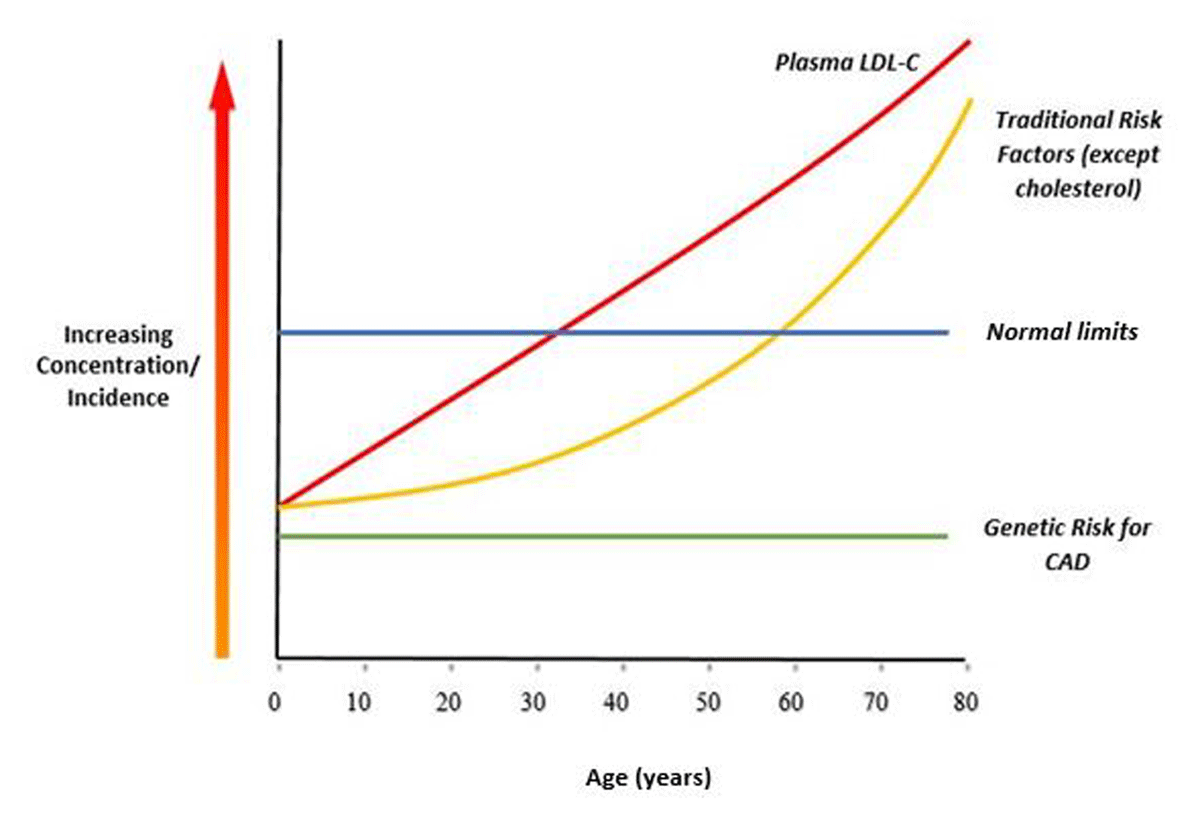
Figure 2
Conventional risk factors are age dependent. Traditional risk factors such as hypertension or diabetes are seldom present until one is in their 50s or 60s. The one exception is cholesterol, which increases early in life. The risk for coronary artery disease (CAD) doubles every 10 years. In contrast, the genetic risk score for CAD is independent of age and remains the same throughout life. Genetic risk obtainable any time after birth provides a major advantage, enabling one to predict the risk for CAD early in life.
The CCCPG committee was attempting to develop a method that would be applicable for those at highest risk for CAD. The average plasma LDL for a 40-year-old American male is 147 mg/dL and 130 mg/dL for a female.31 The guidelines recommend that plasma LDL be less than 70 mg/dL. If one were to treat only on the basis of plasma LDL, more than 50% of this population would unnecessarily be treated since only a half of these individuals are expected to develop a cardiac event.3 The CCCPG committee had hoped that utilizing PCE to estimate the 10-year risk for CAD would minimize unnecessary treatment.
While conventional risk factors are very effective targets for secondary prevention, they are less so for early primary prevention.32 The inadequacy of the traditional risk factors for primary prevention is further confirmed by the recent retrospective analysis of 2,733 individuals who developed premature acute MI earlier than age 55 years.33 Retrospective stratification using the PCE to determine 10-year risk for a cardiac event and a threshold of 7.5% means that only 39.4% of these patients would be qualified for primary prevention.
Discovery of DNA Variants Predisposing to Increased Risk for CAD
It has been known for decades that genetic predisposition accounts for about 50% of the risk for CAD.10 However, technology to discover the DNA sequences responsible for transmitting risk for a polygenic disease such as CAD was not available until recently, and it was expected that these risk-carrying DNA variants would be distributed throughout the genome. The most appropriate technique to pursue these DNA risk variants was considered to be a Case Control Association Study (CCAS),34,35 which would require DNA markers distributed throughout the genome and a large sample size.
In a CCAS, the frequency of each DNA marker in controls is compared with the frequency in cases with proven CAD. Markers occurring more frequently in cases indicate that the DNA marker is a risk variant for CAD or is in close physical proximity to a sequence that predisposes to CAD. The DNA markers became available from the International HapMap Project (HapMap), which discovered millions of single nucleotide polymorphisms (SNPs) distributed throughout the genome.36 The CCAS coupled with SNPs as markers that span the human genome is referred to as a genome-wide association study (GWAS). Utilizing a million markers and a P value of .05 would give rise to 50,000 false positives.12,34 A correction factor was adopted, referred to as the Bonferroni correction, which requires a P value of .00000005, or 10–8. In addition, it was recommended that the results be replicated in an independent population, which would require an even greater sample size.
In 2007, the Ottawa Heart Institute37 and the Icelandic de Code group38 independently and simultaneously discovered the first genetic risk variant for CAD, referred to as 9p21. Our institution (Ottawa Heart) utilized a sample size of 23,000 cases and controls, and the Icelandic group had over 18,000. Shortly thereafter, in an independent population of 17,000, the Welcome Trust Group confirmed 9p21 as a risk variant for CAD.39 Subsequently, 9p21 as a risk variant for CAD was confirmed throughout the world and claimed to be present in about 75% of the population.9 The risk mediated by 9p21 for CAD is independent of known conventional risk factors and amounts to an increase in relative risk of 25% per copy of the 9p21 risk allele.
These results confirmed our expectation that each genetic variant transmits only minimal risk, and thus there would have to be a large number of DNA variants to account for the postulation that genetic risk accounts for 50% of the risk for CAD—which would require even larger sample sizes than we had anticipated. Investigators involved with GWAS pursuing genetic risk for CAD formed an international consortium referred to as CARDioGRAM (coronary artery disease, genome wide, replication and metanalysis)40 and subsequently expanded to CARDioGRAMplusC4D (CARDIoGRAM plus The Coronary Artery Disease [C4D] Genetics) consortium.41 These efforts, along with that of other groups, led to the discovery of over 300 genetic risk variants predisposing to CAD, which are summarized in several reviews.42,43,44,45
In summary, the genetic risk variants predisposing to CAD are located throughout the genome, with over 80% being in regions of DNA that do not code for protein. On average, each variant carries only a 10% increase in relative risk for CAD, and the mechanism whereby they mediate their risk remains unknown for more than 50% of the risk variants.
Risk Stratification for CAD based on the Genetic Risk Score
The impetus to pursue DNA risk variants for CAD was in part to explore whether these variants could be used to predict the risk for CAD. DNA risk variants are randomly distributed at conception and remain the same throughout one’s lifetime. Thus, unlike conventional risk factors, genetic risk for CAD can be determined in utero, at birth, or anytime thereafter, providing the ideal means to risk stratify for early primary prevention. The number of copies of each genetic variant inherited per person can be 0 (neither parent having transmitting a copy), 1 (only one parent transmitting a copy) or 2 (both parents transmitting a copy). The genetic risk score is usually referred to as a polygenic risk score (PRS) since CAD is a polygenic disease. The genetic risk variants for CAD can be encrypted on a microchip. This microchip can be used to rapidly genotype the DNA from a blood sample and determine the number of genetic risk variants a person inherited that predisposes them to CAD. This enables one to express the total genetic risk for CAD in a single number (PRS).
In a randomized placebo controlled clinical trial to assess the effect of statin therapy on cardiac events, Mega et al.46 used a microchip containing 27 genetic risk variants for CAD in a sample size of 48,421. The individuals with the highest genetic risk score had the highest risk for CAD. The PRS predicted cardiac events independent of traditional risk factors. The individuals with the highest PRS score also received the most benefit from statin therapy.
Retrospective analysis of blood samples from the West of Scotland Coronary Prevention Study5 was performed with 57 genetic risk variants for CAD. Individuals receiving statin therapy with the highest PRS score had a 44% reduction of cardiac events versus a 24% reduction in the intermediate and low genetic risk groups. The number of treated patients needed to prevent one cardiac event in the high PRS group was 13 individuals versus 38 in the groups with intermediate and low PRS. Additionally, analysis of two clinical trials assessing the effect of cholesterol-lowering PCSK9 inhibitors showed the PRS to be superior to traditional risk factors.
The FOURIER (further cardiovascular outcomes research with PCSK9 inhibition in subjects with elevated risk) trial—which retrospectively genotyped patients using a microarray with 6,000,000 SNPs predisposing to CAD—showed that patients with the highest PRS score were at high risk for CAD and also experienced the greatest benefit from decreasing plasma cholesterol.47 The ODYSSEY OUTCOMES trial (evaluation of cardiovascular outcomes after an acute coronary syndrome during treatment with alirocumab) had a sample size of 11,953 patients who were genotyped using a microchip with 6 million risk variants.48 Individuals with the highest PRS score had the highest risk for CAD, and the reduction of cardiac events by PCSK9 inhibitors was 37% in the high genetic risk group versus 13% reduction in the low PRS group. These studies consistently showed PRS to be superior and independent of traditional risk factors.
Biobank samples are another way to validate the PRS as a marker to risk stratify for CAD. Inouye et al. used a microarray with 1.7 million genetic risk variants for CAD to genotype a population of 500,000 from the UK biobank, and they observed that those ranking in the top 20% of the PRS had a 4-fold increased risk for CAD.49 Similarly, Khera et al. used a microarray containing 6.7 million risk variants predisposing to CAD and genotyped a population of 288,978 individuals from the UK biobank.50 In this study, 8% of the population had a 3-fold increased risk for CAD and 5% had a 5-fold increased risk. It is noteworthy that in the population with high PRS, indicating high risk for CAD, only 20% had familial hypercholesterolemia, whereas 28% had hypertension and 35% had a family history of CAD. Risk stratification using the AHA/ACC PCE based on traditional risk factors would have detected less than half of the individuals at high risk for CAD. A recent study in India51 utilizing a microchip containing 6.6 million risk variants for CAD confirmed the PRS to be independent of conventional factors and superior to risk stratification using the PCE method.
Reducing CAD Risk in Individuals with a High Polygenic Risk Score
To assess the impact of lifestyle changes on risk of cardiac events in patients with high genetic risk, Khera et al. analyzed four prospective cohorts with a total sample size of 55,685 individuals.52 The overall aim of the study was to compare the incidence of cardiac events in individuals with a healthy lifestyle (no current smoking, no obesity, regular physical activity, and a healthy diet) versus an unhealthy lifestyle (at least two unfavorable features). Individuals in the top 20% of the PRS had a 90% higher risk of cardiac events than the rest. In the group with the highest PRS and a favorable lifestyle, there were 46% fewer cardiac events than those with an unfavorable lifestyle. In a different study by Tikkanen et al. assessing the effects of physical activity on cardiac events, 500,000 individuals from the UK biobank underwent genetic risk stratification for CAD based on the PRS.53 Those with the highest PRS and the highest cardiorespiratory fitness had a 49% decrease in genetic risk for CAD.
There is a common misconception that genetic predisposition to CAD is immutable. However, numerous studies demonstrate that lifestyle and therapeutic interventions can substantially mitigate genetically conferred risk. One of the best examples of this is the use of statin therapy to reduce plasma LDL. Between 65% to 70% of plasma LDL concentration is determined by genetics. A statin reduces plasma LDL concentration by inhibiting the rate-limiting enzyme (3-hydroxy-3-methylglutaryl coenzyme A reductase) in the synthesis of cholesterol, which indirectly blocks the function of the gene that codes for this enzyme. Statin therapy has long been the first line of defense in treating familial hypercholesterolemia. Thus, statins work specifically on that portion of the LDL which is under genetic control. Changes in the dietary intake of cholesterol would affect primarily the remaining 30% of LDL plasma concentration. However, the studies in the preceding paragraph showed that a healthy lifestyle or increased physical activity significantly reduced the risk in those with high genetic risk detected by a high PRS. Thus, treatment is equally effective in those individuals with high risk for CAD whether identified by conventional or genetic risk factors, and the therapy to reduce the risk is the same. As we identify the pathways whereby genetic variants mediate their risk for CAD, it is possible that novel drugs will be designed to specifically inhibit the pathway. The ongoing drug development programs will undoubtedly enrich our preventive armamentarium.
Advantages and Disadvantages of the Polygenic Risk Score
Although the pursuit of DNA variants predisposing to CAD continues, recent results from the CARDIoGRAMplusC4D consortium imply that most of the DNA risk variants for CAD in those of European descent have been identified.41 However, the initial GWAS were performed in populations with more than 85% European descent.55 There are undoubtedly genetic risk variants predisposing to CAD that are unique to certain ethnic or racial groups. Two recent GWAS have significantly contributed to this gap. The US Million Veterans Program enrolled 625,989 individuals, 29% of non-European ancestry.54 Nevertheless, most of the risk variants predisposing to CAD are common and found in most ethnic groups. This is not surprising since there is only 0.1% variability in DNA sequences among humans. It is also argued that since only the top 20% of the PRS is used, it is less than optimal. However, identification of the 20% at high genetic risk for CAD followed by available early primary prevention would save millions of individuals from developing the disease or significantly delay its onset.
The most significant advantage of the PRS is the opportunity to risk stratify asymptomatic individuals in early childhood or their teenage years. It requires only one blood sample for a lifetime since genetic risk does not change. Because DNA remains stable for months to years, it can be shipped to the nearest center for genotyping and estimation of the PRS. The cost of genotyping and determining the PRS will probably be similar to that of routine blood work and currently is in the range of $200 to $300. Finally, genetic risk is relatively independent of conventional risk, and thus the two together are complementary.
An Annual CAD Vaccine Based on Polygenic Risk Score Stratification
Despite our extensive knowledge of CAD and access to safe, efficacious, and relatively inexpensive therapy such as statins, CAD has increased to pandemic proportions and is now the most common cause of mortality worldwide.1 It is estimated that only about one-third of individuals with increased plasma LDL are receiving cholesterol-lowering therapy. The recent introduction of monoclonal antibodies to inhibit PCSK9 has added greater efficacy and is complementary to statins.47,48 However, these PCSK9 monoclonal antibodies must be given by injection every 2 to 4 weeks. While this approach has had remarkable success, it falls far short of its potential. Statins have been safe and efficacious drugs for three decades, and yet secondary prevention, let alone early primary prevention, has not been fully embraced by the medical community, patients, or the general population, even in educated high-income countries.
A new class of drugs specifically targeting LDL and with a long half-life has been developed and is currently undergoing clinical trials. Administered by subcutaneous injection, the drug, known as inclisiran, utilizes small interfering RNA (siRNA) molecules that inhibit expression of the gene encoding PCSK9, and it markedly lowers plasma LDL.56 Inclisiran has been shown to be safe and efficacious in clinical trials and has been approved in Europe and North America for treatment of familial hyperlipidemia.56 In the Orion-1 trial,57 the mean reduction in plasma PCSK9 levels over 1 year with a single dose of 300 mg inclisiran ranged from 44.5% to 55.9% with a corresponding time-average reduction in plasma LDL levels of 30% to 39%. Thus, inclisiran given annually has the potential to act as a vaccine to prevent CAD.
An appropriate concern is how to determine eligibility to receive this vaccine. Administration of the vaccine to everyone with a plasma LDL of ≥ 70 mg/dL is perhaps premature since only 50% of the individuals with increased LDL will develop cardiac events due to CAD.3 One initial approach is to stratify the population utilizing the PRS, which has been evaluated in over 1 million individuals and has demonstrated that those with a score in the top 20% have a 1- to 4-fold increased risk of CAD. One advantage of the PRS score is that it can be done early in life, enabling the vaccine to have maximum benefit. The administration of a vaccine to lower plasma LDL in a group identified to have a high genetic risk for CAD would be cost-effective and provide the clinical experience required to further evaluate who would benefit most from the vaccine. The annual administration of inclisiran along with the flu vaccine would have a huge impact on CAD prevention.
The Optimal Age to Initiate a Vaccine for CAD
In determining the optimal age to initiate a vaccine for CAD for the maximum benefit, one must consider the cumulative risk in mg years of exposure to plasma LDL required to reach the 5,000 mg year clinical threshold proposed by Ference et al.25 This minimum threshold for development of MI is reasonable because the observed incidence of MI is 1% for Americans in their 40s.
Selecting an average LDL of 125 mg/dL is optimistic considering that the reported average plasma LDL is much higher at a mean of 146 mg/dL. If we estimate the age of onset of MI in individuals with familial hyperlipidemia, the results are in keeping with clinical experience. One of the key diagnostic features of familial hyperlipidemia is a plasma LDL ≥ 190 mg/dL. An individual with a plasma LDL of 190 mg/dL reaches the clinical threshold for MI at age 27 years (190 × 190 equals 5,130). These individuals are known to experience MI as early as their 20s although more commonly in the fourth or fifth decade.58 The incidence of MI doubles with each additional 10 years of exposure to the same concentration of plasma LDL. If one accepts the minimal clinical threshold of 5,000 mg years, then the goal for primary prevention of CAD must be to delay the development of the minimal clinical threshold as long as possible. If a male at age 40 yrs has a plasma LDL of 125 mg/dL and it is reduced to 70 mg/dL in keeping with AHA/ACC guidelines, it would take until at least age 70 to reach the minimum clinical threshold for MI. Therefore, to obtain the maximum benefit from a vaccine, every effort should be made to reduce a patient’s plasma LDL levels in the range of 50 to 60 mg/DL—which, if initiated at age 30 years, would delay reaching the clinical threshold until age 100 years (50 × 100 = 5,000).
It is important to recognize that the earlier plasma LDL is reduced, the greater the prevention of CAD. In view of the early onset of coronary arthrosclerosis in the US, it is prudent to propose that PRS stratification be initiated at age 20 years and certainly no later than 30 years in males. In contrast, it would be safe to delay PRS screening in females until age 30 years. In a recent commentary, Dr. Eugene Braunwald59 endorsed adopting the mg years threshold for prevention of CAD, suggesting an annual vaccine of 300 mg of inclisiran starting at age 30 years to delay the onset of the threshold for MI until age 100. In this scenario, PRS screening would be a practical and cost-effective way to identify the roughly 50% of those at risk of developing CAD.
Benefit from Lowering Plasma LDL-C Decreases with Age
It is established that the risk of CAD from plasma LDL depends on both the plasma concentration and duration of exposure. However, the therapeutic effect of lowering plasma LDL-C has an additional variable—namely, the age at which therapy is initiated. The relationship between the reduction of cardiac events per unit decrease of plasma LDL-C remains positive even in the elderly, and it is consistent regardless of the type of therapy to lower plasma LDL-C.60 Ference et al. developed an artificial intelligence (AI) algorithm that was used to estimate the benefit of lowering LDL with a once yearly dose of an siRNA drug directed against PCSK9 beginning at ages 30, 40, 50, or 60 years in a population of 3.3 million collected by the UK General Practice Research Database.56,61 This analysis showed that decreasing plasma LDL-C reduced total lifetime risk of cardiac events by 57% if started at age 30, 48% starting at age 40, 38% at age 50, and 26% at age 60, and the benefit continued to age 80 years among men. The investigators postulate that a similar reduction in total lifetime risk of cardiac events up to 90 years would be expected among women.
Placing the burden of CAD prevention solely on genetic risk and plasma LDL-C is an over simplification. One must also appropriately manage conventional risk factors such as hypertension or diabetes, when present. The genetic risk is relatively independent of conventional risk factors for CAD and thus should be treated separately.
Conclusion
Genetic risk accounts for 50% of the total risk for CAD. DNA risk variants predisposing to CAD can be encrypted on a microarray for rapid determination of genotypes. Based on the number of genotypes predisposing to CAD, one can estimate the genetic risk in a single number referred to as the polygenic risk score. The PRS has been evaluated as a marker to stratify for risk of CAD in over 1 million individuals. Those who score in the top 20% of the PRS have been shown to have a 1- to 4-fold increased risk for CAD. Unlike conventional risk factors, the PRS is determined at conception and does not change throughout one’s lifetime, which makes it ideal for early primary prevention. Individuals exhibiting a high genetic risk for CAD as shown by a high PRS could receive an annual injection, similar to a vaccine, of a long-lasting siRNA to lower plasma LDL-C. If these injections are initiated at age 30 and maintained annually, it could delay the onset of MI until age 100.
Key Points
Genetic risk accounts for 50% of the risk for coronary artery disease (CAD) and can be determined from a blood sample at birth or anytime thereafter.
Patients who rank in the top 20% of the genetic (polygenic) risk score (PRS) have a 1- to 4- fold increased risk for CAD.
Individuals at high risk for CAD as determined by the PRS could receive a long-acting inhibitor of PCSK9 to lower plasma LDL–C analogous to an annual vaccine.
This annual injection initiated at age 30 years and sustained annually could delay onset of myocardial infarction until age 100 years.
Acknowledgements
Thank you to Esperanza Acuna Luna for her help in preparing this manuscript.
Competing Interests
The author has no competing interests to declare.