
Background
An understanding of the need to control the alloimmune response preceded the dawn of the solid organ transplant era by nearly a decade. Indeed, it was Medawar’s seminal studies in the 1940s that defined alloimmunity as an “actively acquired immune” phenomenon. This understanding arose not from the drive to replace failing organs but, rather, from the devastation of World War II and the need for life-saving skin grafts.1
The understanding that rejection of non-self was an immunological phenomenon meant that there could be two possible solutions to the problem of allotransplantation: tolerance and suppression. Although further groundbreaking work by Medawar nearly a decade later outlined a path to tolerance,2 this phenomenon has remained largely elusive. In contrast, immunosuppression ushered in the era of modern transplantation.3
The limited efficacy of corticosteroids and total body irradiation drove experimental use of azathioprine, which was the first therapy to reverse rejection (with high dose corticosteroids) and improved survival after kidney transplantation.4,5,6 The success of anti-lymphocyte globulin (ALG) in the mid 1960s laid the groundwork for extrarenal transplantation, with the first heart transplant performed in 1967, although ALG was not used until later.7,8,9,10 The following decade was marked by limited progress owing to the seemingly unachievable balance between rejection and insurmountable infection.10,11 Yet the field persisted, driven by physician-scientists who refused to concede to the potency of the alloimmune response.
The discovery of cyclosporine in the late 1970s was a major breakthrough, effectively bringing heart transplantation to the clinic by increasing the chance of 1-year survival from less than a flip of a coin to nearly 80%.10,12,13,14 However, both with irony and a critical eye to reflection in our field, Science in 1983 described cyclosporine at once as the drug to obviate “problems of rejection” while also stating outright that “no one yet knows how cyclosporine works on a molecular level.”15 This divide between clinical efficacy and the fundamental basics of immunology has proven both a blessing and curse in the field.
Immunological Considerations for Contemporary Calcineurin-Inhibitor-Based Immunosuppression
T cells recognize alloantigen through three main pathways: direct, semidirect, and indirect.16,17 Direct allorecognition occurs when recipient T cells recognize donor human leukocyte antigens (HLA), either in the early post-transplant period on passenger immune cells or on the allograft itself. Semidirect allorecognition extends the direct pathway to donor HLA/peptide complexes that have been transferred to recipient antigen presenting cells. These two pathways must be considered in the context of the intrinsic ability of T-cell receptors (TCRs) to recognize HLA, resulting in a strikingly high frequency of cross-reactive T cells, estimated to be between 1% and 10% of the total repertoire.18 Indirect T-cell allorecognition occurs when donor HLA peptides are recognized in the context of recipient HLA. This pathway is critical for cognate T-cell help to B cells, which drive humoral responses that continue to limit improvements in long-term survival.19,20,21,22
The interconnected link between TCR allorecognition and immunosuppression can be contextualized within the 3-signal model of T-cell activation. Calcineurin inhibitors (CNIs), of which tacrolimus is now the mainstay of most immunosuppressive regimens in heart transplantation, inhibit signaling downstream of the T-cell receptor (signal 1), thereby potently suppressing effector T-cell responses that contribute to acute rejection. Although signal 1 is critically important, costimulation is required for full T-cell activation (signal 2) while cytokines (signal 3) help polarize the response. The importance of costimulation is evidenced by the fact that, in the absence thereof, a naive T cell becomes energized. This immunological paradigm led to the development of costimulation blockade of which belatacept, a high-avidity variant of CTLA4-Ig, is licensed by the US Food and Drug Administration for use as a CNI-alternative in kidney transplantation.23
The potency of CNIs in suppressing strong signaling via the TCR may come at a cost. First, TCR signaling drives key transcription factors, including interferon regulatory factor 4, which acts as a molecular switch driving T-cell fate.24 High avidity TCR signaling drives T effector responses, while lower avidity signals may favor T-follicular helper (Tfh) cell fate. Hence tacrolimus’ potency in inhibiting high avidity effector T-cell responses responsible for acute T-cell–mediated rejection may conversely contribute to its lesser ability to control humoral alloimmunity, including donor-specific antibodies (DSA) that develop in roughly 25% to 30% of heart transplant recipients.25,26,27,28 Further to the lesser control of lower avidity T cells, we described a striking enrichment for bystander T cells surrounding the coronaries in end-stage cardiac allograft vasculopathy (CAV).29 That these bystander T cells harbored a proinflammatory, profibrotic profile speaks to their inadequate control under CNI-based immunosuppression. Finally, in the quest for considerations of tolerance, it is critical to consider that CNIs limit T regulatory cell (Treg) differentiation and that they may inhibit exhaustion pathways that are potentially necessary for the elimination of high-avidity alloreactive clones.30,31 These limitations contribute to the immunological challenges that continue to face our field.
State-of-the-Field
The remarkable commitment of our predecessors during the 30-year quest preceding the 1980s has now made heart transplantation the gold standard for individuals with end-stage heart disease.10 The fact that CNI-based immunosuppression now results in > 90% 1-year survival sets a high bar for quantifiable early improvement.32 Indeed, the last major clinical trial in heart transplantation to demonstrate a striking survival benefit was in 1998, when mycophenolate mofetil (MMF) was shown to improve survival compared to azathioprine.33,34
Despite these survival outcomes, we continue to encounter the untoward effects of CNIs—namely nephrotoxicity, neurotoxicity, and metabolic derangements—on a daily basis, and some might argue that progress in the field has stalled.35,36,37,38,39 We further struggle to control long-term humoral alloimmunity, which is tightly linked to CAV that develops in 50% of transplant recipients by 10 years.40,41 Higher doses of both MMF and CNIs potentiate leukopenia and infection with little evidence for further benefit in controlling long-term alloimmunity. Hence, transplant continues to replace one disease state with a series of less-acutely dire conditions but ones that ultimately render transplantation a temporary solution. A brief overview of three major categories of immunosuppression is considered below (Table 1).
Table 1
Comparison of immunosuppressive medications. TCMR: T-cell–mediated rejection; NFAT: nuclear factor of activated T cells; CNI: calcineurin inhibitors; DSA: donor-specific antibody; Tx: transplantation
| DRUG CLASS | EXAMPLES | MECHANISM OF ACTION | STRENGTHS | LIMITATIONS | CLINICAL CONSIDERATIONS |
|---|---|---|---|---|---|
| Calcineurin Inhibitors (CNI) | Tacrolimus, Cyclosporine | Inhibits calcineurin
| Effective against acute T-cell mediated rejection (TCMR) | Nephrotoxicity, neurotoxicity, poor control of humoral response | Mainstay of current regimens; high early survival but long-term toxicity |
| mTOR Inhibitors | Sirolimus, Everolimus | Blocks mTOR pathway
| Renal sparing; may reduce progression of cardiac allograft vasculopathy (CAV) | Poor wound healing, risk of early rejection, fungal infections | Often used in CNI reduction/withdrawal strategies |
| Costimulation Blockade (CoB) | Belatacept (variant CTLA4-Ig) | Blocks CD28-CD80/86 interaction
| Superior control of DSA and humoral alloimmunity | Less effective against early TCMR, viral infection risk (eg, CMV, EBV) | Used in delayed substitution protocols; trials ongoing in heart Tx; alternative CoB (anti-CD40L) is being investigated in kidney Tx |
mTOR Inhibitors
Inhibitors of the mTOR pathway (sirolimus, everolimus) have been tested as a CNI alternative and/or reduction strategy. The SCHEDULE (Scandinavian heart transplant everolimus de novo study with early calcineurin inhibitors avoidance) trial tested feasibility of early (week 7-11) CNI-withdrawal under everolimus-based immunosuppression.42 At 12-month follow-up, although renal function was significantly better in the everolimus group, there was more biopsy-proven rejection. Poor early wound healing and a predilection for fungal infection in other studies using mTOR inhibitors (mTORi) early after transplant has resulted in a black-box warning in heart transplantation.43,44 However, it is important to note that long-term follow-up of SCHEDULE demonstrated better renal function and less CAV, hinting at a potential discord between the need to effectively control early effector T-cell mediated alloimmune responses and therapies that may provide long-term benefit.45
Building on these experiences, the MANDELA trial compared delayed CNI-reduction to CNI-withdrawal at 6-months post-transplant. The findings support (1) the reversal of renal dysfunction with CNI-reduction, obviating the need for up-front CNI sparing, and (2) superiority of CNI-withdrawal for kidney sparing, albeit at the cost of an increase in non-hemodynamic compromise rejection.46 A large single-center retrospective study of CNI-substitution with sirolimus also demonstrated efficacy in reducing CAV progression versus remaining on CNI.47 This study was notable for the availability of intravascular ultrasound measurements across multiple timepoints and consistent findings despite capturing patients transplanted in different eras (1994-2014) and with different follow-up durations. It is worth noting that subsequent findings suggested benefit was attenuated in patients with renal dysfunction who developed proteinuria after conversion to sirolimus, which further raised the potential for increased mortality.48
Increased rejection risk, albeit without hemodynamic compromise in most cases, is a consistent theme that has emerged in single-center studies, metanalyses, and the UNOS database.47,49,50,51,52 Hence, despite potential benefit for renal sparing and for the attenuation of CAV, < 10% of heart transplant recipients in the United States receive mTOR inhibitors within the first 2 years after transplant.50
The dichotomy between more rejection and the possibility of attenuating CAV underscores the importance of risk stratification, which may inform on better ways to incorporate mTORi safely into the armamentarium. When substituted for CNI, delaying the switch until > 1-year post-transplant may reduce rejection risk, although unnecessary delay can also attenuate benefit.49,52 Whether current HLA-prediction tools may be helpful in risk stratification remains to be determined. Clinical variables and graft-related considerations also merit further exploration.49,53,54,55,56 Regardless of the strategy and considering the discord between early and late findings, an important lesson from these studies is awareness of the pitfall of binary decision-making in drug development and the potential role for iteratively designed studies and persistence in the field.
Costimulation Blockade
Naïve T cells are critically reliant on CD28 costimulation by CD80/CD86 expressed on antigen presenting cells during activation.57,58,59,60 The alternative CD80/86 ligand expressed on T cells, namely CTLA-4, binds with higher affinity to potently shut off T-cell activation attenuating the immune response.17 This fundamental discovery in the late 1980s led to a decade of work developing CTLA4-Ig, and its high-avidity variant belatacept (distinguished by a 2-amino acid difference), as novel immunosuppressive agents for autoimmunity and allotransplantation, respectively.61,62 Compared to CNI (cyclosporine), belatacept led to markedly better kidney function in phase I and II clinical trials, but early T-cell–mediated rejection attenuated enthusiasm until the long-term follow-up of the phase III trials showed a striking 43% reduction in the composite of death or graft loss in the belatacept arms.63,64,65,66
An important consideration is the superiority of belatacept in inhibiting the development of DSA, including in high-risk HLA-DQ mismatches,67,68 which follows the basic immunologic principle that B cells are critically reliant on Tfh-cell help for their differentiation. Here lies a fundamental divide between CNIs that suppresses signaling downstream of the T-cell receptor (signal 1) and costimulation blockade that blocks signal 2, and therefore inhibits both Tfh priming (eg, by dendritic cells) and T-B crosstalk to more effectively control humoral responses. Importantly, in addition to controlling de novo B-cell alloreactive B-cell priming, belatacept also suppresses memory B cells with the caveat that plasma cell depletion is also required once these cells have developed, at least if a rapid response is considered to be desirable.69,70,71
Real-world evidence has paralleled some findings in clinical trials. Indeed, smaller studies of early conversion both in Europe and North America have shown increased rejection risk in kidney and non-kidney transplant cohorts, albeit with different frequencies.72,73,74,75,76 Nonetheless, in kidney transplantation, consistent with long-term follow-up of the BENEFIT trial, a prospective European study also showed better allograft survival at 7-years post-conversion to belatacept.77 A small two-center study in heart transplantation, in which belatacept was used mainly for kidney sparing, found improvement in glomerular filtration rate when used early (< 3 months).78 This study also suggested an increased risk of rejection but no difference in mortality compared to a matched control cohort and to the national registry. Although patient heterogeneity (several were multi-organ transplants, one was highly sensitized) and differences in timing of belatacept initiation limit interpretation, this study is notable for being among the first to use belatacept in the heart transplant population.78,79
The mechanism of increased rejection remains an intense area of study, with one explanation being the less potent control of alloreactive memory T cells that are responsible for early T-cell mediated rejection.80 Clinically, early rejection has been reduced in kidney transplantation by using delayed substitution strategies and gradual CNI-withdrawal protocols.73,81 The latter possibility is also being tested in a multicenter clinical trial in de novo heart transplantation (NCT06478017).
Belatacept has been associated with an increased risk of certain viral infections and their sequelae, including Epstein-Barr virus and cytomegalovirus (CMV). In a large single-center cohort, high risk CMV mismatch was associated with increased CMV viremia and a nonsignificant trend towards increased graft loss with belatacept compared to tacrolimus-based immunosuppression. Hence, caution is advised in this subgroup.82 It is also important to consider that preemptive supplementation with intravenous immunoglobulin to maintain levels in the normal range may be of benefit from an infectious perspective, a practice routinely employed at our center.
Thus, there is a need to optimize the use of belatacept.83 In addition to timing of CNI-withdrawal, risk stratification and the optimal adjunctive immunosuppressive strategies are the subject of ongoing work. A large single-center study of belatacept with time-limited tacrolimus (weaned off by 1 year) versus standard tacrolimus-based immunosuppression in kidney transplant recipients highlighted some nuance across high, intermediate, and low-risk DR/DQ mismatch groups. Key findings included (1) a reduction in DSA, antibody mediated rejection, and rejection among intermediate and high-risk subgroups, and (2) better patient/allograft survival in the low-eplet mismatch group on belatacept. Importantly, all patients received tacrolimus-inclusive regimens in the first year post-transplant.84
It is also noteworthy that while most clinical trials in kidney transplantation have used belatacept in conjunction with MMF, belatacept/mTORi represents an alternative strategy with potential mechanistic rationale. A single-center study of thymoglobulin induction with belatacept and early (1-month) conversion from MMF to everolimus suggested a low risk of rejection albeit with rather high rates of BK viremia (32%).85 Mechanistically, using a slightly different alemtuzumab-based induction protocol, Li et al. suggested that rapamycin inhibits T-cell repopulation by costimulation-blockade resistant alloreactive CD8+ T cells.86 The belatacept experience, where challenges along the way have nonetheless led to important potential for long-term benefits, highlights the need for iterative clinical design complemented by translational laboratory studies.
Humoral Directed Therapies for Established Alloimmunity
It is increasingly recognized that humoral driven alloimmunity is a spectrum of pathologies linked by the presence of antibody or/and its downstream consequences (in cases where classical anti-donor HLA antibodies cannot be detected in the serum). Hence the cellular-humoral axis must be considered as part of the wholistic immunosuppressive management of the patient rather than a reflex therapeutic intervention once the process has begun.
Although a full discussion of mechanisms of cellular-humoral alloimmunity and their therapeutic implications is beyond the scope of this review,87 it is critical to consider that, in addition to complementing mediated damage, antibodies exert their effects through (1) Fc functions, recruiting innate immune cells (eg, NK cells), (2) providing outside-in signaling, and (3) immune complex formation, together perpetuating adaptive alloimmunity and potentially triggering alloimmune responses that drive persistent inflammation (Figure 1).88 These pathways lead to allograft fibrosis and graft dysfunction even when classical rejection phenotypes are no longer present.29,89
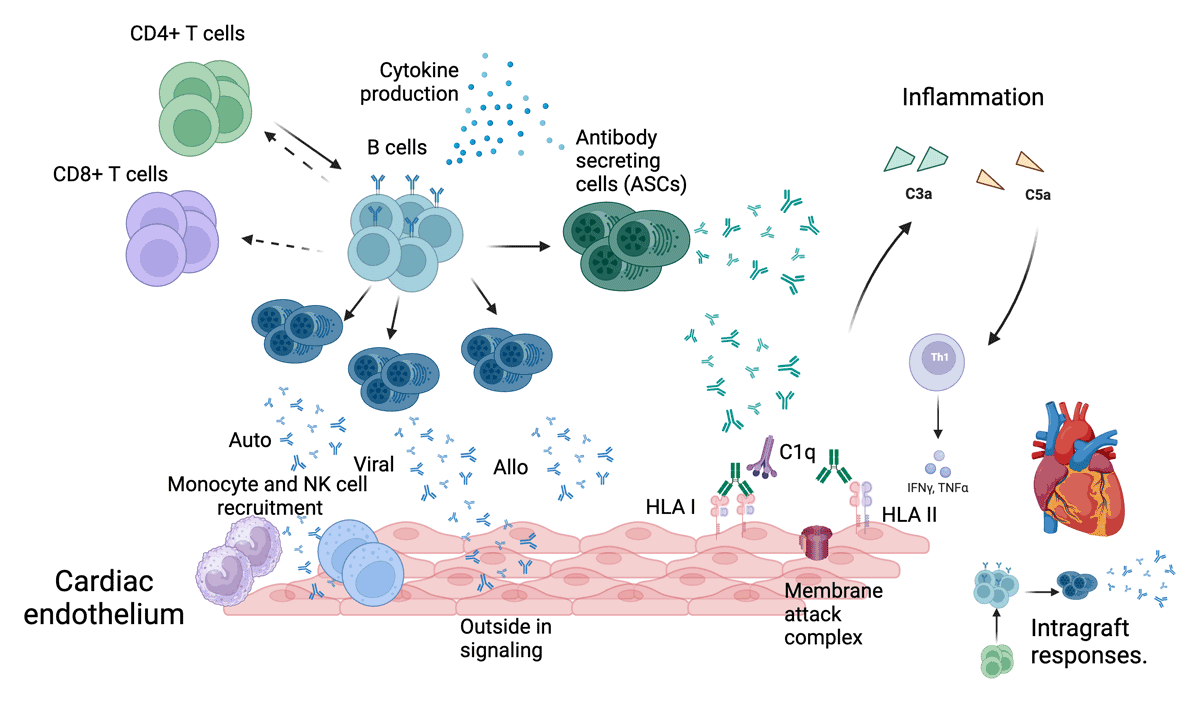
Figure 1
Complexity of the humoral alloresponse. In the context of T-cell help, B cells differentiate into antibody secreting cells in a germinal center (GC) dependent and GC independent manner. Human leukocyte antigen (HLA) and non-HLA antibodies drive the intersection of innate and adaptive immune responses. In addition to activating complement, antibodies exert their effects through Fc-receptor mediated functions, including NK cell and monocyte recruitment and can elicit outside-in signaling. Complement components C3a and C5a drive inflammation, which can further support persistent adaptive alloimmunity and cytokines that upregulate HLA class II which are associated with inferior allograft outcomes. These responses can occur in lymphoid organs and/or in the allograft (bottom right). Created in BioRender, Habal M. (2025) https://BioRender.com/f31u092
At the cellular level, in addition to the conventional paradigm of germinal center (GC) dependent affinity maturation driving the differentiation of long-lived plasma cells, high-avidity B cells differentiating outside of the GC also can contribute to the antibody repertoire—a pathway that may be favored when T-cell help is constrained, for example, by immunosuppression.90,91 Clinically, it is notable that neither B-cell nor plasma-cell depletion in isolation have proven consistently effective in controlling humoral alloimmunity.92,93,94 Taken in the context of the mechanistic paradigm outlined above, synergistic targeting of ongoing B-cell differentiation with co-stimulation blockade in conjunction with plasma-cell therapies may prove more effective, a finding that has been demonstrated in pre-clinical models and in a small cohort of kidney transplant recipients.95,96,97,98
It is interesting to consider that emerging evidence from the use of anti-CD38 biologics shows promise in the treatment of chronic AMR in kidney transplantation, and that this effect appears not so much due to the reduction in DSA but instead due to the abrogation of downstream consequences such as NK cell recruitment.99 This finding points to the broader consequences of DSA, hence limitations in our interpretation of a histologically “negative” biopsy. Therefore, it also should be noted that although the findings with anti-CD38 therapies are promising, failure to suppress the upstream cellular-humoral axis may still carry untoward consequences and thus multidrug regimens may be optimal. How other promising emerging strategies, such as modulating the cytokine environment (anti-IL6 or/and anti-IL6R), fit into this paradigm will require ongoing, careful study.100,101
Where Are We Today?
While improvements in survival define an inflection point between the early and contemporary eras of heart transplantation, there continue to be significant deficits defined broadly by the need for a lower toxicity profile and to achieve better control of the B-cell/antibody axis, which is closely linked to the pathology that drives end-stage graft failure. As novel agents emerge, it is important to consider that the approach will not be “one size fits all,” as success is dependent on the intersection between the recipient’s immune history and the donor allograft. How a therapy is best used requires careful, iterative evaluation in the clinic and should build on fundamental immunological concepts, reinstating the clinical art of immunosuppression management. To this end, the story of belatacept in kidney transplantation is a striking model, dating back to fundamental concepts of the B7/CD28 costimulatory axis and to tolerance in small animal studies. The findings of early rejection in phase III trials were countered by survival benefits and concepts of humoral risk mitigation. Hence, as novel agents emerge, it is important that we not discount them on the basis of rigid definitions that are often required in the clinical trial setting. To this end, the continued use of mTOR inhibitors serve as a model in heart transplantation. Finally, it is important that we remember the goal of tolerance—challenges and limitations in the field should not be seen as failures but, rather, as opportunities for deeper understanding of the fundamental elements required to attain success.102,103,104
Conclusions
Immense progress in the immunosuppressive management of heart transplant recipients has led to excellent short-term outcomes. Challenges remain for the management of long-term immune and nonimmune sequalae. There is an urgent need for better understanding of basic immunological principles, translated to the clinical setting, to inform why strategies are or are not successful and to drive iterative development of more effective and less toxic therapies that will provide long-term allograft quiescence and patient survival.
Key Points
There are three main pathways of T-cell allorecognition with both overlapping and distinct roles in the immune response. Calcineurin inhibitors, costimulation blockade, and mTOR inhibitors differentially influence these pathways.
Humoral alloimmunity and alloantibodies exert effector functions through pleiotropic mechanisms linking innate and adaptive immunity on the surface of the allograft.
Rationally designed synergistic strategies will be required to effectively and durably control the humoral response.
Historical context and the evolution of CNI-reducing strategies in heart and kidney transplantation provide lessons to inform the development of novel therapeutic strategies and for the interpretation of end points in clinical trials.
Acknowledgements
Thanks are due to Dr. Cindy Martin for her contribution to this manuscript.
Competing Interests
Dr. Habal holds an Investigator Initiated Research Grant from Bristol Myer Squibb.