
A 59-year-old male presented with intermittent episodes of atypical chest pain. Electrocardiogram showed normal sinus rhythm. Echocardiography revealed normal biventricular function with no abnormal wall motion. Computed tomography angiography (CTA) was done to rule out coronary artery disease. CTA performed on a 256-slice dual source scanner revealed an intracavitary course of right coronary artery (RCA). The mid RCA after take-off of acute marginal branch showed intracavitary course within the right atrium for a length of 3 cm (Figure 1). After exiting the right atrium, the RCA traversed normally into the atrioventricular groove. The rest of the RCA had a normal epicardial course. There was no significant stenosis seen in any of the coronary arteries.
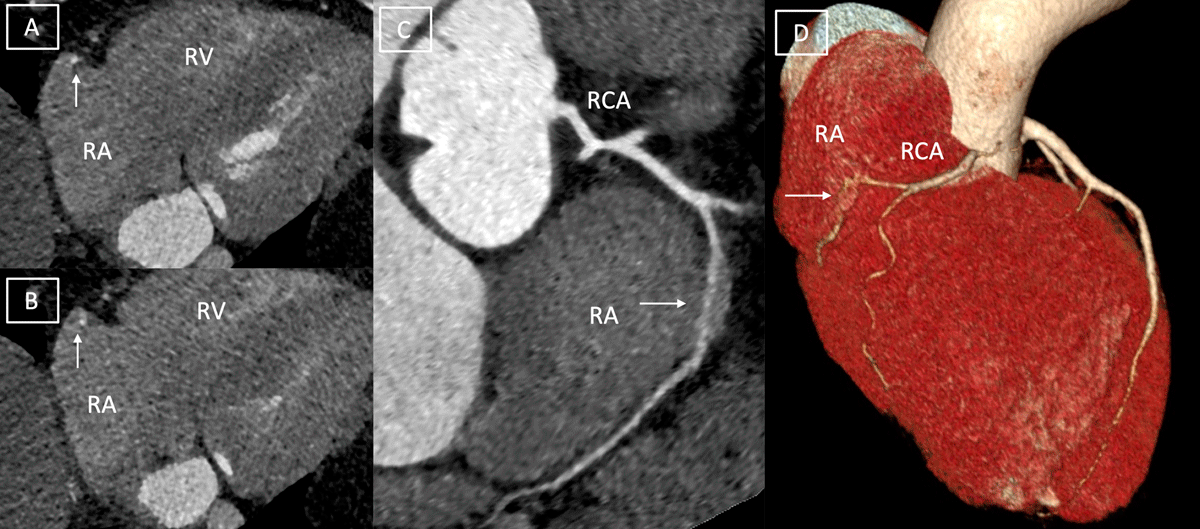
Figure 1
Axial computed tomography image (A, B) depicting intra-atrial course of right coronary artery (RCA, depicted by white arrow). Curvilinear multiplanar image (C) and volume-rendered image (D) demonstrate proximal RCA surrounded by epicardial fat, intra-atrial course of RCA (white arrow) for a length of 3 cm and then normal course of rest of RCA. RV: right ventricle; RA: right atrium
Intra-atrial or intracavitary course of RCA refers to a segment of the RCA coursing through the right atrial chamber. First described by McAlpine in 1975,1 it is a rare entity with an incidence of up to 0.36%.2 It can be differentiated from a myocardial bridge radiologically by the fact that in myocardial bridge, only a segment of the coronary artery appears to be surrounded by myocardial muscle; however, in the case of intra-atrial course of RCA, a segment of the coronary artery is visualized as entirely surrounded by the intra-atrial contrast in all phases of the cardiac cycle. The most often reported intra-atrial segment of the RCA is the mid segment, mostly associated with either no atherosclerotic changes or mild atherosclerotic plaques. Most of the patients are asymptomatic and incidentally diagnosed.
The recognition of intra-atrial course of RCA is important as it can predispose patients to inadvertent iatrogenic injuries during surgical or endovascular procedures, which can prove catastrophic and even fatal. The various procedures predisposing patients at risk of RCA injury include those requiring catheter manipulation in the right atrium, such as the central venous catheter/pacemaker placement and angiography, radiofrequency ablation in arrythmias, trans-septal puncture for left atrial access, coronary localization, and grafting during coronary artery bypass grafting and open-heart surgeries.3 It is thus important to be aware of the intra-atrial course of RCA beforehand to prevent iatrogenic myocardial ischemia due to RCA injury.
Competing Interests
The authors have no competing interests to declare.