
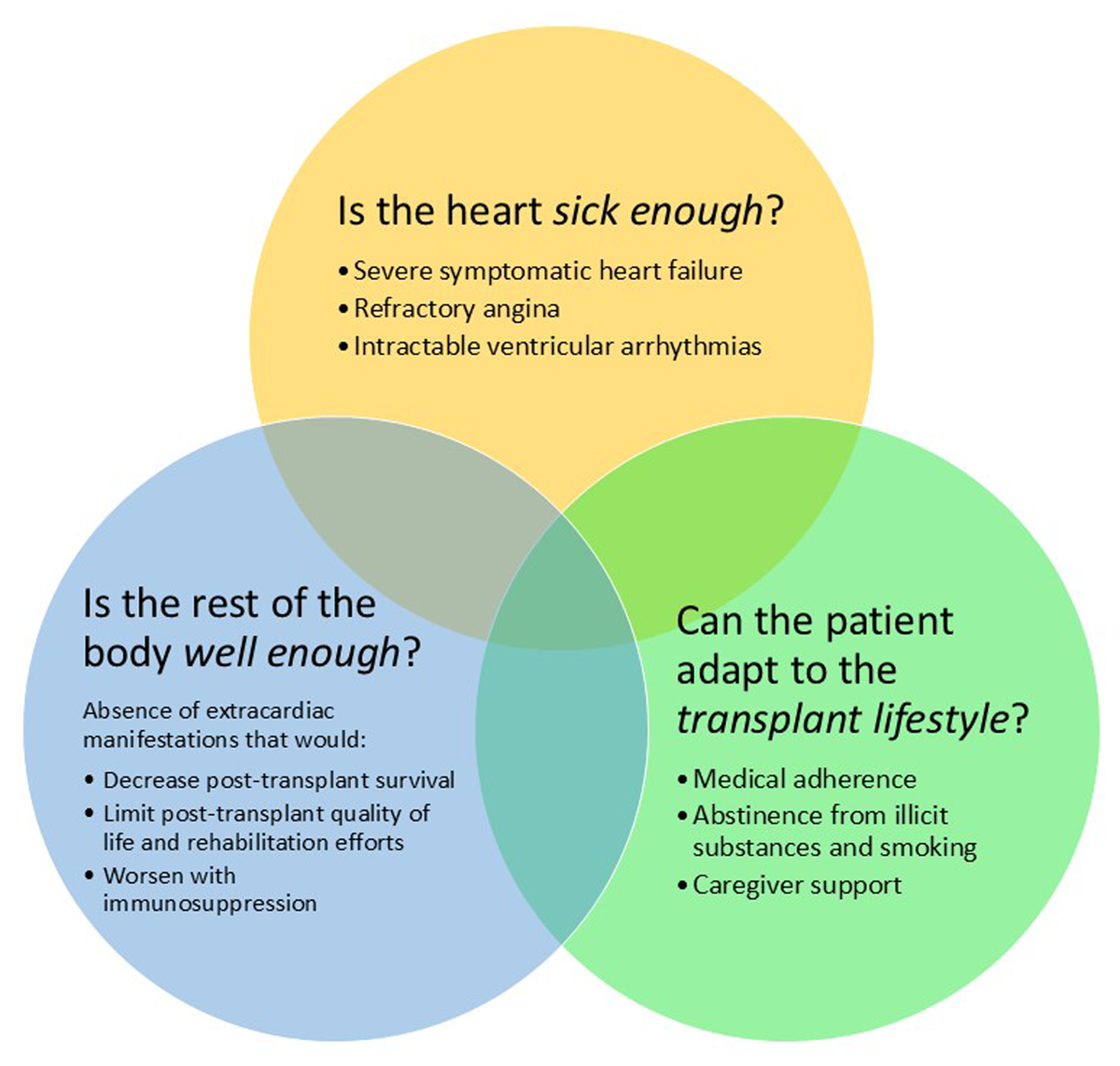
Figure 1
Principles of the heart transplant evaluation.
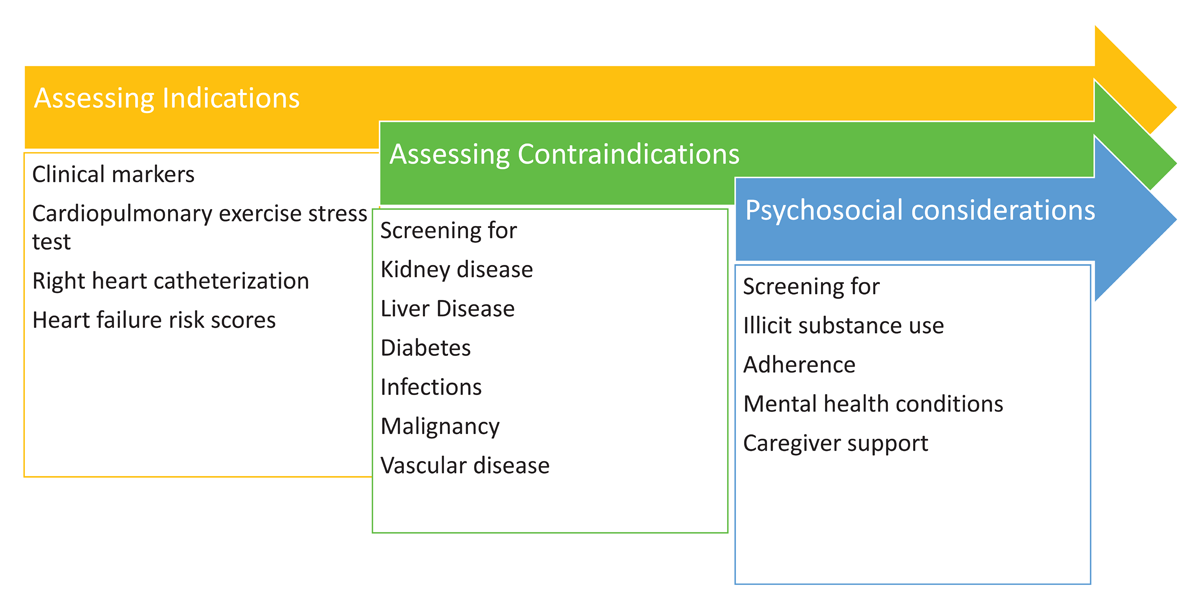
Figure 2
General approach to the transplant evaluation.
Table 1
Markers of advanced heart failure.2 NYHA: New York Heart Association; NT-pro-BNP: B-type natriuretic peptide; BP: blood pressure
| PARAMETER | DESCRIPTION | |
|---|---|---|
| I | Inotropes | Previous or ongoing requirement for dobutamine, milrinone, dopamine or levosimendan |
| N | NYHA class/Natriuretic peptides | Persisting NYHA Class III or IV and/or persistently high BNP or NT-pro-BNP |
| E | End-organ dysfunction | Worsening renal or liver dysfunction in the setting of heart failure |
| E | Ejection fraction | Very low ejection fraction (< 20%) |
| D | Defibrillator shocks | Recurrent appropriate defibrillator shocks |
| H | Hospitalizations | More than one hospitalization with heart failure in the last 12 months |
| E | Edema/Escalating diuretics | Persisting fluid overload and/or increasing diuretic requirement |
| L | Low blood pressure | Consistently low BP with systolic < 90 to 100 mm Hg |
| P | Prognostic medication | Inability to up-titrate (or need to decrease/cease) guideline-directed medical therapy |
Table 2
Cardiopulmonary exercise testing parameters supporting transplant listing in different populations.19,20,21,22,23,24,25,26,27,28,29 Maximal CPET: respiratory exchange ratio (RER) > 1.05 and reaching anaerobic threshold29; VO2: maximal oxygen consumption; VE/VCO2: the relationship between minute ventilation (VE) and carbon dioxide production
| PATIENT POPULATION | PARAMETER SUPPORTING TRANSPLANT LISTING |
|---|---|
| On beta-blocker19,20 | Peak VO2 ≤ 13-14 mL/kg/min in men and ≤ 10-11 mL/kg/min in women |
| Off beta-blocker21,22 | Higher peak VO2 may be considered supportive of transplant listing, generally ≤ 13-14 mL/kg/min |
| Patients with obesity23 | Peak VO2 adjusted for lean body mass <19 mL/kg/min |
| All, especially if submaximal CPET24,25,26 | VE/VCO2 slope > 35 |
| Women or patients ≤ 50 or ≥ 70 years27,28 | Peak VO2 ≤ 50% predicted |
| Patients with congenital heart disease or pediatric patients3,19 | Peak VO2 ≤ 50% predicted |
Table 3
Recommended tests for evaluation of heart transplant candidacy. CT: computed tomography; IgG: immunoglobulin G; IgM: immunoglobulin M
| RECOMMENDED TESTS |
|---|
|
Table 4
Potential contraindications to heart transplantation. BMI: body mass index; TPG: transpulmonary gradient; PVR: pulmonary vascular resistance; HbA1c: glycosylated hemoglobin; mmol; millimoles; mol: moles; eGFR: estimated glomerular filtration rate; mg: milligrams; dl: deciliters; HIV: human immunodeficiency virus.
| POTENTIAL CONTRAINDICATION | COMMENTS |
|---|---|
| Age | >70 years old is a relative contraindication depending on associated comorbidities |
| Obesity | BMI < 35 kg/m2 is recommended |
| Malignancy | Active or metastatic neoplasms are an absolute contraindication |
| Pulmonary hypertension | TPG > 15 mm Hg, PVR > 5 Wood units, or pulmonary artery pressure > 60 mm Hg with one of the above, or the inability to achieve PVR < 2.5 Wood units with vasodilator or inotropic therapy, are relative contraindications; such patients may benefit from long-term unloading with ventricular assist device followed by reassessment |
| Diabetes | Uncontrolled diabetes (HbA1c > 7.5% or 58 mmol/mol) or diabetes with significant end-organ damage is a relative contraindication |
| Kidney dysfunction | eGFR < 30 is a relative contraindication |
| Infection | Active infections except LVAD-related infections are contraindications; HIV, Hepatitis B and Hepatitis C are not contraindications if not active and well-controlled by treatment as defined by viral load/CD4 thresholds. Latent TB and Chagas are not contraindications. |
| Substance use | 6 months of abstinence from smoking, alcohol, and illicit drugs is required; in critically ill patients, consultation with psychiatry and social work is essential. Marijuana is a controversial topic. |
| Psychosocial issues | Noncompliance, lack of caregiver/social support, and dementia are absolute contraindications; mental retardation may be a relative contraindication. |