
Introduction
Despite advances in pharmacological and device treatment for heart failure (HF), morbidity and mortality remain high: the 5-year mortality rate for patients with symptomatic HF approaches 50% and up to 80% at 1 year for those with advanced disease.1 For those patients in whom optimization of HF management is unsuccessful, heart transplantation has emerged as an established standard for advanced HF.
The heart transplant evaluation process is a comprehensive endeavor requiring multidisciplinary collaboration due, in part, to the scarcity of available donor hearts. The goal of a heart transplant evaluation is to determine if (1) the patient’s cardiac status is limited enough, despite optimal medical therapy, to benefit from heart transplantation (ie, are they sick enough?); (2) the patient does not have comorbidities that would preclude heart transplantation (ie, are they well enough?); and (3) the patient demonstrates compliance and possesses adequate social support (ie, can they adapt to a transplant lifestyle?) (Figure 1).
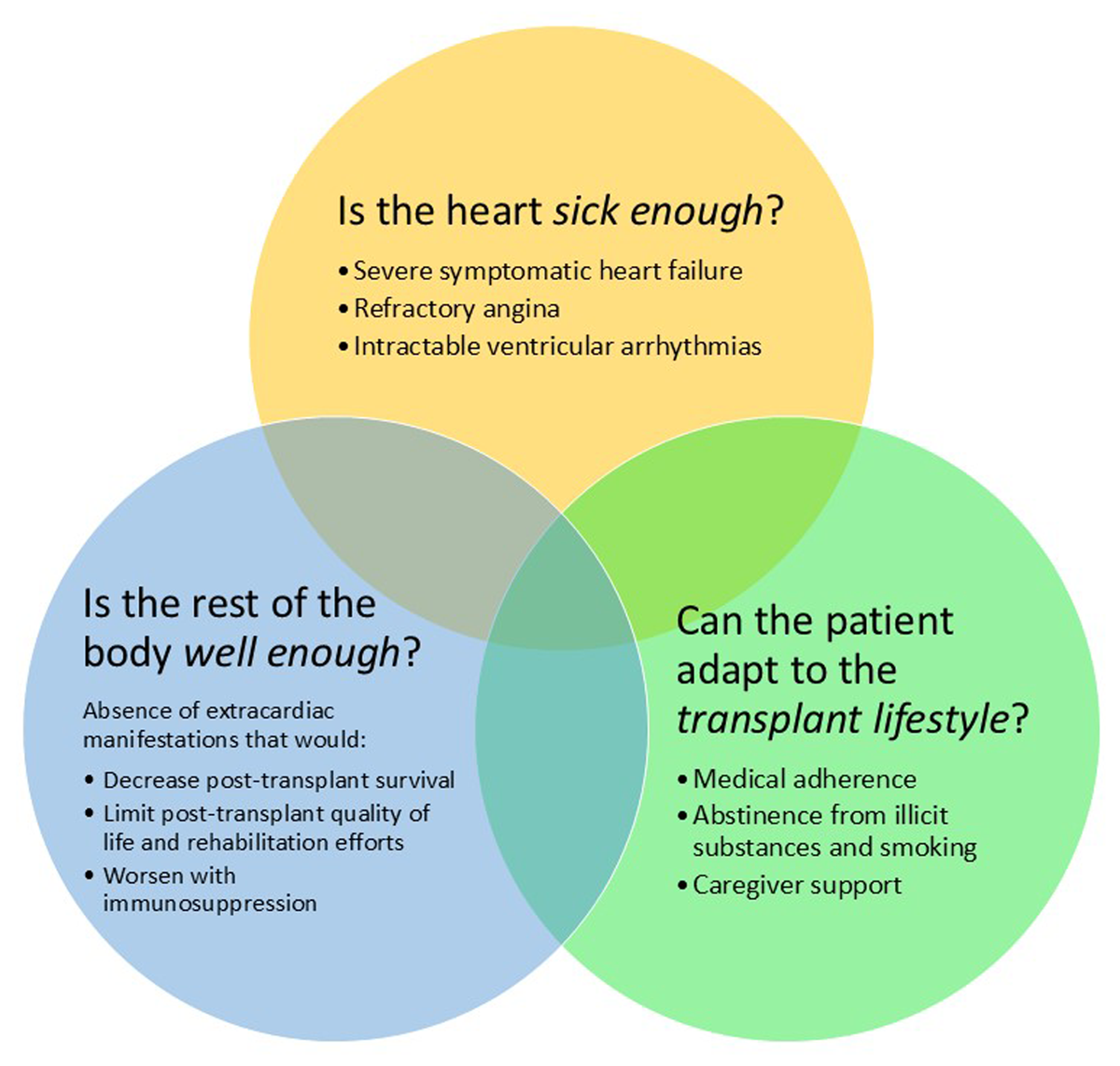
Figure 1
Principles of the heart transplant evaluation.
Appropriate candidates for heart transplantation should have severe functional limitations, limited life expectancy from their heart disease, and no absolute contraindications. Many of these factors are not absolute and need to be considered in the context of the severity of the patient’s heart disease and associated comorbidities. The degree to which they are interpreted and applied may vary considerably among transplant programs.
Indications for Heart Transplantation: Is the Patient Sick Enough?
Despite maximally tolerated guideline-directed medical and device therapies, a subset of patients with chronic HF will progress to advanced disease. The most common indications for heart transplant are severely symptomatic HF with reduced ejection fraction, uncontrolled ventricular arrhythmias, or intractable angina. Other less common indications for transplantation include restrictive cardiomyopathies such as hypertrophic cardiomyopathy and complex congenital heart disease after surgical palliation has failed.
The first step in the heart transplant evaluation is to determine if the patient’s clinical situation is limited enough to warrant consideration, which requires confirmation that all strategies to optimize cardiac function have been addressed (including optimal medical therapy and interventions such as cardiac resynchronization therapy and transcatheter mitral valve repair, as indicated). Measures to identify advanced HF include clinical indicators, objective functional capacity from cardiopulmonary exercise stress testing, hemodynamics from right heart catheterization, and insight from HF prognosis scores (Figure 2).
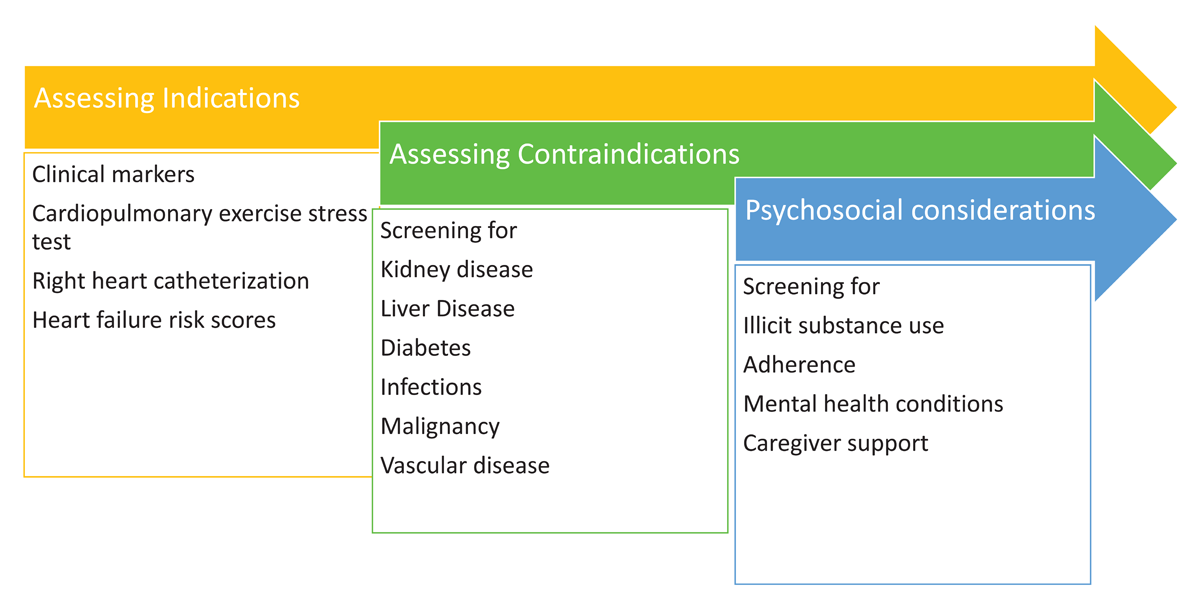
Figure 2
General approach to the transplant evaluation.
Clinical Indicators
Useful clinical signs or symptoms of advanced HF are associated with worse prognosis, and thus recognition of these clinical indicators should prompt timely referral and subsequent evaluation for transplantation (Table 1). The mnemonic “I NEED HELP” describes clinical clues to advanced HF including persistent New York Heart Association Class III or IV symptoms, ≥ 2 HF hospitalizations in the last 12 months, intolerance to guideline-directed medical therapy, ejection fraction below 20% to 30%, need for inotropes, worsening end-organ function, defibrillator shocks for ventricular tachyarrhythmias, or persistence of fluid overload, hypotension, or elevations in natriuretic peptides.2
Table 1
Markers of advanced heart failure.2 NYHA: New York Heart Association; NT-pro-BNP: B-type natriuretic peptide; BP: blood pressure
| PARAMETER | DESCRIPTION | |
|---|---|---|
| I | Inotropes | Previous or ongoing requirement for dobutamine, milrinone, dopamine or levosimendan |
| N | NYHA class/Natriuretic peptides | Persisting NYHA Class III or IV and/or persistently high BNP or NT-pro-BNP |
| E | End-organ dysfunction | Worsening renal or liver dysfunction in the setting of heart failure |
| E | Ejection fraction | Very low ejection fraction (< 20%) |
| D | Defibrillator shocks | Recurrent appropriate defibrillator shocks |
| H | Hospitalizations | More than one hospitalization with heart failure in the last 12 months |
| E | Edema/Escalating diuretics | Persisting fluid overload and/or increasing diuretic requirement |
| L | Low blood pressure | Consistently low BP with systolic < 90 to 100 mm Hg |
| P | Prognostic medication | Inability to up-titrate (or need to decrease/cease) guideline-directed medical therapy |
There are other definitions and indicators of advanced HF.3,4,5 Of note, patients with preserved left ventricular ejection fraction may have advanced HF from restrictive or valvular cardiomyopathy, right ventricular failure, or congenital heart disease.6,7,8 Early recognition of clinical clues will ensure timely evaluation, as late recognition risks development of absolute extracardiac contraindications.
Multiple prognosis scores are used to risk stratify patients with HF.9 The Heart Failure Survival Score, Seattle Heart Failure Model, Meta-Analysis Global Group in Chronic Heart Failure score, and Metabolic Exercise Test Data combined with Cardiac and Kidney Indexes scores were developed in chronic HF,10,11,12,13 while scores such as the Organized Program to Initiate Lifesaving Treatment in Hospitalized Patients with Heart Failure, Get With The Guidelines-Heart Failure, and Evaluation Study of Congestive Heart Failure and Pulmonary Artery Catheterization Effectiveness are focused on acute HF.14,15,16,17 If there is ambiguity regarding appropriateness for listing based on other information, scores indicating an estimated 1-year survival < 85% may assist in decision-making. Of note, few scores have been developed or validated in a contemporary cohort, and most perform poorly when applied to individuals as opposed to populations. Thus, their output should not be the sole criterion for listing.18
Cardiopulmonary Exercise Stress Testing
Parameters derived during cardiopulmonary exercise testing (CPET) are prognostic in ambulatory HF patients being evaluated for heart transplant; a summary of CPET parameters supporting transplant listing is shown in Table 2.19,20,21,22,23,24,25,26,27,28,29 The results of CPET should be taken into context with other data collected during transplant evaluation and not the sole indication for listing.
Table 2
Cardiopulmonary exercise testing parameters supporting transplant listing in different populations.19,20,21,22,23,24,25,26,27,28,29 Maximal CPET: respiratory exchange ratio (RER) > 1.05 and reaching anaerobic threshold29; VO2: maximal oxygen consumption; VE/VCO2: the relationship between minute ventilation (VE) and carbon dioxide production
| PATIENT POPULATION | PARAMETER SUPPORTING TRANSPLANT LISTING |
|---|---|
| On beta-blocker19,20 | Peak VO2 ≤ 13-14 mL/kg/min in men and ≤ 10-11 mL/kg/min in women |
| Off beta-blocker21,22 | Higher peak VO2 may be considered supportive of transplant listing, generally ≤ 13-14 mL/kg/min |
| Patients with obesity23 | Peak VO2 adjusted for lean body mass <19 mL/kg/min |
| All, especially if submaximal CPET24,25,26 | VE/VCO2 slope > 35 |
| Women or patients ≤ 50 or ≥ 70 years27,28 | Peak VO2 ≤ 50% predicted |
| Patients with congenital heart disease or pediatric patients3,19 | Peak VO2 ≤ 50% predicted |
In patients requiring urgent inpatient evaluation, there is no clear role for CPET except in select cases where sufficient clinical improvement occurs and hospital discharge is considered. CPET is challenging in the pediatric HF population due to wide variations in protocols and patients’ ages, sizes, and muscle mass.30 Patients with single-ventricle physiology have poor exercise performance with maximal oxygen consumption (peak VO2) often less than 65% predicted. Thus, in this population, a peak VO2 less than 50% predicted may be considered supportive of transplant listing.31
Right Heart Catheterization
Invasive hemodynamics obtained during right heart catheterization (RHC) inform severity of HF, guide optimization, and assess for pulmonary hypertension that might contribute to post-transplant right HF. Elevations in pulmonary artery systolic pressure, transpulmonary gradient (TPG), and pulmonary vascular resistance (PVR) above certain thresholds have been proposed as contraindications to listing. However, the risk associated with each parameter is continuous, and absolute cutoffs do not exist.32
While all patients should undergo RHC at least once prior to transplant listing, the frequency of RHC thereafter is at the discretion of the treating transplant team based on clinical stability, presence of a left ventricular assist device, degree of pulmonary hypertension on initial testing, and estimated right ventricular systolic pressure on echocardiogram. In pediatric patients, however, periodic RHC surveillance is generally not recommended.
Potential Contraindications to Heart Transplantation: Is the Patient Well Enough?
Eligibility for heart transplant evaluation requires a comprehensive survey of all comorbidities that may impact surgical risk as well as post-transplant quality of life and survival (Figure 2; Table 3). When considering extracardiac contraindications, one must review whether the condition will confer mortality risk such that patients will not achieve the expected improvement in post-transplant survival, affect post-transplant quality of life and hamper rehabilitation efforts, and progress with immunosuppression (Table 4).
Table 3
Recommended tests for evaluation of heart transplant candidacy. CT: computed tomography; IgG: immunoglobulin G; IgM: immunoglobulin M
| RECOMMENDED TESTS |
|---|
|
Table 4
Potential contraindications to heart transplantation. BMI: body mass index; TPG: transpulmonary gradient; PVR: pulmonary vascular resistance; HbA1c: glycosylated hemoglobin; mmol; millimoles; mol: moles; eGFR: estimated glomerular filtration rate; mg: milligrams; dl: deciliters; HIV: human immunodeficiency virus.
| POTENTIAL CONTRAINDICATION | COMMENTS |
|---|---|
| Age | >70 years old is a relative contraindication depending on associated comorbidities |
| Obesity | BMI < 35 kg/m2 is recommended |
| Malignancy | Active or metastatic neoplasms are an absolute contraindication |
| Pulmonary hypertension | TPG > 15 mm Hg, PVR > 5 Wood units, or pulmonary artery pressure > 60 mm Hg with one of the above, or the inability to achieve PVR < 2.5 Wood units with vasodilator or inotropic therapy, are relative contraindications; such patients may benefit from long-term unloading with ventricular assist device followed by reassessment |
| Diabetes | Uncontrolled diabetes (HbA1c > 7.5% or 58 mmol/mol) or diabetes with significant end-organ damage is a relative contraindication |
| Kidney dysfunction | eGFR < 30 is a relative contraindication |
| Infection | Active infections except LVAD-related infections are contraindications; HIV, Hepatitis B and Hepatitis C are not contraindications if not active and well-controlled by treatment as defined by viral load/CD4 thresholds. Latent TB and Chagas are not contraindications. |
| Substance use | 6 months of abstinence from smoking, alcohol, and illicit drugs is required; in critically ill patients, consultation with psychiatry and social work is essential. Marijuana is a controversial topic. |
| Psychosocial issues | Noncompliance, lack of caregiver/social support, and dementia are absolute contraindications; mental retardation may be a relative contraindication. |
Age
As life expectancy increases, traditional heart transplantation age limits may be extended in select cases. Generally, patients are considered for heart transplantation if they are 70 years of age or younger since advances in post-transplant care have shown that survival in the older age group is comparable to that of younger recipients.33 However, older age confers greater risk for certain post-transplant complications; compared to recipients under 60 years of age, older recipients have more infections, kidney dysfunction, and malignancy, although less rejection.34 Increasing recipient age is associated with increased post-transplant mortality, particularly in patients 70 years of age or older at time of transplant.34 Thus, candidates over the age of 70 may have acceptable post-transplant outcomes, but comprehensive consideration of comorbidities is essential. Older patients at some centers are offered nonstandard donor hearts (ie, those with coronary artery disease, mildly decreased left ventricular ejection fraction, left ventricular hypertrophy, or donor age older than 55 years). This may allow older patients to receive transplants without denying this scarce resource to younger candidates.35 However, while older donors may be considered for older candidates, recipients with older donors have worse post-transplant survival both in young and old recipients,36 raising ethical questions.37
Physiologic age may be more important than chronologic age with respect to survival and rehabilitation potential. As a result, many programs focus less on fixed upper age limits and instead assess the patient’s functional status, integrity of major organ systems, and the presence of comorbidities that might impact survival, rehabilitation potential, and quality of life.
Obesity
Obesity is becoming more common in the heart transplant population, and recipients have significant increases in body mass index (BMI) over time.38 BMI ≥ 35 kg/m2 incurs increased waitlist time, increased waitlist mortality,39 and increased post-transplant mortality.39 There is a graded association between increased BMI and worse survival in multiple transplant registries and meta-analyses,40,41,42 with optimal outcomes observed in those with normal BMI; survival is acceptable when BMI is between 30 to 35 kg/m2.43 Thus, achieving a BMI under 35 kg/m2 is preferred to optimize post-transplant quality of life and survival. This may require incretin-based therapies or bariatric surgery, depending on center expertise, resources, and patient stability.44,45
Malignancy
Malignancy after heart transplantation confers significant morbidity and mortality. Candidates should be screened for breast, prostate, and colon cancer as recommended for the general population, as there is little data to support transplant candidate-specific malignancy screening.46 Skin cancer screening by full-body skin examination completed by a dermatologist can be useful given the high prevalence of skin cancer after heart transplantation.
For candidates with pre-transplant malignancies, collaboration with an oncologist is essential for individualized risk stratification. A period of observation prior to transplant listing may be recommended and will be unique to the given candidate’s cancer history. Arbitrary time intervals for observation may result in unwarranted delays in transplant listing.
Those candidates with low-risk pre-transplant malignancy (early-stage cancers with full resection and/or low-risk prostate adenocarcinoma, renal cell carcinoma, cervical cancer, and bladder cancer), may require minimal or no pre-transplant observation with deferred post-transplant intervention.47 However, active and/or metastatic neoplasms with the exception of non-melanomatous skin cancer are absolute contraindications to heart transplantation, as the course of the tumor may be accelerated with immunosuppression.
Further guidance is available in consensus statements from the International Society of Heart Transplantation and American Society of Transplantation with specific recommendations on transplant candidacy based on various pre-transplant malignancies.47,48
Pulmonary Hypertension
Pulmonary hypertension (mean pulmonary artery pressure > 20 mm Hg), typically Group 2 due to left heart disease (pulmonary capillary wedge pressure > 15 mm Hg),49 is common in patients with heart failure,50,51 and an elevated PVR ≥ 2.5 Wood units is associated with increased early post-transplant mortality.41 Although prohibitive cutoffs for elevations in pulmonary artery systolic pressure, transpulmonary gradient, and PVR have been proposed, the associated risk is continuous and absolute thresholds do not exist.52
Nonetheless, if pulmonary artery systolic pressure ≥ 50 mm Hg and either TPG ≥ 15 or PVR ≥ 3 Wood units, a vasodilator (eg, inhaled nitric oxide or nitroprusside if nitric oxide is not available) should be administered.53 An appropriate response to the vasodilator challenge would be: TPG ≤ 12 to 15 mm Hg and PVR to ≤ 2.5 to 3 Wood units. However, if the PVR falls but systolic blood pressure also falls below 85 mm Hg, then the risk of post-transplant right heart failure remains high.53
When the response to the acute vasodilator challenge is not acceptable, continuous vasoactive therapies with hemodynamic monitoring would be the next step,54 followed by implantation of temporary mechanical circulatory support or a durable left ventricular assist device (LVAD) in eligible candidates.55,56
Diabetes Mellitus
Uncomplicated post-transplant diabetes is not associated with worse survival.57 However, candidates with diabetes-related complications (obesity, kidney dysfunction, cerebrovascular disease, or peripheral vascular disease) have an increased risk of post-transplant infections and kidney failure57 and additional risks of late graft failure and mortality.58,59
While diabetes per se is not considered a contraindication for heart transplant, careful assessment of diabetic control and end-organ damage (atherosclerotic vascular disease, nephropathy, proliferative retinopathy) is warranted. Calcineurin inhibitors and corticosteroids may worsen glycemic control,60 so pre-transplant optimization with a goal of glycosylated hemoglobin (HbA1c) of 7% to 8% is ideal.61 There may be center-specific thresholds for HbA1c that are considered a relative contraindication to transplantation, especially in conjunction with diabetes-related complications, which portend worse post-transplant outcomes, and because poorly controlled diabetes also may be an indicator of suboptimal medical adherence in some cases.
Kidney Dysfunction
On September 28, 2023, the United Network for Organ Sharing implemented updated criteria for simultaneous heart-kidney transplantation allocation with a safety net policy for heart transplant recipients who later need a kidney transplant.62 The new criteria were created to improve equity in transplant for multiorgan and single-organ candidates. In the new policy, the donor kidney is only offered along with the donor heart to candidates who meet a specified level of kidney dysfunction.
Specifically, simultaneous heart-kidney allocation requires either evidence of chronic kidney disease or sustained acute kidney injury. To meet qualifications for chronic kidney disease, defined as estimated glomerular filtration rate (eGFR) < 60 mL/min/1.73 m2 for greater than 90 consecutive days, there must be documentation of need for dialysis or creatinine clearance less than 30 mL/min. For sustained acute kidney injury, need for dialysis at least once every 7 days or creatinine clearance < 25 mL/min at least once every 7 days must be documented for a period of 6 weeks.
For those who no longer meet criteria for simultaneous heart kidney transplantation, a safety net allows priority in kidney allocation if kidney transplantation criteria are met within the first post-heart transplant year. Specifically, heart transplant recipients qualify for kidney transplant allocation priority under the safety net policy if they have an estimated eGFR of 20 mL/min/1.73 m2 or less or are on dialysis anytime between 60 and 365 days after heart transplantation.
Infections
Heart transplantation is not recommended in the setting of certain infections, including active infections requiring ongoing antibiotic treatment (except for durable LVAD infection), and human immunodeficiency virus with opportunistic infections or associated malignancy, lack of stable antiretroviral regimen, detectable viral load, and/or low CD4 count. Hepatitis B and C are no longer absolute contraindications due to advances in the directed treatment.
Initiating or updating life-saving vaccines is essential.63 Updated detailed vaccination schedules are publicly available from the United States Advisory Committee on Immunization Practices.64 Pre-transplant vaccination is essential since immunosuppressed individuals are less likely to mount a more robust immune response; this has been observed with vaccination against SARS-CoV-2.65,66,67 Ideally, vaccination should be completed at least 2 weeks prior to transplantation in order to optimize immune response. If live-attenuated vaccines are utilized, transplant should be delayed for 4 weeks to reduce risk of active viral replication at transplant.63
Psychosocial Considerations: Is the Patient Amenable to the Transplant Lifestyle?
Substance Use
Use of illicit drugs, alcohol, and tobacco prior to heart transplant can increase the risk for mortality.68,69,70,71 A thorough substance use history should be performed and include any past or current illicit drug use, alcohol use, and tobacco use. Specifically, the patient evaluation should obtain frequency, amount, duration of use, and length of abstinence as well as the level of impairment with detrimental effects to health, job, and relationships. Any current treatment for substance abuse and the patient’s willingness to seek treatment should be obtained. Substance abuse should be ascertained by patient reporting, questionnaires, and biochemical testing. Patients with active substance use disorders should be referred to addiction services.
In the critically ill patient who urgently needs transplantation, an accurate assessment of illicit substance use may be difficult, and a period of abstinence may not be medically feasible. In this setting, consultation with social work and psychiatric specialists would be essential to gauge the heart transplant candidate’s potential for abstinence and post-transplant adherence.
Active tobacco smoking portends a significant increase in malignancy, cardiac allograft vasculopathy, kidney dysfunction, and death associated with tobacco use in heart transplant recipients72,73 and is thus a contraindication to heart transplantation. Generally, 6-month abstinence is required to demonstrate candidacy, and abstinence can be monitored using serum or urine cotinine levels.74 Given the lack of information on the safety of e-cigarette use, avoidance of all nicotine products is preferred.
Excessive alcohol use is an absolute contraindication for heart transplantation because it incurs risk of poor medication adherence and adverse post-transplant outcomes,68,75 including increased mortality. There is international variation on acceptable alcohol intake, hence there may be center-specific standards to define excessive alcohol use. The recommended period for abstinence from alcohol is at least 6 months given the association of shorter time periods of abstinence with relapse post-transplant.76
Although marijuana is now legal for medical and recreational use in many regions, inhaled or vaporized cannabis use post-transplant is associated with increased infection risks, specifically fungal lung infections.77 Cannabis may also alter the metabolism of immunosuppressive medications.77 Thus, programs may make center-specific decisions regarding marijuana use and transplant candidacy,78 although it would be safest to recommend avoidance of marijuana, regardless of legal status.
Psychosocial Evaluation
Heart transplantation requires significant engagement from patients and their caregivers, as post-transplant care necessitates regular clinic visits and testing, strict adherence to medications, and adoption of a healthy lifestyle. The purpose of the psychosocial evaluation is to identify those candidates at increased risk of poor post-transplant outcomes due to inadequate support, adherence, or optimal mental health. These problems are associated with poor post-transplant outcomes.70
Psychosocial assessment includes determination of the patient’s ability to comprehend and follow care instructions with neurocognitive testing on an individual basis. Poor adherence with drug regimens is a risk factor for graft rejection and mortality, and thus patients who have demonstrated consistent and repeated inability to adhere with medical recommendations should not receive transplantation.
Social support with a dedicated caregiver after transplantation is an absolute requirement for transplant. Options for validated standardized assessments used across transplant programs include the Stanford Integrated Psychosocial Assessment for Transplant.79 The goal of the standardized assessment is to minimize inequity in candidate selection.
Psychiatric evaluation should also be incorporated into the evaluation process, including identification of active psychiatric disease that may negatively affect adherence to care regimens. Transplantation can be emotionally and psychologically taxing given significant challenges related to the evaluation, listing and waiting period for a suitable donor, and adjustment to life with a transplanted organ.
Financial Considerations
Heart transplantation is a covered expense for most insurance companies, but coverage varies on an individual basis. Accordingly, a financial coordinator or counselor should review all coverage benefits prior to transplant listing, including prescription drug coverage, co-pays and deductibles, and requirements for prior authorizations. Candidates should receive an estimate of out-of-pocket costs for the surgery and post-transplant care as well as an overview of fees associated with transplantation to ensure they have adequate resources to manage these financial responsibilities.
Conclusion
For those patients in whom optimization of HF management is unsuccessful, heart transplantation has emerged as an established standard for treatment of advanced HF. Evaluation for transplant candidacy is comprehensive and requires multidisciplinary collaboration. The goal of a heart transplant evaluation is to determine if (1) the patient’s cardiac status is limited enough, despite optimal medical therapy, to benefit from heart transplantation (ie, “sick enough”); (2) the patient does not have comorbidities that would preclude heart transplantation (ie, “well enough”); and (3) the patient demonstrates compliance and possesses adequate social support (“can adapt to a transplant lifestyle”). With careful and appropriate selection, heart transplant recipients are best positioned to experience the improved quality of life and survival expected after transplantation.
Key Points
The most common indications for heart transplant are highly symptomatic heart failure with reduced ejection fraction, uncontrolled ventricular arrhythmias, or intractable angina.
In evaluating extracardiac contraindications to heart transplantation, it is important to determine if the extracardiac condition will (1) confer mortality risk such that patients will not have the expected improvement in post-transplant survival; (2) affect post-transplant quality of life and hinder rehabilitation efforts; and (3) progress with immunosuppression.
Potential relative contraindications include age > 70 yrs, obesity (BMI > 35 kg/m2), pulmonary hypertension, poor diabetic control (HbA1c > 7.5% ), or diabetes with end-organ damage, severe kidney dysfunction (eGFR < 30 mL/min/1.73m2), and any active infection excluding infections related to a left ventricular assist device.
Absolute contraindications include severe or multiple relative contraindications, active or metastatic malignancy, consistent and repeated evidence for adherence, and a lack of adequate social/caregiver support.
The decision to list a candidate for heart transplantation acknowledges multiple factors, including indicators for poor prognosis without transplant as well as potential contraindications that may confer excessive post-transplant risk.
CME Credit opportunity
Houston Methodist is accredited by the Accreditation Council for Continuing Medical Education (ACCME) to provide continuing medical education for physicians.
Houston Methodist designates this Journal-based CME activity for a maximum of 1 AMA PRA Category 1 Credit™. Physicians should claim only the credit commensurate with the extent of their participation in the activity.
Click to earn CME credit: learn.houstonmethodist.org/MDCVJ-21.3.
Competing Interests
The author has no competing interests to declare.