
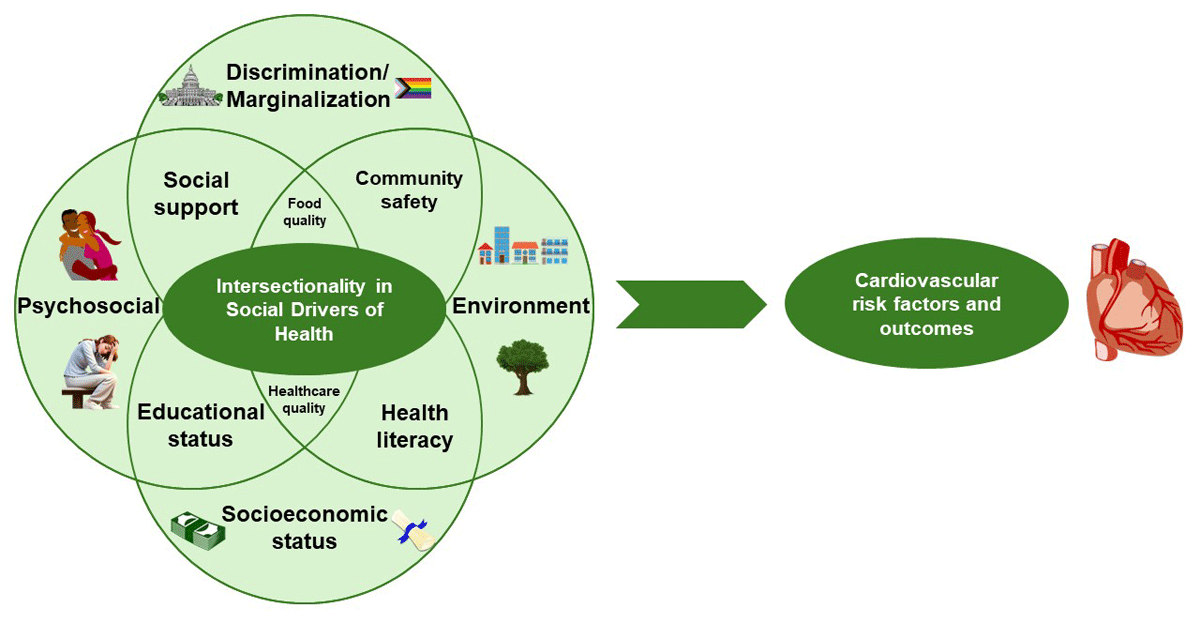
Figure 1
Multiple social drivers of health intersect to impact cardiovascular health.
Table 1
Selected studies on associations between social drivers and cardiovascular outcomes. OR: odds ratio; HR: hazard ratio; CV: cardiovascular; CVD: cardiovascular disease; CAD: coronary artery disease; CHD: coronary heart disease; MI: myocardial infarction
| STUDY | STUDY DESIGN | STUDY SIZE | SOCIAL DRIVER AND OUTCOME (95% CI) |
|---|---|---|---|
| Socioeconomic Status | |||
| Yan et al. 200610 | Prospective cohort | 2913 individuals | Less than high school versus beyond college education; coronary artery calcium adjusted OR
|
| Khaing et al. 201711 | Meta-analysis | 72 studies | Low versus high education, pooled risk ratios
|
| Machado et al. 202112 | Retrospective cohort | 5579 individuals | Financial mobility; CV event or CV death adjusted HR
|
| Johnson et al. 202214 | Cross-sectional | 7771 individuals | High school graduates versus less than high school education; ideal CV health by Life’s Simple 7 adjusted OR
|
| Psychosocial | |||
| Valtorta et al. 201616 | Meta-analysis | 11 CHD; 9 stroke studies | Poor social relationships, pooled relative risk
|
| Stewart et al. 201719 | Prospective cohort | 950 individuals | Chronic moderate/high psychological stress in patients with CAD, adjusted HR
|
| Richardson et al. 201218 | Meta-analysis | 6 studies | High perceived stress, aggregate risk ratio CHD development 1.27 (1.12-1.45) |
| Kwapong et al. 202320 | Cross-sectional | 593,616 individuals | Depression, OR
|
| Environment | |||
| Klompmaker et al. 202227 | Retrospective cohort | 63 million individuals | Increased neighborhood vegetation, HR
|
| Kelli et al. 201929 | Prospective cohort | 4,944 individuals | Residence, sub-distribution HR for MI
|
| Kershaw et al. 201533 | Prospective cohort | 5,229 individuals | Neighborhood with racial/ethnic segregation; adjusted HR for incident CVD
|
| Deo et al. 202334 | Retrospective cohort | 79,997 individuals | Neighborhoods with history of redlining; HR
|
| Al-Shakarchi et al. 202028 | Meta-analysis | 9 studies | Individuals undergoing homelessness
|
| Discrimination and Marginalization | |||
| Hines et al. 202317 | Cross-sectional | 7,720 individuals | Black versus White individuals, high ideal CV health score pooled OR
|
| Burroughs Peña et al. 202139 | Cross-sectional | 25,062 individuals | High versus low ideal CV health score adjusted OR
|
| Hailu et al. 202037 | Cross-sectional | 1,153 individuals | Individuals with low social support, decrease in leukocyte telomere length
|
Table 2
Framework and recommendations for social drivers of health (SDOH) interventions.
| LEVEL OF INTERVENTION | RECOMMENDATIONS FOR ACTION |
|---|---|
| Clinician and Health System | Implement standardized SDOH screening tool in electronic medical record Develop community-specific resource lists to address SDOH Utilize community health workers or social workers on staff for care and services coordination Partner with local community Increase workforce diversity and inclusion |
| Community | Implement community health worker, trained peer advisor, nurse-lead health programs Develop programs regarding housing, food, transportation, employment access Partner with local health systems |
| Research | Use community-led research methodology Consider intersectionality in research design and prioritize recruiting large and diverse populations for studies Develop risk-prediction tools incorporating SDOH Critically analyze use of race in studies Test interventions at small scale before policy change |
| State and Federal | Increase insurance access Develop programs for care coordination and access to social support services Implement public health campaigns regarding health behaviors Increase funding for community and health system programs Consolidate and report results of various initiatives attempted |