
Introduction
The global burden of cardiovascular disease (CVD) remains high, with an estimated 615 million cases and 20 million deaths worldwide in 2021.1 In the United States (US), an estimated 128 million adults over 20 years of age have CVD, a burden that is unequally distributed across racial and ethnic lines, with the highest prevalence noted in non-Hispanic Black Americans.1 Additional disparities are seen based on income and educational attainment.1 Health inequities come at a substantive economic toll, with an estimated > $400 billion cost associated with racial and ethnic disparities and $900 billion cost associated with educational disparities.2 In an effort to address this, increasing attention has been devoted to the role of social drivers of health (SDOH), which is broadly defined as social, cultural, environmental, economic, and governmental factors that drive health behaviors, risk factors, and outcomes.3, 4, 5 A growing body of evidence illustrates the interplay between SDOH in cardiovascular (CV) care and outcomes.3, 4, 6 Factors such as income, education, food deserts (areas where people have limited access to healthy foods), environmental characteristics, structural racism, discrimination, and insurance status have been associated with increased risk of CVD in addition to worse outcomes for those with CVD.3, 4, 6
While studies often examine a particular SDOH in isolation, these elements have complex interactions that can impact individuals in unique ways. Applying the concept of intersectionality attempts to address this. Intersectionality acknowledges that each individual carries numerous identities and characteristics, such as race, ethnicity, sex, gender identity, sexual orientation, age, socioeconomic status, cultural background, and religion, among others.7 These characteristics intersect and interact to inform an individual’s experiences.7 Intersectionality recognizes that these identities and social positions of an individual can compound or mitigate disadvantages and privileges related to cardiovascular health outcomes. An intersectional approach is crucial for understanding and addressing the varied impact of SDOH on individual CVD risk and outcomes (Figure 1).4, 7 This review summarizes the current research on SDOH and CVD and discusses interventions to address SDOH for CVD management. We close with recommendations on incorporating SDOH into clinical practice at the individual, policy, and research level.
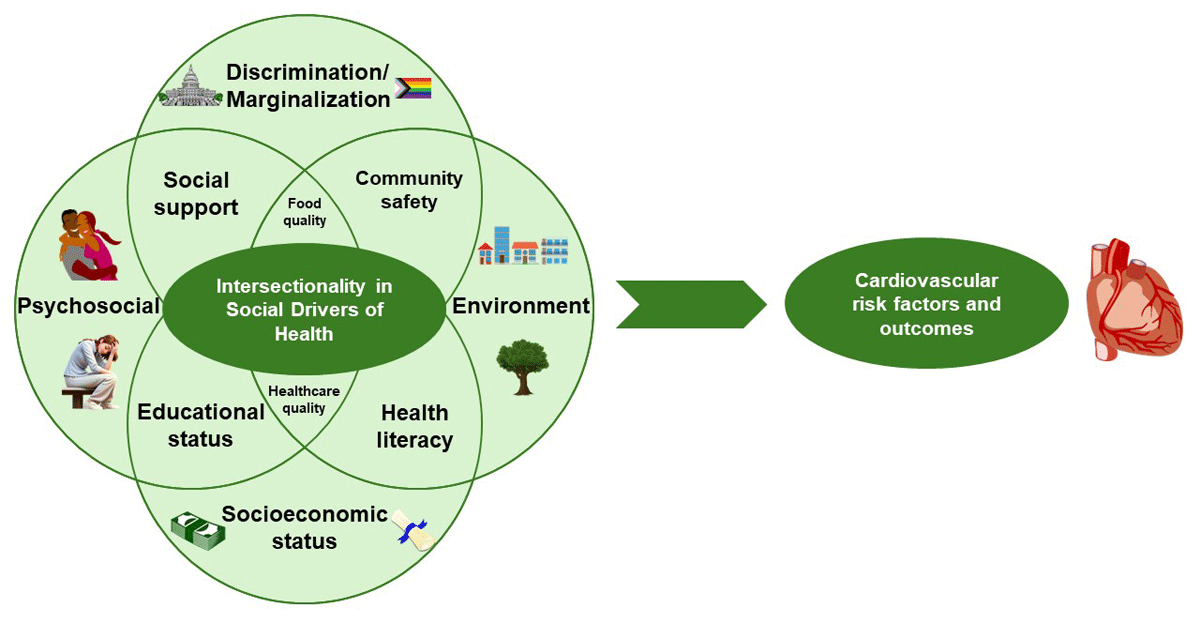
Figure 1
Multiple social drivers of health intersect to impact cardiovascular health.
Intersectional Associations Between Social Drivers of Health and Cardiovascular Disease
Increasing research supports links between various elements of SDOH and CVD risk factors and outcomes, which is highlighted in recent American Heart Association (AHA) publications (Table 1).6, 8, 9 Such social drivers include socioeconomic status, psychosocial factors, environmental characteristics, and discrimination. As no single social driver acts in a vacuum, SDOH and their association with CV health outcomes are best understood through an intersectionality framework that considers the varying impact of social drivers in combination with the broader societal structures, such as structural racism, which may cause certain social drivers to frequently co-occur.4, 7 Representative examples of social drivers, their intersectional associations, and impact on CVD will be discussed in the following subsections.
Table 1
Selected studies on associations between social drivers and cardiovascular outcomes. OR: odds ratio; HR: hazard ratio; CV: cardiovascular; CVD: cardiovascular disease; CAD: coronary artery disease; CHD: coronary heart disease; MI: myocardial infarction
| STUDY | STUDY DESIGN | STUDY SIZE | SOCIAL DRIVER AND OUTCOME (95% CI) |
|---|---|---|---|
| Socioeconomic Status | |||
| Yan et al. 200610 | Prospective cohort | 2913 individuals | Less than high school versus beyond college education; coronary artery calcium adjusted OR
|
| Khaing et al. 201711 | Meta-analysis | 72 studies | Low versus high education, pooled risk ratios
|
| Machado et al. 202112 | Retrospective cohort | 5579 individuals | Financial mobility; CV event or CV death adjusted HR
|
| Johnson et al. 202214 | Cross-sectional | 7771 individuals | High school graduates versus less than high school education; ideal CV health by Life’s Simple 7 adjusted OR
|
| Psychosocial | |||
| Valtorta et al. 201616 | Meta-analysis | 11 CHD; 9 stroke studies | Poor social relationships, pooled relative risk
|
| Stewart et al. 201719 | Prospective cohort | 950 individuals | Chronic moderate/high psychological stress in patients with CAD, adjusted HR
|
| Richardson et al. 201218 | Meta-analysis | 6 studies | High perceived stress, aggregate risk ratio CHD development 1.27 (1.12-1.45) |
| Kwapong et al. 202320 | Cross-sectional | 593,616 individuals | Depression, OR
|
| Environment | |||
| Klompmaker et al. 202227 | Retrospective cohort | 63 million individuals | Increased neighborhood vegetation, HR
|
| Kelli et al. 201929 | Prospective cohort | 4,944 individuals | Residence, sub-distribution HR for MI
|
| Kershaw et al. 201533 | Prospective cohort | 5,229 individuals | Neighborhood with racial/ethnic segregation; adjusted HR for incident CVD
|
| Deo et al. 202334 | Retrospective cohort | 79,997 individuals | Neighborhoods with history of redlining; HR
|
| Al-Shakarchi et al. 202028 | Meta-analysis | 9 studies | Individuals undergoing homelessness
|
| Discrimination and Marginalization | |||
| Hines et al. 202317 | Cross-sectional | 7,720 individuals | Black versus White individuals, high ideal CV health score pooled OR
|
| Burroughs Peña et al. 202139 | Cross-sectional | 25,062 individuals | High versus low ideal CV health score adjusted OR
|
| Hailu et al. 202037 | Cross-sectional | 1,153 individuals | Individuals with low social support, decrease in leukocyte telomere length
|
Socioeconomic Status
Education and income are two commonly used markers of socioeconomic status.4, 6 In the Coronary Artery Risk Development in Young Adults (CARDIA) study examining CVD risk in young adults from US cities, those without a high school degree were approximately 2.5 times more likely to develop coronary artery calcium compared to individuals with education beyond the college level despite adjustment for CVD risk factors such as blood pressure, cholesterol, smoking history, exercise, and waist circumference as well as age, race, and sex.10 A meta-analysis of 72 cohort studies conducted across the world found that educational level and income both conferred an increased risk of coronary artery disease, CV events, CV deaths, and stroke.11 Trends in financial status additionally appear to affect risk: upward financial mobility has been associated with a roughly 15% decreased risk of CV events or CV deaths.12
Income impacts access to health insurance and consequently access to affordable health care, such that expanding insurance access among low-income populations is associated with greater access to preventative and chronic disease care as well as improved self-reported health.13 The impact of these social drivers, such as educational level, is not uniform across all backgrounds.6, 14 For example, completing high school or equivalent was significantly associated with ideal CV health for non-Hispanic White Americans but not for non-Hispanic Black Americans.14
Psychosocial
An individual’s social network and psychological health impacts CV risk and health outcomes.6 For example, an analysis of the Framingham Heart Study demonstrated that an individual is 40% to 60% more likely to develop obesity if friends, siblings, or spouses (but not neighbors) develop obesity.6, 15 Social isolation is associated with an approximate 30% increased risk of developing coronary heart disease and stroke.16 Self-reported neighborhood social cohesion (eg, perceptions of neighborhood trust, values, closeness) is associated with a higher chance of ideal CV health, although when stratified by gender, this association persists among women but not men.17 Social cohesion is also one of many factors that attenuates racial differences in ideal CV health; for example, on average, Black participants surveyed reported lower levels of social cohesion than White paricipants.17 High perceived stress correlates with greater risk of developing coronary heart disease18 as well as greater risks of CV death19 and all-cause mortality19 in patients with coronary artery disease. Mental health disorders such as depression are additionally associated with increased risk of CVD and suboptimal CV health (defined by at least two CVD risk factors).6, 20
High perceived stress or mental health disorders may be associated with other social drivers and identities.4, 6, 9, 21, 22, 23 Evidence suggests Black individuals have higher levels of perceived stress compared with White individuals,17 which has been associated with increased risk of adverse health behaviors, such as smoking.24 In addition, characteristics of the external built environment, such as states of roofs, doors, or windows or adequacy of waste facilities,25 and reported racial discrimination have both been linked to mental health disorders and/or symptoms.6, 26
Environment
Data supports a connection between characteristics of an individual’s physical environment and CVD risk factors and outcomes.3, 4, 6 Increased neighborhood vegetation is associated with a slightly decreased risk of CVD hospitalization among Medicare beneficiaries.27 Meta-analysis data supports that individuals undergoing homelessness are more likely to suffer from CVD and hypertension and are at higher risk for CVD death.28 Lower income neighborhoods may have decreased access to nutritious foods, termed a food desert.29 Residence in a food desert has been associated with a 44% increased risk of myocardial infarction (MI), but based on multivariate analysis, this risk is primarily mediated by low area income rather than food access.29 Data has also demonstrated an urban and rural divide when it comes to access to health care, with lower cardiologist-to-population ratios in rural areas impacting one’s ability to have access to and treatment for cardiovascular disease.6, 7, 30
Neighborhood socioeconomic status additionally impacts the availability of resources such as exercise facilities, which then affects the likelihood of meeting physical activity goals, a critical avenue for CVD risk reduction.31 Zoning laws, which specify public school attendance according to geographic location, mean that a child’s access to public education is dependent on their neighborhood, which leads to concentrations of children from low-income backgrounds in certain schools, thus impacting available resources and the quality of education.23, 32 This then impacts socioeconomic status later in life as well as health literacy, which in turn affects healthcare access and utilization.23 Children of color may be disproportionately affected by this.23, 32
Based on analysis from the Multi-Ethnic Study of Atherosclerosis, neighborhood segregation along racial and ethnic lines is linked to a 12% increased risk of incident CVD for Black individuals despite adjustments for neighborhood characteristics, individual socioeconomic status, and traditional risk factors for CVD.33 The legacy of discriminatory housing policies, such as redlining—the practice in which the Federal Home Owners’ Loan Corporation classified neighborhoods with a high percentage of Black residents as high risk for loans—also plays a role.4, 21 Veterans living in districts with a history of redlining were more likely to be Black or Hispanic and had higher risks for major adverse cardiac events.34 Notably, the effect of segregation does not appear to be consistent across all racial and ethnic groups, with one analysis of National Health Interview data demonstrating an association between segregation and poor self-reported health for US-born Hispanic individuals but not for Hispanic immigrants living in the US.35 Potentially improved social cohesion among immigrants is hypothesized to contribute to this difference.35
Discrimination and Marginalization
Discrimination and marginalization take many forms, including sexism, racism, and homophobia, and occur on interpersonal, cultural, and structural levels.9 Existing evidence links discrimination, predominantly social or interpersonal racism, to adverse CV health markers and outcomes.9, 36 Chronic everyday discrimination adversely impacts telomere length, yet the presence of social support among these individuals has been shown to mitigate this affect, emphasizing the importance of an intersectionality framework.37 Recent scholarship, including a Presidential Advisory from the AHA, presents a critical need to account for structural racism and its many impacts as the underlying driver of racial and ethnic disparities.4, 9, 21, 23 The definition of structural racism employed by the AHA describes “the normalization and legitimization of an array of dynamics—historical, cultural, institutional and interpersonal—that routinely advantage White people while producing cumulative and chronic adverse outcomes for people of color.”9, 38
The role of structural racism is reflected in racial differences seen in CV health. A cross-sectional analysis demonstrated Black adults were approximately half as likely than White adults to have a high ideal CV health score.17 This association was in part mediated by reported neighborhood physical environment, safety, and social support as well as self-reported experiences with discrimination.17 This study additionally demonstrated notable gender disparities stratified by racial group: while White men and women had no difference in ideal CV health score, Black women had lower ideal CV health scores compared with Black men.17 The racial disparity in the chance of having a high ideal CV health score was also larger among women compared with men.17 Similar racial differences in ideal CV health between Black and White women in the Women’s Health Study follow-up cohort remained statistically significant despite adjustment for cumulative psychosocial stress, mental health conditions, and socioeconomic status, likely demonstrating the difficulty of fully accounting for all variables implicated in racial disparities.39
Individual racial/ethnic groups are impacted by discrimination/marginalization and its consequent effect on other social drivers in distinct ways. For example, analysis of Native American communities in the US reveals the interplay between the high prevalence of diabetes, behavioral risk factors such as tobacco use, impacts of historical trauma, and other social drivers including higher rates of poverty, exposure to environmental toxins, and limited healthcare access due to structural issues with the Indian Health Service.40, 41
Discrimination and marginalization may additionally occur based on sex, gender identity, sexual orientation, and other characteristics, leading to CV health disparities that vary dependent on the group. Cardiovascular health in women may be impacted by sex-specific risk factors, such as adverse pregnancy outcomes, rates of which are affected by SDOH, as well as biases and sexism in CV care, such as decreased rates of risk factor management.42, 43 Particular social drivers may have differing impacts on women compared to men; for example, higher social cohesion, lower perceived stress, and lower self-reported discrimination were associated with rates of ideal CV health in women but not men in one cross-sectional analysis.17 Drivers of CV health disparities in the LGBTQ+ (lesbian, gay, bisexual, transgender, queer, and other gender or sexual minority) population may include discrimination, chronic stress, increased frequency of substance use and abuse, decreased access to health care, and increased rates of conditions that increase CVD risk, such as hypertension and obesity, although specific risk factors vary by subgroup.44, 45 These risk factors additionally appear to vary by race within this population, with higher rates of lifetime trauma, obesity, hypertension, and diabetes demonstrated for Black sexual minority women compared to White sexual minority women.46
Mechanisms Underlying the Impact of Social Drivers of Health on Cardiovascular Health
Mechanistic explanations for the associations between many social drivers and health outcomes rely on concepts such as minority stress (stress associated with exposure to persistent discrimination/marginalization), the weathering framework (experiencing chronic disadvantage leads to poor health outcomes), and a heightened allostatic load (chronic stress contributes to overactivation and dysregulation of physical stress response).4, 6, 9, 17, 44 These models all capture a similar concept: individuals repeatedly exposed to disadvantaged status experience higher levels of stress throughout their lifetime, which may lead to increased physical stress response evidenced by dysregulation of the autonomic nervous system, endocrine system, shortened telomere length, and increased inflammation.4, 6, 9, 17, 44 This theory is supported by evidence linking markers of inflammation and nervous system activation associated with CVD risk to various social drivers, including C-reactive protein,47, 48 interleukin-6,49 urinary catecholamines,50, 51 and cortisol.4, 6, 23, 51, 52
Tawakol et al. used positron emission tomography to measure amygdala activity, bone marrow activity, and arterial inflammation and found significant associations between participant income and amygdala activity as well as income and arterial inflammation.53 Mediation analysis of these results support a sequence of decreased neighborhood income leading to increased amygdala activity and in turn increased bone marrow activity and arterial inflammation, which then precipitates increased cardiovascular events.53, 54 These results suggest a pathway by which social drivers cause stress, activating the nervous system and leading to a pro-inflammatory sequence that increases CVD risk.53, 54
Efforts to Mitigate Effect of Social Drivers of Health
Numerous interventions have been attempted in research studies or governmental actions to address SDOH and CVD disparities, with varied results. Methodologically, these interventions may occur on different levels—at the health system/community, research, or state/federal policy level (Table 2).
Table 2
Framework and recommendations for social drivers of health (SDOH) interventions.
| LEVEL OF INTERVENTION | RECOMMENDATIONS FOR ACTION |
|---|---|
| Clinician and Health System | Implement standardized SDOH screening tool in electronic medical record Develop community-specific resource lists to address SDOH Utilize community health workers or social workers on staff for care and services coordination Partner with local community Increase workforce diversity and inclusion |
| Community | Implement community health worker, trained peer advisor, nurse-lead health programs Develop programs regarding housing, food, transportation, employment access Partner with local health systems |
| Research | Use community-led research methodology Consider intersectionality in research design and prioritize recruiting large and diverse populations for studies Develop risk-prediction tools incorporating SDOH Critically analyze use of race in studies Test interventions at small scale before policy change |
| State and Federal | Increase insurance access Develop programs for care coordination and access to social support services Implement public health campaigns regarding health behaviors Increase funding for community and health system programs Consolidate and report results of various initiatives attempted |
Health System and Community-based Interventions
Interventions at the community level often include the use of community health workers, nurses, and/or trained peers in the community with similar backgrounds to patients to improve education, promote healthy lifestyles, and adherence to medical therapy.4, 6, 55, 56 For instance, the Community Outreach and Cardiovascular Health (COACH) trial randomized individuals with CVD or CVD risk factors to care delivered by a nurse practitioner and community health worker team, which involved both medication management as well as counseling on lifestyle management and addressing barriers to adherence, versus usual care.57 In the usual care cohort, patients and providers received baseline screening results along with materials on risk factor mitigation and AHA guidelines for secondary prevention.57 After 1 year, patients in the intervention group had improvements in lipids (estimated between group difference for low-density lipoproteins decrease 15.9; 95% CI, 8.8-23.0) and blood pressure (estimated between group difference for systolic blood pressure decrease: 6.2 mm Hg; 95% CI, 2.1-10.2) and rated the intervention significantly higher on the Patient Assessment of Chronic Illness Care scale (estimated between group difference 1.2; 95% CI, 1.0-1.3).57
The Charlotte branch of the Center for Disease Control and Prevention’s Racial and Ethnic Approaches to Community Health (REACH) project, which relied on a lay health advisor program for peer advising regarding health behaviors, demonstrated increased rates of fruit and vegetable consumption and physical activity and decreased rates of smoking in the predominantly Black population.6, 58 A “Health in all Policies” framework, which emphasizes the health impacts of policies across all sectors, advocates for consideration of health goals in policy decisions and argues that improving health also facilitates other sectors’ priorities.59 This approach may additionally be employed at the community level for interventions such as food access or early childhood education programs.59
Research-based Interventions
Interventions at the research level may promote community-led research focused on unique groups, such as the Strong Heart Study on CVD and risk factors in 12 Native American tribes in Arizona, Oklahoma, North Dakota, and South Dakota. The Strong Heart Study was an early adopter of a community-based research methodology by involving community members in the design and implementation of research practices and presenting results back to the community for their use.40, 60, 61 The study team holds meetings and publishes educational videos, brochures on risk factor management, and newsletters that additionally highlight Native investigators on the team.61 These methods have allowed this research program to flourish over decades, accumulating a wealth of data including long-term cohort data and family data.40, 62, 63 This research program has also been used to develop interventions and tools, such as multiple risk calculators specific to Native Americans61 and the Strong Heart Water Study program to mitigate arsenic exposure, which increases CVD risk.64
Alternatively, research-level interventions may propose alterations to research methodologies or develop research tools to better align with an SDOH framework and support health equity. For example, the newest AHA risk prediction score, the PREVENT equation, has the option to incorporate a social deprivation index based on the patient’s zip code.65 Other examples include efforts to increase racial and ethnic diversity in clinical trials66 and to challenge the uncritical use of race as a proxy for genetic ancestry or SDOH.67 Additional research-level interventions may evaluate an intervention on a small scale and measure outcomes that both further support causal relationships between SDOH and health outcomes as well as lay groundwork for interventions at the policy and governmental level. One such study investigated the effect of single-mother families living in low-income areas moving into higher-income areas and found reductions in rates of obesity and hemoglobin A1c.6, 68
State and Federal Interventions
Interventions at the state and federal levels offer opportunities to shape the healthcare system and other sectors that have substantive impacts on SDOH. The “Health in all Policies” approach described earlier in relation to community-based interventions can also be used for interventions at these larger levels, with one example being the National Prevention Council established by the Affordable Care Act (ACA) to develop a multifaceted approach to improving health.59, 69 The ACA’s Medicaid expansion was one measure to improve healthcare access among low-income populations. Medicaid expansion has been associated with improvements in systolic blood pressure and hemoglobin A1c,70 increased access to preventive care with decreased emergency department usage,13 and decreased rates of patients lacking insurance among hospitalizations for MI; however, no change in MI care outcomes were noted.71 Multiple states have additionally developed other programs through Medicaid to address SDOH, such as establishment of “health homes” that emphasize care coordination and access to services or development of programs to facilitate housing or employment access.59 However, these interventions require additional study to further characterize their impact on health disparities and construct best practices. Public health campaigns offer an additional opportunity for intervention at this level to impact health disparities and shape health behaviors.72
Recommendations at the Clinical, Research, and Policy Levels
Clinician, Health System, and Community Opportunities
At the clinician and hospital level, methods to address SDOH may include the development of new SDOH screening tools, protocols, and resource lists to address SDOH both inside and outside the clinic and community partnerships to emphasize community-specific needs.4, 6 Multiple tools already exist to facilitate SDOH screening of patients in the clinical setting.73 One example is the Centers for Medicare and Medicaid Services’ Accountable Health Communities social screening tool, which evaluates access to housing, utilities, food, and transportation as well as interpersonal safety.73, 74 Electronic medical records (EMRs) offer a useful opportunity to integrate and standardize SDOH screening.4 Incorporation of SDOH tools into EMRs may improve prediction of health outcomes or referral to services, although analysis of this is limited by a lack of standardization in SDOH tools used and methods of EMR integration.4, 75 Once SDOH is appropriately evaluated via screening tools, the development of resources to respond to patient needs is critical, such as local resource lists specific to particular social drivers.4 Community health workers or social workers may be an invaluable resource for coordination of social support and financial assistance services.73
Forging community partnerships may facilitate obtaining resources to address social drivers, promote a healthcare system’s broader role in the community, and improve patient response to care received.4 Hospitals and healthcare systems may partner with local groups and governments to identify areas of need and to influence local programs and policies relating to social drivers, such as affordable housing, food access, transportation access, and environmental sustainability.59, 76, 77 Community stakeholders can offer important feedback to health systems to prioritize interventions to address local SDOH and, in turn, health systems can promote work done by community organizations on an economic or policy level.76, 77 Internally, these systems can also implement strategies to improve diversity and inclusion in the workforce, which may have multiple beneficial effects such as improving patient experience and increasing care to underserved populations.23, 78, 79, 80
Community-based Research Opportunities
Building community partnerships and increasing workforce diversity is equally as important in research, and the methods of the Strong Heart Study described earlier can be emulated for community-based participatory research.40, 60 A key component of this model is the early involvement of community advisory boards and establishment of a diverse research team that includes members of the target population wherever possible.60, 61 These steps may increase study participation by historically underserved populations, many of whom carry distrust of medical and research institutions due to a history of unethical and discriminatory treatment of these populations.9, 21, 40, 66 Evidence gathered from community-based research can also be applied to develop healthcare policy addressing key SDOH at the local and state/federal levels; any policies implemented can then receive feedback from the community to inform future changes.6, 40 SDOH research would additionally benefit from implementing an intersectional framework when examining specific associations or interventions in order to better capture the varied impact of particular social drivers on the individual.7 Doing so necessitates drawing from large and diverse populations to compare intersections of race, economic status, sexual orientation, and other identities.7
State and Federal Policy Opportunities
On a policy level, since the passage of the ACA, the Centers for Medicare and Medicaid Services as well as individual states have made strides in addressing SDOH.59 Various states and other groups are implementing diverse initiatives, such as partnerships between healthcare organizations and community foundations or social services, increasing access to key medications like insulin by installing refrigerators in homeless shelters, and housing access programs.59 The results of these initiatives should be analyzed and shared nationally to allow for similar or modified initiatives elsewhere; in line with an intersectionality framework, success of interventions may vary depending on the specific context and locale.7, 59, 81 Analysis after the Medicaid expansion demonstrates improved access to care but is mixed regarding CV health outcomes, suggesting that interventions to increase insurance access should not stand alone.4, 13, 70, 71 Incorporation of performance metrics into reimbursement structures may be an opportunity to directly incentive SDOH screening and implementation of evidence-based initiatives.56
Conclusion
Research demonstrates the close association between various SDOH and CV health. There is a complex interplay between various social drivers and their impact on CVD as well as risk factors, much of which is mediated by an individual’s particular identity. Intersectionality highlights how multiple, intersecting social identities and structural factors converge to create unique disadvantages or privileges impacting CVD risk and outcomes for different population groups. Incorporating an intersectional lens is crucial for cardiovascular health research and interventions to effectively address health inequities. Many interventions to address SDOH have been studied and implemented at different scales with some success, but further improvements need to be made to promote health equity. A central theme of such interventions is the critical importance of involving the specific community of interest in every step of the process and accounting for their unique context.
Key Points
Multiple social drivers of health, such as income, education, neighborhood characteristics, mental health conditions, and discrimination, have been associated with cardiovascular risk factors and outcomes.
Intersectionality, which emphasizes the interactions between individual social drivers, is the optimal framework in order to understand and intervene on social drivers.
The effect of social drivers on health appears to be mediated by increased physiological stress and inflammation, which can contribute to adverse cardiac outcomes.
Opportunities exist at the individual clinician, health system, community, research, and state/federal levels to address and incorporate social drivers of health.
Competing Interests
Dr. Sharma is supported by the AHA 979462. The other authors have no competing interests to declare.