
Introduction
Over recent years, advancements in cancer therapy have significantly reduced mortality rates. However, these novel treatments also have led to an increase in chemotherapy side effects, notably cancer therapy-related cardiac dysfunction (CTRCD)—one of the most common complications, affecting approximately 10% of patients.1 Therefore, it is crucial to establish guidelines for CTRCD risk assessment, early diagnosis, and appropriate treatment to enhance cardiac recovery in these patients.
Case
A 48-year-old woman was diagnosed with invasive ductal carcinoma of the left breast, characterized as HER2 positive and hormonal receptor positive. The tumor was staged as T4b, N3a, M0, corresponding to stage IIIC. Medical history was notable for hypertension and dyslipidemia and managed with ACE inhibitors and statins, respectively. A risk assessment for cardiotoxicity, performed using the Heart Failure Association-International Cardio-Oncology Society (HFA-ICOS) tool, indicated a moderate risk level. The patient underwent conservative breast surgery.
A baseline echocardiographic study before chemotherapy initiation revealed preserved systolic function with a left ventricular ejection fraction (LVEF) of 62.14% and an average global longitudinal strain of the left ventricle (LV-GLS) of -20.19% (Figure 1A).
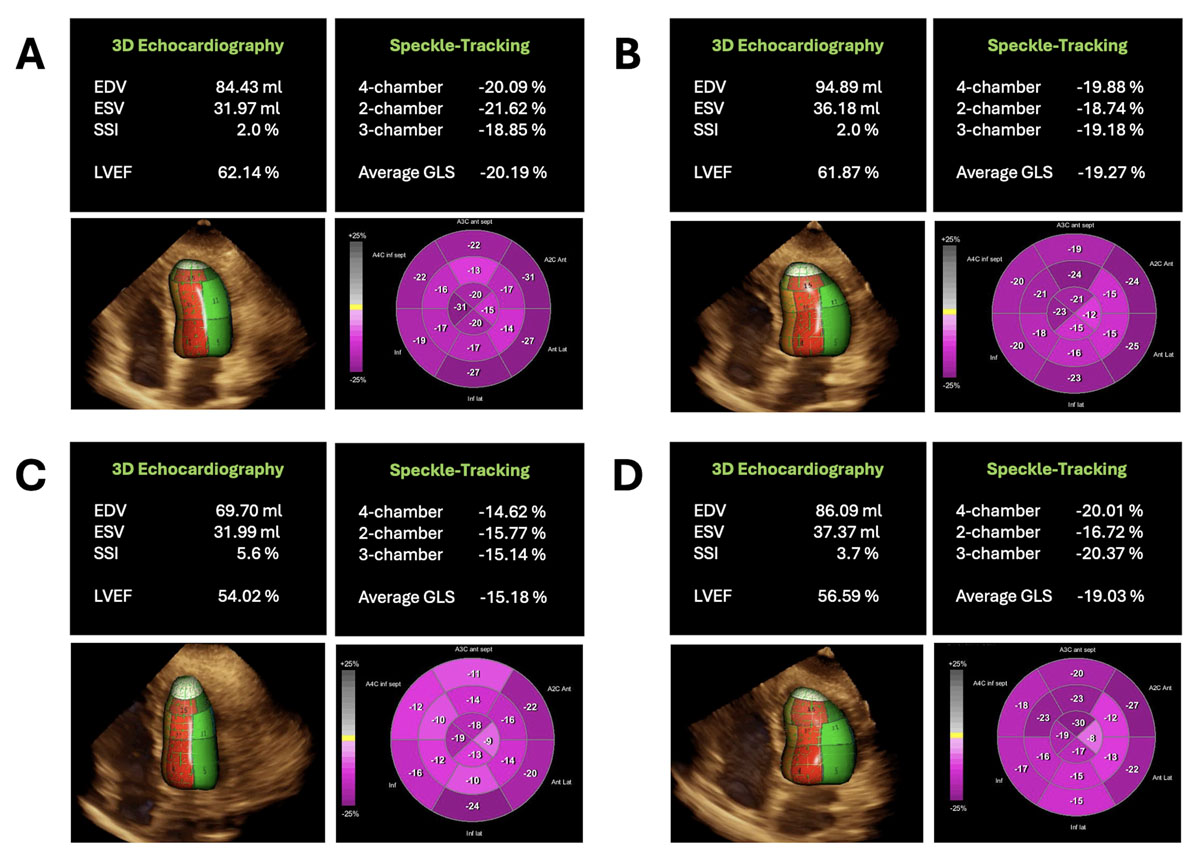
Figure 1
Echocardiographic assessment before and after chemotherapy. (A) Baseline echocardiographic parameters reveal a left ventricular ejection fraction (LVEF) of 62.14% and an average global longitudinal strain (LV-GLS) of -20.19%. (B) 6 months post-chemotherapy demonstrates an LVEF of 61.87% and LV-GLS of -19.27%. (C) 12 months post-chemotherapy reveals a notable decline in cardiac function, with LVEF decreasing to 54.02% and LV-GLS to -15.18%. (D) Following 1 month of cardioprotective medication, there is evidence of improved cardiac function as indicated by an increase in LVEF to 56.59% and improvement in LV-GLS to -19.03%.
The patient received chemotherapy with anthracyclines (240 mg/m2) and targeted therapy with trastuzumab (total dose of 1440 mg). She was followed up at 6 and 12 months post-chemotherapy (Figure 1B, C). At the 12-month follow up, the patient reported symptoms of shortness of breath with minimal exertion and orthopnea. Physical examination revealed bilateral rales in the lower lung fields and lower extremities edema. The echocardiogram evidenced a significant decrease in LVEF (54.02%) and LV-GLS (-15.18%). These findings fulfilled criteria for symptomatic CTRCD (heart failure symptoms with > 15% LV-GLS decrease).2
Thus, the patient was initiated on cardioprotective therapy including carvedilol, enalapril, and spironolactone. She also initiated a cardiac rehabilitation and exercise training program. Follow-up at 1 month revealed significant improvement in symptoms, correlating with an increased LVEF and LV-GLS (Figure 1D).
Points to Remember
Cancer therapy-related cardiac dysfunction (CTRCD) definitions: CTRCD can present with heart failure symptoms or be asymptomatic. Asymptomatic CTRCD is divided into mild (LVEF > 50% and LV-GLS decline > 15% AND/OR new rise in cardiac biomarkers), moderate (new LVEF reduction > 10% to a basal LVEF of 40-49% OR new LVEF reduction < 10% to a basal LVEF of 40-49% and either LV-GLS decline or new rise in cardiac biomarkers), and severe (new LVEF reduction < 40%).2
Types of cancer therapy associated with CTRCD: Many current cancer therapies are associated with CTRCD, which can manifest years after treatment. Medications linked to CTRCD include anthracyclines, HER2-inhibitors (trastuzumab), alkylating agents (cyclophosphamide), taxanes (paclitaxel), platinum-based therapies (cisplatin), and tyrosine kinase inhibitors, among others. The risk of cardiotoxicity with these therapies can depend on the method of administration and cumulative dosage, and in some cases the damage may be irreversible, such as with anthracyclines.3, 4
Risk assessment: CTRCD risk assessment should be performed in all patients with cancer prior to chemotherapy initiation. The HFA-ICOS risk assessment tools, although based on expert opinion with limited validation, have shown promise, particularly for high-risk individuals, despite challenges in accurately identifying low-risk patients.5, 6
Biomarkers used in CTRCD: Previous studies have shown a significant association between biomarkers such as troponin and B-type natriuretic peptide and early cardiotoxicity. Recently, additional biomarkers related to cardiac injury, inflammation, and metabolic processes have emerged as potential alternatives. These include C-reactive protein, ST2, myeloperoxidase, and various microRNAs.7
Imaging assessment: Multimodality imaging is crucial for early detection and diagnosis of CTRCD. Echocardiography is the first-line modality imaging for cardiovascular assessment. It should include LVEF and LV-GLS measurement, as LV-GLS may decrease before a drop in LVEF is evidenced. If unavailable, cardiac magnetic resonance, cardiac computed tomography angiography or nuclear cardiac scanning (MUGA or SPECT) may be used as an alternative.8
Pharmacological therapy: Dexrazoxane, ACE-inhibitors, angiotensin-receptor blockers, and statins can be considered for primary prevention in patients with high or very high risk of CTRCD. A recent metanalysis demonstrated that statins, aldosterone receptor antagonists, ACE-inhibitors, and beta-blockers can significantly attenuate chemotherapy-induced cardiotoxicity, while ARB showed no significant effects.9 Thus, these medications can aid in cardiac recovery by improving cardiac function and mitigating further damage.
Cardiac rehabilitation: Cardiac rehabilitation and exercise training programs have been shown to attenuate cardiac dysfunction in cancer patients and result in significant weight reduction, lowering cardiometabolic risk. However, further studies are necessary to establish protocols to individualize treatment.10
Future of CTRCD: Significant advances are expected in the prevention and treatment of CTRCD, with a focus on achieving cardiac recovery. Emerging therapies, such as SGLT2-inhibitors, have shown potential in improving CTRCD outcomes, though further prospective research is necessary to establish definitive guidelines. Additionally, interventions like remote ischemic conditioning are under investigation to validate their efficacy. Furthermore, senescence-associated secretory phenotype-related factors measured in peripheral blood are being explored as potential biomarkers for early detection, monitoring, and treatment. These investigations hold promise for enhancing cancer therapy and improving patient outcomes.11, 12
Competing Interests
The authors have no competing interests to declare.