
Figure 1
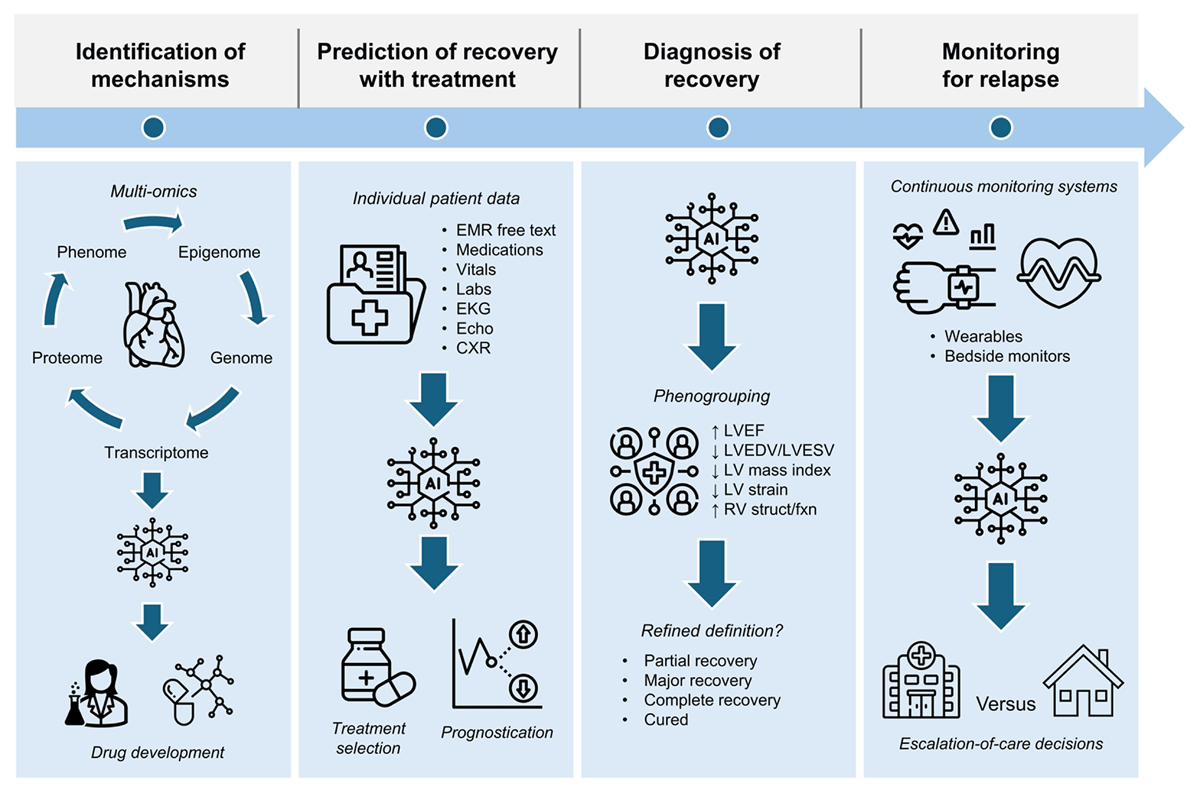
Incorporation of artificial intelligence (AI) and machine learning (ML) into research and clinical workflows to achieve successful implementation of purposeful myocardial recovery programs. ML could be applied to multi-omic datasets to elucidate novel drivers of myocardial recovery and accelerate drug development. ML could process vast amounts of individual patient data to predict chances of recovery with tailored treatment regimens. ML could create new heart failure phenogroups that better delineate prognostically important thresholds for changes in myocardial structure and function, thereby allowing for a refined definition of recovery that incorporates a spectrum of phenotypes from partial recovery to cure. In a patient who has recovered, ML could track data from high-volume continuous monitoring systems to identify candidates who need escalation of care to prevent relapse. Icons were obtained from flaticon.com. CXR: chest x-ray; Echo: echocardiography; EKG: electrocardiogram; EMR: electronic medical record; LV: left ventricular; LVEDV: left ventricular end-diastolic volume; LVEF: left ventricular ejection fraction; LVESV: left ventricular end-systolic volume; RV struct/fxn: right ventricular structure and function
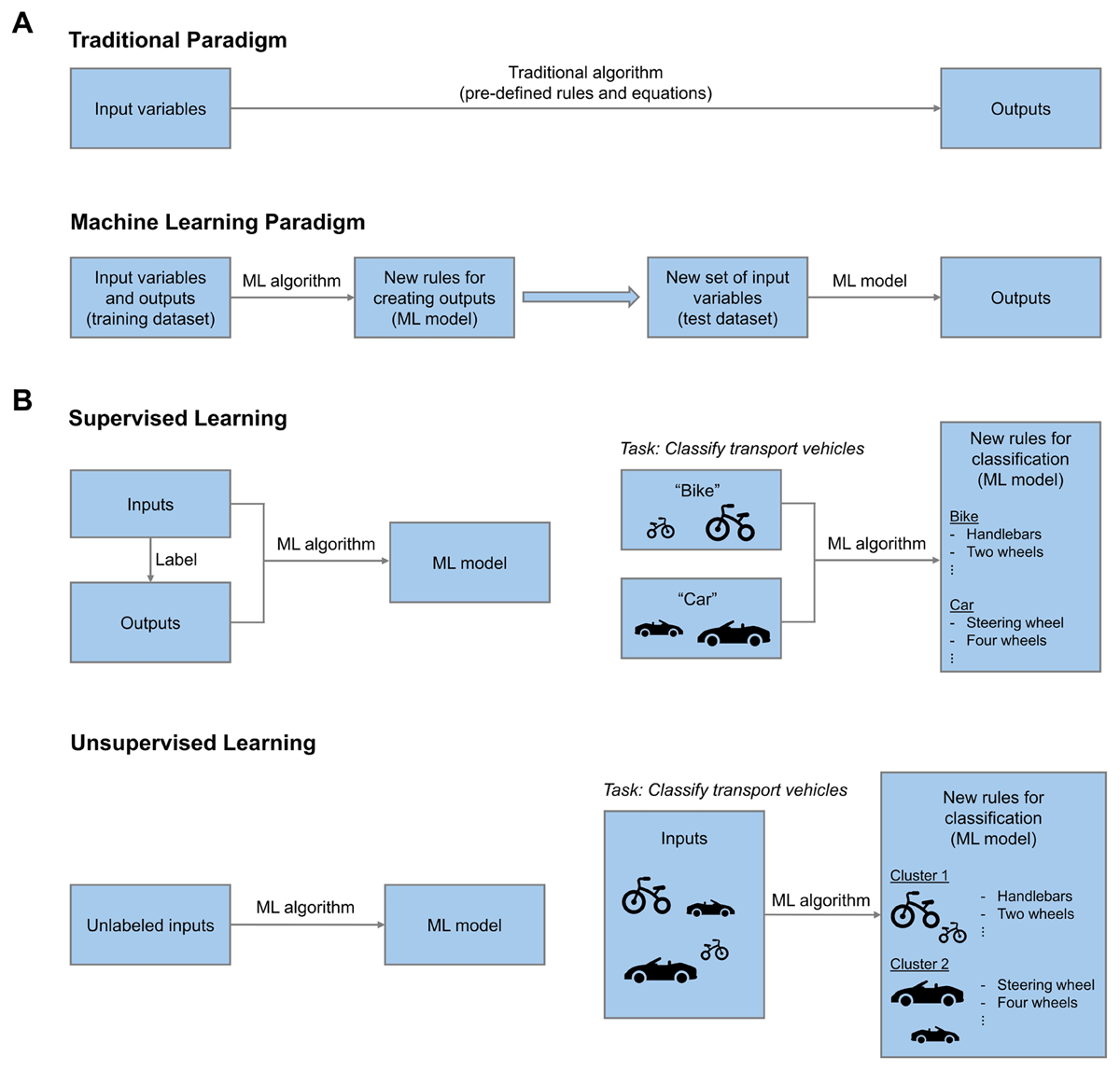
Figure 2
Differences between (A) traditional algorithms and machine learning (ML) algorithms and (B) supervised and unsupervised learning. Traditional algorithms apply predefined rules to input data, whereas ML algorithms create rules from training data to apply to new test data without human intervention. Supervised learning utilizes labeled data to train the ML model. When training a model to perform a task of classifying transport vehicles into bikes and cars, an ML algorithm will identify the key features comprising a bike versus a car and develop a set of rules for classification of each. Unsupervised learning trains the model on unlabeled data. An unsupervised ML algorithm training a model to classify transport vehicles into bikes and cars will cluster the data into groups with similar features, generating a set of rules for classification of each group. “Bikes” and “cars” are not explicitly named, but successful clustering will have properly separated out the two types of vehicles